A New Heart and Restoration

A Simple, Biblical Explanation of Ezekiel 35–36
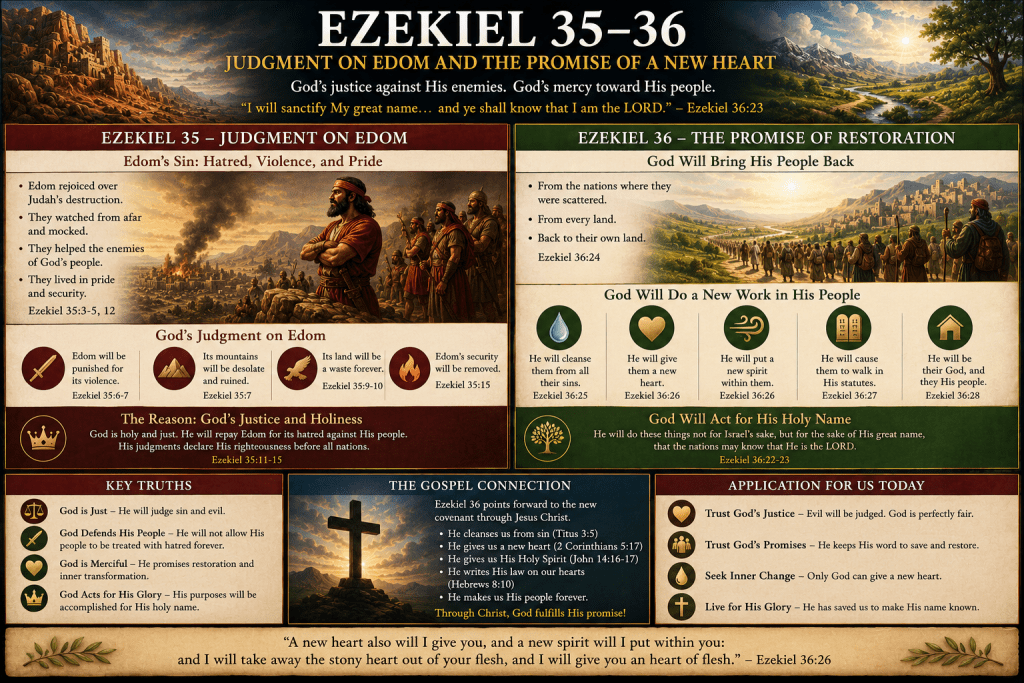
A New Heart and RestorationEzekiel 35–36 presents a dramatic contrast between judgment and restoration.

Chapter 35 announces God’s judgment against Edom, a nation filled with hatred and pride against God’s people. In contrast, the following chapters focus on themes such as A New Heart and Restoration for God’s people.

Chapter 36 then shifts toward one of the greatest promises in all the Old Testament:

God promises to restore His people, cleanse them from sin, and give them a new heart and a new spirit.

Together, these chapters teach:

  • God judges pride and hatred;
  • God remains faithful to His promises;
  • restoration comes through God’s grace;
  • true transformation begins in the heart.

These chapters ultimately point toward the salvation and renewal found in Jesus Christ.

Ezekiel 35: Judgment Against Mount Seir (Edom)

Who Was Edom?

Edom descended from Esau, the brother of Jacob.

Though related to Israel, Edom became one of Israel’s bitter enemies.

Throughout history, Edom showed:

  • hatred;
  • violence;
  • pride;
  • revenge against God’s people.

When Jerusalem fell, Edom rejoiced instead of showing compassion.

Perpetual Hatred

God accuses Edom of having:

“a perpetual hatred.” — Ezekiel 35:5

Edom continually sought Israel’s destruction.

Important Truth

Hatred hardens the heart and destroys both individuals and nations.

God takes seriously how people treat others.

Pride and Possession

Edom believed it could possess the land of Israel after Jerusalem’s destruction.

But God reminds them:

“Whereas the LORD was there.” — Ezekiel 35:10

The land ultimately belonged to God.

Application

Human pride forgets that everything ultimately belongs to the Lord.

People often boast in power, possessions, and success while ignoring God’s authority.

The Judgment of Edom

God announces that Edom’s violence and arrogance will return upon its own head.

The nation that rejoiced over judgment would itself face judgment.

Important Lesson

God is just.

No hatred, cruelty, or pride escapes His notice.

Ezekiel 36: The Mountains of Israel Restored

A Message of Hope

After many chapters focused on judgment, Ezekiel 36 introduces hope and restoration.

God now speaks to the mountains of Israel and promises future blessing.

The land that had been devastated by war and exile would one day flourish again.

The Nations Mocked Israel

The surrounding nations believed Israel’s destruction proved God had abandoned His people.

But God explains that Israel’s exile was not due to weakness in God.

It happened because of Israel’s sin.

Important Truth

God disciplines His people without abandoning His covenant purposes.

God Acts for His Holy Name

One of the central themes of Ezekiel 36 is God’s concern for His holy name.

Israel’s sin caused the nations to dishonor God.

Therefore, God says:

“I do not this for your sakes… but for mine holy name’s sake.” — Ezekiel 36:22

The Meaning

God’s restoration of Israel would demonstrate:

  • His holiness;
  • His faithfulness;
  • His mercy;
  • His power.

Application

Salvation ultimately glorifies God.

God’s grace reveals His character to the world.

The Promise of Cleansing

Washed from Sin

God promises:

“Then will I sprinkle clean water upon you, and ye shall be clean.” — Ezekiel 36:25

The people needed more than political restoration.

They needed spiritual cleansing.

Important Truth

Sin stains the human heart.

Only God can truly cleanse sinners.

The Promise of a New Heart

One of the Greatest Promises in Scripture

God declares:

“A new heart also will I give you, and a new spirit will I put within you.” — Ezekiel 36:26

This is one of the clearest Old Testament promises of inward spiritual transformation.

God promises to:

  • remove the heart of stone;
  • give a heart of flesh;
  • place His Spirit within His people.

The Problem of the Human Heart

The root problem was never merely external behavior.

The real problem was the sinful heart.

People need more than:

  • rules;
  • religion;
  • ceremonies;
  • outward reform.

They need inward transformation.

Application

Only God can change a hard heart.

True Christianity is not merely external religion.

It is spiritual rebirth.

The Gift of the Holy Spirit

God promises:

“And I will put my spirit within you.” — Ezekiel 36:27

This points forward to the New Covenant and the coming of the Holy Spirit.

The Spirit would empower God’s people to:

  • obey Him;
  • walk in His ways;
  • live transformed lives.

Restoration and Fruitfulness

The Land Restored

God promises the land would again become fruitful and prosperous.

The desolate places would be rebuilt.

The nations would recognize that the Lord alone restores what sin destroyed.

Important Lesson

God specializes in restoration.

What sin ruins, God can renew.

The Gospel in Ezekiel 35–36

These chapters reveal both God’s justice and His mercy.

Chapter 35 shows God judging:

  • hatred;
  • pride;
  • violence;
  • rebellion.

Chapter 36 shows God restoring:

  • sinners;
  • hearts;
  • lives;
  • relationship with Himself.

This restoration is fulfilled through Jesus Christ.

At the cross:

  • Jesus bore the judgment sinners deserve;
  • God’s justice was satisfied;
  • forgiveness became available.

Through faith in Christ:

  • hearts of stone become hearts of flesh;
  • sinners are cleansed;
  • the Holy Spirit indwells believers;
  • spiritual life begins anew.

Jesus fulfills the promise of the New Covenant.

Lessons We Must Learn

1. God Judges Pride and Hatred

Edom’s downfall reminds us that pride and bitterness destroy.

2. God Remains Faithful to His Promises

Even after judgment, God still planned restoration.

3. Humanity’s Greatest Need Is a New Heart

External religion cannot solve the problem of sin.

4. Only God Can Truly Transform a Person

Real change comes through spiritual rebirth.

5. The Holy Spirit Changes Lives

God empowers believers to walk in obedience.

6. God Restores What Sin Destroys

No life is beyond God’s power to renew.

Conclusion

Ezekiel 35–36 moves from judgment to restoration.

Edom’s pride and hatred brought destruction.

But God’s mercy toward His people brought hope.

Most importantly, God promised something greater than national recovery.

He promised new hearts.

That promise is fulfilled through Jesus Christ.

The Gospel offers:

  • cleansing from sin;
  • spiritual rebirth;
  • the indwelling Holy Spirit;
  • restored fellowship with God.

The message still speaks powerfully today.

God can remove hearts of stone and replace them with hearts that love Him.

Through Christ, ruined lives can be restored and made new.

<<Back to Bible Passages


For more insights to the Book of Ezekiel, order Pastor Alan’s book from the links below.Book of Ezekiel

Dr. Alan Holden has served in pastoral ministry for more than 35 years, preaching and teaching the Bible in churches across the United States. He holds a Doctor of Ministry from Luther Rice Seminary and a Master of Divinity from The Southern Baptist Theological Seminary. Through What’s It Mean?, he seeks to help readers understand the meaning of Scripture and grow in their walk with Christ. He is currently the pastor of Lake Saunders Baptist Church in Tavares, FL.
The Good Shepherd

A Simple, Biblical Explanation of Ezekiel 34

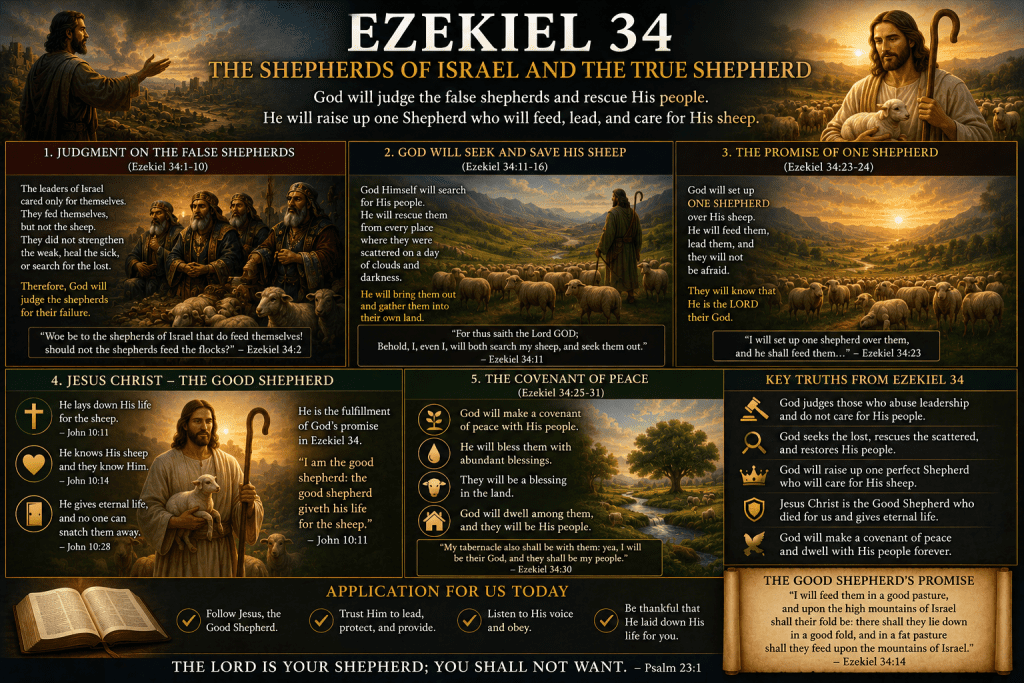
The Good ShepherdEzekiel 34 is one of the most important chapters in the entire book of Ezekiel. After exposing the failures of Israel’s leaders, God promises that He Himself will become the Shepherd of His people.
The chapter contains both judgment and hope:

  • judgment against false shepherds;
  • comfort for scattered sheep;
  • the promise of restoration;
  • the prophecy of a coming Shepherd-King.

This chapter points directly toward Jesus Christ, the Good Shepherd who came to seek, save, and care for God’s people.

The Historical Setting

Jerusalem had fallen.

The nation was scattered.

The kings, priests, prophets, and rulers who should have protected the people had failed miserably.

Instead of leading the people toward God, many leaders abused their authority for personal gain.

God now speaks against these false shepherds.

The Shepherds of Israel Condemned

Feeding Themselves Instead of the Flock

God says the shepherds cared more about themselves than the sheep.

They:

  • fed themselves;
  • used the people for profit;
  • neglected the weak;
  • ignored the wounded;
  • failed to seek the lost.

Important Truth

God holds spiritual leaders accountable for how they treat His people.

Leadership is not about personal power or comfort.

True leadership serves others.

The Sheep Were Scattered

Because of poor leadership, the people became scattered like sheep without a shepherd.

They were vulnerable to spiritual danger and destruction.

Application

False spiritual leadership always harms people.

When leaders neglect truth and holiness, confusion and spiritual weakness spread.

God Himself Will Shepherd His People

The Great Promise

After condemning the false shepherds, God gives one of the most comforting promises in Scripture:

“Behold, I, even I, will both search my sheep, and seek them out.” — Ezekiel 34:11

What human shepherds failed to do, God Himself would do.

God Promises To:

  • seek the lost;
  • gather the scattered;
  • rescue the endangered;
  • heal the wounded;
  • strengthen the weak;
  • feed His flock.

The Heart of God

This chapter reveals God’s compassion for hurting and wandering people.

He is not distant or uncaring.

He actively seeks His sheep.

The Separation of the Sheep

Judgment Within the Flock

God also rebukes selfish sheep who mistreated others.

Some grew fat and strong while oppressing weaker sheep.

God promises to judge between:

  • sheep and sheep;
  • rams and goats.

Important Lesson

God sees how people treat one another.

Religion without love and compassion displeases Him.

The Promise of One Shepherd

My Servant David

God gives a remarkable prophecy:

“And I will set up one shepherd over them, and he shall feed them, even my servant David.” — Ezekiel 34:23

This does not mean David himself would literally return as king.

This points to the coming Messiah from David’s royal line.

The promised Shepherd-King is Jesus Christ.

Jesus the Good Shepherd

Ezekiel 34 finds its ultimate fulfillment in Christ.

Jesus declared:

“I am the good shepherd.” — John 10:11

Unlike false shepherds:

  • Jesus loves His sheep;
  • He seeks the lost;
  • He protects the flock;
  • He lays down His life for the sheep.

The Contrast

False shepherds use the sheep.

Jesus sacrifices Himself for the sheep.

The Covenant of Peace

Blessing and Restoration

God promises a “covenant of peace” with His people.

The land would experience:

  • safety;
  • blessing;
  • fruitfulness;
  • peace.

This restoration points both to Israel’s future hope and ultimately to the peace believers receive through Christ.

Spiritual Meaning

Sin brings separation and scattering.

God’s salvation brings peace and restoration.

The Sheep Will Know the Lord

God says:

“Ye my flock, the flock of my pasture, are men, and I am your God.” — Ezekiel 34:31

The goal of salvation is restored relationship with God.

God desires His people to know Him personally.

The Gospel in Ezekiel 34

This chapter beautifully points to the Gospel.

Human leaders fail.

Their systems fail.

Human hearts wander like lost sheep.

But God did not abandon His people.

Jesus Christ came as the Good Shepherd.

At the cross:

  • He laid down His life for the sheep;
  • He bore the judgment sinners deserve;
  • He gathered wandering sinners into God’s flock.

Through faith in Christ:

  • the lost are found;
  • the wounded are healed;
  • the guilty are forgiven;
  • the scattered are brought home.

Lessons We Must Learn

1. God Holds Leaders Accountable

Spiritual leadership is a serious responsibility.

God condemns leaders who exploit people instead of serving them.

2. God Cares Deeply for His People

The Lord sees the hurting, weak, scattered, and forgotten.

3. False Shepherds Damage the Flock

Poor spiritual leadership creates confusion and spiritual harm.

4. Jesus Is the True Shepherd

Only Christ perfectly leads, protects, and saves God’s people.

5. God Seeks the Lost

No wandering sheep is beyond God’s reach.

6. Salvation Brings Peace and Restoration

God gathers sinners into His flock through Jesus Christ.

Conclusion

Ezekiel 34 is a powerful chapter about failed leadership and God’s faithful love.

Israel’s shepherds abused and neglected the flock.

But God promised He would personally seek His sheep and provide a true Shepherd-King.

That promise is fulfilled in Jesus Christ.

The Good Shepherd still seeks the lost today.

He calls wandering sinners to come home.

Through Him, the scattered are gathered, the wounded are healed, and the lost find eternal life.

The message of Ezekiel 34 remains full of hope:

God has not abandoned His sheep.

The Shepherd still calls.

<<Back to Bible Passages


For more insights to the Book of Ezekiel, order Pastor Alan’s book from the links below.Book of Ezekiel


Dr. Alan Holden has served in pastoral ministry for more than 35 years, preaching and teaching the Bible in churches across the United States. He holds a Doctor of Ministry from Luther Rice Seminary and a Master of Divinity from The Southern Baptist Theological Seminary. Through What’s It Mean?, he seeks to help readers understand the meaning of Scripture and grow in their walk with Christ. He is currently the pastor of Lake Saunders Baptist Church in Tavares, FL.

The Watchman’s Warning

A Simple, Biblical Explanation of Ezekiel 33

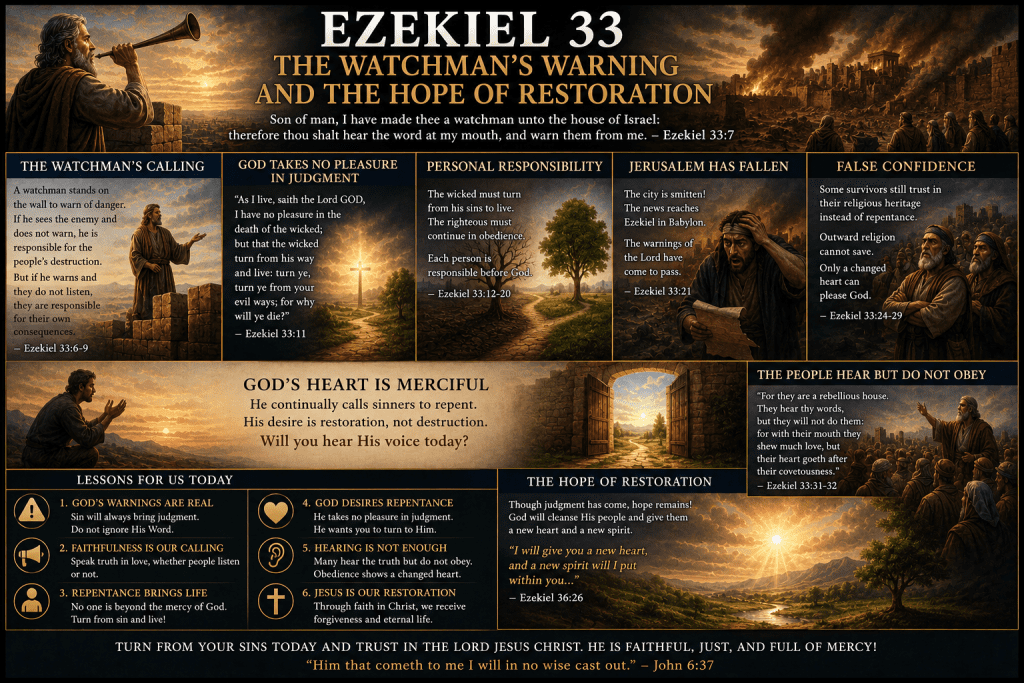
The Watchman's WarningEzekiel 33 marks a major turning point in the book of Ezekiel. Up to this point, much of Ezekiel’s message focused on judgment against Jerusalem and the surrounding nations. Now the focus begins shifting toward restoration and hope.
But before restoration could come, the people first had to face the seriousness of sin and the necessity of repentance.

In this chapter, God reminds Ezekiel of his calling as a watchman and emphasizes personal responsibility before God. Then comes the devastating news:

Jerusalem has fallen.

Yet even after judgment, God still offers hope to those who will truly turn back to Him.

The Historical Background

For years Ezekiel warned that Jerusalem would be destroyed because of the people’s rebellion. Many refused to believe him.

Then the unthinkable happened.

Babylon conquered Jerusalem, destroyed the temple, and carried more people into captivity around 586 BC.

Ezekiel 33 records the moment when news of Jerusalem’s fall finally reaches the exiles in Babylon.

The warnings had become reality.

The Watchman on the Wall

The Responsibility of the Watchman

God again calls Ezekiel a watchman for the house of Israel.

In ancient cities, watchmen stood on the walls looking for approaching danger. If an enemy came, the watchman had to sound the trumpet and warn the people.

If he failed to warn them, he shared responsibility for their destruction.

But if he gave the warning and the people ignored it, the responsibility belonged to them.

The Spiritual Meaning

Ezekiel’s role was to faithfully proclaim God’s message whether people listened or not.

Important Truth

God’s servants are called to speak truth faithfully, not merely say what people want to hear.

Personal Responsibility Before God

The Wicked Must Turn

God repeats a major theme found earlier in Ezekiel:

“The wickedness of the wicked shall not fall thereby in the day that he turneth from his wickedness.” — Ezekiel 33:12

Repentance changes a person’s direction.

No sinner is beyond God’s mercy if he truly turns to the Lord.

The Righteous Cannot Trust in Past Righteousness

God also warns that a righteous person who turns away into sin cannot rely upon former obedience.

Faith must remain living and genuine.

Important Lesson

Outward religion without a faithful heart is empty.

God desires ongoing trust and obedience.

God Takes No Pleasure in Judgment

One of the most beautiful statements in Ezekiel appears again in this chapter:

“As I live, saith the Lord GOD, I have no pleasure in the death of the wicked.” — Ezekiel 33:11

Then God gives His invitation:

“Turn ye, turn ye from your evil ways; for why will ye die?”

The Heart of God

God is holy and must judge sin.

But judgment is not His delight.

His desire is repentance, forgiveness, and restoration.

Jerusalem Has Fallen

The Messenger Arrives

A survivor escapes from Jerusalem and arrives in Babylon with the news:

“The city is smitten.” — Ezekiel 33:21

The destruction Ezekiel prophesied for years had finally happened.

The temple was gone.

The city was ruined.

Thousands were dead or exiled.

Why This Matters

This moment confirmed that God’s Word is always true.

The people ignored repeated warnings, but judgment still came exactly as God said.

False Confidence Remains

The Survivors in Judah

Even after Jerusalem’s destruction, some remaining people still falsely believed they were secure because Abraham once possessed the land.

They trusted religious history instead of repentance.

Application

People often trust in:

  • church membership;
  • family heritage;
  • religious traditions;
  • moral appearance.

But none of these can replace genuine faith and repentance.

Hearing Without Obeying

The People Enjoyed Ezekiel’s Messages

God tells Ezekiel something heartbreaking:

The people listened to him like someone listening to beautiful music, but they did not obey.

“They hear thy words, but they will not do them.” — Ezekiel 33:32

Important Truth

It is possible to enjoy sermons while refusing to obey God.

Hearing truth is not enough.

Truth must transform the heart.

The Gospel in Ezekiel 33

Ezekiel 33 points clearly toward the Gospel of Jesus Christ.

Humanity faces the same problems:

  • sin;
  • rebellion;
  • false confidence;
  • outward religion without repentance.

Like Ezekiel, Jesus came warning people to repent before judgment comes.

But Jesus did more than warn.

At the cross:

  • He took the judgment sinners deserve;
  • He satisfied God’s justice;
  • He opened the door for forgiveness and eternal life.

God’s invitation still stands today:

“Turn ye, turn ye from your evil ways.”

Through faith in Jesus Christ:

  • sinners can be forgiven;
  • hearts can be transformed;
  • spiritual death can become eternal life.

Lessons We Must Learn

1. God’s Warnings Are Serious

Jerusalem eventually fell exactly as God warned.

Delayed judgment is not canceled judgment.

2. God’s Servants Must Speak Truth Faithfully

A watchman cannot stay silent when danger approaches.

Believers are called to speak truth with courage and love.

3. Every Person Is Responsible Before God

Each person must personally respond to God’s invitation to repent.

4. God Desires Repentance, Not Destruction

God takes no pleasure in judgment.

His heart is merciful toward sinners.

5. Hearing Truth Is Not Enough

People may enjoy spiritual teaching while remaining spiritually unchanged.

True faith produces obedience.

6. False Confidence Cannot Save

Religion, tradition, and outward appearances cannot replace genuine repentance and faith.

Conclusion

Ezekiel 33 stands at the crossroads between judgment and restoration.

Jerusalem had fallen because the people ignored God’s warnings.

Yet even after such devastating judgment, God still called sinners to repent and live.

The message remains urgent today.

God still warns people about sin and judgment.

But He also offers mercy through Jesus Christ.

The Great Watchman still calls:

“Turn ye, turn ye from your evil ways.”

Those who respond to Christ in repentance and faith will find forgiveness, restoration, and eternal life.

<<Back to Bible Passages


For more insights to the Book of Ezekiel, order Pastor Alan’s book from the links below.Book of Ezekiel


Dr. Alan Holden has served in pastoral ministry for more than 35 years, preaching and teaching the Bible in churches across the United States. He holds a Doctor of Ministry from Luther Rice Seminary and a Master of Divinity from The Southern Baptist Theological Seminary. Through What’s It Mean?, he seeks to help readers understand the meaning of Scripture and grow in their walk with Christ. He is currently the pastor of Lake Saunders Baptist Church in Tavares, FL.

Judgment on the Nations

A Simple, Biblical Explanation of Ezekiel 25–32

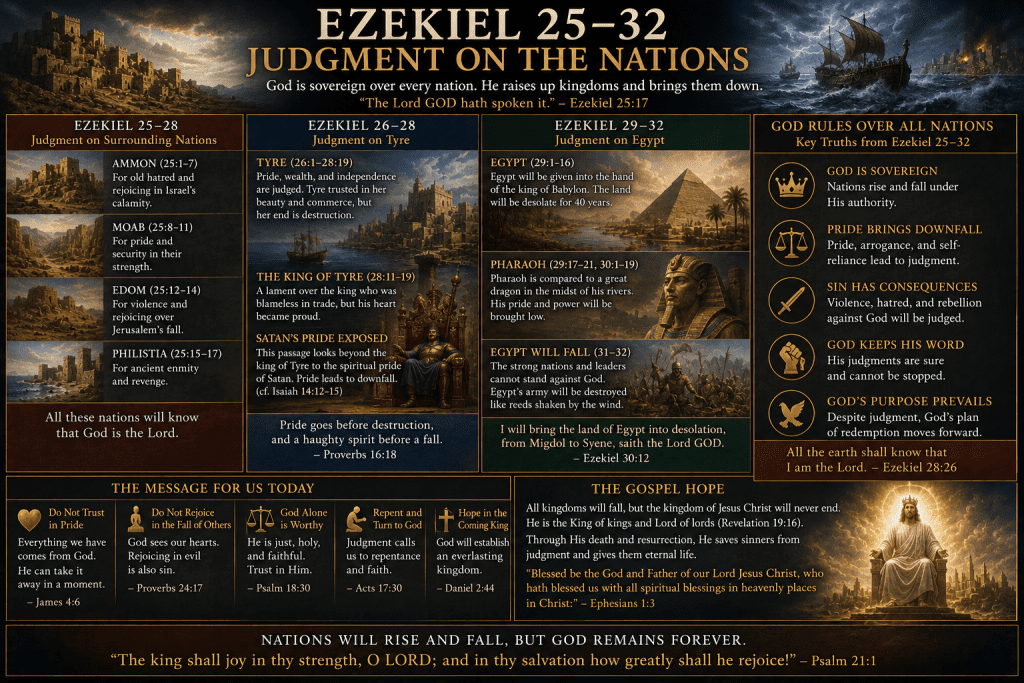
Judgment on the NationsAfter announcing judgment on Jerusalem, the book of Ezekiel now turns toward the surrounding nations.
In Ezekiel 25–32, God declares judgment against:

  • Ammon;
  • Moab;
  • Edom;
  • Philistia;
  • Tyre;
  • Sidon;
  • Egypt.

These nations were not innocent observers. They rejoiced over Judah’s fall, practiced violence and idolatry, and exalted themselves in pride against God.

These chapters teach an important truth:

God is not only the Judge of Israel — He is the Judge of all nations.

No kingdom, ruler, economy, military power, or culture stands above His authority.

Yet even within these judgments, God points toward a future kingdom where He alone will reign supreme.

Ezekiel 25: Judgment on Israel’s Enemies

Ammon: Rejoicing Over God’s People

The Ammonites mocked Judah when Jerusalem fell.

Instead of grieving over judgment, they celebrated it.

God condemns them for their hatred and pride.

Important Lesson

God takes seriously how people treat His people.

Mocking the suffering of others reveals a hard and sinful heart.

Moab: Rejecting God’s Distinction

Moab claimed Judah was no different from the pagan nations.

They rejected the idea that Israel belonged uniquely to God.

God announces judgment against Moab for its pride and unbelief.

Application

The world often dismisses God’s people and rejects God’s truth.

But God still distinguishes those who belong to Him.

Edom: Revenge and Bitterness

Edom had a long history of hatred toward Israel.

Rather than showing mercy, Edom sought revenge and violence.

God promises judgment against them.

Important Truth

Bitterness and revenge destroy both individuals and nations.

God alone has the right to final vengeance.

Philistia: Persistent Hostility

The Philistines continually opposed God’s people.

Their hostility reflected long-standing rebellion against God.

God declares that their pride and violence would end in destruction.

Ezekiel 26–28: Judgment on Tyre

The Pride of Tyre

Tyre was one of the wealthiest and most powerful trading cities in the ancient world.

When Jerusalem fell, Tyre rejoiced because it expected greater commercial prosperity.

The city trusted in:

  • wealth;
  • trade;
  • military defenses;
  • political influence.

But God warned that pride would bring destruction.

Ezekiel 26: The Fall of Tyre

The Coming Siege

God prophesies that many nations would come against Tyre like waves of the sea.

Nebuchadnezzar would attack the city, and later conquerors would continue its downfall.

Historically, Tyre eventually fell under repeated invasions.

Important Lesson

Economic success cannot protect a society from God’s judgment.

Wealth is a poor substitute for righteousness.

Ezekiel 27: A Funeral Song for Tyre

The Beautiful Ship

Tyre is pictured as a magnificent ship filled with riches and luxury.

The nations admired her beauty and prosperity.

But suddenly the ship sinks into the sea.

The Meaning

Human greatness is fragile.

Nations built on pride and greed eventually collapse.

The Mourning of the Nations

Merchants and kings mourn Tyre’s destruction because their wealth depended upon her.

Their grief was not spiritual repentance.

It was sorrow over economic loss.

Application

People often mourn losing worldly treasures more than losing fellowship with God.

Ezekiel 28: The King of Tyre and Satan’s Pride

The Prince of Tyre

God rebukes the ruler of Tyre for claiming godlike wisdom and power.

Though merely a man, he exalted himself proudly.

The Danger of Pride

Pride convinces people they do not need God.

It is one of the root sins behind human rebellion.

The King of Tyre and the Fall of Satan

The language in this chapter appears to move beyond the earthly ruler and describe Satan himself.

The figure is described as:

  • being in Eden;
  • full of beauty and wisdom;
  • corrupted by pride;
  • cast down from exaltation.

Many scholars understand this as a picture of Satan working behind the prideful king.

Important Truth

Behind human rebellion stands spiritual rebellion.

Pride was the sin that led to Satan’s fall.

Judgment on Sidon

God also announces judgment against Sidon, another Phoenician city known for idolatry.

Then God promises future restoration for Israel.

Even after judgment, God still intends to fulfill His covenant purposes.

Ezekiel 29–32: Judgment on Egypt

Egypt’s False Security

Egypt was a great world power.

Judah repeatedly trusted Egypt for military help instead of trusting God.

But Egypt itself would face judgment.

Application

Human alliances cannot replace dependence upon God.

What people trust instead of God eventually fails.

Ezekiel 29: Pharaoh the Great Dragon

Pharaoh’s Pride

God compares Pharaoh to a great river monster living in the Nile.

Egypt believed its prosperity came from its own power.

Pharaoh proudly claimed ownership of the Nile and the nation’s greatness.

But God would humble him.

Important Lesson

Every blessing ultimately comes from God.

Prideful self-sufficiency leads to downfall.

Egypt’s Failure to Help Judah

God says Egypt had been like a broken reed.

Judah leaned on Egypt for support, but Egypt failed them.

Application

Whatever replaces trust in God becomes unstable support.

Only God is completely trustworthy.

Ezekiel 30: The Day of the Lord Against Egypt

A Coming Disaster

God announces devastation upon Egypt and its allies.

The “day of the Lord” refers to God stepping into history in judgment.

Egypt’s military strength, wealth, and alliances would not save her.

False Confidence Destroyed

The people trusted in:

  • armies;
  • idols;
  • rulers;
  • cities;
  • economic power.

But God would bring all human pride low.

Important Truth

Anything built apart from God eventually crumbles.

Ezekiel 31: Egypt Compared to Assyria

The Great Cedar Tree

God compares Assyria to a towering cedar tree that once dominated the nations.

Yet despite its greatness, Assyria fell because of pride.

Now Egypt would suffer the same fate.

The Pattern of History

Powerful nations rise and fall.

God alone remains eternal.

Ezekiel 32: A Funeral Song for Pharaoh

Pharaoh the Lion and Sea Monster

God describes Pharaoh as a lion among nations and a sea creature thrashing in the waters.

But God would capture and destroy him.

Egypt’s glory would descend into the grave.

The Graveyard of Nations

The chapter closes with a sobering picture of fallen nations in the realm of the dead.

Assyria, Elam, Meshech, Tubal, Edom, and others all lie defeated.

Important Truth

Every earthly kingdom eventually falls.

Only God’s kingdom endures forever.

The Gospel in Ezekiel 25–32

These chapters reveal humanity’s universal problem:

  • pride;
  • violence;
  • greed;
  • idolatry;
  • self-sufficiency;
  • rejection of God.

The judgment of the nations proves that all people stand accountable before the Lord.

No nation is righteous enough to escape judgment.

But these chapters also point toward humanity’s need for a true King and eternal kingdom.

That King is Jesus Christ.

Unlike earthly rulers:

  • Jesus rules in righteousness;
  • His kingdom never falls;
  • His glory never fades.

At the cross, Jesus took the judgment sinners deserve.

Through Him:

  • prideful sinners can be humbled and forgiven;
  • enemies of God can become children of God;
  • eternal life becomes possible.

Lessons We Must Learn

1. God Rules Over All Nations

No government or kingdom exists outside His authority.

2. Pride Leads to Destruction

Tyre, Egypt, and other nations fell because of arrogance and self-sufficiency.

3. Wealth and Power Cannot Save

Economic success and military strength are temporary.

4. God Sees How Nations Treat Others

Violence, cruelty, and hatred do not escape His judgment.

5. Human Kingdoms Always Pass Away

Every empire eventually falls.

Only God’s kingdom is eternal.

6. Jesus Christ Is the True Eternal King

The failures of earthly rulers point us to our need for the perfect King.

Conclusion

Ezekiel 25–32 shows God judging the nations surrounding Israel.

These powerful kingdoms trusted in:

  • wealth;
  • pride;
  • military strength;
  • false gods;
  • human wisdom.

But none could stand against the Lord.

The message still speaks today.

Nations rise and fall, economies prosper and collapse, rulers come and go — but God remains sovereign over history.

Human pride always leads downward.

Only those who humble themselves before God will find lasting hope.

That hope is found fully in Jesus Christ, the eternal King whose kingdom will never be destroyed.

<<Back to Bible Passages


For more insights to the Book of Ezekiel, order Pastor Alan’s book from the links below.Book of Ezekiel


Dr. Alan Holden has served in pastoral ministry for more than 35 years, preaching and teaching the Bible in churches across the United States. He holds a Doctor of Ministry from Luther Rice Seminary and a Master of Divinity from The Southern Baptist Theological Seminary. Through What’s It Mean?, he seeks to help readers understand the meaning of Scripture and grow in their walk with Christ. He is currently the pastor of Lake Saunders Baptist Church in Tavares, FL.

Judgment of God

A Simple, Biblical Explanation of Ezekiel 19–24

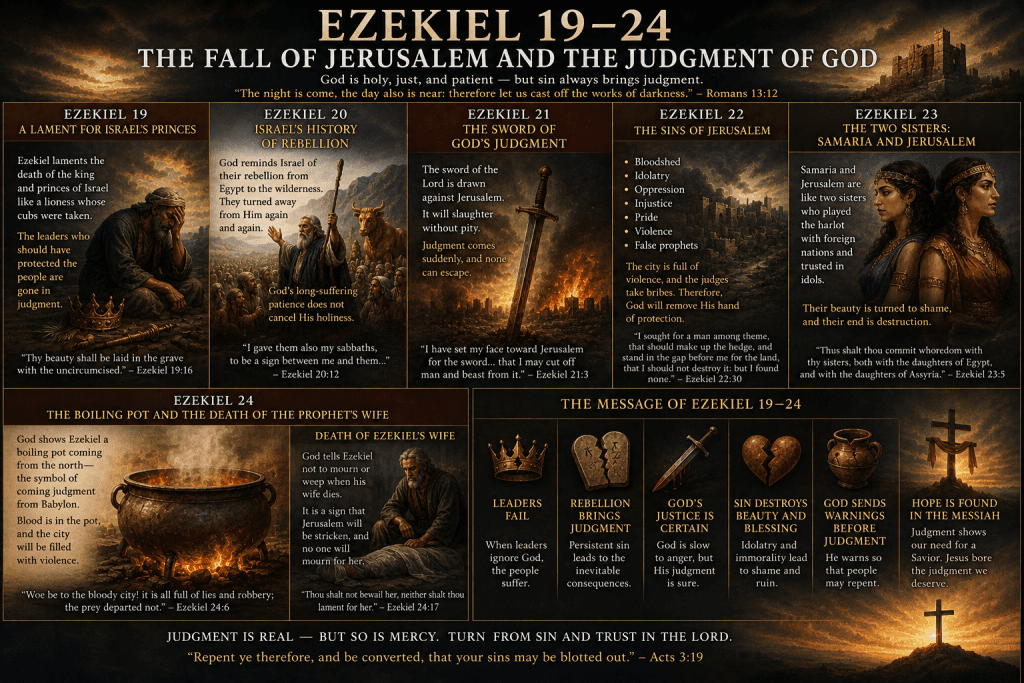
Judgment of GodEzekiel 19–24 marks a major turning point in the book of Ezekiel. These chapters focus on the coming destruction of Jerusalem because of the nation’s persistent rebellion against God.
The people still believed Jerusalem could survive. False prophets continued promising peace. But God declared through Ezekiel that judgment was no longer avoidable.

These chapters contain:

  • funeral songs for Israel’s leaders;
  • a review of Israel’s long history of rebellion;
  • warnings through parables and signs;
  • God’s judgment against corrupt leadership and idolatry;
  • the final announcement that Jerusalem’s destruction had begun.

The overall message is clear:

God is patient, but persistent rebellion eventually brings judgment.

Yet even in wrath, God still points toward future restoration and hope.

Ezekiel 19: A Funeral Song for Israel’s Princes

The Lioness and Her Cubs

God gives Ezekiel a lamentation — a funeral song — for the rulers of Judah.

Israel is pictured as a lioness raising young lions.

The first lion likely represents King Jehoahaz.

He became violent and wicked, so the nations captured him and carried him away to Egypt.

The second lion likely represents King Jehoiachin or Zedekiah.

He too became corrupt and was eventually captured by Babylon.

The Meaning

Israel’s leaders were supposed to guide the people toward God.

Instead, they became destructive and rebellious.

Corrupt leadership helped bring national judgment.

The Burned Vine

The chapter closes by describing Israel as a once-strong vine now burned by fire.

The kingdom that once flourished under God’s blessing was collapsing because of sin.

Application

Leadership matters.

When leaders reject truth and righteousness, entire nations and families suffer.

Ezekiel 20: Israel’s Long History of Rebellion

The Elders Seek God

Some elders come to Ezekiel seeking a word from the Lord.

But instead of giving comfort, God reviews Israel’s long history of rebellion.

The nation repeatedly rejected Him despite His mercy and blessings.

Rebellion in Egypt

Even while enslaved in Egypt, Israel practiced idolatry.

Yet God delivered them for the sake of His name.

Important Truth

God’s grace preceded Israel’s obedience.

God rescued them not because they deserved it, but because He is merciful.

Rebellion in the Wilderness

Even after witnessing miracles:

  • the Red Sea crossing;
  • manna from heaven;
  • water from the rock;
  • God’s presence;

Israel still rebelled.

The people rejected God’s commandments and polluted the Sabbath.

Application

Miracles alone do not change the human heart.

Without repentance, people can experience God’s blessings and still reject Him.

Rebellion in the Promised Land

Even after entering Canaan, the nation continued worshiping idols.

Instead of remaining faithful to God, they adopted the sinful practices of surrounding nations.

The Root Problem

The issue was always the heart.

Outward religion cannot replace inward obedience.

God’s Promise of Restoration

Despite Israel’s rebellion, God promises future restoration.

One day He would gather His people again and purify them.

This points toward the future kingdom of God and ultimately toward Christ.

Ezekiel 21: The Sword of God’s Judgment

The Sword Is Drawn

God announces that His sword of judgment is unsheathed against Jerusalem.

Babylon would become the instrument of divine judgment.

The people had ignored repeated warnings, and now judgment was certain.

The Sword Symbolizes:

  • war;
  • destruction;
  • death;
  • divine justice.

Nebuchadnezzar’s Decision

God describes Babylon’s king standing at a crossroads deciding whether to attack Jerusalem or another city.

Though Nebuchadnezzar used pagan methods of divination, God sovereignly directed events.

Important Truth

God remains sovereign even over pagan rulers and world events.

History is ultimately under God’s control.

Judgment on the Prince of Israel

God announces judgment against Judah’s corrupt king.

The crown would be removed until the rightful King comes.

This is a Messianic prophecy pointing toward Jesus Christ.

“Until he come whose right it is.” — Ezekiel 21:27

Jesus alone is the true and eternal King.

Ezekiel 22: The Sins of Jerusalem

The Bloody City

God calls Jerusalem a “bloody city” because of violence, corruption, and injustice.

The people were guilty of:

  • idolatry;
  • oppression;
  • immorality;
  • bribery;
  • dishonesty;
  • abuse of the weak.

The nation’s corruption infected every level of society.

Corrupt Leaders

God condemns:

The Princes

They abused power for selfish gain.

The Priests

They profaned holy things and ignored God’s law.

The Prophets

They preached false visions and lies.

The People

They practiced violence and oppression.

Application

When truth collapses in leadership, society quickly decays.

Spiritual corruption affects entire communities.

The Furnace of Judgment

God compares Jerusalem to metal placed in a furnace.

The coming Babylonian invasion would expose the impurity of the people.

Judgment would become a refining fire.

God Sought One Man

One of the saddest verses in Ezekiel appears here:

“And I sought for a man among them, that should make up the hedge, and stand in the gap before me for the land… but I found none.” — Ezekiel 22:30

No spiritual leaders stood faithfully for truth.

Application

God still seeks men and women willing to stand for righteousness in corrupt times.

Ezekiel 23: The Two Sisters

Oholah and Oholibah

God uses shocking imagery to describe the spiritual adultery of Samaria and Jerusalem.

The two sisters symbolize:

  • Samaria (the northern kingdom);
  • Jerusalem (the southern kingdom).

Both pursued pagan nations and false gods instead of remaining faithful to the Lord.

Spiritual Adultery

The graphic language emphasizes how seriously God views idolatry.

Idolatry is not merely disobedience.

It is covenant unfaithfulness.

Jerusalem Became Worse

Though Jerusalem witnessed the judgment of Samaria, she refused to learn from it.

Instead, she became even more corrupt.

Important Lesson

Greater spiritual light brings greater responsibility.

Religious privilege without obedience increases accountability.

Ezekiel 24: The Boiling Pot and the Death of Ezekiel’s Wife

The Boiling Pot

God compares Jerusalem to a boiling pot filled with corruption.

The city’s sin had become deeply ingrained.

The Babylonian siege would soon begin.

Historically, this chapter marks the very day Nebuchadnezzar began the siege of Jerusalem.

The Death of Ezekiel’s Wife

One of the most heartbreaking moments in Ezekiel occurs when God tells the prophet his beloved wife will die suddenly.

Yet Ezekiel is commanded not to publicly mourn.

Why?

Ezekiel’s personal tragedy became a sign to the people.

When Jerusalem and the temple fell, the shock would be so overwhelming that normal mourning would be impossible.

Important Truth

The ministry of a prophet often involved deep personal sacrifice.

Ezekiel carried not only God’s message but also the burden of living it.

The Gospel in Ezekiel 19–24

These chapters reveal humanity’s desperate condition:

  • corrupt leadership;
  • rebellious hearts;
  • spiritual adultery;
  • violence;
  • false worship;
  • rejection of truth.

Jerusalem’s destruction shows the seriousness of sin.

But these chapters also point toward hope.

God promised:

  • a future King;
  • a purified people;
  • eventual restoration.

That hope is fulfilled in Jesus Christ.

Jesus is:

  • the true King;
  • the faithful Shepherd;
  • the perfect Prophet;
  • the righteous Savior.

At the cross, Jesus bore the judgment sinners deserve.

Through Him:

  • guilty sinners can be forgiven;
  • hearts can be cleansed;
  • spiritual restoration becomes possible.

Lessons We Must Learn

1. God Is Patient but Holy

God warned Israel repeatedly before judgment came.

But persistent rebellion eventually brings consequences.

2. Leadership Matters

Corrupt spiritual and political leaders influence entire nations toward destruction.

3. Religious Privilege Cannot Save

Jerusalem had the temple, priests, sacrifices, and Scriptures — yet still faced judgment because the people rejected God.

4. God Sees Every Sin

Nothing in Jerusalem’s corruption escaped God’s notice.

5. God Still Seeks Faithful People

God looked for someone willing to stand in the gap.

Believers today are called to stand faithfully for truth.

6. Judgment Is Never God’s Final Word

Even in these dark chapters, God points toward future restoration through the coming Messiah.

Conclusion

Ezekiel 19–24 records the final warnings before Jerusalem’s fall.

The nation had rejected God for generations through:

  • idolatry;
  • injustice;
  • false worship;
  • corrupt leadership;
  • spiritual adultery.

Eventually, judgment arrived.

Yet even in wrath, God promised hope.

A future King would come.

That King is Jesus Christ.

The message still speaks powerfully today.

God calls people everywhere to repent, reject false idols, and place their trust in the true King before judgment comes.

Only Christ can cleanse the heart and restore broken sinners to fellowship with God.

<<Back to Bible Passages


For more insights to the Book of Ezekiel, order Pastor Alan’s book from the links below.Book of Ezekiel


Dr. Alan Holden has served in pastoral ministry for more than 35 years, preaching and teaching the Bible in churches across the United States. He holds a Doctor of Ministry from Luther Rice Seminary and a Master of Divinity from The Southern Baptist Theological Seminary. Through What’s It Mean?, he seeks to help readers understand the meaning of Scripture and grow in their walk with Christ. He is currently the pastor of Lake Saunders Baptist Church in Tavares, FL.

Personal Responsibility Before God

A Simple, Biblical Explanation of Ezekiel 18

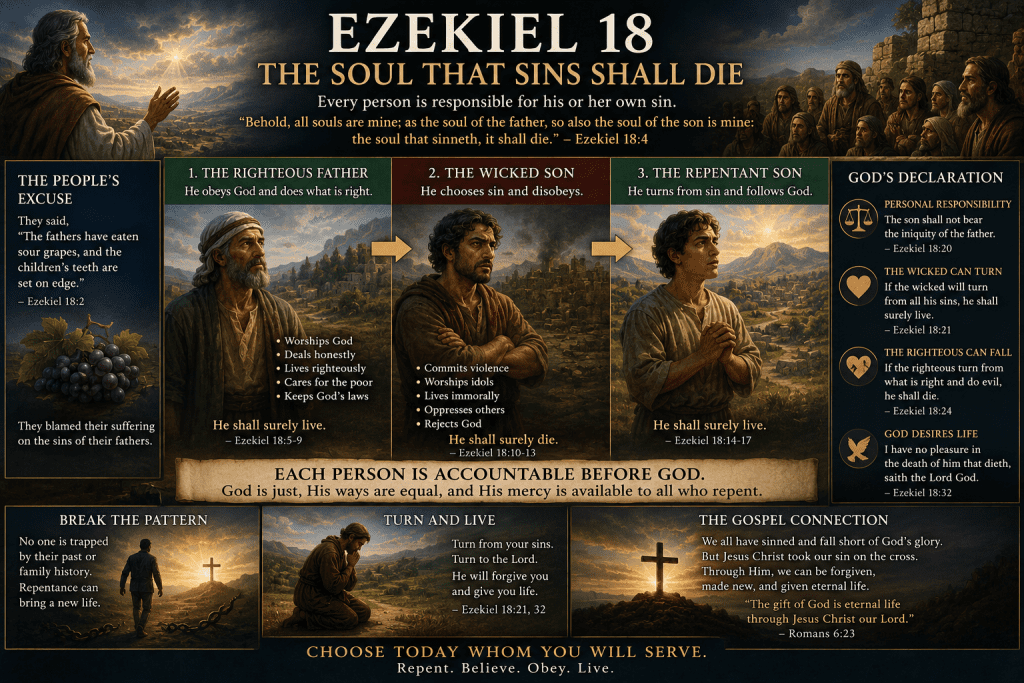
Personal ResponsibilityEzekiel 18 is one of the clearest chapters in the Old Testament about personal responsibility before God. The people of Judah blamed their suffering on previous generations instead of facing their own sin.
But God declared that every person is accountable for his or her own relationship with Him.

This chapter teaches that:

  • God is perfectly just;
  • every person must personally respond to God;
  • repentance brings life;
  • persistent rebellion leads to judgment.

At its heart, Ezekiel 18 is not merely about punishment — it is a passionate call for sinners to turn back to God and live.

The Historical Background

The Jewish people were suffering under Babylonian judgment. Many complained that they were paying for the sins of their fathers.

They used a popular proverb:

“The fathers have eaten sour grapes, and the children’s teeth are set on edge.” — Ezekiel 18:2

In other words:

“Our parents sinned, and now we are suffering for it.”

The people were shifting blame away from themselves.

God responds by rejecting this excuse.

God’s Declaration: Every Soul Belongs to Him

God begins with a powerful statement:

“Behold, all souls are mine.” — Ezekiel 18:4

Every human being belongs to God because He is the Creator.

No one escapes His authority.

Then God announces the central truth of the chapter:

“The soul that sinneth, it shall die.” — Ezekiel 18:4

This refers primarily to spiritual judgment and separation from God.

Sin always carries consequences.

The Righteous Man Lives

The Example of a Godly Man

God describes a righteous man who:

  • worships the Lord alone;
  • treats others honestly;
  • avoids immorality;
  • cares for the poor;
  • obeys God’s commandments.

This man “shall surely live.”

Important Truth

Salvation was never earned by good works. Rather, righteous living reveals genuine faith in God.

True faith affects how people live.

The Wicked Son Dies

A Different Generation

Next, God describes the righteous man’s son.

Unlike his father, this son becomes violent, immoral, and idolatrous.

Even though he had a godly father, he would still face judgment for his own sin.

Lesson

A godly heritage cannot save a rebellious heart.

Every person must personally know and obey God.

The Grandson Turns Back to God

Breaking the Pattern

Then God introduces a third generation.

This grandson sees his father’s wickedness and chooses a different path.

He repents and walks in God’s ways.

God declares that he will live.

Application

No one is trapped forever by family history.

A person raised in sin can still turn to God.

Likewise, someone raised in a godly home must still personally choose faith.

Personal Responsibility Before God

Each Person Answers for Himself

God repeats the principle clearly:

“The son shall not bear the iniquity of the father.” — Ezekiel 18:20

Every person stands accountable before God individually.

This Does NOT Mean Sin Has No Influence

Family sin affects future generations in many ways:

  • emotionally;
  • spiritually;
  • socially;
  • morally.

But each individual is still personally responsible for his or her choices before God.

God’s Mercy Toward the Repentant

The Wicked Can Turn and Live

One of the most hopeful truths in this chapter is God’s promise to forgive the repentant sinner.

“If the wicked will turn from all his sins… he shall surely live.” — Ezekiel 18:21

God delights in repentance and restoration.

No sinner is beyond God’s mercy.

The Danger of Turning Away

God also warns that a righteous person who abandons righteousness and embraces sin faces judgment.

This does not teach salvation by works. Rather, it reveals that genuine faith must continue in obedience.

Outward religion without a faithful heart cannot save.

“The Way of the Lord Is Equal”

The people accused God of being unfair.

But God turns the accusation back on them.

The real problem was not God’s justice — it was their sinful hearts.

Important Truth

God’s judgments are always righteous.

Human beings naturally excuse their own sin while questioning God’s holiness.

God Takes No Pleasure in Judgment

One of the most beautiful verses in Ezekiel appears here:

“For I have no pleasure in the death of him that dieth, saith the Lord GOD.” — Ezekiel 18:32

God is holy and must judge sin.

But judgment is not His delight.

God calls sinners to repentance because He desires life, not destruction.

The Gospel in Ezekiel 18

Ezekiel 18 exposes humanity’s greatest problem:

Every individual is guilty before God because of sin.

No one can blame:

  • parents;
  • society;
  • culture;
  • upbringing;
  • circumstances.

Each person must personally answer to God.

This chapter prepares the way for the Gospel.

The New Testament teaches:

“For all have sinned.” — Romans 3:23

But it also declares that Jesus Christ came to bear the judgment sinners deserve.

At the cross:

  • Christ took our guilt;
  • justice was satisfied;
  • forgiveness became available.

Through faith in Jesus:

  • sinners receive mercy;
  • hearts are transformed;
  • spiritual death gives way to eternal life.

Lessons We Must Learn

1. Every Person Is Personally Responsible Before God

We cannot blame others for our spiritual condition.

2. Family History Does Not Determine Destiny

A person can break sinful patterns through repentance and faith.

3. God Welcomes the Repentant

No matter how far someone has fallen, God still calls sinners to turn back to Him.

4. God Is Perfectly Just

His judgments are always righteous and fair.

5. God Desires Life, Not Destruction

God’s warnings are invitations to repentance.

6. Salvation Requires a Changed Heart

True repentance involves turning away from sin and turning toward God.

Conclusion

Ezekiel 18 is a powerful chapter about personal responsibility, repentance, and the mercy of God.

The people wanted to blame previous generations for their problems, but God called each individual to examine his own heart.

The message remains deeply relevant today.

Every person must personally respond to God.

No one is saved through family heritage, religion, or outward appearances.

Yet the chapter also overflows with hope:

The sinner who turns to God can live.

That hope is fully realized in Jesus Christ, who died and rose again so guilty sinners could receive forgiveness, new life, and eternal salvation.

<<Back to Bible Passages


For more insights to the Book of Ezekiel, order Pastor Alan’s book from the links below.Book of Ezekiel


Dr. Alan Holden has served in pastoral ministry for more than 35 years, preaching and teaching the Bible in churches across the United States. He holds a Doctor of Ministry from Luther Rice Seminary and a Master of Divinity from The Southern Baptist Theological Seminary. Through What’s It Mean?, he seeks to help readers understand the meaning of Scripture and grow in their walk with Christ. He is currently the pastor of Lake Saunders Baptist Church in Tavares, FL.

Useless Vine and Broken Promises

A Simple, Biblical Explanation of Ezekiel 15–17

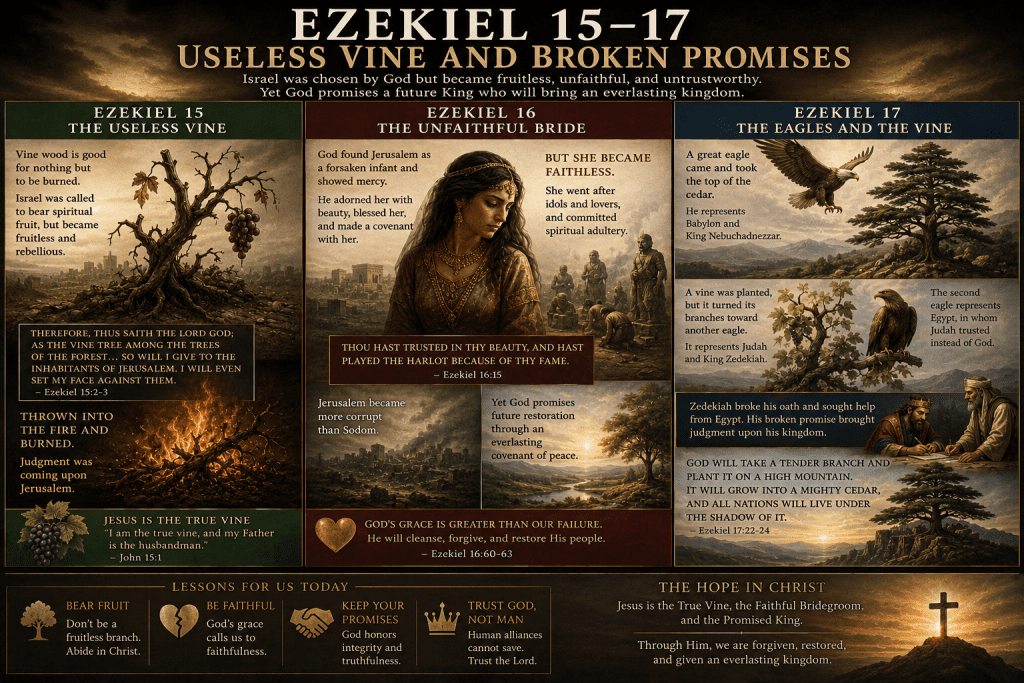
Useless Vine and Broken PromisesEzekiel 15–17 contains some of the most powerful illustrations in the book of Ezekiel. One of the key themes is the useless vine and broken promises that symbolise the people’s disobedience. Through parables and symbolic pictures, God explains why judgment was coming upon Jerusalem.
Israel had been chosen to bear spiritual fruit for God, but instead became corrupt, rebellious, and unfaithful. The nation was like a useless vine, an unfaithful bride, and a kingdom breaking sacred promises.

These chapters remind us that outward privilege means nothing without obedience and faithfulness to God.

At the same time, God also gives a remarkable promise of future restoration through the coming Messiah.

Ezekiel 15: The Useless Vine

The Vine Wood

God asks a simple question:

What good is vine wood compared to other trees?

Unlike cedar or oak, vine wood is weak and twisted. It cannot be used to build furniture or tools. Its only value comes from producing fruit.

The Meaning

Israel was called to produce spiritual fruit for God among the nations.

But instead of bearing fruit, the people turned to idolatry and rebellion.

Therefore, they had become like a useless vine fit only for the fire.

Burned by Fire

God describes the vine being thrown into the fire and consumed.

This symbolized the coming destruction of Jerusalem by Babylon.

The people believed they were secure because they were God’s chosen nation. But privilege without obedience brought greater accountability.

Application

God is not impressed merely by religious identity.

The question is not:

  • “Do we appear religious?”
  • “Do we belong to a church?”
  • “Do we know Bible language?”

The real question is:

Are we bearing spiritual fruit?

Jesus and the True Vine

This chapter points forward to Jesus’ words in John 15.

Jesus declared:

“I am the true vine.” — John 15:1

A branch disconnected from Christ becomes spiritually fruitless.

Real spiritual life comes only through abiding in Christ.

Ezekiel 16: The Unfaithful Bride

Jerusalem’s Shameful Beginning

God pictures Jerusalem as an abandoned infant left to die.

No one cared for her.

But God passed by, showed mercy, and gave her life.

This beautiful picture shows God’s grace toward Israel.

Israel did not become great because of her own goodness. God rescued and blessed her.

God’s Love and Blessing

God cared for Jerusalem, clothed her, protected her, and entered into covenant with her.

The city became beautiful and prosperous because of God’s kindness.

Important Truth

Everything good Israel possessed came from God’s grace.

The same is true for believers today.

Every blessing we enjoy comes from the Lord.

Spiritual Adultery

Instead of remaining faithful, Jerusalem turned to idols and pagan nations.

God compares this to prostitution and adultery.

The imagery is strong because idolatry is not merely rule-breaking — it is covenant unfaithfulness against a loving God.

Jerusalem’s Sin

The people trusted in:

  • false gods;
  • political alliances;
  • wealth;
  • foreign nations.

They forgot the God who rescued them.

Worse Than Sodom

Shockingly, God says Jerusalem became more corrupt than Sodom.

The people had greater spiritual light and therefore greater responsibility.

Application

Religious knowledge without obedience hardens the heart.

A person may know Scripture yet still rebel against God.

A Promise of Restoration

Even after exposing Jerusalem’s sin, God promises future mercy.

He speaks of an everlasting covenant.

This points toward the New Covenant fulfilled through Jesus Christ.

God’s grace is greater than human failure.

Ezekiel 17: The Eagles and the Vine

The Parable of the Two Eagles

God gives Ezekiel a symbolic riddle involving:

  • a great eagle;
  • a cedar tree;
  • a vine;
  • another eagle.

The first eagle represents Babylon and King Nebuchadnezzar.

The vine represents Judah.

The second eagle represents Egypt.

King Zedekiah’s Broken Promise

Babylon had installed Zedekiah as king under an oath of loyalty.

But Zedekiah rebelled and sought help from Egypt.

This was not merely political betrayal — it was breaking a sacred oath made before God.

Important Lesson

God takes promises seriously.

Broken vows reveal deeper spiritual rebellion.

The Failure of Human Alliances

Judah trusted Egypt instead of trusting God.

But Egypt could not save them.

Human solutions cannot rescue people from spiritual problems.

Application

People still place false confidence in:

  • governments;
  • money;
  • power;
  • institutions;
  • human wisdom.

Anything trusted more than God eventually fails.

God’s Future Kingdom

The chapter ends with one of Ezekiel’s great Messianic promises.

God says He will take a tender branch and plant it on a high mountain where it will grow into a mighty cedar tree sheltering many nations.

This points to the coming Messiah — Jesus Christ.

Though Israel’s kingdom would fall, God would establish an eternal kingdom through Christ.

The Gospel in Ezekiel 15–17

These chapters reveal humanity’s repeated failure:

  • fruitlessness;
  • unfaithfulness;
  • broken promises;
  • misplaced trust.

Israel failed as God’s vine and bride.

But Jesus succeeded where humanity failed.

Jesus is:

  • the True Vine;
  • the faithful Bridegroom;
  • the righteous King;
  • the keeper of God’s covenant.

At the cross, Jesus bore the judgment sinners deserve for spiritual unfaithfulness.

Through Him:

  • barren lives can bear fruit;
  • broken sinners can be forgiven;
  • covenant relationship with God can be restored.

Lessons We Must Learn

1. Fruitlessness Leads to Judgment

God desires spiritual fruit, not empty religion.

2. God’s Grace Should Produce Faithfulness

Israel forgot the God who rescued them.

We must never take God’s grace lightly.

3. Idolatry Is Spiritual Unfaithfulness

Anything that replaces God in our hearts becomes an idol.

4. Broken Promises Matter to God

God values truthfulness, integrity, and faithfulness.

5. Human Solutions Cannot Replace Trust in God

Political power and worldly alliances cannot save the soul.

6. God Still Offers Hope Through the Messiah

Even in judgment, God promised a future King and eternal kingdom.

That hope is fulfilled in Jesus Christ.

Conclusion

Ezekiel 15–17 presents a sobering picture of spiritual failure.

Israel had become:

  • a fruitless vine;
  • an unfaithful bride;
  • a nation breaking sacred promises.

Yet even in judgment, God promised restoration through a coming King.

The message still speaks today.

God does not desire empty religion or divided hearts.

He seeks faithfulness, repentance, and genuine trust.

Only through Jesus Christ can broken sinners become fruitful, forgiven, and restored to fellowship with God.

<<Back to Bible Passages


For more insights to the Book of Ezekiel, order Pastor Alan’s book from the links below.Book of Ezekiel


Dr. Alan Holden has served in pastoral ministry for more than 35 years, preaching and teaching the Bible in churches across the United States. He holds a Doctor of Ministry from Luther Rice Seminary and a Master of Divinity from The Southern Baptist Theological Seminary. Through What’s It Mean?, he seeks to help readers understand the meaning of Scripture and grow in their walk with Christ. He is currently the pastor of Lake Saunders Baptist Church in Tavares, FL.

False Confidence and False Prophets

A Simple, Biblical Explanation of Ezekiel 12–14

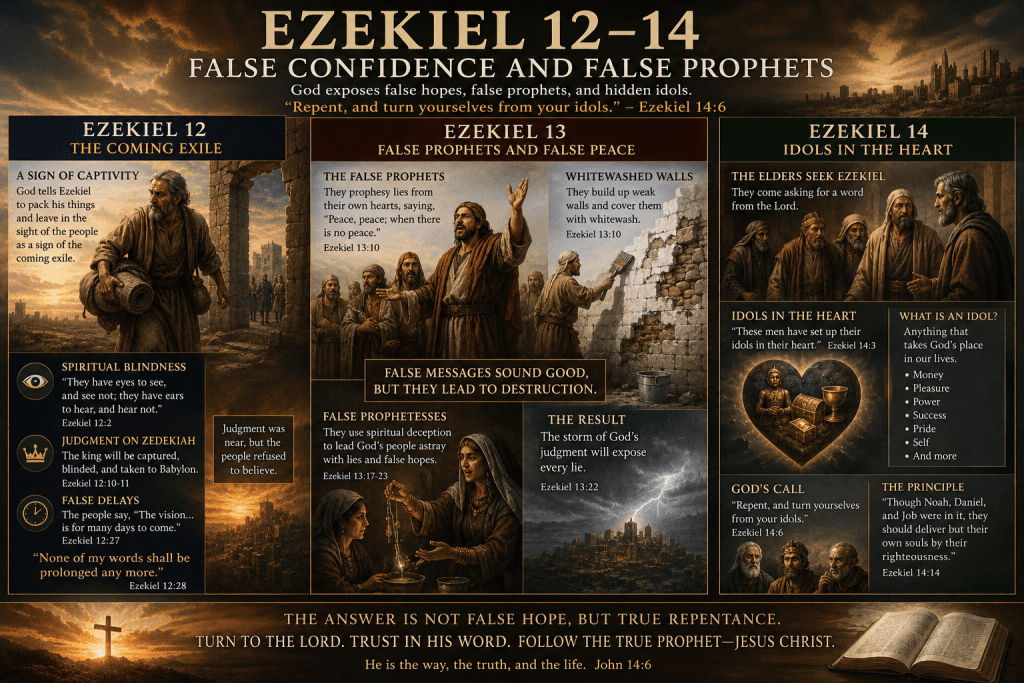
False ProphetsOne of the greatest dangers in spiritual life is false confidence — believing everything is fine when judgment is actually near. In Ezekiel 12–14, God exposes the false hopes, false prophets, and hardened hearts of the people of Judah.
The people believed Jerusalem could never fall. They trusted religious traditions, political security, and optimistic preachers instead of listening to God’s Word. Even as judgment approached, false prophets kept promising peace and safety.

These chapters warn us about the danger of believing comforting lies instead of difficult truth.

God’s message through Ezekiel was clear:

Judgment was coming, and only genuine repentance could save the people.

Yet even in these stern warnings, God still called sinners to turn back to Him.

The Historical Setting

Ezekiel was prophesying from Babylon during the exile. Many Jews had already been carried away captive, but Jerusalem still stood.

The people remaining in Jerusalem believed God would protect the city no matter how sinful they became. False prophets strengthened this belief by preaching messages of peace and prosperity.

But God revealed through Ezekiel that destruction was certain because the nation refused to repent.

Ezekiel 12: The Coming Exile

Ezekiel Acts Out the Captivity

God tells Ezekiel to pack his belongings like a man going into exile. He digs through a wall and carries his possessions out at twilight.

This strange acted-out sermon symbolized the coming fall of Jerusalem and the captivity of the people.

Why Did God Use Signs?

The people had become spiritually deaf. Sometimes God used dramatic illustrations to awaken hardened hearts.

Ezekiel’s life became a living sermon.

The Blindness of the People

God describes Israel as:

“A rebellious house, which have eyes to see, and see not; they have ears to hear, and hear not.” — Ezekiel 12:2

The problem was not lack of information.

The problem was refusal to obey.

Application

A person can hear sermons, read the Bible, attend church, and still harden their heart against God.

Spiritual blindness is often willful.

Judgment on King Zedekiah

God specifically predicts the downfall of Jerusalem’s king.

Zedekiah would attempt to escape the city but would be captured by Babylon.

This prophecy was fulfilled exactly.

The king fled by night, was captured, blinded, and taken to Babylon (2 Kings 25:1–7).

Important Lesson

God’s Word always proves true.

Human leaders fail, but God’s promises and warnings stand forever.

False Delays

The people mocked Ezekiel’s warnings by saying:

“The vision that he seeth is for many days to come.” — Ezekiel 12:27

In other words:

“Judgment is not coming anytime soon.”

People often assume delayed judgment means canceled judgment.

But God declares:

“None of my words shall be prolonged any more.” — Ezekiel 12:28

Judgment was near.

Ezekiel 13: False Prophets and False Peace

The False Prophets

God condemns prophets who speak from their own imagination instead of from the Lord.

These men claimed divine authority while preaching lies.

What Were They Saying?

They promised:

  • peace;
  • safety;
  • prosperity;
  • victory over enemies.

But none of it came from God.

The Real Problem

False prophets tell people what they want to hear instead of what they need to hear.

“Peace” When There Was No Peace

God compares the false prophets to builders covering a weak wall with whitewash.

The wall looked secure outwardly, but underneath it was collapsing.

Soon the storm of judgment would expose the truth.

Application

Many people today want spiritual encouragement without repentance.

They want:

  • blessing without obedience;
  • salvation without surrender;
  • heaven without holiness.

False teaching comforts people while leaving them spiritually unprepared.

False Prophetesses

God also rebukes women who practiced occult-like spiritual deception.

They manipulated people with false promises and spiritual superstition.

Instead of leading sinners to repentance, they strengthened rebellion.

Important Truth

Any spiritual message that pulls people away from truth is dangerous, no matter how attractive or emotional it appears.

Ezekiel 14: Idols in the Heart

The Elders Seek Ezekiel

Some elders come to Ezekiel seeking a word from God.

But God reveals their real problem:

“These men have set up their idols in their heart.” — Ezekiel 14:3

Outwardly they appeared religious.

Inwardly they worshiped idols.

What Is an Idol of the Heart?

An idol is anything that takes God’s rightful place in our lives.

It may be:

  • money;
  • pleasure;
  • power;
  • success;
  • relationships;
  • politics;
  • pride;
  • self.

The heart can become an idol factory.

Application

A person may reject physical idols while still worshiping hidden idols internally.

God looks deeper than outward appearances.

God’s Call to Repentance

Even in judgment, God graciously calls the people to turn back:

“Repent, and turn yourselves from your idols.” — Ezekiel 14:6

God’s desire is always repentance before judgment.

The Righteous Cannot Save the Wicked

God says even if Noah, Daniel, and Job were present, they could only save themselves by their righteousness.

This teaches an important principle:

Faith cannot be borrowed.

Every individual must personally respond to God.

A godly family member, pastor, or church cannot save someone else.

The Gospel in Ezekiel 12–14

These chapters reveal humanity’s deep spiritual problem:

  • blindness to truth;
  • love for falsehood;
  • idolatry in the heart;
  • rejection of God’s warnings.

This condition still exists today.

People naturally prefer messages that affirm them rather than confront sin.

But Jesus Christ came as the true Prophet sent from God.

Unlike false teachers, Jesus spoke truth even when people rejected Him.

At the cross, Christ took the judgment sinners deserve so hearts can be cleansed and restored.

Through Christ:

  • idols can be removed;
  • hearts can be changed;
  • sinners can be forgiven;
  • truth can set people free.

Lessons We Must Learn

1. False Confidence Is Dangerous

The people believed they were safe while judgment stood at the door.

Religious activity alone does not guarantee a right relationship with God.

2. False Teachers Often Sound Encouraging

False prophets usually preach comforting messages.

But truth matters more than comfort.

3. God Sees the Heart

Hidden idols are never hidden from God.

4. Delayed Judgment Is Still Judgment

God’s patience should lead us to repentance, not complacency.

5. Every Person Must Personally Respond to God

Nobody can believe for us.

Faith in God must become personal.

Conclusion

Ezekiel 12–14 is a powerful warning against false confidence, false religion, and false prophets.

The people trusted in outward appearances while their hearts drifted far from God.

But God exposed their hidden idols and warned that judgment was near.

Yet even here, God’s mercy shines through.

He still called the people to repent.

That invitation still stands today.

Do not trust comforting lies while ignoring God’s truth.

Turn from idols, listen to God’s Word, and place your faith fully in Jesus Christ — the true Prophet, true Savior, and true Shepherd of God’s people.

<<Back to Bible Passages


For more insights to the Book of Ezekiel, order Pastor Alan’s book from the links below.Book of Ezekiel


Dr. Alan Holden has served in pastoral ministry for more than 35 years, preaching and teaching the Bible in churches across the United States. He holds a Doctor of Ministry from Luther Rice Seminary and a Master of Divinity from The Southern Baptist Theological Seminary. Through What’s It Mean?, he seeks to help readers understand the meaning of Scripture and grow in their walk with Christ. He is currently the pastor of Lake Saunders Baptist Church in Tavares, FL.

God’s Glory Departs

A Simple, Biblical Explanation of Ezekiel 8–11

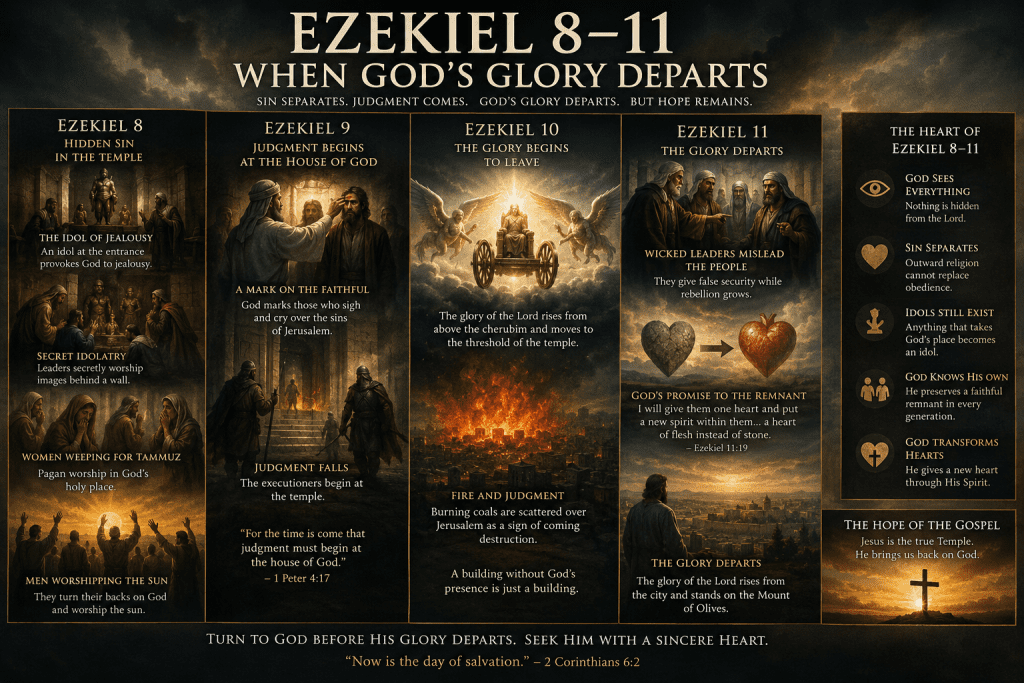
God's Glory DepartsFew passages in the Bible are more heartbreaking than Ezekiel 8–11. In these chapters, the prophet Ezekiel sees a vision of the glory of God leaving the temple in Jerusalem. God had dwelt among His people for centuries, but now His glory slowly departs because of the people’s sin, rebellion, and idolatry.
This section teaches a powerful truth: God is holy, and persistent sin drives people away from His presence. Yet even in judgment, God still promises hope for those who truly repent.

These chapters are not merely ancient history. They warn every generation about spiritual compromise, hypocrisy, and the danger of worshiping other gods while pretending to honor the Lord.

The Historical Background

Ezekiel was already living in Babylonian captivity when God gave him this vision around 592 BC. Jerusalem had not yet been completely destroyed, and many Jews still believed the city and temple were safe because God’s house was there.

But the people had filled the land with violence, corruption, and idol worship. They trusted in religion while living in rebellion.

God showed Ezekiel what was happening secretly inside the temple itself.

Ezekiel 8: Hidden Sin in the Temple

The Vision Begins

God carries Ezekiel in a vision from Babylon to Jerusalem. There he sees shocking scenes of idolatry taking place inside the temple.

The Idol of Jealousy

At the entrance of the temple stood an idol provoking God to jealousy.

God alone deserves worship. Any rival worship is spiritual adultery.

Israel was breaking the very first commandment:

“Thou shalt have no other gods before me.” — Exodus 20:3

Secret Idolatry

God tells Ezekiel to dig through a wall. Behind it, Ezekiel sees religious leaders secretly worshiping images of animals and creeping things.

These elders thought nobody could see them.

But God sees hidden sin.

Application

People often live one way publicly and another way privately. But nothing is hidden from God.

Church attendance cannot cover a rebellious heart.

Women Weeping for Tammuz

Ezekiel then sees women mourning for Tammuz, a false Babylonian fertility god.

This pagan worship had entered God’s own house.

The world had invaded the worship of God.

Men Worshiping the Sun

Finally, Ezekiel sees twenty-five men with their backs toward the temple worshiping the rising sun.

This was the ultimate insult.

Instead of facing God, they turned their backs on Him.

Illustration

A marriage collapses when one spouse continually gives affection and loyalty to another person. Israel was doing this spiritually to God.

Ezekiel 9: Judgment Begins at the House of God

The Mark on the Faithful

God calls six executioners and one man clothed in linen carrying a writer’s ink horn.

The man marks those who grieve over the sins of Jerusalem.

These people were not perfect, but they still loved God and mourned over evil.

Important Truth

God always knows those who belong to Him.

Even in judgment, God distinguishes the faithful from the rebellious.

Judgment Falls

The executioners move through Jerusalem bringing death, beginning at the temple itself.

This is a sobering principle throughout Scripture:

Judgment begins with God’s people.

Compare:

“For the time is come that judgment must begin at the house of God.” — 1 Peter 4:17

Religious privilege does not excuse sin.

Ezekiel 10: The Glory Begins to Leave

The Cherubim and the Wheels

Ezekiel again sees the cherubim and heavenly throne first described in Ezekiel 1.

The glory of God rises from above the cherubim and moves to the threshold of the temple.

This movement is deeply symbolic.

God is preparing to leave.

Fire and Judgment

Burning coals are scattered over Jerusalem as a sign of coming destruction.

Soon Babylon would destroy the city and temple in 586 BC.

The people trusted in the building while ignoring the God who once filled it.

Application

A church can have buildings, traditions, music, and programs — yet lose the presence and power of God.

Religion without repentance becomes empty.

Ezekiel 11: The Final Departure of Glory

Wicked Leaders Mislead the People

God exposes corrupt leaders who encouraged rebellion and false confidence.

They claimed Jerusalem was safe, but judgment was coming.

False spiritual leaders always tell people what they want to hear instead of what they need to hear.

God’s Promise to the Remnant

In the middle of judgment comes hope.

God promises that after exile He will gather His people again and give them:

  • One heart
  • A new spirit
  • A heart of flesh instead of stone

This points forward to the New Covenant fulfilled in Christ.

God is not merely interested in outward religion. He transforms hearts.

The Glory Departs

The most tragic moment comes at the end of chapter 11.

The glory of the Lord rises from the city and stands upon the Mount of Olives east of Jerusalem.

God’s presence leaves the temple.

The nation had chosen idols over God.

Why This Matters

The temple was the center of Israel’s worship and identity. God’s departure symbolized:

  • Broken fellowship
  • Judgment
  • Spiritual emptiness
  • National collapse

Without God’s presence, the temple was just another building.

The Gospel in Ezekiel 8–11

These chapters reveal humanity’s greatest problem: sin separates us from God.

Israel’s outward religion could not save them because their hearts were corrupt.

But centuries later, Jesus Christ came as the true Temple of God.

On the cross, Jesus bore the judgment sinners deserve so that God’s presence could dwell with His people again.

Through Christ:

  • hearts of stone become hearts of flesh;
  • sinners are forgiven;
  • the Holy Spirit indwells believers.

The tragedy of God’s departing glory points us to the greater hope of God dwelling with His people through Jesus Christ.

Lessons We Must Learn

1. God Sees Hidden Sin

Nothing is concealed from the Lord.

Secret sin is never truly secret.

2. Outward Religion Cannot Replace Obedience

Israel had a temple but lost God’s favor because their hearts were far from Him.

Church attendance alone does not equal true faith.

3. Idolatry Still Exists Today

Modern idols may not be statues, but anything that replaces God becomes an idol:

  • money
  • pleasure
  • politics
  • success
  • self
  • entertainment

4. God Preserves a Faithful Remnant

Even in dark times, God knows those who truly belong to Him.

5. God Desires Heart Transformation

The answer is not better religion but a new heart through Jesus Christ.

Conclusion

Ezekiel 8–11 is one of the saddest sections in Scripture because it records the departure of God’s glory from His people.

The people wanted religion without holiness, worship without repentance, and blessing without obedience.

Eventually, God’s glory departed.

Yet these chapters also point to hope. God promised a future restoration and a new heart for His people.

That promise finds its fulfillment in Jesus Christ, through whom God dwells with His people forever.

The warning remains clear today:

Do not turn your back on God while pretending to worship Him.

Seek the Lord with a sincere heart while His presence may still be found.

<<Back to Bible Passages


For more insights to the Book of Ezekiel, order Pastor Alan’s book from the links below.Book of Ezekiel


Dr. Alan Holden has served in pastoral ministry for more than 35 years, preaching and teaching the Bible in churches across the United States. He holds a Doctor of Ministry from Luther Rice Seminary and a Master of Divinity from The Southern Baptist Theological Seminary. Through What’s It Mean?, he seeks to help readers understand the meaning of Scripture and grow in their walk with Christ. He is currently the pastor of Lake Saunders Baptist Church in Tavares, FL.

Danger of Idolatry

A Simple, Biblical Explanation of False Worship and Coming Judgment

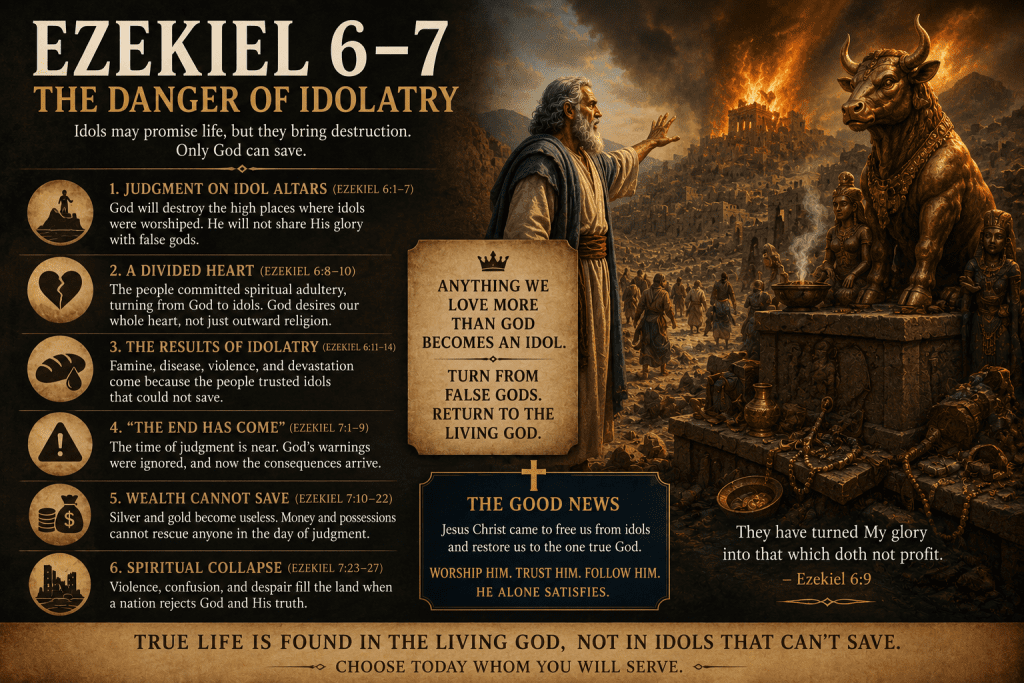
Danger of IdolatryIn Ezekiel chapters 6 and 7, God speaks directly against the sin that had poisoned the hearts of His people: idolatry. These passages highlight the danger of idolatry and the consequences it brings.

The people of Judah had turned away from the Lord and filled the land with false worship. They bowed before idols, trusted in pagan gods, and embraced the sinful practices of the surrounding nations.

God’s message is direct and sobering:
Idolatry always leads to destruction.

These chapters remind us that anything we place above God eventually becomes dangerous to our souls.

Judgment Against the Mountains of Israel

Ezekiel 6:1–7

God tells Ezekiel to prophesy against the mountains of Israel.

Why the mountains?

Because many of the idol altars and pagan shrines had been built on high places throughout the land. These locations had become centers of false worship.

The people mixed the worship of God with the worship of idols.

God declares that these altars would be destroyed and the idols broken down.

Simple Explanation

God will not share His glory with false gods.

Application

Modern idolatry may not involve carved statues, but idols still exist.

Anything we love, trust, fear, or pursue more than God can become an idol:

  • Money
  • Success
  • Politics
  • Pleasure
  • Entertainment
  • Relationships
  • Self

An idol is anything that takes God’s rightful place in our hearts.

The Tragedy of a Divided Heart

Ezekiel 6:8–10

Even in judgment, God promises to preserve a remnant of people who will remember Him and turn back to Him.

One of the saddest statements in the chapter is when God says He was “broken” by their unfaithful hearts.

The people had committed spiritual adultery.

They outwardly belonged to God while inwardly chasing other loves.

Illustration

It is like a marriage where one spouse says the right words but gives their heart to someone else.

Important Truth

God does not only want outward religion—He wants our hearts.

The Results of Idolatry

Ezekiel 6:11–14

God describes famine, disease, violence, and devastation spreading throughout the land.

The people had trusted idols for security and blessing, but the idols could not save them.

False gods always fail.

Application

People often turn to idols because they promise:

  • Happiness
  • Security
  • Identity
  • Escape

But idols cannot satisfy the human soul.

Only God can.

“The End Has Come”

Ezekiel 7:1–9

Chapter 7 intensifies the warning.

Again and again God says:
“The end has come.”

Judgment was no longer distant—it was near.

The people had ignored warning after warning. Now the consequences of sin were arriving.

Simple Explanation

God is patient, but His patience should never be mistaken for approval.

Illustration

A person may ignore cracks in a dam for years, but eventually the collapse comes suddenly.

Wealth Cannot Save

Ezekiel 7:10–22

God says silver and gold would become useless in the day of judgment.

The people trusted material wealth, but money could not rescue them from spiritual collapse.

Important Truth

What people trust in apart from God eventually fails them.

Application

Modern culture often treats money, possessions, and success as saviors.

But when life collapses:

  • Wealth cannot forgive sin
  • Success cannot give peace
  • Possessions cannot save the soul

Spiritual Collapse

Ezekiel 7:23–27

The chapter closes with complete confusion and despair:

  • Violence fills the land
  • Leadership fails
  • Prophets are silent
  • People panic

Why?

Because a nation that rejects God eventually loses its moral and spiritual foundation.

Application

When people abandon truth, confusion follows.

A society cannot remove God from its foundation without consequences.

Ezekiel 6–7 and the Gospel

These chapters reveal something deeply important:
Idolatry is ultimately a worship problem.

Human beings were created to worship God. When we reject Him, we replace Him with lesser things.

That is why the Gospel is not merely about behavior change—it is about returning to God.

Jesus Christ came to rescue people from false worship and restore them to a right relationship with God.

Jesus alone deserves:

  • Our worship
  • Our trust
  • Our obedience
  • Our hearts

Every idol eventually disappoints.
Christ never will.

What Ezekiel 6–7 Means for Us Today

1. Idolatry Is Still Dangerous

Modern idols may look different, but they are just as spiritually destructive.

Anything above God becomes dangerous.

2. God Wants Our Whole Heart

God is not interested in partial devotion.

He desires sincerity and wholehearted worship.

3. False Gods Always Fail

The idols of Judah could not save them.

Neither can modern idols save us today.

4. God’s Warnings Are Acts of Mercy

Before judgment came, God repeatedly warned His people.

Warnings are expressions of God’s grace.

5. Only God Can Satisfy the Soul

People search for meaning everywhere:

  • Success
  • Pleasure
  • Relationships
  • Possessions

But the human heart was created for God.

Conclusion

Ezekiel 6–7 is a powerful warning about the danger of idolatry.

The people of Judah slowly drifted away from God until false worship filled the land and hardened their hearts.

The tragedy is that they trusted things that could never save them.

And people still make that mistake today.

Anything we place above God eventually becomes an idol.
And idols always disappoint.

But the good news is this:
God still calls people back to Himself.

The same God who warned Judah also offers grace, forgiveness, and restoration through Jesus Christ.

Turn away from false gods.
Return to the living God.
Because only He can truly satisfy the heart.

<<Back to Bible Passages


For more insights to the Book of Ezekiel, order Pastor Alan’s book from the links below.Book of Ezekiel


Dr. Alan Holden has served in pastoral ministry for more than 35 years, preaching and teaching the Bible in churches across the United States. He holds a Doctor of Ministry from Luther Rice Seminary and a Master of Divinity from The Southern Baptist Theological Seminary. Through What’s It Mean?, he seeks to help readers understand the meaning of Scripture and grow in their walk with Christ. He is currently the pastor of Lake Saunders Baptist Church in Tavares, FL.