






A Simple, Biblical Explanation of Ezekiel 25–32
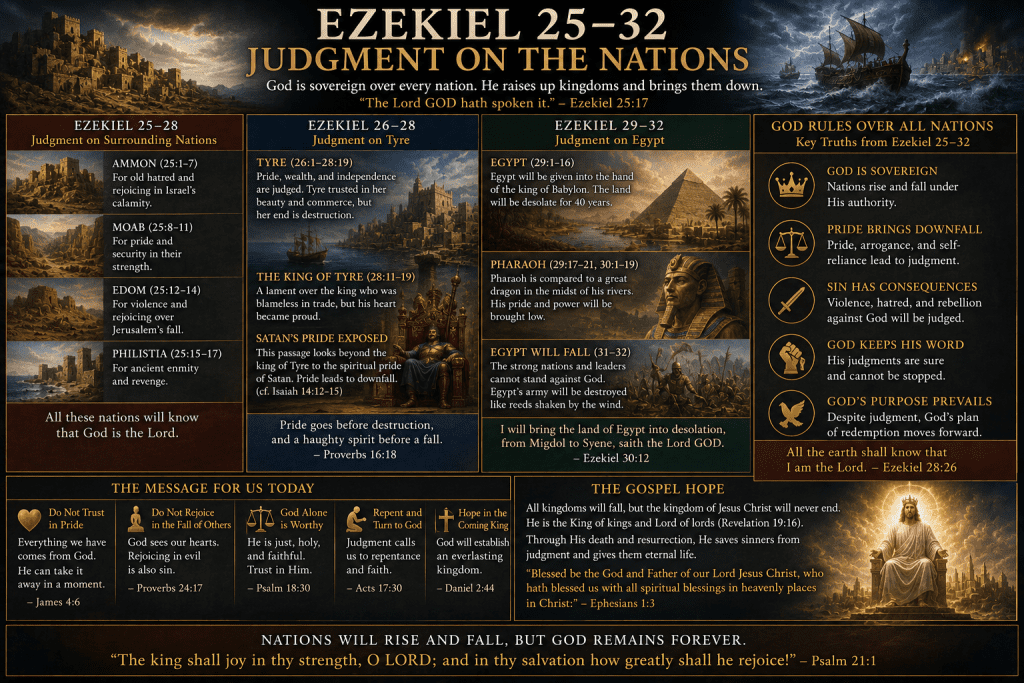 After announcing judgment on Jerusalem, the book of Ezekiel now turns toward the surrounding nations.
In Ezekiel 25–32, God declares judgment against:
- Ammon;
- Moab;
- Edom;
- Philistia;
- Tyre;
- Sidon;
- Egypt.
These nations were not innocent observers. They rejoiced over Judah’s fall, practiced violence and idolatry, and exalted themselves in pride against God.
These chapters teach an important truth:
God is not only the Judge of Israel — He is the Judge of all nations.
No kingdom, ruler, economy, military power, or culture stands above His authority.
Yet even within these judgments, God points toward a future kingdom where He alone will reign supreme.
Ezekiel 25: Judgment on Israel’s Enemies
Ammon: Rejoicing Over God’s People
The Ammonites mocked Judah when Jerusalem fell.
Instead of grieving over judgment, they celebrated it.
God condemns them for their hatred and pride.
Important Lesson
God takes seriously how people treat His people.
Mocking the suffering of others reveals a hard and sinful heart.
Moab: Rejecting God’s Distinction
Moab claimed Judah was no different from the pagan nations.
They rejected the idea that Israel belonged uniquely to God.
God announces judgment against Moab for its pride and unbelief.
Application
The world often dismisses God’s people and rejects God’s truth.
But God still distinguishes those who belong to Him.
Edom: Revenge and Bitterness
Edom had a long history of hatred toward Israel.
Rather than showing mercy, Edom sought revenge and violence.
God promises judgment against them.
Important Truth
Bitterness and revenge destroy both individuals and nations.
God alone has the right to final vengeance.
Philistia: Persistent Hostility
The Philistines continually opposed God’s people.
Their hostility reflected long-standing rebellion against God.
God declares that their pride and violence would end in destruction.
Ezekiel 26–28: Judgment on Tyre
The Pride of Tyre
Tyre was one of the wealthiest and most powerful trading cities in the ancient world.
When Jerusalem fell, Tyre rejoiced because it expected greater commercial prosperity.
The city trusted in:
- wealth;
- trade;
- military defenses;
- political influence.
But God warned that pride would bring destruction.
Ezekiel 26: The Fall of Tyre
The Coming Siege
God prophesies that many nations would come against Tyre like waves of the sea.
Nebuchadnezzar would attack the city, and later conquerors would continue its downfall.
Historically, Tyre eventually fell under repeated invasions.
Important Lesson
Economic success cannot protect a society from God’s judgment.
Wealth is a poor substitute for righteousness.
Ezekiel 27: A Funeral Song for Tyre
The Beautiful Ship
Tyre is pictured as a magnificent ship filled with riches and luxury.
The nations admired her beauty and prosperity.
But suddenly the ship sinks into the sea.
The Meaning
Human greatness is fragile.
Nations built on pride and greed eventually collapse.
The Mourning of the Nations
Merchants and kings mourn Tyre’s destruction because their wealth depended upon her.
Their grief was not spiritual repentance.
It was sorrow over economic loss.
Application
People often mourn losing worldly treasures more than losing fellowship with God.
Ezekiel 28: The King of Tyre and Satan’s Pride
The Prince of Tyre
God rebukes the ruler of Tyre for claiming godlike wisdom and power.
Though merely a man, he exalted himself proudly.
The Danger of Pride
Pride convinces people they do not need God.
It is one of the root sins behind human rebellion.
The King of Tyre and the Fall of Satan
The language in this chapter appears to move beyond the earthly ruler and describe Satan himself.
The figure is described as:
- being in Eden;
- full of beauty and wisdom;
- corrupted by pride;
- cast down from exaltation.
Many scholars understand this as a picture of Satan working behind the prideful king.
Important Truth
Behind human rebellion stands spiritual rebellion.
Pride was the sin that led to Satan’s fall.
Judgment on Sidon
God also announces judgment against Sidon, another Phoenician city known for idolatry.
Then God promises future restoration for Israel.
Even after judgment, God still intends to fulfill His covenant purposes.
Ezekiel 29–32: Judgment on Egypt
Egypt’s False Security
Egypt was a great world power.
Judah repeatedly trusted Egypt for military help instead of trusting God.
But Egypt itself would face judgment.
Application
Human alliances cannot replace dependence upon God.
What people trust instead of God eventually fails.
Ezekiel 29: Pharaoh the Great Dragon
Pharaoh’s Pride
God compares Pharaoh to a great river monster living in the Nile.
Egypt believed its prosperity came from its own power.
Pharaoh proudly claimed ownership of the Nile and the nation’s greatness.
But God would humble him.
Important Lesson
Every blessing ultimately comes from God.
Prideful self-sufficiency leads to downfall.
Egypt’s Failure to Help Judah
God says Egypt had been like a broken reed.
Judah leaned on Egypt for support, but Egypt failed them.
Application
Whatever replaces trust in God becomes unstable support.
Only God is completely trustworthy.
Ezekiel 30: The Day of the Lord Against Egypt
A Coming Disaster
God announces devastation upon Egypt and its allies.
The “day of the Lord” refers to God stepping into history in judgment.
Egypt’s military strength, wealth, and alliances would not save her.
False Confidence Destroyed
The people trusted in:
- armies;
- idols;
- rulers;
- cities;
- economic power.
But God would bring all human pride low.
Important Truth
Anything built apart from God eventually crumbles.
Ezekiel 31: Egypt Compared to Assyria
The Great Cedar Tree
God compares Assyria to a towering cedar tree that once dominated the nations.
Yet despite its greatness, Assyria fell because of pride.
Now Egypt would suffer the same fate.
The Pattern of History
Powerful nations rise and fall.
God alone remains eternal.
Ezekiel 32: A Funeral Song for Pharaoh
Pharaoh the Lion and Sea Monster
God describes Pharaoh as a lion among nations and a sea creature thrashing in the waters.
But God would capture and destroy him.
Egypt’s glory would descend into the grave.
The Graveyard of Nations
The chapter closes with a sobering picture of fallen nations in the realm of the dead.
Assyria, Elam, Meshech, Tubal, Edom, and others all lie defeated.
Important Truth
Every earthly kingdom eventually falls.
Only God’s kingdom endures forever.
The Gospel in Ezekiel 25–32
These chapters reveal humanity’s universal problem:
- pride;
- violence;
- greed;
- idolatry;
- self-sufficiency;
- rejection of God.
The judgment of the nations proves that all people stand accountable before the Lord.
No nation is righteous enough to escape judgment.
But these chapters also point toward humanity’s need for a true King and eternal kingdom.
That King is Jesus Christ.
Unlike earthly rulers:
- Jesus rules in righteousness;
- His kingdom never falls;
- His glory never fades.
At the cross, Jesus took the judgment sinners deserve.
Through Him:
- prideful sinners can be humbled and forgiven;
- enemies of God can become children of God;
- eternal life becomes possible.
Lessons We Must Learn
1. God Rules Over All Nations
No government or kingdom exists outside His authority.
2. Pride Leads to Destruction
Tyre, Egypt, and other nations fell because of arrogance and self-sufficiency.
3. Wealth and Power Cannot Save
Economic success and military strength are temporary.
4. God Sees How Nations Treat Others
Violence, cruelty, and hatred do not escape His judgment.
5. Human Kingdoms Always Pass Away
Every empire eventually falls.
Only God’s kingdom is eternal.
6. Jesus Christ Is the True Eternal King
The failures of earthly rulers point us to our need for the perfect King.
Conclusion
Ezekiel 25–32 shows God judging the nations surrounding Israel.
These powerful kingdoms trusted in:
- wealth;
- pride;
- military strength;
- false gods;
- human wisdom.
But none could stand against the Lord.
The message still speaks today.
Nations rise and fall, economies prosper and collapse, rulers come and go — but God remains sovereign over history.
Human pride always leads downward.
Only those who humble themselves before God will find lasting hope.
That hope is found fully in Jesus Christ, the eternal King whose kingdom will never be destroyed.
<<Back to Bible Passages
For more insights to the Book of Ezekiel, order Pastor Alan’s book from the links below.
Dr. Alan Holden has served in pastoral ministry for more than 35 years, preaching and teaching the Bible in churches across the United States. He holds a Doctor of Ministry from Luther Rice Seminary and a Master of Divinity from The Southern Baptist Theological Seminary. Through What’s It Mean?, he seeks to help readers understand the meaning of Scripture and grow in their walk with Christ. He is currently the pastor of Lake Saunders Baptist Church in Tavares, FL.