






A Simple, Biblical Explanation of Ezekiel 19–24
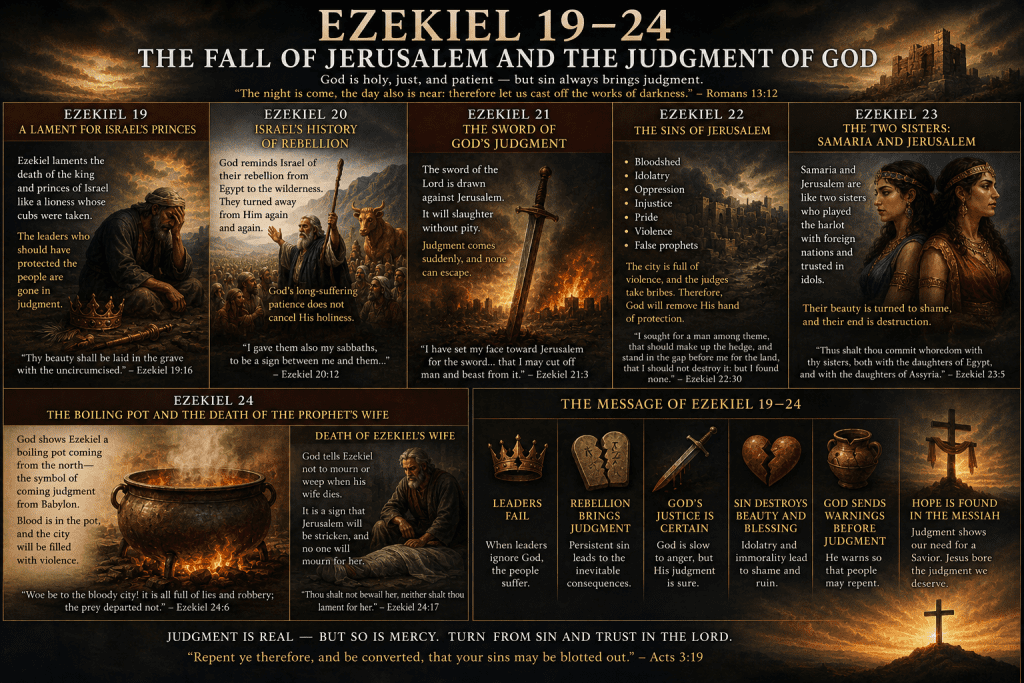 Ezekiel 19–24 marks a major turning point in the book of Ezekiel. These chapters focus on the coming destruction of Jerusalem because of the nation’s persistent rebellion against God.
The people still believed Jerusalem could survive. False prophets continued promising peace. But God declared through Ezekiel that judgment was no longer avoidable.
These chapters contain:
- funeral songs for Israel’s leaders;
- a review of Israel’s long history of rebellion;
- warnings through parables and signs;
- God’s judgment against corrupt leadership and idolatry;
- the final announcement that Jerusalem’s destruction had begun.
The overall message is clear:
God is patient, but persistent rebellion eventually brings judgment.
Yet even in wrath, God still points toward future restoration and hope.
Ezekiel 19: A Funeral Song for Israel’s Princes
The Lioness and Her Cubs
God gives Ezekiel a lamentation — a funeral song — for the rulers of Judah.
Israel is pictured as a lioness raising young lions.
The first lion likely represents King Jehoahaz.
He became violent and wicked, so the nations captured him and carried him away to Egypt.
The second lion likely represents King Jehoiachin or Zedekiah.
He too became corrupt and was eventually captured by Babylon.
The Meaning
Israel’s leaders were supposed to guide the people toward God.
Instead, they became destructive and rebellious.
Corrupt leadership helped bring national judgment.
The Burned Vine
The chapter closes by describing Israel as a once-strong vine now burned by fire.
The kingdom that once flourished under God’s blessing was collapsing because of sin.
Application
Leadership matters.
When leaders reject truth and righteousness, entire nations and families suffer.
Ezekiel 20: Israel’s Long History of Rebellion
The Elders Seek God
Some elders come to Ezekiel seeking a word from the Lord.
But instead of giving comfort, God reviews Israel’s long history of rebellion.
The nation repeatedly rejected Him despite His mercy and blessings.
Rebellion in Egypt
Even while enslaved in Egypt, Israel practiced idolatry.
Yet God delivered them for the sake of His name.
Important Truth
God’s grace preceded Israel’s obedience.
God rescued them not because they deserved it, but because He is merciful.
Rebellion in the Wilderness
Even after witnessing miracles:
- the Red Sea crossing;
- manna from heaven;
- water from the rock;
- God’s presence;
Israel still rebelled.
The people rejected God’s commandments and polluted the Sabbath.
Application
Miracles alone do not change the human heart.
Without repentance, people can experience God’s blessings and still reject Him.
Rebellion in the Promised Land
Even after entering Canaan, the nation continued worshiping idols.
Instead of remaining faithful to God, they adopted the sinful practices of surrounding nations.
The Root Problem
The issue was always the heart.
Outward religion cannot replace inward obedience.
God’s Promise of Restoration
Despite Israel’s rebellion, God promises future restoration.
One day He would gather His people again and purify them.
This points toward the future kingdom of God and ultimately toward Christ.
Ezekiel 21: The Sword of God’s Judgment
The Sword Is Drawn
God announces that His sword of judgment is unsheathed against Jerusalem.
Babylon would become the instrument of divine judgment.
The people had ignored repeated warnings, and now judgment was certain.
The Sword Symbolizes:
- war;
- destruction;
- death;
- divine justice.
Nebuchadnezzar’s Decision
God describes Babylon’s king standing at a crossroads deciding whether to attack Jerusalem or another city.
Though Nebuchadnezzar used pagan methods of divination, God sovereignly directed events.
Important Truth
God remains sovereign even over pagan rulers and world events.
History is ultimately under God’s control.
Judgment on the Prince of Israel
God announces judgment against Judah’s corrupt king.
The crown would be removed until the rightful King comes.
This is a Messianic prophecy pointing toward Jesus Christ.
“Until he come whose right it is.” — Ezekiel 21:27
Jesus alone is the true and eternal King.
Ezekiel 22: The Sins of Jerusalem
The Bloody City
God calls Jerusalem a “bloody city” because of violence, corruption, and injustice.
The people were guilty of:
- idolatry;
- oppression;
- immorality;
- bribery;
- dishonesty;
- abuse of the weak.
The nation’s corruption infected every level of society.
Corrupt Leaders
God condemns:
The Princes
They abused power for selfish gain.
The Priests
They profaned holy things and ignored God’s law.
The Prophets
They preached false visions and lies.
The People
They practiced violence and oppression.
Application
When truth collapses in leadership, society quickly decays.
Spiritual corruption affects entire communities.
The Furnace of Judgment
God compares Jerusalem to metal placed in a furnace.
The coming Babylonian invasion would expose the impurity of the people.
Judgment would become a refining fire.
God Sought One Man
One of the saddest verses in Ezekiel appears here:
“And I sought for a man among them, that should make up the hedge, and stand in the gap before me for the land… but I found none.” — Ezekiel 22:30
No spiritual leaders stood faithfully for truth.
Application
God still seeks men and women willing to stand for righteousness in corrupt times.
Ezekiel 23: The Two Sisters
Oholah and Oholibah
God uses shocking imagery to describe the spiritual adultery of Samaria and Jerusalem.
The two sisters symbolize:
- Samaria (the northern kingdom);
- Jerusalem (the southern kingdom).
Both pursued pagan nations and false gods instead of remaining faithful to the Lord.
Spiritual Adultery
The graphic language emphasizes how seriously God views idolatry.
Idolatry is not merely disobedience.
It is covenant unfaithfulness.
Jerusalem Became Worse
Though Jerusalem witnessed the judgment of Samaria, she refused to learn from it.
Instead, she became even more corrupt.
Important Lesson
Greater spiritual light brings greater responsibility.
Religious privilege without obedience increases accountability.
Ezekiel 24: The Boiling Pot and the Death of Ezekiel’s Wife
The Boiling Pot
God compares Jerusalem to a boiling pot filled with corruption.
The city’s sin had become deeply ingrained.
The Babylonian siege would soon begin.
Historically, this chapter marks the very day Nebuchadnezzar began the siege of Jerusalem.
The Death of Ezekiel’s Wife
One of the most heartbreaking moments in Ezekiel occurs when God tells the prophet his beloved wife will die suddenly.
Yet Ezekiel is commanded not to publicly mourn.
Why?
Ezekiel’s personal tragedy became a sign to the people.
When Jerusalem and the temple fell, the shock would be so overwhelming that normal mourning would be impossible.
Important Truth
The ministry of a prophet often involved deep personal sacrifice.
Ezekiel carried not only God’s message but also the burden of living it.
The Gospel in Ezekiel 19–24
These chapters reveal humanity’s desperate condition:
- corrupt leadership;
- rebellious hearts;
- spiritual adultery;
- violence;
- false worship;
- rejection of truth.
Jerusalem’s destruction shows the seriousness of sin.
But these chapters also point toward hope.
God promised:
- a future King;
- a purified people;
- eventual restoration.
That hope is fulfilled in Jesus Christ.
Jesus is:
- the true King;
- the faithful Shepherd;
- the perfect Prophet;
- the righteous Savior.
At the cross, Jesus bore the judgment sinners deserve.
Through Him:
- guilty sinners can be forgiven;
- hearts can be cleansed;
- spiritual restoration becomes possible.
Lessons We Must Learn
1. God Is Patient but Holy
God warned Israel repeatedly before judgment came.
But persistent rebellion eventually brings consequences.
2. Leadership Matters
Corrupt spiritual and political leaders influence entire nations toward destruction.
3. Religious Privilege Cannot Save
Jerusalem had the temple, priests, sacrifices, and Scriptures — yet still faced judgment because the people rejected God.
4. God Sees Every Sin
Nothing in Jerusalem’s corruption escaped God’s notice.
5. God Still Seeks Faithful People
God looked for someone willing to stand in the gap.
Believers today are called to stand faithfully for truth.
6. Judgment Is Never God’s Final Word
Even in these dark chapters, God points toward future restoration through the coming Messiah.
Conclusion
Ezekiel 19–24 records the final warnings before Jerusalem’s fall.
The nation had rejected God for generations through:
- idolatry;
- injustice;
- false worship;
- corrupt leadership;
- spiritual adultery.
Eventually, judgment arrived.
Yet even in wrath, God promised hope.
A future King would come.
That King is Jesus Christ.
The message still speaks powerfully today.
God calls people everywhere to repent, reject false idols, and place their trust in the true King before judgment comes.
Only Christ can cleanse the heart and restore broken sinners to fellowship with God.
<<Back to Bible Passages
For more insights to the Book of Ezekiel, order Pastor Alan’s book from the links below.
Dr. Alan Holden has served in pastoral ministry for more than 35 years, preaching and teaching the Bible in churches across the United States. He holds a Doctor of Ministry from Luther Rice Seminary and a Master of Divinity from The Southern Baptist Theological Seminary. Through What’s It Mean?, he seeks to help readers understand the meaning of Scripture and grow in their walk with Christ. He is currently the pastor of Lake Saunders Baptist Church in Tavares, FL.