






A Simple, Biblical Explanation of Ezekiel 8–11
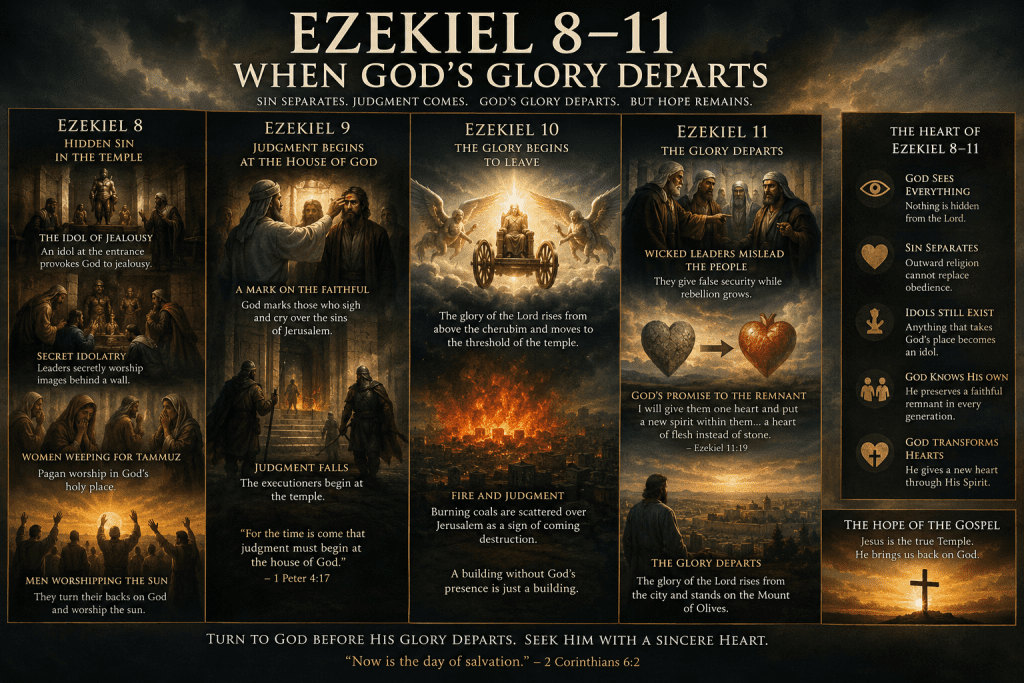 Few passages in the Bible are more heartbreaking than Ezekiel 8–11. In these chapters, the prophet Ezekiel sees a vision of the glory of God leaving the temple in Jerusalem. God had dwelt among His people for centuries, but now His glory slowly departs because of the people’s sin, rebellion, and idolatry.
This section teaches a powerful truth: God is holy, and persistent sin drives people away from His presence. Yet even in judgment, God still promises hope for those who truly repent.
These chapters are not merely ancient history. They warn every generation about spiritual compromise, hypocrisy, and the danger of worshiping other gods while pretending to honor the Lord.
The Historical Background
Ezekiel was already living in Babylonian captivity when God gave him this vision around 592 BC. Jerusalem had not yet been completely destroyed, and many Jews still believed the city and temple were safe because God’s house was there.
But the people had filled the land with violence, corruption, and idol worship. They trusted in religion while living in rebellion.
God showed Ezekiel what was happening secretly inside the temple itself.
Ezekiel 8: Hidden Sin in the Temple
The Vision Begins
God carries Ezekiel in a vision from Babylon to Jerusalem. There he sees shocking scenes of idolatry taking place inside the temple.
The Idol of Jealousy
At the entrance of the temple stood an idol provoking God to jealousy.
God alone deserves worship. Any rival worship is spiritual adultery.
Israel was breaking the very first commandment:
“Thou shalt have no other gods before me.” — Exodus 20:3
Secret Idolatry
God tells Ezekiel to dig through a wall. Behind it, Ezekiel sees religious leaders secretly worshiping images of animals and creeping things.
These elders thought nobody could see them.
But God sees hidden sin.
Application
People often live one way publicly and another way privately. But nothing is hidden from God.
Church attendance cannot cover a rebellious heart.
Women Weeping for Tammuz
Ezekiel then sees women mourning for Tammuz, a false Babylonian fertility god.
This pagan worship had entered God’s own house.
The world had invaded the worship of God.
Men Worshiping the Sun
Finally, Ezekiel sees twenty-five men with their backs toward the temple worshiping the rising sun.
This was the ultimate insult.
Instead of facing God, they turned their backs on Him.
Illustration
A marriage collapses when one spouse continually gives affection and loyalty to another person. Israel was doing this spiritually to God.
Ezekiel 9: Judgment Begins at the House of God
The Mark on the Faithful
God calls six executioners and one man clothed in linen carrying a writer’s ink horn.
The man marks those who grieve over the sins of Jerusalem.
These people were not perfect, but they still loved God and mourned over evil.
Important Truth
God always knows those who belong to Him.
Even in judgment, God distinguishes the faithful from the rebellious.
Judgment Falls
The executioners move through Jerusalem bringing death, beginning at the temple itself.
This is a sobering principle throughout Scripture:
Judgment begins with God’s people.
Compare:
“For the time is come that judgment must begin at the house of God.” — 1 Peter 4:17
Religious privilege does not excuse sin.
Ezekiel 10: The Glory Begins to Leave
The Cherubim and the Wheels
Ezekiel again sees the cherubim and heavenly throne first described in Ezekiel 1.
The glory of God rises from above the cherubim and moves to the threshold of the temple.
This movement is deeply symbolic.
God is preparing to leave.
Fire and Judgment
Burning coals are scattered over Jerusalem as a sign of coming destruction.
Soon Babylon would destroy the city and temple in 586 BC.
The people trusted in the building while ignoring the God who once filled it.
Application
A church can have buildings, traditions, music, and programs — yet lose the presence and power of God.
Religion without repentance becomes empty.
Ezekiel 11: The Final Departure of Glory
Wicked Leaders Mislead the People
God exposes corrupt leaders who encouraged rebellion and false confidence.
They claimed Jerusalem was safe, but judgment was coming.
False spiritual leaders always tell people what they want to hear instead of what they need to hear.
God’s Promise to the Remnant
In the middle of judgment comes hope.
God promises that after exile He will gather His people again and give them:
- One heart
- A new spirit
- A heart of flesh instead of stone
This points forward to the New Covenant fulfilled in Christ.
God is not merely interested in outward religion. He transforms hearts.
The Glory Departs
The most tragic moment comes at the end of chapter 11.
The glory of the Lord rises from the city and stands upon the Mount of Olives east of Jerusalem.
God’s presence leaves the temple.
The nation had chosen idols over God.
Why This Matters
The temple was the center of Israel’s worship and identity. God’s departure symbolized:
- Broken fellowship
- Judgment
- Spiritual emptiness
- National collapse
Without God’s presence, the temple was just another building.
The Gospel in Ezekiel 8–11
These chapters reveal humanity’s greatest problem: sin separates us from God.
Israel’s outward religion could not save them because their hearts were corrupt.
But centuries later, Jesus Christ came as the true Temple of God.
On the cross, Jesus bore the judgment sinners deserve so that God’s presence could dwell with His people again.
Through Christ:
- hearts of stone become hearts of flesh;
- sinners are forgiven;
- the Holy Spirit indwells believers.
The tragedy of God’s departing glory points us to the greater hope of God dwelling with His people through Jesus Christ.
Lessons We Must Learn
1. God Sees Hidden Sin
Nothing is concealed from the Lord.
Secret sin is never truly secret.
2. Outward Religion Cannot Replace Obedience
Israel had a temple but lost God’s favor because their hearts were far from Him.
Church attendance alone does not equal true faith.
3. Idolatry Still Exists Today
Modern idols may not be statues, but anything that replaces God becomes an idol:
- money
- pleasure
- politics
- success
- self
- entertainment
4. God Preserves a Faithful Remnant
Even in dark times, God knows those who truly belong to Him.
5. God Desires Heart Transformation
The answer is not better religion but a new heart through Jesus Christ.
Conclusion
Ezekiel 8–11 is one of the saddest sections in Scripture because it records the departure of God’s glory from His people.
The people wanted religion without holiness, worship without repentance, and blessing without obedience.
Eventually, God’s glory departed.
Yet these chapters also point to hope. God promised a future restoration and a new heart for His people.
That promise finds its fulfillment in Jesus Christ, through whom God dwells with His people forever.
The warning remains clear today:
Do not turn your back on God while pretending to worship Him.
Seek the Lord with a sincere heart while His presence may still be found.
<<Back to Bible Passages
For more insights to the Book of Ezekiel, order Pastor Alan’s book from the links below.
Dr. Alan Holden has served in pastoral ministry for more than 35 years, preaching and teaching the Bible in churches across the United States. He holds a Doctor of Ministry from Luther Rice Seminary and a Master of Divinity from The Southern Baptist Theological Seminary. Through What’s It Mean?, he seeks to help readers understand the meaning of Scripture and grow in their walk with Christ. He is currently the pastor of Lake Saunders Baptist Church in Tavares, FL.