







A Simple, Biblical Explanation of Ezekiel 34
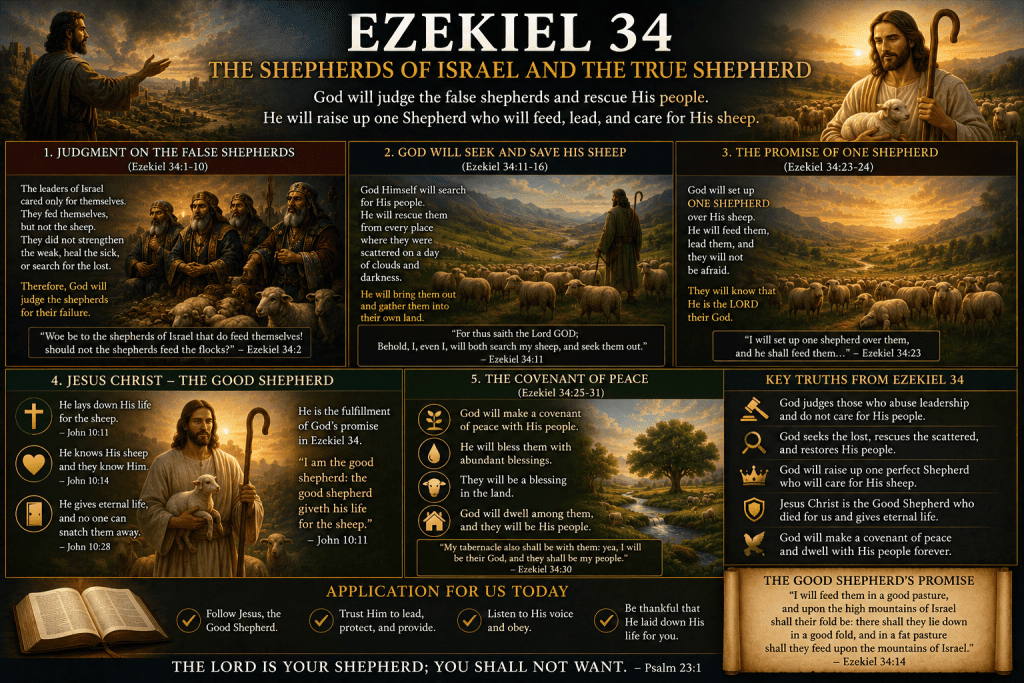 Ezekiel 34 is one of the most important chapters in the entire book of Ezekiel. After exposing the failures of Israel’s leaders, God promises that He Himself will become the Shepherd of His people.
The chapter contains both judgment and hope:
- judgment against false shepherds;
- comfort for scattered sheep;
- the promise of restoration;
- the prophecy of a coming Shepherd-King.
This chapter points directly toward Jesus Christ, the Good Shepherd who came to seek, save, and care for God’s people.
The Historical Setting
Jerusalem had fallen.
The nation was scattered.
The kings, priests, prophets, and rulers who should have protected the people had failed miserably.
Instead of leading the people toward God, many leaders abused their authority for personal gain.
God now speaks against these false shepherds.
The Shepherds of Israel Condemned
Feeding Themselves Instead of the Flock
God says the shepherds cared more about themselves than the sheep.
They:
- fed themselves;
- used the people for profit;
- neglected the weak;
- ignored the wounded;
- failed to seek the lost.
Important Truth
God holds spiritual leaders accountable for how they treat His people.
Leadership is not about personal power or comfort.
True leadership serves others.
The Sheep Were Scattered
Because of poor leadership, the people became scattered like sheep without a shepherd.
They were vulnerable to spiritual danger and destruction.
Application
False spiritual leadership always harms people.
When leaders neglect truth and holiness, confusion and spiritual weakness spread.
God Himself Will Shepherd His People
The Great Promise
After condemning the false shepherds, God gives one of the most comforting promises in Scripture:
“Behold, I, even I, will both search my sheep, and seek them out.” — Ezekiel 34:11
What human shepherds failed to do, God Himself would do.
God Promises To:
- seek the lost;
- gather the scattered;
- rescue the endangered;
- heal the wounded;
- strengthen the weak;
- feed His flock.
The Heart of God
This chapter reveals God’s compassion for hurting and wandering people.
He is not distant or uncaring.
He actively seeks His sheep.
The Separation of the Sheep
Judgment Within the Flock
God also rebukes selfish sheep who mistreated others.
Some grew fat and strong while oppressing weaker sheep.
God promises to judge between:
- sheep and sheep;
- rams and goats.
Important Lesson
God sees how people treat one another.
Religion without love and compassion displeases Him.
The Promise of One Shepherd
My Servant David
God gives a remarkable prophecy:
“And I will set up one shepherd over them, and he shall feed them, even my servant David.” — Ezekiel 34:23
This does not mean David himself would literally return as king.
This points to the coming Messiah from David’s royal line.
The promised Shepherd-King is Jesus Christ.
Jesus the Good Shepherd
Ezekiel 34 finds its ultimate fulfillment in Christ.
Jesus declared:
“I am the good shepherd.” — John 10:11
Unlike false shepherds:
- Jesus loves His sheep;
- He seeks the lost;
- He protects the flock;
- He lays down His life for the sheep.
The Contrast
False shepherds use the sheep.
Jesus sacrifices Himself for the sheep.
The Covenant of Peace
Blessing and Restoration
God promises a “covenant of peace” with His people.
The land would experience:
- safety;
- blessing;
- fruitfulness;
- peace.
This restoration points both to Israel’s future hope and ultimately to the peace believers receive through Christ.
Spiritual Meaning
Sin brings separation and scattering.
God’s salvation brings peace and restoration.
The Sheep Will Know the Lord
God says:
“Ye my flock, the flock of my pasture, are men, and I am your God.” — Ezekiel 34:31
The goal of salvation is restored relationship with God.
God desires His people to know Him personally.
The Gospel in Ezekiel 34
This chapter beautifully points to the Gospel.
Human leaders fail.
Their systems fail.
Human hearts wander like lost sheep.
But God did not abandon His people.
Jesus Christ came as the Good Shepherd.
At the cross:
- He laid down His life for the sheep;
- He bore the judgment sinners deserve;
- He gathered wandering sinners into God’s flock.
Through faith in Christ:
- the lost are found;
- the wounded are healed;
- the guilty are forgiven;
- the scattered are brought home.
Lessons We Must Learn
1. God Holds Leaders Accountable
Spiritual leadership is a serious responsibility.
God condemns leaders who exploit people instead of serving them.
2. God Cares Deeply for His People
The Lord sees the hurting, weak, scattered, and forgotten.
3. False Shepherds Damage the Flock
Poor spiritual leadership creates confusion and spiritual harm.
4. Jesus Is the True Shepherd
Only Christ perfectly leads, protects, and saves God’s people.
5. God Seeks the Lost
No wandering sheep is beyond God’s reach.
6. Salvation Brings Peace and Restoration
God gathers sinners into His flock through Jesus Christ.
Conclusion
Ezekiel 34 is a powerful chapter about failed leadership and God’s faithful love.
Israel’s shepherds abused and neglected the flock.
But God promised He would personally seek His sheep and provide a true Shepherd-King.
That promise is fulfilled in Jesus Christ.
The Good Shepherd still seeks the lost today.
He calls wandering sinners to come home.
Through Him, the scattered are gathered, the wounded are healed, and the lost find eternal life.
The message of Ezekiel 34 remains full of hope:
God has not abandoned His sheep.
The Shepherd still calls.
<<Back to Bible Passages
For more insights to the Book of Ezekiel, order Pastor Alan’s book from the links below.
Dr. Alan Holden has served in pastoral ministry for more than 35 years, preaching and teaching the Bible in churches across the United States. He holds a Doctor of Ministry from Luther Rice Seminary and a Master of Divinity from The Southern Baptist Theological Seminary. Through What’s It Mean?, he seeks to help readers understand the meaning of Scripture and grow in their walk with Christ. He is currently the pastor of Lake Saunders Baptist Church in Tavares, FL.