






A Simple, Biblical Explanation of Ezekiel 15–17
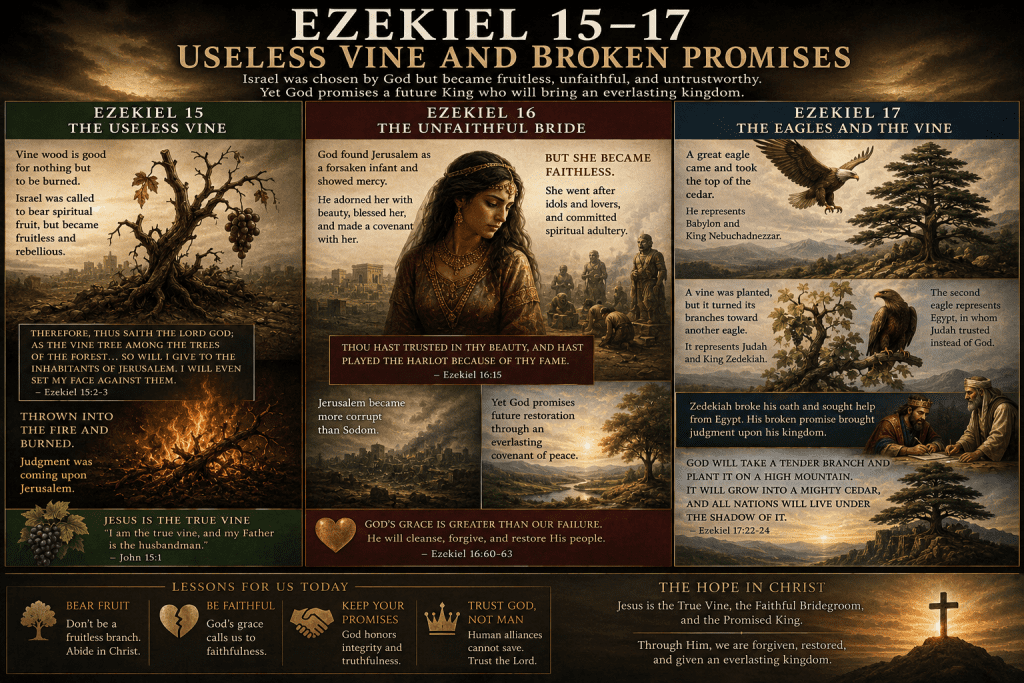 Ezekiel 15–17 contains some of the most powerful illustrations in the book of Ezekiel. One of the key themes is the useless vine and broken promises that symbolise the people’s disobedience. Through parables and symbolic pictures, God explains why judgment was coming upon Jerusalem.
Israel had been chosen to bear spiritual fruit for God, but instead became corrupt, rebellious, and unfaithful. The nation was like a useless vine, an unfaithful bride, and a kingdom breaking sacred promises.
These chapters remind us that outward privilege means nothing without obedience and faithfulness to God.
At the same time, God also gives a remarkable promise of future restoration through the coming Messiah.
Ezekiel 15: The Useless Vine
The Vine Wood
God asks a simple question:
What good is vine wood compared to other trees?
Unlike cedar or oak, vine wood is weak and twisted. It cannot be used to build furniture or tools. Its only value comes from producing fruit.
The Meaning
Israel was called to produce spiritual fruit for God among the nations.
But instead of bearing fruit, the people turned to idolatry and rebellion.
Therefore, they had become like a useless vine fit only for the fire.
Burned by Fire
God describes the vine being thrown into the fire and consumed.
This symbolized the coming destruction of Jerusalem by Babylon.
The people believed they were secure because they were God’s chosen nation. But privilege without obedience brought greater accountability.
Application
God is not impressed merely by religious identity.
The question is not:
- “Do we appear religious?”
- “Do we belong to a church?”
- “Do we know Bible language?”
The real question is:
Are we bearing spiritual fruit?
Jesus and the True Vine
This chapter points forward to Jesus’ words in John 15.
Jesus declared:
“I am the true vine.” — John 15:1
A branch disconnected from Christ becomes spiritually fruitless.
Real spiritual life comes only through abiding in Christ.
Ezekiel 16: The Unfaithful Bride
Jerusalem’s Shameful Beginning
God pictures Jerusalem as an abandoned infant left to die.
No one cared for her.
But God passed by, showed mercy, and gave her life.
This beautiful picture shows God’s grace toward Israel.
Israel did not become great because of her own goodness. God rescued and blessed her.
God’s Love and Blessing
God cared for Jerusalem, clothed her, protected her, and entered into covenant with her.
The city became beautiful and prosperous because of God’s kindness.
Important Truth
Everything good Israel possessed came from God’s grace.
The same is true for believers today.
Every blessing we enjoy comes from the Lord.
Spiritual Adultery
Instead of remaining faithful, Jerusalem turned to idols and pagan nations.
God compares this to prostitution and adultery.
The imagery is strong because idolatry is not merely rule-breaking — it is covenant unfaithfulness against a loving God.
Jerusalem’s Sin
The people trusted in:
- false gods;
- political alliances;
- wealth;
- foreign nations.
They forgot the God who rescued them.
Worse Than Sodom
Shockingly, God says Jerusalem became more corrupt than Sodom.
The people had greater spiritual light and therefore greater responsibility.
Application
Religious knowledge without obedience hardens the heart.
A person may know Scripture yet still rebel against God.
A Promise of Restoration
Even after exposing Jerusalem’s sin, God promises future mercy.
He speaks of an everlasting covenant.
This points toward the New Covenant fulfilled through Jesus Christ.
God’s grace is greater than human failure.
Ezekiel 17: The Eagles and the Vine
The Parable of the Two Eagles
God gives Ezekiel a symbolic riddle involving:
- a great eagle;
- a cedar tree;
- a vine;
- another eagle.
The first eagle represents Babylon and King Nebuchadnezzar.
The vine represents Judah.
The second eagle represents Egypt.
King Zedekiah’s Broken Promise
Babylon had installed Zedekiah as king under an oath of loyalty.
But Zedekiah rebelled and sought help from Egypt.
This was not merely political betrayal — it was breaking a sacred oath made before God.
Important Lesson
God takes promises seriously.
Broken vows reveal deeper spiritual rebellion.
The Failure of Human Alliances
Judah trusted Egypt instead of trusting God.
But Egypt could not save them.
Human solutions cannot rescue people from spiritual problems.
Application
People still place false confidence in:
- governments;
- money;
- power;
- institutions;
- human wisdom.
Anything trusted more than God eventually fails.
God’s Future Kingdom
The chapter ends with one of Ezekiel’s great Messianic promises.
God says He will take a tender branch and plant it on a high mountain where it will grow into a mighty cedar tree sheltering many nations.
This points to the coming Messiah — Jesus Christ.
Though Israel’s kingdom would fall, God would establish an eternal kingdom through Christ.
The Gospel in Ezekiel 15–17
These chapters reveal humanity’s repeated failure:
- fruitlessness;
- unfaithfulness;
- broken promises;
- misplaced trust.
Israel failed as God’s vine and bride.
But Jesus succeeded where humanity failed.
Jesus is:
- the True Vine;
- the faithful Bridegroom;
- the righteous King;
- the keeper of God’s covenant.
At the cross, Jesus bore the judgment sinners deserve for spiritual unfaithfulness.
Through Him:
- barren lives can bear fruit;
- broken sinners can be forgiven;
- covenant relationship with God can be restored.
Lessons We Must Learn
1. Fruitlessness Leads to Judgment
God desires spiritual fruit, not empty religion.
2. God’s Grace Should Produce Faithfulness
Israel forgot the God who rescued them.
We must never take God’s grace lightly.
3. Idolatry Is Spiritual Unfaithfulness
Anything that replaces God in our hearts becomes an idol.
4. Broken Promises Matter to God
God values truthfulness, integrity, and faithfulness.
5. Human Solutions Cannot Replace Trust in God
Political power and worldly alliances cannot save the soul.
6. God Still Offers Hope Through the Messiah
Even in judgment, God promised a future King and eternal kingdom.
That hope is fulfilled in Jesus Christ.
Conclusion
Ezekiel 15–17 presents a sobering picture of spiritual failure.
Israel had become:
- a fruitless vine;
- an unfaithful bride;
- a nation breaking sacred promises.
Yet even in judgment, God promised restoration through a coming King.
The message still speaks today.
God does not desire empty religion or divided hearts.
He seeks faithfulness, repentance, and genuine trust.
Only through Jesus Christ can broken sinners become fruitful, forgiven, and restored to fellowship with God.
<<Back to Bible Passages
For more insights to the Book of Ezekiel, order Pastor Alan’s book from the links below.
Dr. Alan Holden has served in pastoral ministry for more than 35 years, preaching and teaching the Bible in churches across the United States. He holds a Doctor of Ministry from Luther Rice Seminary and a Master of Divinity from The Southern Baptist Theological Seminary. Through What’s It Mean?, he seeks to help readers understand the meaning of Scripture and grow in their walk with Christ. He is currently the pastor of Lake Saunders Baptist Church in Tavares, FL.