







Series Theme: Romans: The Gospel of God’s Righteousness, Grace, and Transforming Power.
Primary Scripture: Romans 4:1–25 Key Verse: Romans 4:3 (KJV)
“For what saith the scripture? Abraham believed God, and it was counted unto him for righteousness.”
Theme: Salvation has always been based upon God’s grace and received through faith, not earned through human effort or religious works.
Central Truth: God declares sinners righteous through faith in Jesus Christ, just as Abraham was counted righteous because he believed God’s promise.
Sermon Prep: Romans 4 Study
Sermon Slide Deck: CLICK HERE to DOWNLOAD
Sermon Length: Approximately 30 minutes
1. Suggested Order of Worship
- Welcome and Announcements
- Opening Prayer
- Congregational Hymn — Standing on the Promises
- Scripture Reading — Romans 4:1–8
- Congregational Hymn — Amazing Grace
- Offertory Scripture and Prayer
- Receiving of Tithes and Offerings
- Special Music or Congregational Hymn — My Faith Has Found a Resting Place
- Prayer Before the Sermon
- Sermon — Abraham Believed God
- Invitation Hymn — Just As I Am
- Invitation Prayer
- Benediction
2. Opening Prayer
Heavenly Father,
We come before You this morning with grateful hearts.
Thank You for Your goodness, Your mercy, and Your faithfulness.
Thank You that Your promises never fail.
Throughout the generations, You have remained faithful to Your Word.
You kept Your promises to Abraham.
You fulfilled Your promises through Jesus Christ.
And You continue to demonstrate Your faithfulness to everyone who trusts in You.
Father, we recognize that we could never earn Your favor through our own efforts.
Our good works cannot remove our sins.
Our religious activities cannot make us righteous.
And our personal accomplishments cannot purchase eternal life.
But in Your wonderful grace, You have provided salvation through Jesus Christ.
As we worship today, strengthen our faith.
Help us trust Your promises even when circumstances seem uncertain.
Encourage those who are discouraged.
Comfort those who are grieving.
Provide for those who are facing financial difficulties.
And draw those who do not know Jesus Christ into a saving relationship with Him.
May everything we say and do today bring honor and glory to Your name.
In Jesus’ name we pray.
Amen.
3. Offertory Scripture and Prayer
Scripture: James 1:17 (KJV)
“Every good gift and every perfect gift is from above, and cometh down from the Father of lights, with whom is no variableness, neither shadow of turning.”
Offertory Prayer
Heavenly Father,
We thank You for every blessing You have provided.
You have given us life, strength, family, friends, and the necessities of daily living.
But above all, You have given us the wonderful gift of salvation through Jesus Christ.
We recognize that everything we possess ultimately comes from Your hand.
As we receive our tithes and offerings this morning, help us give with grateful and willing hearts.
May these gifts support the ministry of this church, provide assistance to those in need, and help carry the Gospel to our community and beyond.
Teach us to be faithful stewards of the resources You have entrusted to us.
And may our giving reflect our confidence in Your continued faithfulness.
In Jesus’ name we pray.
Amen.
4. Prayer Before the Sermon
Father,
As we open the fourth chapter of Romans, we ask You to guide our understanding.
Your Word reminds us that Abraham believed You, and his faith was counted for righteousness.
Help us understand that salvation is not something we earn through good works.
It is a gift of Your grace, received through faith.
Strengthen our confidence in Your promises.
Teach us to trust You even when circumstances seem impossible.
And remind us that the same God who raised Jesus Christ from the dead is able to accomplish everything He has promised.
May Your Holy Spirit apply these truths to our hearts.
Strengthen believers.
Encourage those whose faith is weak.
And draw those who are lost to repentance and faith in Jesus Christ.
In His name we pray.
Amen.
5. Sermon Manuscript
Abraham Believed God: The Promise of Justification by Faith
Romans 4:1–25
Introduction: Can You Really Trust a Promise?
We live in a world filled with promises.
Politicians make promises.
Businesses make promises.
Advertisements make promises.
People make promises to one another.
Some promises are kept.
Others are broken.
And sometimes promises are made with the best intentions, but circumstances prevent them from being fulfilled.
Perhaps you have experienced the disappointment of someone failing to keep a promise.
Maybe you trusted someone who let you down.
Or perhaps you made a promise that you were unable to fulfill.
Human promises are limited by human weakness.
But God’s promises are different.
When God makes a promise, He has both the integrity and the power to fulfill it.
He never lies.
He never forgets.
And He never encounters a circumstance that is beyond His control.
That brings us to Romans chapter 4.
In Romans 1, Paul explained that the Gospel is the power of God unto salvation.
In Romans 2, he demonstrated that religious privilege and moral accomplishments cannot make anyone righteous before God.
In Romans 3, he declared that all have sinned and come short of God’s glory.
Then he revealed the wonderful truth that sinners can be justified freely by God’s grace through faith in Jesus Christ.
Now, in Romans 4, Paul answers an important question.
Is justification by faith a new idea?
Did God introduce a completely different way of salvation when Jesus Christ came into the world?
Paul answers by taking us back to Abraham.
Abraham lived centuries before Jesus Christ.
He lived before God gave the law through Moses.
And he became the father of the Jewish nation.
Yet Paul demonstrates that Abraham was counted righteous because he believed God.
Romans 4:3 says:
“For what saith the scripture? Abraham believed God, and it was counted unto him for righteousness.”
That is the central truth of Romans chapter 4.
God has always called people to trust Him.
And salvation has always depended upon His grace rather than human merit.
Today, I want us to consider five important truths about justification by faith.
I. Abraham Was Justified by Faith, Not by Works (Romans 4:1–5)
Paul begins with a question.
Romans 4:1 says:
“What shall we say then that Abraham our father, as pertaining to the flesh, hath found?”
Why does Paul begin with Abraham?
Because Abraham was one of the most respected figures in Jewish history.
He was the father of the nation.
He received God’s covenant promises.
And he demonstrated remarkable obedience throughout his life.
If anyone could claim righteousness through personal accomplishments, Abraham might seem like a strong candidate.
But Paul explains that Abraham was not justified by works.
Abraham Had Nothing to Boast About Before God
Romans 4:2 says:
“For if Abraham were justified by works, he hath whereof to glory; but not before God.”
If Abraham had earned righteousness through his accomplishments, he could have boasted about what he had achieved.
But salvation does not work that way.
No sinner can stand before God and claim to deserve eternal life.
Abraham Believed God
Romans 4:3 says:
“For what saith the scripture? Abraham believed God, and it was counted unto him for righteousness.”
Paul is quoting Genesis 15:6.
God had promised Abraham descendants.
But Abraham and Sarah were growing older.
They had no child through whom the promise could be fulfilled.
Humanly speaking, the situation appeared impossible.
Yet Abraham believed God.
And God counted his faith for righteousness.
Faith Is Different from Works
Romans 4:4 says:
“Now to him that worketh is the reward not reckoned of grace, but of debt.”
Paul explains the difference between wages and gifts.
When someone works for an employer, the employer owes him his wages.
The payment is not a gift.
It is compensation for work performed.
But salvation is not a paycheck.
God does not owe us eternal life because we have performed enough good deeds.
Salvation is a gift of grace.
God Justifies the Ungodly
Romans 4:5 says:
“But to him that worketh not, but believeth on him that justifieth the ungodly, his faith is counted for righteousness.”
That is an extraordinary statement.
God justifies the ungodly.
He does not wait until sinners become morally perfect.
He does not require them to earn forgiveness.
He provides righteousness through faith.
Illustration: The Gift and the Paycheck
Imagine receiving two envelopes.
One contains your paycheck.
You worked for that money.
You earned it.
The other contains a gift from someone who loves you.
You did nothing to earn it.
You simply receive it with gratitude.
Salvation is not the first envelope.
It is the second.
God does not give us eternal life because we have earned it.
He gives it because of His grace.
Application
Are you trying to earn God’s acceptance?
Perhaps you believe that if you attend church regularly, read your Bible, give generously, and avoid certain sins, God will accept you.
Those activities can be important expressions of Christian obedience.
But they cannot purchase salvation.
You must trust Jesus Christ.
Righteousness is not a reward for human achievement. It is God’s gift to those who believe.
II. David Described the Blessing of Forgiveness Apart from Works (Romans 4:6–8)
Paul now introduces another important Old Testament figure.
King David.
Abraham was the father of the Jewish nation.
David was Israel’s great king.
Both men were deeply respected.
And both demonstrated that righteousness comes through God’s grace.
David Understood the Need for Forgiveness
Romans 4:6 says:
“Even as David also describeth the blessedness of the man, unto whom God imputeth righteousness without works,”
Paul then quotes Psalm 32.
Romans 4:7–8 says:
“Saying, Blessed are they whose iniquities are forgiven, and whose sins are covered.”
“Blessed is the man to whom the Lord will not impute sin.”
David understood the seriousness of sin.
He had experienced the consequences of disobedience.
His sin involving Bathsheba and Uriah brought terrible suffering into his life.
But David also experienced God’s mercy.
When he confessed his sin, he discovered the blessing of forgiveness.
The Meaning of Imputed Righteousness
Paul uses the language of reckoning or crediting.
God does not declare sinners righteous because they have never sinned.
He declares believers righteous on the basis of Jesus Christ’s saving work.
Our guilt is addressed through Christ’s sacrifice.
And His righteousness becomes the basis of our acceptance before God.
The Blessing of Forgiveness
Think about the words Paul quotes.
Forgiven.
Covered.
Not counted against us.
What wonderful blessings!
Forgiveness means that God has dealt with our guilt through Jesus Christ.
Our sins are not ignored.
They are answered by the sacrifice of the Savior.
Illustration: The Cleared Account
Imagine discovering that you owe an enormous debt.
You have no ability to repay it.
Every month, the balance continues to grow.
Then someone steps forward and pays the entire amount.
The account is settled.
The debt no longer stands against you.
That illustrates an important aspect of forgiveness.
Jesus Christ has accomplished what we could never accomplish for ourselves.
Through Him, our guilt can be removed.
Application
Perhaps you are carrying guilt from your past.
Maybe you remember decisions you regret.
Words you wish you had never spoken.
Actions you wish you could undo.
You cannot change the past.
But through Jesus Christ, you can receive forgiveness.
God’s grace is greater than your guilt.
The greatest blessing is not that we have never sinned, but that through Jesus Christ our sins can be forgiven.
III. God’s Promise Is Received by Faith, Not Religious Ceremony (Romans 4:9–12)
Paul now addresses an important question concerning circumcision.
For Jewish men, circumcision was the physical sign of God’s covenant with Abraham.
It was an important part of Jewish religious identity.
But Paul asks whether Abraham was counted righteous before or after he was circumcised.
Abraham Was Justified Before Circumcision
Romans 4:10 says:
“How was it then reckoned? when he was in circumcision, or in uncircumcision? Not in circumcision, but in uncircumcision.”
This is an important chronological point.
Genesis 15 records Abraham’s faith being counted for righteousness.
Genesis 17 records the establishment of circumcision as the covenant sign.
Therefore, Abraham was counted righteous before he received circumcision.
Circumcision Was a Sign, Not the Source of Righteousness
Romans 4:11 says:
“And he received the sign of circumcision, a seal of the righteousness of the faith which he had yet being uncircumcised…”
The outward ceremony did not create Abraham’s righteousness.
It confirmed the faith he already possessed.
The sign followed the reality.
Abraham Is the Father of All Who Believe
Paul explains that Abraham is the spiritual father of believers, whether Jewish or Gentile.
God’s promise of righteousness through faith extends beyond one nation or religious tradition.
The Gospel is for everyone who believes.
Illustration: The Wedding Ring
A wedding ring is a meaningful symbol.
It represents a marriage covenant.
But the ring itself does not create the marriage.
A person does not become a faithful spouse merely by wearing a ring.
The outward symbol points to an existing relationship and commitment.
In a similar way, religious ceremonies can express spiritual realities.
But they cannot create salvation.
Application: Baptism and Church Membership
This principle is especially important for Christians.
Baptism is an important act of obedience.
Church membership is valuable.
Participation in worship and the Lord’s Supper strengthens our Christian fellowship.
But none of these activities can save us.
They are not substitutes for personal faith in Jesus Christ.
Religious ceremonies may testify to our faith, but they cannot take the place of faith.
IV. God’s Promise Rests Upon Grace and Is Available to All Who Believe (Romans 4:13–17)
Paul now explains that God’s promise to Abraham did not depend upon the law.
Romans 4:13 says:
“For the promise, that he should be the heir of the world, was not to Abraham, or to his seed, through the law, but through the righteousness of faith.”
The Promise Came Before the Law
Abraham lived centuries before God gave the Mosaic Law.
Therefore, God’s promise could not have depended upon Abraham’s obedience to that law.
The promise rested upon God’s grace.
And Abraham received it through faith.
Faith Makes the Promise Depend Upon Grace
Romans 4:16 says:
“Therefore it is of faith, that it might be by grace; to the end the promise might be sure to all the seed…”
That is a beautiful explanation.
The promise is received by faith so that it rests upon grace.
If salvation depended upon perfect obedience, no sinner could receive it.
But because salvation depends upon God’s grace, it is available to everyone who believes.
God Gives Life to the Dead
Romans 4:17 describes God as the One:
“…who quickeneth the dead, and calleth those things which be not as though they were.”
God has power beyond human limitations.
He can accomplish what appears impossible.
He can bring life where there is death.
And He can fulfill promises that seem beyond human possibility.
Illustration: The Unbreakable Promise
Imagine someone promising you a gift.
But the promise depends upon your ability to meet a long list of requirements.
You must never make a mistake.
You must never fail.
You must never forget anything.
And you must maintain perfect performance for the rest of your life.
How confident would you be that you would receive the gift?
Not very confident.
But imagine that the promise depends entirely upon the faithfulness and generosity of the giver.
That is a much stronger foundation.
God’s promise of salvation rests upon His grace.
Application
Our assurance of salvation should rest upon God’s promises.
Not our feelings.
Not our personal accomplishments.
Not our ability to maintain perfect performance.
But the finished work of Jesus Christ.
The security of God’s promise rests upon His faithfulness, not our ability to earn His favor.
V. Genuine Faith Trusts God’s Power and His Promises (Romans 4:18–25)
Paul concludes the chapter by returning to Abraham’s faith.
God had promised Abraham that he would become the father of many nations.
But Abraham and Sarah were elderly.
They had no child through whom the promise could be fulfilled.
Humanly speaking, the situation appeared hopeless.
Yet Abraham continued to trust God.
Abraham Believed Against Hope
Romans 4:18 says:
“Who against hope believed in hope, that he might become the father of many nations…”
Abraham’s faith was not based upon favorable circumstances.
It was based upon the character and promise of God.
Abraham Considered the Circumstances Without Surrendering to Them
Romans 4:19 says:
“And being not weak in faith, he considered not his own body now dead, when he was about an hundred years old, neither yet the deadness of Sara’s womb:”
Abraham understood the human impossibility of the situation.
But he also understood that God’s power was greater than human limitations.
Abraham Was Fully Persuaded
Romans 4:20–21 says:
“He staggered not at the promise of God through unbelief; but was strong in faith, giving glory to God;”
“And being fully persuaded that, what he had promised, he was able also to perform.”
That is the heart of biblical faith.
Believing that God is able to accomplish what He has promised.
Faith Is Not Pretending Problems Do Not Exist
Sometimes people misunderstand faith.
They imagine that faith means refusing to acknowledge difficulties.
But Abraham knew the difficulties were real.
He understood his age.
He understood Sarah’s condition.
And he understood the human impossibility of the promise.
Yet he trusted God.
Faith does not require us to deny reality.
It requires us to recognize that God’s power is greater than our circumstances.
Abraham’s Faith Points Toward Our Faith in Christ
Romans 4:23–24 says:
“Now it was not written for his sake alone, that it was imputed to him;”
“But for us also, to whom it shall be imputed, if we believe on him that raised up Jesus our Lord from the dead;”
Paul explains that Abraham’s experience was recorded for our instruction.
We also receive righteousness through faith.
But our faith rests upon the saving work of Jesus Christ.
Romans 4:25 says:
“Who was delivered for our offences, and was raised again for our justification.”
Jesus died for our sins.
He rose from the grave.
And through Him, God provides justification for everyone who believes.
Illustration: The Chair
Imagine entering a room and seeing a sturdy chair.
You examine it.
You believe it can support your weight.
You may even explain why it is well constructed.
But you have not actually trusted the chair until you sit down.
Saving faith involves more than intellectual agreement.
It means personally relying upon Jesus Christ.
Application
Are you trusting God’s promises?
Perhaps you are facing circumstances that seem impossible.
You may be dealing with sickness.
Financial difficulties.
Family problems.
Uncertainty about the future.
Or spiritual discouragement.
God has not promised that every difficulty will disappear.
But He has promised to remain faithful to His people.
And He has demonstrated His power through the resurrection of Jesus Christ.
Faith does not mean that we understand everything God is doing. It means that we trust the One who does.
Conclusion: Abraham Believed God
Romans chapter 4 gives us one of the clearest explanations of justification by faith in the Bible.
Paul takes us back to Abraham.
The father of the Jewish nation.
The recipient of God’s covenant promises.
And one of the great examples of faith in Scripture.
Yet Abraham was not counted righteous because of his accomplishments.
He was not justified through religious ceremonies.
And he did not earn God’s favor through obedience to the law.
Abraham believed God.
And it was counted unto him for righteousness.
That same principle applies to us today.
We cannot earn salvation.
We cannot purchase forgiveness.
And we cannot make ourselves righteous through our own efforts.
But God has provided salvation through Jesus Christ.
He died for our sins.
He rose from the grave.
And He offers forgiveness and eternal life to everyone who believes.
Think about the five truths we have considered.
First, Abraham was justified by faith, not by works.
Second, David described the blessing of forgiveness apart from works.
Third, God’s promise is received by faith, not religious ceremony.
Fourth, God’s promise rests upon grace and is available to all who believe.
And fifth, genuine faith trusts God’s power and His promises.
Now, let me ask you a question.
What are you trusting for your salvation?
Your good works?
Your church membership?
Your baptism?
Your religious knowledge?
Or Jesus Christ?
Abraham believed God.
And God counted his faith for righteousness.
You can trust the same faithful God today.
Through Jesus Christ, you can receive forgiveness, righteousness, and eternal life.
And for those of us who already know Christ, Romans 4 gives us encouragement.
We serve a God who keeps His promises.
He has never failed.
He has never forgotten.
And He will never abandon those who belong to Him.
Let us trust Him.
Let us stand upon His promises.
And let us give Him the glory.
Because salvation is not something we achieve.
It is something God provides through His grace.
Amen.
6. Closing Invitation
As we prepare to sing Just As I Am, I want to invite you to respond to the truth of God’s Word.
Perhaps you have never trusted Jesus Christ as your personal Lord and Savior.
You may have tried to live a good life.
You may have attended church for many years.
You may have participated in religious ceremonies.
But none of those things can save you.
Salvation is God’s gift of grace.
Jesus Christ died for your sins.
He rose from the grave.
And He offers forgiveness and eternal life to everyone who turns to Him in repentance and faith.
Perhaps you are already a Christian, but your faith has become weak.
You may be facing circumstances that seem impossible.
You may be discouraged.
Or perhaps you have forgotten the faithfulness of God’s promises.
Remember Abraham.
He believed God even when the circumstances appeared hopeless.
And God fulfilled His promise.
Whatever the Lord is speaking to your heart, respond to Him today.
7. Invitation Prayer
Heavenly Father,
Thank You for the wonderful example of Abraham.
Your Word reminds us that Abraham believed You, and his faith was counted for righteousness.
Thank You that salvation is not something we must earn through our own efforts.
It is Your gift of grace, received through faith in Jesus Christ.
Forgive us when we place confidence in our accomplishments rather than in Your promises.
Strengthen our faith.
Help us trust You even when circumstances seem uncertain.
And remind us that the same God who raised Jesus Christ from the dead is able to accomplish everything He has promised.
For anyone who has never trusted Jesus Christ as Savior, I pray that today would be the day of salvation.
In Jesus’ name we pray.
Amen.
8. Benediction
Romans 4:20–21 (KJV)
“He staggered not at the promise of God through unbelief; but was strong in faith, giving glory to God;”
“And being fully persuaded that, what he had promised, he was able also to perform.”
May the Lord strengthen your faith.
May His promises give you confidence.
And may His grace fill your hearts with gratitude.
Go into the world trusting the faithfulness of God, rejoicing in the salvation provided through Jesus Christ, and giving glory to His name.
Amen.
9. Sermon Outline for the Bulletin
Abraham Believed God: The Promise of Justification by Faith
Central Truth: God declares sinners righteous through faith in Jesus Christ, just as Abraham was counted righteous because he believed God’s promise.
| Sermon Point | Scripture |
| I. Abraham Was Justified by Faith, Not by Works | Romans 4:1–5 |
| II. David Described the Blessing of Forgiveness Apart from Works | Romans 4:6–8 |
| III. God’s Promise Is Received by Faith, Not Religious Ceremony | Romans 4:9–12 |
| IV. God’s Promise Rests Upon Grace and Is Available to All Who Believe | Romans 4:13–17 |
| V. Genuine Faith Trusts God’s Power and His Promises | Romans 4:18–25 |
Take-Home Truth: Salvation is not earned through human effort. It is received by faith in Jesus Christ.
10. Questions for Reflection and Discussion
- Why does Paul use Abraham as an example of justification by faith?
- What does it mean that Abraham’s faith was counted for righteousness?
- How does Paul distinguish between wages and grace?
- Why is it important that God justifies the ungodly?
- What does David teach us about the blessing of forgiveness?
- Why was Abraham counted righteous before he was circumcised?
- How does justification by faith demonstrate that salvation is available to both Jews and Gentiles?
- Why does God’s promise rest upon grace rather than human obedience?
- What does Abraham’s faith teach us about trusting God during difficult circumstances?
- How does the resurrection of Jesus Christ strengthen our confidence in God’s promises?
11. Pastoral Teaching Notes
Romans 4 continues Paul’s explanation of justification by faith.
Several themes deserve careful attention.
First, Romans 4:1–5 demonstrates that Abraham was justified by faith rather than works. Paul quotes Genesis 15:6 to show that Abraham believed God and was counted righteous. This establishes that justification by faith was already present in the Old Testament.
Second, Romans 4:6–8 uses David as another witness to justification apart from works. Paul quotes Psalm 32 to emphasize the blessing of forgiveness and the non-imputation of sin.
Third, Romans 4:9–12 explains the chronological relationship between Abraham’s faith and circumcision. Abraham was counted righteous before receiving circumcision. Therefore, the outward covenant sign did not create his righteousness.
Fourth, Romans 4:13–17 emphasizes that God’s promise rests upon grace. Because the promise is received through faith, it is available to all who believe rather than being restricted to those who possess the Mosaic Law.
Fifth, Romans 4:18–22 presents Abraham as an example of persevering faith. Abraham trusted God’s promise despite circumstances that appeared humanly impossible. His confidence rested upon God’s power and faithfulness.
Sixth, Romans 4:23–25 connects Abraham’s faith to Christian faith in the risen Christ. Believers receive righteousness through faith in the God who raised Jesus from the dead. Christ was delivered for our offenses and raised for our justification.
Seventh, Romans 4 should be preached as an explanation of saving faith, not merely as a lesson about positive thinking. Abraham’s faith was effective because it rested upon the promise and character of God. Saving faith today rests upon Jesus Christ and His completed work of redemption.
A memorable sentence for the sermon:
Faith does not make God’s promises true. Faith trusts the God whose promises are already true.
<<Back to Romans 3 Sermon Outline OR Forward to Romans 5 Sermon Outline>>
<<Back to Romans Sermon Outlines OR <<Back to Sermon Resources
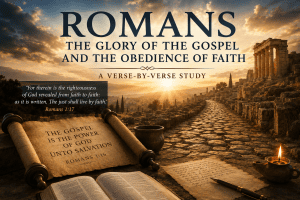
Want to do a deeper dive in the study of Romans? Get my book, Romans: The Glory of the Gospel and the Obedience of Faith, by making your choice of platforms below:
Dr. Alan Holden has served in pastoral ministry for more than 35 years, preaching and teaching the Bible in churches across the United States. He holds a Doctor of Ministry from Luther Rice Seminary and a Master of Divinity from The Southern Baptist Theological Seminary. Through What’s It Mean?, he seeks to help readers understand the meaning of Scripture and grow in their walk with Christ. He is currently the pastor of Lake Saunders Baptist Church in Tavares, FL.