







Romans 4 teaches that salvation has always been by grace through faith. God declared Abraham righteous because he believed God’s promise, not because he earned God’s favor through good works or religious rituals. Likewise, every believer is justified by trusting in Jesus Christ, who died for our sins and rose again for our justification. The Christian life is built on trusting God’s promises and resting in His grace.
Read the article below or watch the video here:
Key Text: Romans 4
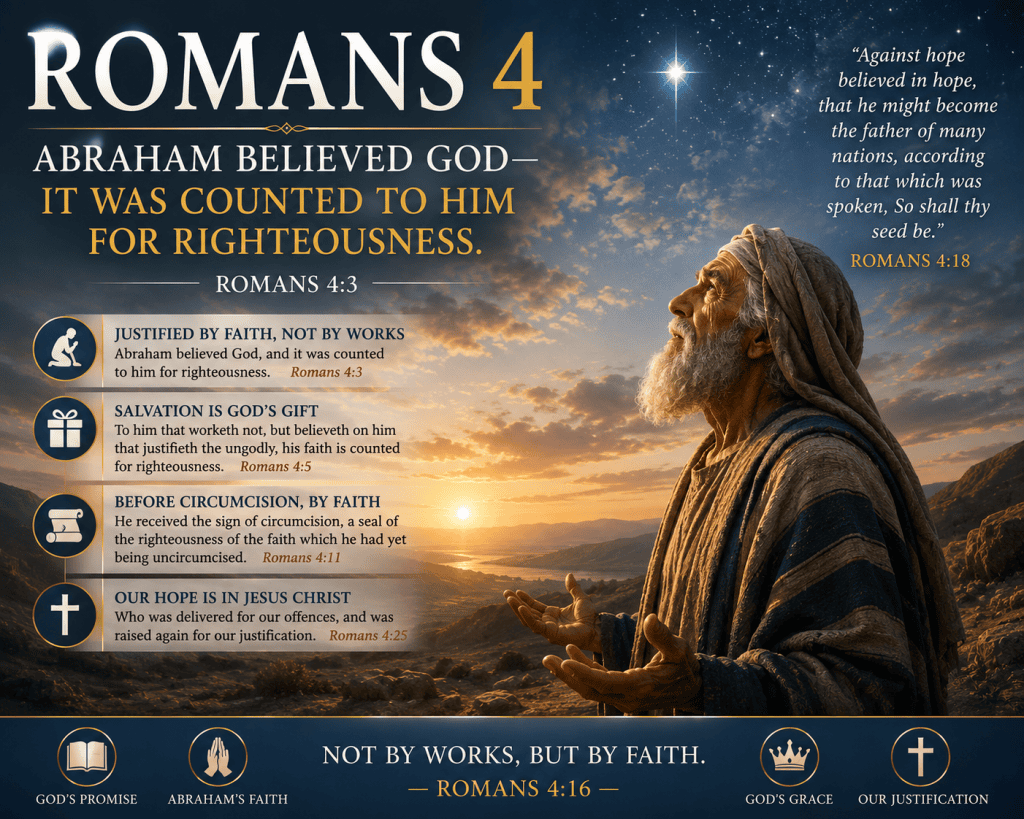
“For what saith the scripture? Abraham believed God, and it was counted unto him for righteousness.” — Romans 4:3 (KJV)
Introduction
How has anyone ever been saved?
Many people assume that people in the Old Testament were saved by keeping the Law, while people in the New Testament are saved by grace. Romans 4 completely destroys that misconception.
Paul points to Abraham—the father of the Jewish nation—and proves that salvation has always been by grace through faith.
Long before Moses received the Law, before the Ten Commandments, before circumcision became the sign of God’s covenant,
Abraham simply believed God.
His story reminds us that salvation has never been earned. It has always been received as God’s gracious gift.
Abraham Was Not Saved by His Works (Romans 4:1–8)
Paul begins with an important question.
“What shall we say then that Abraham our father…hath found?”
If anyone could claim salvation by works, surely Abraham could.
He obeyed God, left his homeland, followed God’s call, and became the father of God’s covenant people.
Yet Paul says:
“If Abraham were justified by works, he hath whereof to glory; but not before God.”
Even Abraham had nothing to boast about before the Lord.
Faith, Not Performance
Genesis 15:6 says:
“Abraham believed God, and it was counted unto him for righteousness.”
Notice what Abraham did.
He believed.
God did the saving.
Faith is not a work that earns salvation.
Faith is the empty hand that receives God’s gift.
Grace Is a Gift, Not a Wage (Romans 4:4–5)
Paul uses a simple illustration.
If you work forty hours, your employer pays you a wage.
That paycheck is not a gift.
It is something you earned.
Salvation works differently.
Paul writes:
“To him that worketh not, but believeth…his faith is counted for righteousness.”
God does not pay salvation as wages.
He freely gives it through grace.
That is wonderful news because none of us could ever earn eternal life.
David Celebrated God’s Forgiveness (Romans 4:6–8)
Paul now introduces another Old Testament witness—King David.
David knew what it meant to experience God’s forgiveness after terrible failure.
He writes:
“Blessed are they whose iniquities are forgiven, and whose sins are covered.”
What joy belongs to those whose sins are forgiven!
Notice what David does not say.
He does not rejoice because he became perfect.
He rejoices because God forgave him.
Every believer shares that same joy today.
Abraham Was Justified Before Circumcision (Romans 4:9–12)
Paul now answers another objection.
Was Abraham accepted because he had been circumcised?
The answer is no.
God declared Abraham righteous years before circumcision.
Circumcision became the outward sign of a relationship that already existed.
The order is important.
Faith came first.
The sign followed.
The same principle applies today.
Baptism does not save us.
Church membership does not save us.
Religious ceremonies do not save us.
They are expressions of faith—not substitutes for faith.
The Promise Comes Through Faith (Romans 4:13–17)
God promised Abraham that he would become the father of many nations.
That promise was not based upon law-keeping.
It rested upon God’s grace.
Paul writes:
“Therefore it is of faith, that it might be by grace.”
If salvation depended upon perfect obedience, no one could receive it.
Because it depends upon God’s grace, everyone who believes may come to Him.
The Gospel opens the door to all people.
God invites Jew and Gentile into His family through faith in Jesus Christ.
Abraham Believed the Impossible (Romans 4:18–22)
Perhaps the greatest lesson from Abraham is the strength of his faith.
God promised him a son.
There was only one problem.
Abraham was nearly one hundred years old.
Sarah was ninety.
Humanly speaking, the promise seemed impossible.
Yet Paul says:
“Against hope believed in hope.”
Abraham looked beyond circumstances.
He looked to God’s character.
Faith Trusts God’s Promises
Paul says Abraham:
- Considered not the impossibility.
- Did not stagger in unbelief.
- Grew strong in faith.
- Gave glory to God.
- Was fully persuaded that God would do what He promised.
Faith is not wishful thinking.
Faith rests upon the character of a faithful God.
God’s promises are always greater than our circumstances.
Abraham’s Story Is Our Story (Romans 4:23–25)
Paul concludes by saying Abraham’s experience was recorded:
“Not for his sake alone.”
His story was written for us.
Just as Abraham trusted God’s promise…
We trust God’s provision through Jesus Christ.
Paul points us to the heart of the Gospel.
Jesus:
“Was delivered for our offences, and was raised again for our justification.”
The cross paid for our sins.
The resurrection declared God’s acceptance of Christ’s sacrifice.
Because Jesus lives, believers stand justified before God.
What Romans 4 Means for Us Today
Romans 4 offers tremendous encouragement.
Stop Trying to Earn God’s Favor
Many people live as though God grades on a curve.
They constantly wonder whether they have done enough.
The Gospel says:
Christ has already done enough.
Rest in His finished work.
Trust God’s Promises
Like Abraham, we often face impossible situations.
Health problems.
Financial struggles.
Family concerns.
Uncertain futures.
Faith remembers that God’s promises never fail.
Rejoice in Forgiveness
David reminds us that forgiven people are blessed people.
The burden of guilt no longer defines us.
God has removed our sins as far as the east is from the west.
Live by Faith Every Day
Faith is not merely how we begin the Christian life.
It is how we continue walking with God.
Each day we choose to trust His wisdom above our own.
Living Romans 4
Ask yourself these questions this week:
- Am I trying to earn what God freely gives?
- Do I truly believe God’s promises even when circumstances seem impossible?
- Am I living in the joy of forgiveness?
- Is my confidence resting in Christ or in my own performance?
- How can I demonstrate faith through obedience today?
Faith does not ignore reality.
It simply believes that God is greater than every circumstance.
Final Thoughts
Romans 4 reminds us that God’s plan of salvation has never changed.
From Abraham to David…
From the apostles to today…
People are made right with God by faith.
Abraham’s life points us forward to Jesus Christ.
He believed God’s promise.
We believe God’s Son.
The object of our faith is different in clarity, but the principle remains the same.
Salvation is God’s gift, received by faith alone.
When we understand Romans 4, we stop striving to earn God’s acceptance and begin resting in His amazing grace.
Enjoy simple, Bible-centered teaching? Receive a short Daily Devotion by email and spend a few minutes each day in God’s Word. For more information, CLICK HERE.
Continue studying Romans: Explore our complete chapter-by-chapter guide to the Book of Romans, including humanity’s sin to Christ’s sacrifice, from justification by faith to the victorious Christian life in the Spirit, and the law of love–OR go:
<<Back to Romans 3 OR Forward to Romans 5>>
<<Back to Bible Passages
Want to do a deeper dive in the study of Romans? Get my book, Romans: The Glory of the Gospel and the Obedience of Faith, by making your choice of platforms below:
Dr. Alan Holden has served in pastoral ministry for more than 35 years, preaching and teaching the Bible in churches across the United States. He holds a Doctor of Ministry from Luther Rice Seminary and a Master of Divinity from The Southern Baptist Theological Seminary. Through What’s It Mean?, he seeks to help readers understand the meaning of Scripture and grow in their walk with Christ. He is currently the pastor of Lake Saunders Baptist Church in Tavares, FL.