







Series Theme: Romans: The Gospel of God’s Righteousness, Grace, and Transforming Power.
Sermon Title: Living as Christians in a Fallen World: Authority, Love, and Holiness
Primary Scripture: Romans 13:1–14
Key Verse: Romans 13:14 (KJV)
“But put ye on the Lord Jesus Christ, and make not provision for the flesh, to fulfil the lusts thereof.”
Theme: Christians demonstrate their faith through respect for legitimate authority, genuine love for others, and holy living in anticipation of Christ’s return.
Central Truth: Because we belong to Jesus Christ, we must live as responsible citizens, loving neighbors, and spiritually alert followers of our Lord.
Sermon Prep: Romans 13 Study
Sermon Slide Deck: CLICK HERE to DOWNLOAD
Sermon Length: Approximately 25–30 minutes
1. Suggested Order of Worship
- Welcome and Announcements
- Opening Prayer
- Congregational Hymn — To God Be the Glory
- Scripture Reading — Romans 13:8–14
- Congregational Hymn — Trust and Obey
- Offertory Scripture and Prayer
- Receiving of Tithes and Offerings
- Special Music or Congregational Hymn — Living for Jesus
- Prayer Before the Sermon
- Sermon — Living as Christians in a Fallen World
- Invitation Hymn — I Surrender All
- Invitation Prayer
- Benediction
2. Opening Prayer
Heavenly Father,
We come into Your presence this morning with grateful hearts, praising You for Your goodness, mercy, and faithfulness.
You are the sovereign Lord of heaven and earth. You rule over the nations, guide the course of history, and remain faithful to Your promises.
Lord, we recognize that we live in a world filled with confusion, conflict, and uncertainty. We see divisions in our communities, disagreements among our leaders, and attitudes that often stand in opposition to Your Word.
Yet we know that You remain in control.
Help us remember that our first allegiance belongs to Jesus Christ.
Teach us to be responsible citizens, compassionate neighbors, and faithful witnesses of Your grace.
As we worship today, turn our hearts away from the distractions of this world and toward the eternal truths of Your Word.
Strengthen those who are weary, comfort those who are grieving, encourage those who are discouraged, and draw those who are lost to the Savior.
May everything we say and do today bring glory to Your holy name.
In Jesus’ name we pray.
Amen.
3. Offertory Scripture and Prayer
Scripture: 2 Corinthians 9:8 (KJV)
“And God is able to make all grace abound toward you; that ye, always having all sufficiency in all things, may abound to every good work.”
Offertory Prayer
Heavenly Father,
We thank You for Your generous provision and constant care.
You have given us life, health, opportunities, and the resources necessary to meet our daily needs.
Above all, You have given us the priceless gift of salvation through Jesus Christ.
As we receive our tithes and offerings this morning, help us give with grateful hearts.
May our gifts reflect our love for You and our commitment to the work of Your kingdom.
Bless these offerings and use them to support the ministry of this church, proclaim the Gospel, care for those in need, and strengthen the fellowship of believers.
And help us remember that faithful stewardship involves not only our money but also our time, abilities, and daily conduct.
In Jesus’ name, Amen.
4. Prayer Before the Sermon
Father,
As we open the thirteenth chapter of Romans, we thank You that Your Word speaks to the practical responsibilities of everyday life.
You have called us to live in this world without adopting its sinful values.
You have instructed us to respect authority, love our neighbors, and walk in holiness.
Lord, these responsibilities are not always easy.
We sometimes struggle with those who govern us.
We sometimes find it difficult to love those who disagree with us.
And we sometimes allow the desires of the flesh to interfere with our obedience to You.
Open our minds to understand Your truth.
Give us humble hearts that are willing to obey.
And may Your Holy Spirit use this passage to make us more like Jesus Christ.
In His name we pray.
Amen.
5. Sermon Manuscript
Living as Christians in a Fallen World
Romans 13:1–14
Introduction: How Should Christians Live in a World That Does Not Share Their Values?
One of the greatest challenges Christians face is learning how to live faithfully in a world that often rejects the values of Scripture.
We live among people who do not always share our beliefs.
We are governed by leaders with whom we may disagree.
We encounter attitudes and behaviors that conflict with God’s Word.
And sometimes we find ourselves wondering, “How should a Christian respond?”
Should we withdraw from society?
Should we become angry and confrontational?
Should we compromise our convictions in order to fit in?
Or does God have a better way?
Romans chapter 13 provides important answers.
Remember where we have been in our study of Romans.
In chapters 1–11, Paul explained the great doctrines of salvation.
He showed us that all people are sinners.
He taught that salvation comes through faith in Jesus Christ.
He explained the transforming work of the Holy Spirit.
And he reminded us of God’s faithfulness to His promises.
Then, in Romans 12, Paul began explaining how Christians should live in response to God’s mercy.
He told us to present ourselves as living sacrifices.
He instructed us to renew our minds.
He taught us to serve with humility, love sincerely, and overcome evil with good.
Now, in Romans 13, Paul continues that practical instruction.
But he expands our attention beyond the church.
He explains how Christians should relate to government, neighbors, and the world around them.
And he concludes by reminding us that our time is limited and Christ’s return is approaching.
Today, I want us to consider five responsibilities of Christians living in a fallen world.
I. Christians Should Respect Legitimate Authority (Romans 13:1–4)
Paul begins with a statement that sometimes makes Christians uncomfortable.
Romans 13:1 says:
“Let every soul be subject unto the higher powers. For there is no power but of God: the powers that be are ordained of God.”
Paul is teaching that civil government has a legitimate place in God’s ordering of human society.
God has established the institution of government to promote order, restrain wrongdoing, and protect communities.
Without government, society would quickly descend into disorder.
Imagine what would happen if everyone decided that traffic laws were optional.
Some drivers would stop at red lights.
Others would drive straight through.
Some would stay on their side of the road.
Others would drive wherever they pleased.
The result would be chaos.
Laws and governing authorities serve an important purpose.
Government Is Accountable to God
Now, we need to understand something important.
Paul is not saying that every government official is righteous.
He is not saying that every law is just.
And he is certainly not saying that governments have unlimited authority.
He is teaching that government, as an institution, has a God-given responsibility.
Romans 13:3–4 describes the proper role of government as encouraging good conduct and punishing wrongdoing.
But human governments sometimes fail to fulfill that responsibility.
History provides many examples of rulers who abused their power.
And Scripture itself records faithful believers who resisted unjust commands.
The Limits of Human Authority
Remember Daniel.
When the king’s decree prohibited prayer to anyone except the king, Daniel continued praying to the Lord.
Remember Shadrach, Meshach, and Abednego.
When Nebuchadnezzar commanded them to worship a golden image, they refused.
And remember the apostles in Acts 5:29.
Peter declared:
“We ought to obey God rather than men.”
That establishes an important principle.
Christians should respect civil authority, but our ultimate allegiance belongs to God.
When government commands something that directly contradicts God’s Word, we must obey God.
But we should not use that principle as an excuse for general rebellion, disrespect, or unnecessary conflict.
Illustration: The Traffic Officer
Suppose a police officer directs traffic around an accident.
He tells you to stop.
You may be in a hurry.
You may not understand why he has closed the road.
You may even disagree with his decision.
But his authority serves a legitimate purpose.
Your cooperation helps protect everyone involved.
Respecting lawful authority does not mean that the officer is perfect.
It means recognizing the importance of order.
Application
Christians should be responsible citizens.
We should obey just laws.
We should treat public officials with respect.
We should pray for those in authority.
We should participate responsibly in the civic life of our communities.
And when we disagree with government policies, we should express those disagreements truthfully, respectfully, and lawfully.
Our conduct should demonstrate that our first loyalty belongs to Jesus Christ.
II. Christians Should Fulfill Their Civic Responsibilities (Romans 13:5–7)
Paul continues by explaining that submission to legitimate authority involves more than avoiding punishment.
Romans 13:5 says:
“Wherefore ye must needs be subject, not only for wrath, but also for conscience sake.”
Paul says Christians should act from conscience.
We obey legitimate laws not merely because we fear consequences, but because we desire to honor God.
Paying What We Owe
Paul then addresses a subject that most people do not particularly enjoy.
Taxes.
Romans 13:6 says:
“For for this cause pay ye tribute also: for they are God’s ministers, attending continually upon this very thing.”
Then verse 7 says:
“Render therefore to all their dues: tribute to whom tribute is due; custom to whom custom; fear to whom fear; honour to whom honour.”
Paul is telling Christians to fulfill their legitimate obligations.
Pay what you owe.
Respect those who deserve respect.
Honor those who hold positions of responsibility.
The Christian’s Testimony
Now, none of us enjoys paying taxes.
And we may have strong opinions about how government spends our money.
But Paul reminds us that our responsibilities do not disappear simply because we disagree with those in authority.
We should conduct ourselves with honesty and integrity.
That includes paying lawful taxes, honoring contracts, and fulfilling our obligations.
Illustration: The Honest Businessman
Imagine a Christian businessman who has an opportunity to make extra money by falsifying a financial report.
He knows that he probably will not get caught.
He could justify his actions by saying that everyone else does it.
But he refuses.
Why?
Because his integrity is not determined by the likelihood of punishment.
It is determined by his commitment to Jesus Christ.
That is the kind of conscience Paul is describing.
Application
Our Christian testimony extends into everyday responsibilities.
It affects how we conduct business.
How we pay our bills.
How we treat employees and employers.
How we respond to public officials.
And how we fulfill our obligations.
A Christian’s integrity should be evident not only in church but also in the ordinary responsibilities of life.
III. Christians Should Love Their Neighbors (Romans 13:8–10)
Now Paul moves from civic responsibility to personal relationships.
Romans 13:8 says:
“Owe no man any thing, but to love one another: for he that loveth another hath fulfilled the law.”
Paul is not issuing an absolute prohibition against every form of borrowing.
His emphasis is upon fulfilling our obligations and recognizing that love is a continuing responsibility.
We should pay what we owe.
But there is one debt we can never completely discharge.
The debt of love.
Love Fulfills the Law
Paul mentions several commandments.
Do not commit adultery.
Do not kill.
Do not steal.
Do not bear false witness.
Do not covet.
Then he summarizes them with the command:
“Thou shalt love thy neighbour as thyself.” (Romans 13:9)
Why does love fulfill the Law?
Because genuine love seeks the good of others.
If I truly love my neighbor, I will not steal from him.
If I love my neighbor, I will not lie about him.
If I love my neighbor, I will not deliberately harm him.
Love does not eliminate God’s moral standards.
It motivates us to obey them.
Love Does No Harm
Romans 13:10 says:
“Love worketh no ill to his neighbour: therefore love is the fulfilling of the law.”
That is a simple but powerful statement.
Love does not seek another person’s destruction.
Love does not delight in another person’s suffering.
Love does not use people for selfish purposes.
Instead, love seeks what is good, right, and beneficial.
Illustration: The Difficult Neighbor
Imagine that you have a neighbor who is difficult to get along with.
Perhaps he complains about everything.
Maybe he plays loud music.
Perhaps he makes unreasonable demands.
Your natural reaction may be to avoid him or respond with irritation.
But what would happen if you decided to treat him with consistent kindness?
You speak respectfully.
You offer assistance when he needs help.
You refuse to gossip about him.
You pray for him.
That does not guarantee that he will change.
But it demonstrates the love of Christ.
Application
Christian love is not limited to people who agree with us.
We are called to love our families.
Our church members.
Our neighbors.
Our coworkers.
And even those who oppose us.
That does not mean approving sinful behavior.
It means treating people with dignity, compassion, and concern.
Let me ask you something.
Would the people who know you best describe you as a loving person?
Not merely someone who talks about love.
But someone who demonstrates it.
IV. Christians Should Recognize the Urgency of the Hour (Romans 13:11–12)
Paul now changes the emphasis.
He moves from our responsibilities toward others to our awareness of the times in which we live.
Romans 13:11 says:
“And that, knowing the time, that now it is high time to awake out of sleep: for now is our salvation nearer than when we believed.”
Paul is speaking to Christians.
These believers have already trusted Christ.
So when he says their salvation is nearer, he is referring to the future completion of their salvation.
The day when Christ returns and God’s redemptive purposes are brought to fulfillment is drawing nearer.
Wake Up!
Paul uses the illustration of waking from sleep.
Have you ever overslept?
Perhaps you had an important appointment.
You set the alarm.
But somehow, you slept through it.
Then you suddenly woke up, looked at the clock, and realized you were late.
Immediately, everything changed.
You stopped resting.
You got out of bed.
You began preparing.
Why?
Because you recognized the urgency of the hour.
Paul is telling Christians that we need to wake up spiritually.
The Danger of Spiritual Sleep
It is possible to be physically awake but spiritually asleep.
We may become comfortable with sin.
We may neglect prayer.
We may lose our concern for the lost.
We may become so occupied with the temporary things of this world that we forget about eternity.
Paul says it is time to wake up.
Romans 13:12 declares:
“The night is far spent, the day is at hand: let us therefore cast off the works of darkness, and let us put on the armour of light.”
Put On the Armor of Light
Paul uses the contrast between darkness and light.
Darkness represents sinful behavior.
Light represents the holy life that belongs to those who follow Christ.
Christians should not continue living according to the patterns of darkness.
We belong to the light.
And our conduct should reflect that identity.
Illustration: Preparing for an Important Guest
Imagine that you are expecting an important guest at your home.
You know the guest is coming.
But you do not know the exact time.
Would you wait until the guest knocked on the door before beginning to clean the house?
Of course not.
You would prepare in advance.
You would make sure everything was ready.
That is the attitude Christians should have toward the return of Jesus Christ.
We do not know the day or hour.
But we know that He is coming.
And we should live in readiness.
Application
Are you spiritually awake?
Are you growing in your relationship with Christ?
Are you faithful in prayer?
Are you studying God’s Word?
Are you looking for opportunities to share the Gospel?
Are you living in a way that would honor Christ if He returned today?
We should not become obsessed with predicting dates or interpreting every world event as a sign of the end.
Instead, we should live faithfully every day.
The best way to prepare for Christ’s return is to live for Christ today.
V. Christians Should Put On the Lord Jesus Christ (Romans 13:13–14)
Paul concludes the chapter with a direct command concerning personal holiness.
Romans 13:13 says:
“Let us walk honestly, as in the day; not in rioting and drunkenness, not in chambering and wantonness, not in strife and envying.”
Paul identifies behaviors that are inconsistent with the Christian life.
Drunkenness.
Sexual immorality.
Quarreling.
Jealousy.
Self-indulgence.
These are the works of darkness.
And Christians should turn away from them.
Put On Christ
Then Paul gives us the positive command.
Romans 13:14 says:
“But put ye on the Lord Jesus Christ, and make not provision for the flesh, to fulfil the lusts thereof.”
What does it mean to put on the Lord Jesus Christ?
It means allowing our relationship with Him to shape our attitudes, priorities, decisions, and behavior.
Just as we put on clothing each morning, we should consciously prepare ourselves to live in a manner consistent with belonging to Christ.
We should ask:
How would Jesus want me to respond?
What does His Word teach?
Will this decision honor Him?
Does this attitude reflect His character?
Make No Provision for the Flesh
Paul also tells us not to make provision for the flesh.
That means we should not deliberately create opportunities for sinful desires to control us.
We should not place ourselves in situations that encourage temptation.
We should not entertain thoughts that lead us toward sin.
We should not excuse behavior that contradicts God’s Word.
Illustration: Playing with Fire
Imagine someone who knows that gasoline is highly flammable.
Yet he pours gasoline around his house and then begins playing with matches.
That would be foolish.
He is creating the conditions for disaster.
The same principle applies spiritually.
If we know that certain situations, habits, or influences encourage sinful behavior, we should not deliberately expose ourselves to them.
We should avoid making provision for the flesh.
The Example of Augustine
One of the most famous conversions in Christian history involved this very passage.
Augustine of Hippo struggled for years with questions of faith and with sinful desires he found difficult to surrender.
In his Confessions, he described hearing a child’s voice repeating words that meant, “Take up and read.”
He opened the Scriptures and read Romans 13:13–14.
Those verses became a decisive moment in his conversion.
The command to put on the Lord Jesus Christ confronted him with the need to abandon his old life and trust Christ.
The same Word continues to challenge us today.
Application
What are you allowing into your mind?
What influences are shaping your attitudes?
What habits are drawing you closer to Christ?
And what habits are pulling you away from Him?
The Christian life requires deliberate choices.
We cannot control every circumstance.
But we can choose what we pursue.
We can choose what we watch.
We can choose what we read.
We can choose the company we keep.
And we can choose to submit ourselves to the leadership of the Holy Spirit.
Holiness does not happen by accident. It grows as we surrender ourselves to Jesus Christ and walk in obedience to His Word.
Conclusion: Living Faithfully Until Christ Returns
As we come to the end of Romans 13, let us remember the five responsibilities Paul has given us.
First, Christians should respect legitimate authority.
Second, Christians should fulfill their civic responsibilities.
Third, Christians should love their neighbors.
Fourth, Christians should recognize the urgency of the hour.
And fifth, Christians should put on the Lord Jesus Christ.
Now, notice how these responsibilities fit together.
Our relationship with Christ affects our relationship with government.
It affects our responsibilities as citizens.
It affects the way we treat our neighbors.
It affects the way we use our time.
And it affects our personal conduct.
Christianity is not simply something we practice on Sunday morning.
It is a way of life.
But I want to remind you of something important.
Paul is not telling us to do these things in order to earn salvation.
He has already explained that salvation comes through faith in Jesus Christ.
We do not obey God to make ourselves worthy of His grace.
We obey Him because we have received His grace.
And that grace should transform the way we live.
Perhaps someone here today has never trusted Jesus Christ as Savior.
You may be a good citizen.
You may pay your taxes.
You may treat your neighbors kindly.
You may live a respectable life.
But none of those things can save you.
You need Jesus Christ.
He died upon the cross for your sins.
He rose from the grave.
And He offers forgiveness and eternal life to everyone who trusts Him.
And for those of us who already know Christ, Romans 13 gives us a challenge.
Wake up.
Recognize the urgency of the hour.
Put aside the works of darkness.
Put on the Lord Jesus Christ.
And live every day in a way that honors Him.
We do not know how much time remains before Christ returns.
We do not know how many opportunities we will have to share the Gospel.
We do not know what tomorrow may bring.
But we do know what God expects of us today.
He calls us to live faithfully.
To love sincerely.
To walk in holiness.
And to remain ready for the return of our Lord.
The Christian who is ready to meet Christ tomorrow is the Christian who is faithfully living for Christ today.
Amen.
6. Closing Invitation
As we prepare to sing I Surrender All, I want to extend an invitation.
First, if you have never trusted Jesus Christ as your Lord and Savior, I invite you to come to Him today.
You cannot earn salvation through good citizenship, religious activity, or moral behavior.
You need the forgiveness that only Jesus Christ can provide.
Turn from your sin and place your faith in Him.
Perhaps you are already a Christian, but God has spoken to your heart through this passage.
Maybe you have allowed anger or resentment to affect your attitude toward others.
Perhaps you have neglected your responsibility to love your neighbors.
Maybe you have become spiritually careless, allowing the world’s values to influence your decisions.
Today is an opportunity to renew your commitment to Christ.
Ask Him to help you put aside the works of darkness and walk in the light of His truth.
And perhaps there is someone in your life who needs to hear the Gospel.
Would you commit yourself to praying for that person and sharing Christ?
Whatever the Lord is calling you to do, respond to Him in faith and obedience.
7. Invitation Prayer
Heavenly Father,
Thank You for reminding us that our relationship with Jesus Christ should affect every area of our lives.
Forgive us for the times we have failed to honor You through our attitudes, words, and actions.
Help us respect legitimate authority while remaining faithful to Your Word.
Teach us to fulfill our responsibilities with honesty and integrity.
Give us hearts that genuinely love our neighbors.
And awaken us from spiritual complacency.
Lord, help us put aside the works of darkness and put on the Lord Jesus Christ.
For anyone here today who has never trusted Christ as Savior, I pray that Your Holy Spirit would draw that person to repentance and faith.
And for every believer, may this day mark a renewed commitment to holy living.
In Jesus’ name we pray.
Amen.
8. Benediction
Romans 13:11–12, 14 (KJV)
“And that, knowing the time, that now it is high time to awake out of sleep: for now is our salvation nearer than when we believed.”
“The night is far spent, the day is at hand: let us therefore cast off the works of darkness, and let us put on the armour of light.”
“But put ye on the Lord Jesus Christ, and make not provision for the flesh, to fulfil the lusts thereof.”
May the Lord strengthen your faith, guide your decisions, and fill your hearts with His love.
Go into the world as faithful witnesses of Jesus Christ, honoring God through your conduct, loving your neighbors, and walking in the light of His truth.
And may you live each day in joyful anticipation of our Lord’s return.
Amen.
9. Sermon Outline for the Bulletin
Living as Christians in a Fallen World — Romans 13:1–14
Central Truth: Because we belong to Jesus Christ, we should live as responsible citizens, loving neighbors, and spiritually alert followers of our Lord.
| Sermon Point | Scripture |
| I. Christians Should Respect Legitimate Authority | Romans 13:1–4 |
| II. Christians Should Fulfill Their Civic Responsibilities | Romans 13:5–7 |
| III. Christians Should Love Their Neighbors | Romans 13:8–10 |
| IV. Christians Should Recognize the Urgency of the Hour | Romans 13:11–12 |
| V. Christians Should Put On the Lord Jesus Christ | Romans 13:13–14 |
Take-Home Truth: Our faith in Jesus Christ should be evident in our citizenship, relationships, daily conduct, and readiness for His return.
10. Questions for Reflection and Discussion
- Why does Paul teach that Christians should respect civil authority?
- What are the biblical limits of obedience to government?
- How can Christians disagree with government policies while maintaining a respectful testimony?
- What does Paul mean when he says that love fulfills the Law?
- How can we demonstrate genuine love toward difficult neighbors?
- What does it mean to wake up from spiritual sleep?
- How should the expectation of Christ’s return affect our daily priorities?
- What does it mean to put on the Lord Jesus Christ?
- How can Christians avoid making provision for the flesh?
11. Pastoral Teaching Notes
Romans 13 continues Paul’s practical instruction concerning the Christian life.
In Romans 12, Paul emphasized personal surrender, humility, love, and overcoming evil with good.
In Romans 13, he applies those principles to civic responsibilities, relationships with others, and personal holiness.
Four matters deserve particular attention.
First, distinguish between the institution of government and the actions of individual rulers. Paul teaches that civil authority has a legitimate role in God’s ordering of society. However, Scripture does not require unquestioning obedience to commands that contradict God’s Word. Acts 5:29 provides an important biblical qualification.
Second, explain that love fulfills the moral purpose of the Law. Paul is not teaching that love eliminates moral standards. Genuine love motivates us to avoid harming others and to seek their good.
Third, interpret the urgency of Christ’s return responsibly. Paul calls Christians to spiritual alertness, not speculation about dates. The proper response to the expectation of Christ’s return is faithful living.
Fourth, emphasize the difference between salvation and sanctification. Christians do not become righteous before God by obeying the instructions of Romans 13. Rather, those who have been justified by faith should demonstrate the transforming power of God’s grace through holy conduct.
The chapter begins with the Christian’s responsibility toward earthly authorities and ends with the Christian’s responsibility to the Lord Jesus Christ. Our earthly obligations matter, but our ultimate allegiance belongs to Him.
A sentence worth repeating during the sermon:
The Christian life is not merely about believing the right things; it is about living every day under the lordship of Jesus Christ.
<<Back to Romans 12 Sermon Outline OR Forward to Romans 14 Sermon Outline>>
<<Back to Romans Sermon Outlines OR <<Back to Sermon Resources
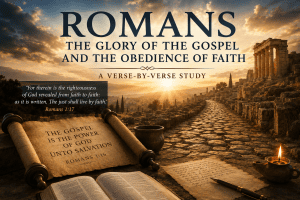
Want to do a deeper dive in the study of Romans? Get my book, Romans: The Glory of the Gospel and the Obedience of Faith, by making your choice of platforms below:
Dr. Alan Holden has served in pastoral ministry for more than 35 years, preaching and teaching the Bible in churches across the United States. He holds a Doctor of Ministry from Luther Rice Seminary and a Master of Divinity from The Southern Baptist Theological Seminary. Through What’s It Mean?, he seeks to help readers understand the meaning of Scripture and grow in their walk with Christ. He is currently the pastor of Lake Saunders Baptist Church in Tavares, FL.