






Money: What’s It Mean?
Key Scriptures: Matthew 6:19–24; Luke 12:15; 1 Timothy 6:6–10, 17–19; 2 Corinthians 9:6–8; Proverbs 3:9–10
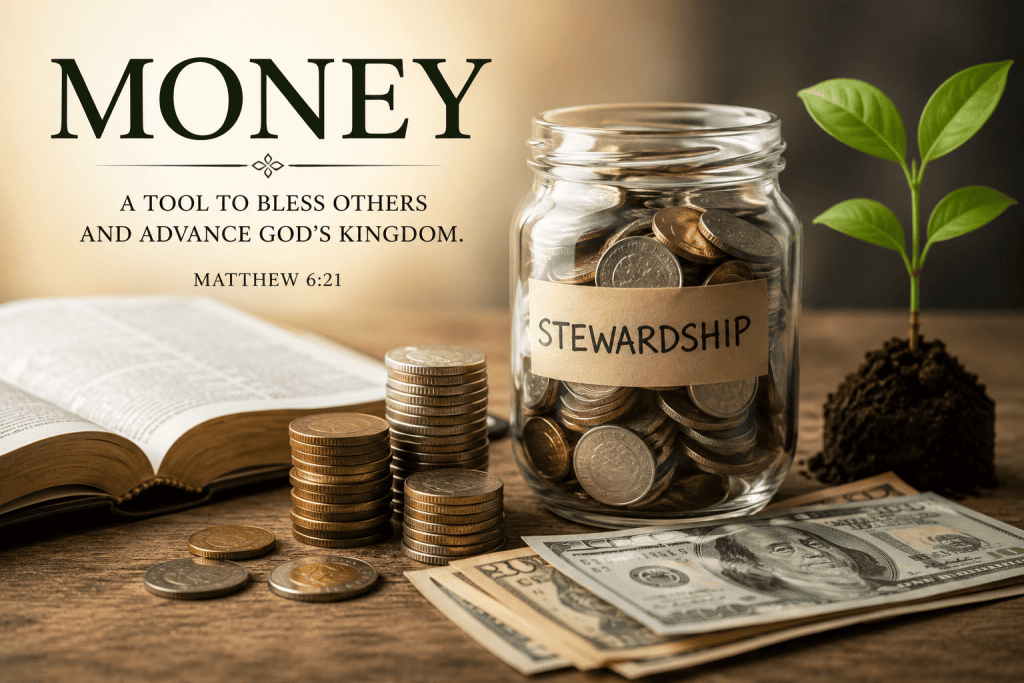
Money touches almost every part of life. We use it to buy food, provide shelter, care for our families, support the church, help people in need, and prepare for the future. Yet few subjects reveal the condition of the human heart as clearly as money.
The Bible has a great deal to say about possessions, wealth, generosity, greed, contentment, and stewardship. Scripture does not teach that money itself is evil. Nor does it teach that poverty automatically makes someone righteous or that wealth proves God’s blessing.
Instead, the Bible teaches us to see money from God’s perspective.
Money is a tool. It can be used wisely or foolishly, generously or selfishly, faithfully or sinfully. The real spiritual issue is not how much money we possess, but whether money possesses us.
Jesus said:
“For where your treasure is, there will your heart be also.”
— Matthew 6:21
Our attitude toward money reveals what we value, what we trust, and ultimately whom we serve.
First, God Owns Everything
Biblical stewardship begins with a simple truth: Everything belongs to God.
Psalm 24:1 declares:
“The earth is the LORD’S, and the fulness thereof; the world, and they that dwell therein.”
We may speak of “my house,” “my car,” “my savings,” or “my money,” but ultimately everything belongs to God. We are temporary managers of what He has placed into our hands.
Even our ability to earn money comes from Him.
Moses warned Israel:
“But thou shalt remember the LORD thy God: for it is he that giveth thee power to get wealth.”
— Deuteronomy 8:18
This changes the Christian’s entire perspective on finances.
Instead of asking, “What do I want to do with my money?” we begin asking, “Lord, what would You have me do with what You have entrusted to me?”
That is stewardship.
Second, Money Is Not Evil
One of the most frequently misquoted verses in Scripture concerns money.
The Bible does not say, “Money is the root of all evil.”
Paul wrote:
“For the love of money is the root of all evil.”
— 1 Timothy 6:10
The problem is not money itself. The problem is the love of money.
Money can feed a hungry family, support a missionary, build a church, purchase Bibles, care for the elderly, educate children, and provide assistance during a crisis.
But money can also become an idol.
When wealth becomes the source of our security, identity, happiness, or purpose, it begins occupying a place that belongs to God.
That is why Jesus warned:
“Ye cannot serve God and mammon.”
— Matthew 6:24
Jesus did not say that we cannot have money. He said we cannot serve both God and money.
One of them will become master.
Third, Money Reveals the Heart
Jesus spoke frequently about money because money reveals what is happening inside us.
Suppose someone suddenly receives an unexpected thousand dollars.
One person immediately thinks, What can I buy?
Another thinks, I need to save this.
Someone else thinks, Now I can pay that bill.
Another thinks, I know someone who needs help.
The money is the same. The difference is the heart.
Jesus told the story of a wealthy farmer whose crops produced abundantly. The man decided to tear down his barns, build larger ones, store his wealth, and spend the coming years enjoying himself.
But God said:
“Thou fool, this night thy soul shall be required of thee.”
— Luke 12:20
The man’s problem was not that he had a successful harvest. His problem was that his entire life had become centered on himself.
Jesus concluded:
“So is he that layeth up treasure for himself, and is not rich toward God.”
— Luke 12:21
There is nothing wrong with planning for tomorrow. The Bible encourages wisdom and preparation. But there is something terribly wrong when we prepare financially for everything except eternity.
Fourth, Work and Money Belong Together
God normally provides for our needs through work.
Paul told the Thessalonians:
“If any would not work, neither should he eat.”
— 2 Thessalonians 3:10
Work allows us to provide for ourselves and our families, but the Christian purpose of work goes even further.
Paul wrote:
“Let him labour, working with his hands the thing which is good, that he may have to give to him that needeth.”
— Ephesians 4:28
Notice the progression.
We work not merely so that we can have, but so that we can give.
That is radically different from the world’s philosophy.
The world often says:
Earn more so you can have more.
Scripture teaches:
Work faithfully, provide responsibly, live wisely, and be ready to share.
Fifth, Learn Contentment
Our culture constantly tells us that we need more.
A larger house.
A newer car.
A better phone.
>More clothes.
>More entertainment.
>More money.
The problem with “more” is that it never tells us when we have enough.
Paul discovered something far more valuable than wealth. He discovered contentment.
“For I have learned, in whatsoever state I am, therewith to be content.”
— Philippians 4:11
Contentment does not mean that ambition is wrong or that we should never improve our circumstances. Contentment means that our joy does not depend upon our circumstances.
Paul wrote:
“But godliness with contentment is great gain.”
— 1 Timothy 6:6
Contentment says:
God has provided for me. He is with me. God knows what I need. My happiness does not depend upon having everything I want.
A contented person can enjoy wealth without worshiping it and endure scarcity without losing faith.
Sixth, Beware of Greed
Jesus gave a direct warning:
“Take heed, and beware of covetousness.”
— Luke 12:15
Covetousness is the uncontrolled desire for what someone else has.
It whispers:
If only I had that, I would be happy.
But once we get “that,” something else quickly takes its place.
Greed has no finish line.
That is why pursuing wealth for its own sake is spiritually dangerous. Paul warned that those who are determined to become rich can fall into temptation and destructive desires (1 Timothy 6:9).
Money makes a terrible god because it continually demands more and never provides lasting satisfaction.
Jesus provides what money never can: forgiveness, peace with God, eternal life, purpose, hope, and a treasure that cannot be taken away.
Seventh, Practice Generosity
One of the clearest signs that money does not control us is generosity.
Paul wrote:
“God loveth a cheerful giver.”
— 2 Corinthians 9:7
Christian giving should not come from manipulation, guilt, or pressure. It flows from gratitude.
We give:
- because God has given to us.</li>
- to support the work of the
- church.
- to spread the Gospel.
- to help people in need.
- because generosity reflects the character of our heavenly Father.
The greatest example of giving is Jesus Christ Himself.
“For ye know the grace of our Lord Jesus Christ, that, though he was rich, yet for your sakes he became poor.”
— 2 Corinthians 8:9
At the cross, Jesus gave Himself for us.
Christian generosity begins there.
We do not give in order to purchase God’s favor. We give because in Christ we have already received grace beyond measure.
Eighth, Handle Money Wisely
Spirituality does not excuse financial foolishness.
The Bible repeatedly encourages wisdom, planning, diligence, honesty, and self-control.
A Christian should seek to:
- Earn money honestly.
- Spend money carefully.
- Avoid unnecessary debt.
- Provide responsibly for family.
- Save wisely when possible.
- Give generously.
- Help those in genuine need.
- Refuse dishonest financial practices.
- Remember that possessions are temporary.
Proverbs 21:20 praises the wisdom of storing resources rather than consuming everything immediately. Proverbs 22:7 warns that the borrower becomes servant to the lender.
Debt is not always presented as sinful, but Scripture clearly recognizes its danger. Debt can reduce freedom and turn tomorrow’s income into payment for yesterday’s decisions.
Financial wisdom often requires learning one simple word:
No:
- I do not need everything I want.
- I do not have to impress other people.
- I do not have to purchase something simply because credit makes it possible.
Sometimes one of the most spiritual financial decisions we can make is to live within our means.
Ninth, Wealth Is Uncertain
Money creates the illusion of security.
A healthy bank account can make us feel protected. But money cannot guarantee tomorrow.
Markets fall. Businesses fail. Jobs disappear. Houses need repairs. Cars break down. Medical bills arrive. Economies change.
Paul instructed wealthy Christians:
“Charge them that are rich in this world, that they be not highminded, nor trust in uncertain riches, but in the living God.”
— 1 Timothy 6:17
Notice the phrase “uncertain riches.”
Money is useful, but uncertain.
God is faithful.
Our savings may help us through difficult circumstances, and wise planning is good stewardship. But our ultimate confidence must never rest in a bank account.
Our security rests in God.
Tenth, You Cannot Take It With You
Eventually every earthly possession changes owners.
Solomon observed:
“As he came forth of his mother’s womb, naked shall he return to go as he came.”
— Ecclesiastes 5:15
No one has ever seen a hearse pulling a moving van.
Everything we accumulate during this life eventually stays behind.
Jesus therefore told His followers:
“Lay up for yourselves treasures in heaven.”
— Matthew 6:20
Earthly treasure is temporary.
Heavenly treasure is eternal.
Every dollar will eventually disappear from our hands. But what we do for the glory of God has eternal significance.
Eleventh, Money and the Gospel
The Gospel transforms our relationship with money because the Gospel transforms our hearts.
Before Christ, we naturally ask:
What belongs to me?
Grace teaches us to ask:
What has God entrusted to me?
Before Christ:
How much can I accumulate?
Grace asks:
How much good can I accomplish with what God has given me?
Before Christ:
My possessions provide my security.
Faith says:
My Father provides for me.
Jesus said:
“Seek ye first the kingdom of God, and his righteousness; and all these things shall be added unto you.”
— Matthew 6:33
That is the Christian approach to money.
God comes first.
Twelveth, What Does Money Mean for the Christian?
Money is a tool, not a master.
It is:
- a trust, not an identity.
- a resource, not our security.
- a temporary possession that can be used for eternal purposes.
God may entrust one believer with much and another with little. The question is not whether we have been given the same amount.
The question is whether we are faithful with what we have been given.
One day we will leave every earthly possession behind. The house, car, savings account, investments, furniture, and belongings will pass to someone else.
But a life invested in the kingdom of God will never be wasted.
So earn honestly.
Spend wisely.
Save responsibly.
Give generously.
Live contentedly.
And above all, trust God completely.
Our treasure does not determine the condition of our hearts.
Our hearts determine what we treasure.
Questions for Reflection
- Do I view my money as mine or as something God has entrusted to me?
- Does my spending reflect my Christian priorities?
- Am I content with what God has provided?
- Is debt limiting my ability to serve God or help others?
- Am I regularly practicing generosity?
- Am I trusting money for security that only God can provide?
- What could I change financially to become a better steward?
Final Thought
Money will always be part of earthly life, but it was never meant to become the purpose of life.
Jesus offers something infinitely greater.
The world says, “Get all you can.”
Jesus says, “Follow Me.”
The world measures wealth by what we possess.
God measures faithfulness by what we do with what He entrusts to us.
Use money. Manage money. Give money. Save money when wisdom allows.
But never worship money.
Money makes a useful servant, but only Jesus deserves to be Lord.
<<Back to the Teaching Library
Dr. Alan Holden has served in pastoral ministry for more than 35 years, preaching and teaching the Bible in churches across the United States. He holds a Doctor of Ministry from Luther Rice Seminary and a Master of Divinity from The Southern Baptist Theological Seminary. Through What’s It Mean?, he seeks to help readers understand the meaning of Scripture and grow in their walk with Christ. He is currently the pastor of Lake Saunders Baptist Church in Tavares, FL.