







Series Theme: Romans: The Gospel of God’s Righteousness, Grace, and Transforming Power.
Primary Scripture: Romans 8:1–39
Key Verses: Romans 8:1, 28, 37–39 (KJV)
Theme: Through Jesus Christ, believers are freed from condemnation, empowered by the Holy Spirit, adopted into God’s family, sustained through suffering, and eternally secure in God’s love.
Central Truth: The Christian’s victory rests not in human strength but in the saving work of Jesus Christ, the power of the Holy Spirit, and the unfailing love of God.
Sermon Prep: Romans 8 Study
Sermon Slide Deck: CLICK HERE to DOWNLOAD
Sermon Length: Approximately 30–35 minutes
1. Suggested Order of Worship
- Welcome and Announcements
- Opening Prayer
- Congregational Hymn — Victory in Jesus
- Scripture Reading — Romans 8:31–39
- Congregational Hymn — Blessed Assurance
- Offertory Scripture and Prayer
- Receiving of Tithes and Offerings
- Special Music or Congregational Hymn — It Is Well with My Soul
- Prayer Before the Sermon
- Sermon — No Condemnation, No Separation
- Invitation Hymn — Just As I Am
- Invitation Prayer
- Benediction
2. Opening Prayer
Heavenly Father,
We come before You this morning with grateful hearts, rejoicing in the wonderful salvation You have provided through Jesus Christ.
Thank You that those who belong to Christ are no longer under condemnation.
Thank You for the Holy Spirit, who lives within Your children, strengthens us in our weakness, and guides us in the paths of righteousness.
Thank You that we can call You our Father and know that we belong to Your family.
Lord, we confess that life is not always easy. We face sickness, disappointment, sorrow, temptation, and uncertainty. Yet Your Word assures us that You are working in all things for the good of those who love You.
Strengthen those who are discouraged. Comfort those who are grieving. Provide for those who are struggling financially. Restore those who are weak in body or spirit.
And remind us that nothing in all creation can separate us from Your love in Jesus Christ.
As we worship today, turn our attention away from our circumstances and toward our Savior.
May our songs bring You praise, our prayers reflect our faith, and our hearts remain open to Your Word.
In Jesus’ name we pray.
Amen.
3. Offertory Scripture and Prayer
Offertory Scripture — Romans 8:32 (KJV)
“He that spared not his own Son, but delivered him up for us all, how shall he not with him also freely give us all things?”
Offertory Prayer
Heavenly Father,
Your Word reminds us that You did not spare Your own Son but gave Him for our salvation.
If You have already given us the greatest gift, we can trust You to provide everything necessary to accomplish Your purposes in our lives.
Thank You for Your daily provision.
Thank You for our homes, our families, our church, and the opportunities You give us to serve others.
As we receive our tithes and offerings, help us give cheerfully, willingly, and gratefully.
May these gifts be used wisely to strengthen this church, minister to those in need, and share the Gospel with people who have never experienced the saving grace of Jesus Christ.
Teach us to trust You not only with our finances but with every part of our lives.
In Jesus’ name we pray.
Amen.
4. Prayer Before the Sermon
Heavenly Father,
As we open Romans chapter 8, we recognize that we are standing before one of the most encouraging passages in all of Scripture.
Your Word begins with the declaration that there is no condemnation for those who are in Jesus Christ.
And it concludes with the promise that nothing can separate us from Your love.
Between those two promises, You remind us of the work of the Holy Spirit, our adoption into Your family, the hope of future glory, and Your sovereign purpose in every circumstance.
Lord, help us understand these wonderful truths.
Give us clarity of mind, humility of heart, and a willingness to obey.
Encourage believers who are struggling.
Strengthen those who are weary.
And speak to those who have never trusted Jesus Christ as Savior.
May Your Holy Spirit use Your Word to transform our hearts and bring glory to Your name.
In Jesus’ name we pray.
Amen.
5. Sermon Manuscript
No Condemnation, No Separation: The Victorious Life in Christ
Romans 8:1–39
Introduction: From the Struggle to the Victory
Have you ever watched a sporting event when everything seemed hopeless?
Perhaps a football team was behind by several touchdowns.
The clock was running out.
The opposing team appeared to have complete control.
And everyone assumed the game was over.
But then something remarkable happened.
The team began making a comeback.
One successful play led to another.
The momentum changed.
And before the game ended, what appeared to be certain defeat became an unexpected victory.
Now, the Christian life is not a football game.
But there is something about that illustration that reminds us of the transition between Romans 7 and Romans 8.
In Romans 7, Paul described the struggle with sin.
He recognized the goodness of God’s law.
He understood what was right.
But he also recognized the weakness of human flesh.
Finally, he cried out in Romans 7:24:
“O wretched man that I am! who shall deliver me from the body of this death?”
Then came the answer.
Romans 7:25:
“I thank God through Jesus Christ our Lord.”
That answer prepares us for Romans chapter 8.
Romans 8 is one of the greatest chapters in the entire Bible.
It begins with no condemnation.
It ends with no separation.
And between those two glorious promises, Paul explains how believers can live with confidence, hope, and assurance through Jesus Christ.
Notice something remarkable about this chapter.
Paul does not promise that Christians will never suffer.
He does not say that believers will never struggle.
And he certainly does not teach that following Christ will eliminate every difficulty.
Instead, he explains why Christians can possess confidence even in the middle of life’s greatest challenges.
Our confidence is not based upon our circumstances.
It is based upon our relationship with Jesus Christ.
Today, I want us to consider five wonderful truths from Romans chapter 8.
I. In Christ, We Are Free from Condemnation (Romans 8:1–4)
Paul begins with one of the most comforting declarations in Scripture.
Romans 8:1 says:
“There is therefore now no condemnation to them which are in Christ Jesus…”
Think about those words.
No condemnation.
Not less condemnation.
Not temporary condemnation.
No condemnation.
A. Condemnation Has Been Removed
In a courtroom, condemnation is the declaration that a person stands guilty and deserves punishment.
That was our condition before salvation.
We were sinners.
We had violated God’s righteous standards.
And we deserved judgment.
Romans 3:23 says:
“For all have sinned, and come short of the glory of God;”
But Jesus Christ came into the world to save sinners.
He lived a sinless life.
He died upon the cross.
And He rose from the grave.
Through faith in Him, believers are justified before God.
Our guilt has been addressed through the saving work of Jesus Christ.
B. The Freedom Comes Through Jesus Christ
Romans 8:2 says:
“For the law of the Spirit of life in Christ Jesus hath made me free from the law of sin and death.”
Paul is describing a new spiritual reality.
Through Christ, believers have been freed from the condemning power of sin and death.
We are no longer under the sentence of condemnation.
We belong to Jesus Christ.
C. God Accomplished What the Law Could Not
Romans 8:3 explains:
“For what the law could not do, in that it was weak through the flesh, God sending his own Son in the likeness of sinful flesh, and for sin, condemned sin in the flesh:”
God’s law could reveal sin.
It could identify wrongdoing.
And it could expose our guilt.
But it could not save us.
The weakness was not in God’s law.
The weakness was in our sinful humanity.
So God did what we could never do for ourselves.
He sent His Son.
And through Jesus Christ, He provided salvation.
Illustration: The Canceled Debt
Imagine receiving a letter informing you that you owe an enormous debt.
The amount is far beyond anything you could ever repay.
Every month, the debt increases.
You have no realistic hope of satisfying the obligation.
Then someone steps forward and pays the debt completely.
You receive a second letter.
This one says:
“Paid in Full.”
There is nothing left to pay.
The obligation has been satisfied.
That illustrates what Jesus Christ has accomplished for those who trust Him.
Our salvation is not based upon our ability to pay for our sins.
Jesus paid the price.
Application
Perhaps you are carrying guilt from something in your past.
You have confessed your sin.
You have trusted Jesus Christ.
But you continue living as though God has not forgiven you.
Remember Romans 8:1.
If you belong to Jesus Christ, you are no longer under condemnation.
This does not mean that sin is unimportant.
God still disciplines His children.
And the Holy Spirit still convicts us when we disobey.
But conviction is not the same as condemnation.
Conviction leads us toward repentance and restoration.
Condemnation declares guilt and punishment.
In Jesus Christ, the believer’s condemnation has been removed.
The Christian’s confidence begins with this wonderful truth: In Christ, there is no condemnation.
II. Through the Holy Spirit, We Have New Life (Romans 8:5–13)
Paul now explains the difference between living according to the flesh and living according to the Spirit.
Romans 8:5 says:
“For they that are after the flesh do mind the things of the flesh; but they that are after the Spirit the things of the Spirit.”
A. The Flesh and the Spirit Represent Opposing Directions
In this passage, the flesh refers to fallen human nature operating apart from the Spirit of God.
The person controlled by the flesh lives according to sinful desires.
The person who belongs to Christ has received the Holy Spirit and is called to live under His influence.
Romans 8:6 says:
“For to be carnally minded is death; but to be spiritually minded is life and peace.”
Paul presents a clear contrast.
The flesh leads toward death.
The Spirit produces life and peace.
B. Every Believer Has the Holy Spirit
Romans 8:9 says:
“Now if any man have not the Spirit of Christ, he is none of his.”
The Holy Spirit is not reserved for a special class of Christians.
Every person who truly belongs to Jesus Christ has the Holy Spirit.
He lives within us.
He convicts us of sin.
He helps us understand God’s Word.
And He strengthens us to obey.
C. The Spirit Gives Us Power to Resist Sin
Romans 8:13 says:
“For if ye live after the flesh, ye shall die: but if ye through the Spirit do mortify the deeds of the body, ye shall live.”
Notice the phrase “through the Spirit.”
Paul does not tell believers to overcome sin through human determination alone.
He tells us that the Holy Spirit enables us to put sinful practices to death.
We still have responsibilities.
We must resist temptation.
We must obey God’s Word.
And we must turn away from sinful habits.
But the power for Christian living comes from the Holy Spirit.
Illustration: The Sailboat
Imagine a sailboat sitting in the middle of a lake.
The boat is well constructed.
The sails are raised.
And the sailor understands where he wants to go.
But without wind, the boat makes little progress.
Then the wind begins to blow.
The sails fill.
And the boat begins moving across the water.
The sailor must still guide the boat.
But the power that moves it comes from the wind.
In a similar way, Christians must obey God’s Word and make godly decisions.
But the power for spiritual transformation comes from the Holy Spirit.
Application
Are you attempting to live the Christian life entirely through your own strength?
Perhaps you are struggling with anger.
Bitterness.
Pride.
Fear.
Or a persistent temptation.
Do not imagine that determination alone will produce lasting spiritual victory.
Turn to God in prayer.
Study His Word.
Surrender yourself to His will.
And depend upon the Holy Spirit.
The Christian life is not merely a life of trying harder. It is a life of depending upon the Holy Spirit.
III. As God’s Children, We Have a Glorious Hope (Romans 8:14–25)
Paul now moves from the work of the Spirit to the wonderful privilege of belonging to God’s family.
Romans 8:14 says:
“For as many as are led by the Spirit of God, they are the sons of God.”
A. We Have Been Adopted into God’s Family
Romans 8:15 says:
“For ye have not received the spirit of bondage again to fear; but ye have received the Spirit of adoption, whereby we cry, Abba, Father.”
Through Jesus Christ, believers have been adopted into God’s family.
We are not merely forgiven criminals.
We are God’s children.
We can approach Him as our heavenly Father.
And we can know that He loves us.
B. We Are Heirs with Christ
Romans 8:17 says:
“And if children, then heirs; heirs of God, and joint-heirs with Christ…”
Think about that promise.
We are heirs of God.
Our future is connected to Jesus Christ.
We have the promise of eternal life.
And we will share in the glory of our risen Savior.
C. Present Suffering Cannot Compare with Future Glory
Romans 8:18 says:
“For I reckon that the sufferings of this present time are not worthy to be compared with the glory which shall be revealed in us.”
Paul knew something about suffering.
He experienced persecution.
Imprisonment.
Opposition.
Physical hardship.
And rejection.
Yet he declared that present suffering cannot compare with the glory awaiting God’s children.
That does not mean suffering is insignificant.
Pain is real.
Grief is real.
And hardship can be overwhelming.
But Paul reminds us that suffering is temporary.
The glory awaiting believers is eternal.
D. Creation Itself Awaits Redemption
Romans 8:22 says:
“For we know that the whole creation groaneth and travaileth in pain together until now.”
Sin has affected the entire creation.
The world is marked by decay, suffering, and death.
But God has promised a future restoration.
One day, the effects of sin will be removed.
God’s people will experience the fullness of redemption, including the resurrection of their bodies.
Illustration: The Long Journey Home
Imagine someone traveling a long distance to return home.
The journey is difficult.
The roads are rough.
The weather is unpleasant.
And the traveler becomes tired.
But he continues because he knows what awaits him.
At the end of the journey, he will be home.
He will be reunited with loved ones.
And the difficulties of the road will be behind him.
That illustrates the Christian’s hope.
We are traveling through a world marked by suffering.
But this world is not our final home.
We are moving toward the glory God has promised.
Application
Perhaps you are experiencing suffering today.
You may be dealing with illness.
Grief.
Financial uncertainty.
Family difficulties.
Or disappointment.
Romans 8 does not tell you that your pain is imaginary.
It reminds you that your suffering is not the end of the story.
You belong to God.
You are His child.
And a glorious future awaits you.
Our present suffering is real, but our future glory is greater.
IV. God Is Working in All Things for Our Good (Romans 8:26–30)
Now we come to one of the most familiar promises in Scripture.
Romans 8:28 says:
“And we know that all things work together for good to them that love God, to them who are the called according to his purpose.”
This verse has comforted countless Christians through difficult circumstances.
But we must understand what Paul is saying.
A. The Holy Spirit Helps Us in Our Weakness
Romans 8:26 says:
“Likewise the Spirit also helpeth our infirmities: for we know not what we should pray for as we ought…”
Sometimes we do not know how to pray.
We face circumstances that are too complicated.
We feel overwhelmed.
And we cannot find the right words.
But the Holy Spirit helps us.
He intercedes for believers according to the will of God.
What a wonderful assurance!
Even when we do not know what to pray, God has not abandoned us.
B. God Works Through All Circumstances
Romans 8:28 does not say that all things are good.
Sickness is not good.
Death is not good.
Sin is not good.
And suffering is not good in itself.
But God is able to work through all circumstances to accomplish His purposes.
He is never surprised.
He is never confused.
And He is never powerless.
C. God’s Purpose Is to Make Us Like Christ
Romans 8:29 says:
“For whom he did foreknow, he also did predestinate to be conformed to the image of his Son…”
Here Paul explains the good toward which God is working.
His purpose is to conform believers to the image of Jesus Christ.
Sometimes we define good as comfort.
We want an easy life.
We want financial security.
We want good health.
And we want freedom from difficulty.
Those desires are understandable.
But God’s ultimate purpose is greater than our comfort.
He is making us more like Jesus Christ.
D. God’s Saving Purpose Will Be Completed
Romans 8:30 says:
“Moreover whom he did predestinate, them he also called: and whom he called, them he also justified: and whom he justified, them he also glorified.”
Paul describes the certainty of God’s saving purpose.
Notice that he speaks of glorification as though it has already been accomplished.
That emphasizes the certainty of what God has promised.
The God who begins the work of salvation will bring His people to their promised glory.
Illustration: The Master Weaver
Imagine watching someone weave a beautiful tapestry.
From the back, the threads appear tangled.
The colors seem confusing.
And the pattern is difficult to understand.
But when the tapestry is turned around, a beautiful design appears.
What seemed confusing from one perspective makes sense from another.
Our lives sometimes resemble the back of that tapestry.
We see disappointment.
Suffering.
Unanswered questions.
And circumstances we cannot understand.
But God sees the whole picture.
He is working according to His wisdom and purpose.
Application
Perhaps something has happened in your life that you cannot explain.
You have prayed.
You have sought God’s guidance.
And you still do not understand.
Romans 8:28 does not promise that you will understand everything.
It promises that God is working.
You can trust His wisdom.
You can trust His goodness.
And you can trust His purpose.
God does not promise that every circumstance will be pleasant. He promises that no circumstance is beyond His ability to accomplish His purpose.
V. Nothing Can Separate Us from the Love of God (Romans 8:31–39)
Paul concludes Romans 8 with one of the most magnificent declarations in the entire Bible.
Romans 8:31 says:
“What shall we then say to these things? If God be for us, who can be against us?”
A. God Has Already Given Us His Greatest Gift
Romans 8:32 says:
“He that spared not his own Son, but delivered him up for us all, how shall he not with him also freely give us all things?”
Paul directs our attention to the cross.
God has already demonstrated His love by giving His Son.
If He has provided our greatest need, we can trust Him with everything else.
B. No Accusation Can Overturn God’s Justification
Romans 8:33 says:
“Who shall lay any thing to the charge of God’s elect? It is God that justifieth.”
Satan is called the accuser of the brethren.
Our consciences may remind us of past failures.
And other people may criticize or condemn us.
But no accusation can overturn the justification God has granted through Jesus Christ.
C. Jesus Christ Intercedes for Us
Romans 8:34 says:
“Who is he that condemneth? It is Christ that died, yea rather, that is risen again, who is even at the right hand of God, who also maketh intercession for us.”
Think about that wonderful truth.
Jesus Christ died for us.
He rose from the grave.
He sits at the right hand of God.
And He intercedes for His people.
Our Savior has not abandoned us.
He continues to represent us before the Father.
D. Trouble Cannot Separate Us from God’s Love
Romans 8:35 says:
“Who shall separate us from the love of Christ? shall tribulation, or distress, or persecution, or famine, or nakedness, or peril, or sword?”
Paul lists some of the most difficult experiences imaginable.
Trouble.
Distress.
Persecution.
Hunger.
Danger.
And even death.
But none of these things can separate believers from the love of Jesus Christ.
E. We Are More Than Conquerors
Romans 8:37 says:
“Nay, in all these things we are more than conquerors through him that loved us.”
Notice that Paul does not say we avoid all these things.
He says we are more than conquerors in them.
Christian victory does not mean the absence of suffering.
It means that suffering cannot defeat God’s saving purpose.
F. Nothing Can Separate Us from God’s Love
Romans 8:38–39 says:
“For I am persuaded, that neither death, nor life, nor angels, nor principalities, nor powers, nor things present, nor things to come,”
“Nor height, nor depth, nor any other creature, shall be able to separate us from the love of God, which is in Christ Jesus our Lord.”
What a wonderful conclusion!
Death cannot separate us.
Life cannot separate us.
Angels cannot separate us.
Powers cannot separate us.
The present cannot separate us.
The future cannot separate us.
Nothing in all creation can separate God’s children from His love in Jesus Christ.
Illustration: The Father’s Hand
Imagine a father walking with his young child beside a busy road.
The child reaches up and takes his father’s hand.
But the child is small.
His grip is weak.
And he may become distracted.
The father’s grip, however, is strong.
He holds his child securely.
The child’s safety does not depend entirely upon the strength of his little hand.
It depends upon the strength of the father who holds him.
That illustrates the believer’s security in Jesus Christ.
Our assurance is not based upon the strength of our grip on God.
It is based upon the faithfulness of the God who holds us.
Application
Perhaps you are afraid of the future.
You wonder what will happen to your health.
Your family.
Your finances.
Or your church.
You cannot know everything tomorrow will bring.
But you can know this:
If you belong to Jesus Christ, nothing can separate you from God’s love.
The Christian’s security rests not in the strength of our faith, but in the faithfulness of our Savior.
Sermon Conclusion: No Condemnation, No Separation
Romans chapter 8 begins with a wonderful declaration.
“There is therefore now no condemnation to them which are in Christ Jesus…”
And it ends with an equally wonderful promise.
Nothing can separate us from the love of God in Jesus Christ.
Between those two promises, Paul reminds us of everything God has provided.
We have freedom from condemnation.
We have the indwelling Holy Spirit.
We have been adopted into God’s family.
We have the hope of future glory.
We have the assurance of God’s sovereign purpose.
And we have the promise of His unfailing love.
Think about the five truths we have considered.
First, in Christ, we are free from condemnation.
Second, through the Holy Spirit, we have new life.
Third, as God’s children, we have a glorious hope.
Fourth, God is working in all things for our good.
And fifth, nothing can separate us from the love of God.
Now, let me ask you a question.
Do you have that assurance?
Perhaps you are facing a difficult situation.
You may be discouraged.
You may be worried about the future.
Or perhaps you are struggling with guilt from your past.
If you belong to Jesus Christ, remember that there is no condemnation.
God has forgiven your sins.
He has given you His Holy Spirit.
And He has promised never to abandon you.
Perhaps you have never trusted Jesus Christ as your personal Lord and Savior.
You cannot claim these promises merely because you attend church or try to live a good life.
These promises belong to those who are in Jesus Christ.
But today, you can turn to Him in repentance and faith.
You can receive forgiveness.
You can become a child of God.
And you can possess the assurance of eternal life.
For those of us who already know Christ, let us live with confidence.
Not confidence in ourselves.
But confidence in our Savior.
We may face trouble.
We may experience suffering.
We may struggle with temptation.
But our salvation rests in the hands of Almighty God.
And nothing can separate us from His love.
Romans 8 begins with no condemnation, ends with no separation, and assures us of victory through Jesus Christ.
Amen.
6. Closing Invitation
As we prepare to sing Just As I Am, I want to invite you to respond to the truth of God’s Word.
Perhaps you have never trusted Jesus Christ as your personal Lord and Savior.
Romans 8 begins with the promise that there is no condemnation for those who are in Christ.
But that raises an important question.
Are you in Christ?
Have you turned from your sins and trusted Him as your Savior?
Jesus Christ died for your sins.
He rose from the grave.
And He offers forgiveness and eternal life to everyone who believes.
You can receive that gift today.
Perhaps you are already a Christian, but you have been living in fear.
You may be struggling with guilt.
You may be discouraged by suffering.
Or you may be worried about the future.
Remember the promises of Romans 8.
There is no condemnation.
The Holy Spirit lives within you.
God is working according to His purpose.
And nothing can separate you from His love.
Whatever the Lord is speaking to your heart, respond to Him today.
7. Invitation Prayer
Heavenly Father,
Thank You for the wonderful promises of Romans chapter 8.
Thank You that those who belong to Jesus Christ are no longer under condemnation.
Thank You for the Holy Spirit, who lives within us and strengthens us in our weakness.
Thank You that we are Your children and heirs of Your eternal promises.
And thank You that nothing can separate us from Your love.
Forgive us when we allow fear, worry, or discouragement to control our thoughts.
Help us trust Your wisdom.
Help us depend upon Your Spirit.
And help us remember that our future is secure in Jesus Christ.
For anyone who has never trusted Jesus Christ as Savior, I pray that today would be the day of salvation.
In Jesus’ name we pray.
Amen.
8. Benediction
Romans 8:37–39 (KJV)
“Nay, in all these things we are more than conquerors through him that loved us.”
“For I am persuaded, that neither death, nor life, nor angels, nor principalities, nor powers, nor things present, nor things to come,”
“Nor height, nor depth, nor any other creature, shall be able to separate us from the love of God, which is in Christ Jesus our Lord.”
May the grace of our Lord Jesus Christ strengthen your hearts.
May the Holy Spirit guide your steps.
And may the unfailing love of God fill you with peace, confidence, and hope.
Go into the world remembering that in Christ there is no condemnation, and in His love there is no separation.
Amen.
9. Sermon Outline for the Bulletin
No Condemnation, No Separation: The Victorious Life in Christ
Central Truth: The Christian’s victory rests in the saving work of Jesus Christ, the power of the Holy Spirit, and the unfailing love of God.
| Sermon Point | Scripture |
| I. In Christ, We Are Free from Condemnation | Romans 8:1–4 |
| II. Through the Holy Spirit, We Have New Life | Romans 8:5–13 |
| III. As God’s Children, We Have a Glorious Hope | Romans 8:14–25 |
| IV. God Is Working in All Things for Our Good | Romans 8:26–30 |
| V. Nothing Can Separate Us from the Love of God | Romans 8:31–39 |
Take-Home Truth: Romans 8 begins with no condemnation, ends with no separation, and assures us of victory through Jesus Christ.
10. Questions for Reflection and Discussion
- What does Paul mean when he declares that there is no condemnation for those who are in Jesus Christ?
- How does the Holy Spirit change the way believers live?
- What is the difference between living according to the flesh and living according to the Spirit?
- What does it mean to be adopted into God’s family?
- How should the promise of future glory influence our response to present suffering?
- How does the Holy Spirit help us when we do not know how to pray?
- What does Romans 8:28 promise, and what does it not promise?
- According to Romans 8:29, what is God’s ultimate purpose in the lives of believers?
- How does Christ’s intercession strengthen our assurance of salvation?
- Why can believers be confident that nothing will separate them from the love of God?
11. Pastoral Teaching Notes
Romans 8 is the theological and pastoral climax of Paul’s teaching about justification, sanctification, and assurance in Romans 1–8.
Several themes deserve special attention.
First, Romans 8:1–4 emphasizes the believer’s freedom from condemnation. Justification is God’s declaration that believers are righteous in His sight through faith in Jesus Christ. The saving work of Christ has addressed the guilt and penalty of sin.
Second, Romans 8:5–13 describes the contrast between the flesh and the Spirit. The Holy Spirit indwells every genuine believer and enables Christians to pursue holiness. This passage should be preached as a call to Spirit-empowered obedience rather than self-reliant moral improvement.
Third, Romans 8:14–17 teaches adoption into God’s family. Believers are not merely forgiven sinners. They are God’s children, possessing the privilege of calling Him Father and the promise of an eternal inheritance.
Fourth, Romans 8:18–25 places present suffering in the context of future glory. Paul acknowledges the reality of suffering while directing believers toward the certainty of bodily resurrection and the final restoration of creation.
Fifth, Romans 8:26–27 explains the intercessory ministry of the Holy Spirit. The Spirit helps believers in their weakness and intercedes according to God’s will. This truth provides encouragement when Christians struggle to find words in prayer.
Sixth, Romans 8:28–30 must be interpreted in light of God’s ultimate purpose. The promised good is not necessarily immediate comfort, prosperity, or relief from suffering. God’s purpose is to conform His people to the image of Jesus Christ and bring them to final glory.
Seventh, Romans 8:31–39 provides one of Scripture’s strongest statements of assurance. No accusation, hardship, spiritual power, or created thing can overturn God’s saving work or separate His people from His love in Jesus Christ.
Eighth, the entire chapter should be presented as a message of Christ-centered confidence. The believer’s assurance does not rest upon personal strength, emotional stability, or favorable circumstances. It rests upon God’s saving grace, the ministry of the Holy Spirit, and the finished work of Jesus Christ.
A memorable sentence for the sermon:
Romans 8 begins with no condemnation, ends with no separation, and assures us of victory through Jesus Christ.
<<Back to Romans 7 Sermon Outline OR Forward to Romans 9 Sermon Outline>>
<<Back to Romans Sermon Outlines OR <<Back to Sermon Resources
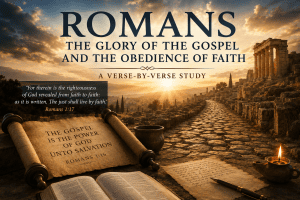
Want to do a deeper dive in the study of Romans? Get my book, Romans: The Glory of the Gospel and the Obedience of Faith, by making your choice of platforms below:
Dr. Alan Holden has served in pastoral ministry for more than 35 years, preaching and teaching the Bible in churches across the United States. He holds a Doctor of Ministry from Luther Rice Seminary and a Master of Divinity from The Southern Baptist Theological Seminary. Through What’s It Mean?, he seeks to help readers understand the meaning of Scripture and grow in their walk with Christ. He is currently the pastor of Lake Saunders Baptist Church in Tavares, FL.