







Series Theme: Romans: The Gospel of God’s Righteousness, Grace, and Transforming Power.
Key Verse: Romans 1:16 (KJV)
“For I am not ashamed of the gospel of Christ: for it is the power of God unto salvation to every one that believeth; to the Jew first, and also to the Greek.”
Theme: The Gospel reveals God’s righteousness, exposes humanity’s sin, and offers salvation to everyone who believes in Jesus Christ.
Central Truth: Humanity’s greatest problem is sin, and God’s only remedy is the saving power of the Gospel of Jesus Christ.
Sermon Preparation: Romans 1 The Gospel Revealed–The Power of God for Salvation
Sermon Slide Deck: CLICK HERE TO DOWNLOAD
Sermon Length: Approximately 30 minutes
1. Suggested Order of Worship
- Welcome and Announcements
- Opening Prayer
- Congregational Hymn — To God Be the Glory
- Scripture Reading — Romans 1:14–20
- Congregational Hymn — Amazing Grace
- Offertory Scripture and Prayer
- Receiving of Tithes and Offerings
- Special Music or Congregational Hymn — There Is Power in the Blood
- Prayer Before the Sermon
- Sermon — The Gospel: God’s Power to Save
- Invitation Hymn — Just As I Am
- Invitation Prayer
- Benediction
2. Opening Prayer
Heavenly Father,
We come into Your presence this morning with grateful hearts.
Thank You for the privilege of gathering together to worship You.
Thank You for Your goodness, mercy, and faithfulness.
Above all, thank You for the Gospel of Jesus Christ.
We recognize that we could never save ourselves.
Our good works cannot remove our sins.
Our religious activities cannot make us righteous.
And our best efforts cannot earn eternal life.
But in Your great love, You sent Your Son, Jesus Christ, to die upon the cross for our sins.
Through His death and resurrection, You have provided salvation for everyone who believes.
Lord, as we worship today, remind us of the greatness of Your grace.
Strengthen those who are discouraged.
Comfort those who are grieving.
Help those who are facing sickness, financial difficulties, or family concerns.
And draw those who do not know Jesus Christ into a saving relationship with Him.
May everything we say and do today bring honor and glory to Your name.
In Jesus’ name we pray.
Amen.
3. Offertory Scripture and Prayer
Scripture: 2 Corinthians 9:7 (KJV)
“Every man according as he purposeth in his heart, so let him give; not grudgingly, or of necessity: for God loveth a cheerful giver.”
Offertory Prayer
Heavenly Father,
We thank You for the many ways You have blessed us.
You have provided for our needs, sustained us through difficult seasons, and given us opportunities to serve others.
Most importantly, You have given us the greatest gift of all—salvation through Jesus Christ.
As we receive our tithes and offerings this morning, help us give with grateful and generous hearts.
May these gifts support the ministry of this church, provide assistance to those in need, and help carry the Gospel to our community and beyond.
Teach us to be faithful stewards of everything You have entrusted to us.
And may our giving reflect our love for You and our concern for others.
In Jesus’ name we pray.
Amen.
4. Prayer Before the Sermon
Father,
As we open the first chapter of Romans, we ask You to prepare our hearts to receive Your Word.
Help us understand the seriousness of sin and the greatness of Your salvation.
Remind us that the Gospel is not merely a religious message or a collection of moral teachings.
It is the power of God unto salvation.
Give us courage to proclaim the truth of Jesus Christ without shame.
Give us compassion for those who do not know Him.
And give us humility to recognize that we stand before You only because of Your grace.
May Your Holy Spirit guide our understanding and apply these truths to our lives.
In Jesus’ name we pray.
Amen.
5. Sermon Manuscript
The Gospel: God’s Power to Save
Romans 1:1–32
Introduction: The Most Important Message in the World
If you could deliver one message to every person in the world, what would it be?
Would you tell them how to become wealthy?
How to enjoy better health?
How to build stronger relationships?
Or how to live a happier life?
Those are important subjects.
But none of them addresses humanity’s greatest need.
Our greatest problem is not poverty.
It is not sickness.
It is not political instability.
It is not even death itself.
Our greatest problem is sin.
Sin separates us from God.
Sin corrupts our thinking.
Sin damages our relationships.
And sin brings us under the judgment of a holy and righteous God.
But there is good news.
God has provided a remedy.
That remedy is the Gospel of Jesus Christ.
And that is the central message of the book of Romans.
The Apostle Paul wrote Romans to explain the Gospel clearly and systematically.
He wanted believers to understand why salvation is necessary, how God provides it, and how the Gospel transforms our lives.
Romans is one of the most important books in the New Testament.
It explains the righteousness of God.
The universal problem of sin.
Justification by faith.
The transforming work of the Holy Spirit.
God’s faithfulness to His promises.
And the practical responsibilities of Christian living.
But everything begins with the Gospel.
Romans 1:16 declares:
“For I am not ashamed of the gospel of Christ: for it is the power of God unto salvation to every one that believeth; to the Jew first, and also to the Greek.”
Today, I want us to consider five truths from Romans chapter 1.
I. The Gospel Is God’s Good News About Jesus Christ (Romans 1:1–7)
Paul begins his letter by identifying himself.
Romans 1:1 says:
“Paul, a servant of Jesus Christ, called to be an apostle, separated unto the gospel of God.”
Notice how Paul describes himself.
He is a servant of Jesus Christ.
He is called to be an apostle.
And he is separated unto the Gospel of God.
The Gospel Belongs to God
Paul does not claim that he invented the Gospel.
He does not describe it as his personal philosophy.
He calls it the Gospel of God.
The Gospel originates with God.
It is His plan.
His message.
His provision for salvation.
And His revelation of grace through Jesus Christ.
The word gospel means good news.
But good news about what?
Romans 1:3 answers that question.
The Gospel concerns God’s Son, Jesus Christ.
The Gospel Centers Upon Jesus
Paul explains that Jesus Christ came as a descendant of David according to the flesh.
This connects Jesus to the promises God made in the Old Testament.
The Messiah would come through David’s royal line.
Then Romans 1:4 declares:
“And declared to be the Son of God with power, according to the spirit of holiness, by the resurrection from the dead:”
The resurrection publicly demonstrated the power and identity of Jesus Christ.
Jesus was not merely a religious teacher.
He was not simply a moral example.
He is the Son of God.
He died for our sins.
And He rose victoriously from the grave.
The Gospel Is Not Good Advice
Sometimes people treat Christianity as though it were merely a collection of helpful suggestions.
Be kind.
Help others.
Tell the truth.
Live responsibly.
Those are worthwhile principles.
But they are not the Gospel.
The Gospel is not primarily advice about what we must do.
It is good news about what God has done through Jesus Christ.
Illustration: The Rescue
Imagine someone trapped in a burning building.
Smoke fills the hallways.
The exits are blocked.
The person cannot escape.
Now imagine a firefighter standing outside shouting instructions about how to become a better person.
That would not solve the problem.
The trapped person needs someone to rescue him.
That is what Jesus Christ has done for sinners.
We could not save ourselves.
So God sent His Son to rescue us.
Application
When you think about Christianity, what comes to mind?
Religious activities?
Church traditions?
Moral responsibilities?
Those things have their place.
But the center of Christianity is Jesus Christ.
Our faith rests upon who He is and what He has accomplished.
The Gospel is not the story of humanity reaching up to God. It is the story of God reaching down to save humanity through Jesus Christ.
II. The Gospel Must Be Proclaimed Without Shame (Romans 1:8–17)
Paul now expresses his desire to visit the Christians in Rome.
He thanks God for their faith.
He prays for them.
And he longs to strengthen and encourage them.
But his greatest desire is to preach the Gospel.
Paul’s Obligation
Romans 1:14 says:
“I am debtor both to the Greeks, and to the Barbarians; both to the wise, and to the unwise.”
Paul understood that God had entrusted him with a responsibility.
He had received the Gospel.
And he was obligated to proclaim it.
He did not believe that salvation was intended for one social class, nationality, or educational level.
The Gospel was for everyone.
Paul’s Readiness
Romans 1:15 says:
“So, as much as in me is, I am ready to preach the gospel to you that are at Rome also.”
Paul was eager to proclaim Christ.
He knew that Rome was the center of political and cultural power.
He understood that preaching Christ could bring ridicule, opposition, and persecution.
But he was ready.
Paul’s Confidence
Then comes one of the greatest declarations in Scripture.
Romans 1:16 says:
“For I am not ashamed of the gospel of Christ: for it is the power of God unto salvation to every one that believeth…”
Why was Paul unashamed?
Because he knew the power of the Gospel.
He had experienced it personally.
Before his conversion, Paul persecuted Christians.
He opposed the church.
He believed he was serving God by attempting to destroy the followers of Jesus.
But on the road to Damascus, he encountered the risen Christ.
His life was transformed.
The persecutor became a preacher.
The enemy of the church became one of its greatest missionaries.
The Gospel Has Power to Save
Paul says the Gospel is the power of God unto salvation.
Not merely a message about salvation.
It is the means through which God brings salvation to those who believe.
The Gospel has power to forgive sins.
Transform lives.
Reconcile sinners to God.
And give eternal life.
Illustration: The Cure
Imagine a physician discovering a cure for a deadly disease.
He knows the treatment works.
He knows people are dying.
But he refuses to tell anyone because he is afraid they might criticize him.
We would consider that a terrible failure of responsibility.
Christians possess a message far more important than any medical discovery.
We know the way of salvation.
We know the Savior.
And we have been commanded to share the good news.
Application
Are you ashamed of the Gospel?
Perhaps you would never say that openly.
But do you hesitate to speak about Jesus Christ?
Do you avoid conversations about salvation because you fear rejection?
Do you remain silent when God gives you an opportunity to witness?
Remember Paul’s words.
“I am not ashamed.”
We should never be embarrassed by the message that saved us.
The Righteousness of God Revealed
Romans 1:17 says:
“For therein is the righteousness of God revealed from faith to faith: as it is written, The just shall live by faith.”
The Gospel reveals how God provides righteousness for sinners while remaining perfectly righteous Himself.
We cannot earn that righteousness through our own efforts.
We receive it through faith in Jesus Christ.
The Gospel is too important to keep to ourselves and too powerful to be ashamed of.
III. Humanity Is Accountable to God Because He Has Revealed Himself (Romans 1:18–20)
Now Paul’s message takes a serious turn.
After announcing the good news of salvation, he begins explaining why salvation is necessary.
Romans 1:18 says:
“For the wrath of God is revealed from heaven against all ungodliness and unrighteousness of men, who hold the truth in unrighteousness;”
That is not a popular subject.
People enjoy hearing about God’s love.
His mercy.
His grace.
And His blessings.
But many become uncomfortable when we speak about God’s wrath.
Yet the Bible teaches that God is perfectly holy and righteous.
Therefore, He must oppose sin.
God’s Wrath Is His Righteous Opposition to Evil
God’s wrath is not an uncontrolled emotional outburst.
It is His holy and righteous response to sin.
God is not indifferent toward evil.
He does not overlook wickedness as though it were unimportant.
He is a righteous Judge.
And His judgment is just.
God Has Revealed Himself Through Creation
Romans 1:19–20 explains that God has made His existence and power evident through the created world.
Verse 20 says:
“For the invisible things of him from the creation of the world are clearly seen, being understood by the things that are made, even his eternal power and Godhead; so that they are without excuse:”
Look at the world around us.
The order of the universe.
The complexity of living things.
The beauty of creation.
The remarkable systems that sustain life.
Creation bears witness to God’s eternal power and divine nature.
This does not mean that creation reveals everything necessary for salvation.
We need the Gospel to know the saving work of Jesus Christ.
But creation reveals enough to establish humanity’s accountability before God.
Illustration: The Painting
Imagine walking into a museum and seeing a beautiful painting.
The colors are carefully arranged.
The details are remarkable.
The composition is skillful.
Would you assume that the painting appeared by accident without an artist?
Of course not.
You would recognize evidence of creative intelligence.
In a far greater way, the created world points beyond itself to its Creator.
Application
We should approach creation with gratitude and humility.
The world around us is not merely something to use or enjoy.
It is also a reminder of God’s greatness.
But recognizing that God exists is not the same as trusting Jesus Christ for salvation.
We must respond to the Gospel.
Creation reveals God’s power, but the Gospel reveals His saving grace through Jesus Christ.
IV. Rejecting God Leads to Spiritual Darkness and Idolatry (Romans 1:21–25)
Paul now explains how humanity responds to God’s revelation.
Romans 1:21 says:
“Because that, when they knew God, they glorified him not as God, neither were thankful; but became vain in their imaginations, and their foolish heart was darkened.”
Notice the progression.
People recognize evidence of God.
But they refuse to honor Him.
They become unthankful.
Their thinking becomes distorted.
And their hearts become spiritually darkened.
The Problem Begins With the Heart
Sin is not merely a matter of breaking rules.
It begins with a heart that refuses to honor God.
When people reject the Creator, they begin looking for substitutes.
They seek meaning, identity, security, and satisfaction apart from Him.
The Exchange of Truth for Lies
Romans 1:22–23 says:
“Professing themselves to be wise, they became fools,”
“And changed the glory of the uncorruptible God into an image made like to corruptible man, and to birds, and fourfooted beasts, and creeping things.”
Paul describes the foolishness of idolatry.
People exchanged the worship of the living God for images representing created things.
Instead of worshiping the Creator, they worshiped creation.
Modern Idolatry
Now, most of us do not bow before carved statues.
But idolatry is not limited to physical images.
Anything that takes God’s rightful place in our hearts can become an idol.
Money.
Possessions.
Power.
Success.
Pleasure.
Even our own opinions and desires.
A good thing can become an idol when we give it the devotion that belongs to God.
Illustration: The Wrong Destination
Imagine someone using a GPS system while driving.
The device gives clear directions.
But the driver decides he knows a better route.
He ignores every instruction.
He turns where he wants.
He travels wherever he pleases.
Eventually, he finds himself completely lost.
The problem was not the lack of direction.
The problem was his refusal to follow it.
Humanity’s spiritual problem is similar.
God has revealed Himself.
But people choose their own way.
God Gave Them Up
Romans 1:24 says:
“Wherefore God also gave them up to uncleanness through the lusts of their own hearts, to dishonour their own bodies between themselves:”
This is a sobering expression.
God’s judgment can include allowing people to pursue the sinful desires they have chosen.
Sometimes the consequences of sin are part of God’s judgment upon sin.
Application
We must guard our hearts against idolatry.
Ask yourself:
What receives most of my attention?
What controls my decisions?
What do I fear losing most?
What do I trust for security?
What occupies the place that belongs to God?
Whenever we remove God from the center of our lives, something else will take His place—and that substitute can never satisfy the human soul.
V. Rejecting God’s Truth Produces Moral and Spiritual Ruin (Romans 1:26–32)
In the final section of Romans 1, Paul describes the moral consequences of humanity’s rejection of God.
This is one of the most sobering passages in the New Testament.
Paul explains that when people reject God’s truth, their desires and behavior become increasingly distorted.
God’s Judgment Through Human Rebellion
Romans 1:28 says:
“And even as they did not like to retain God in their knowledge, God gave them over to a reprobate mind, to do those things which are not convenient;”
Paul repeats the idea that God gives people over to the consequences of their rebellion.
When people persistently reject God, their thinking and conduct become corrupted.
A Comprehensive Picture of Sin
Romans 1:29–31 contains a long list of sins.
Among them are:
- Unrighteousness
- Covetousness
- Maliciousness
- Envy
- Murder
- Deceit
- Pride
- Disobedience to parents
- Unmercifulness
Paul also addresses sexual immorality and same-sex sexual conduct in verses 24–27 as part of his wider description of humanity’s rebellion.
The important point is that Paul does not limit sin to one category of behavior.
He describes a broad range of attitudes and actions that reveal the corruption of the human heart.
We Must Not Use This Passage to Condemn Others While Excusing Ourselves
It is easy to read a list of sins and focus upon those committed by other people.
We may point to the failures of society.
We may criticize the behavior of others.
And we may congratulate ourselves because we have avoided certain sins.
But that would miss Paul’s larger argument.
In Romans 2, Paul will turn directly to those who judge others while practicing sin themselves.
And in Romans 3:23, he will declare:
“For all have sinned, and come short of the glory of God;”
Paul is building a case that every person needs salvation.
Not merely the openly immoral.
Not merely the irreligious.
Not merely those whose sins are especially visible.
Everyone.
The Root of the Problem
Romans 1:32 says:
“Who knowing the judgment of God, that they which commit such things are worthy of death, not only do the same, but have pleasure in them that do them.”
Paul describes a society in which sin is not merely practiced but increasingly approved.
When people reject God’s truth, their moral judgment becomes distorted.
Things that should produce repentance may instead become sources of pride.
Illustration: The Warning Light
Imagine driving your automobile when the engine warning light appears.
You have two choices.
You can investigate the problem.
Or you can ignore the warning.
Perhaps you decide to place a piece of tape over the light so you no longer have to see it.
But covering the warning does not repair the engine.
The problem remains.
God’s Word functions like a warning light.
It exposes sin.
It reveals our spiritual condition.
And it tells us that something is terribly wrong.
But the purpose of the warning is not merely to make us feel guilty.
It is to direct us toward the remedy.
And that remedy is Jesus Christ.
Application
We must take sin seriously.
Not merely the sins of others.
Our own sins.
We must examine our hearts.
Confess our failures.
Turn from disobedience.
And place our confidence in the grace of Jesus Christ.
We should speak the truth about sin.
But we should do so with humility and compassion.
Because every one of us needs the same Savior.
The purpose of exposing sin is not to make us feel superior to others. It is to show us how desperately we need Jesus Christ.
Conclusion: The Gospel Is Our Only Hope
Romans chapter 1 presents a powerful contrast.
On one hand, Paul declares that the Gospel is the power of God unto salvation.
On the other hand, he reveals the terrible consequences of humanity’s rebellion against God.
Why does Paul begin his letter this way?
Because we cannot fully appreciate the good news until we understand the bad news.
We cannot understand the greatness of salvation until we recognize the seriousness of sin.
And we cannot appreciate the grace of God until we realize how desperately we need it.
Think about what Paul has taught us.
First, the Gospel is God’s good news about Jesus Christ.
Second, the Gospel must be proclaimed without shame.
Third, humanity is accountable to God because He has revealed Himself.
Fourth, rejecting God leads to spiritual darkness and idolatry.
And fifth, rejecting God’s truth produces moral and spiritual ruin.
Now, someone might ask:
“Is there any hope for sinners?”
Absolutely!
That is the wonderful message of Romans.
The same God who reveals His righteousness also provides a way for sinners to be declared righteous.
The same God who judges sin has provided a Savior.
And the same God who exposes our guilt offers forgiveness through Jesus Christ.
Romans 1:16 says:
“For I am not ashamed of the gospel of Christ: for it is the power of God unto salvation to every one that believeth…”
That includes you.
No matter your background.
No matter your past.
No matter how far you have wandered from God.
Jesus Christ died for sinners.
He rose from the grave.
And He offers forgiveness and eternal life to everyone who turns to Him in repentance and faith.
Perhaps you have never trusted Jesus Christ as Savior.
You may be religious.
You may attend church.
You may try to live a moral life.
But none of those things can remove your sin.
You need a Savior.
And His name is Jesus.
For those of us who already know Christ, Romans 1 gives us another challenge.
Are we ashamed of the Gospel?
Are we willing to speak about Jesus Christ?
Are we concerned about the spiritual condition of those around us?
And are we living in a way that demonstrates the transforming power of God’s grace?
Let us leave this place with renewed confidence in the Gospel.
Because the Gospel is not merely one message among many.
It is God’s message of salvation.
It is the power of God unto salvation to everyone who believes.
And it is the greatest news the world will ever hear.
Amen.
6. Closing Invitation
As we prepare to sing Just As I Am, I want to invite you to respond to what God has spoken to your heart.
Perhaps you have never trusted Jesus Christ as your personal Lord and Savior.
You cannot earn salvation through good works, church membership, or religious activities.
But Jesus Christ has provided everything necessary for your salvation through His death and resurrection.
Turn from your sin and place your faith in Him today.
Perhaps you are already a Christian, but God has reminded you that you have become hesitant to share your faith.
Maybe you have allowed fear of criticism or rejection to silence your witness.
Remember Paul’s declaration:
“I am not ashamed of the gospel of Christ.”
Ask God to give you courage, wisdom, and compassion to share the good news with others.
Whatever the Lord is speaking to your heart, respond to Him in faith and obedience.
7. Invitation Prayer
Heavenly Father,
Thank You for the Gospel of Jesus Christ.
Thank You that although we are sinners, You have provided salvation through Your Son.
Forgive us for the times we have taken Your grace for granted.
Forgive us when we have remained silent about the message of salvation.
Give us courage to proclaim Jesus Christ without shame.
Give us compassion for those who are lost.
And help us live in a way that reflects the transforming power of Your grace.
For anyone who has never trusted Jesus Christ as Savior, I pray that today would be the day of salvation.
In Jesus’ name we pray.
Amen.
8. Benediction
Romans 1:16–17 (KJV)
“For I am not ashamed of the gospel of Christ: for it is the power of God unto salvation to every one that believeth; to the Jew first, and also to the Greek.”
“For therein is the righteousness of God revealed from faith to faith: as it is written, The just shall live by faith.”
May the Lord strengthen your faith, fill your hearts with His grace, and give you courage to proclaim the Gospel.
Go into the world as faithful witnesses of Jesus Christ, sharing His love, demonstrating His righteousness, and declaring the good news of salvation.
And may all glory belong to our Lord and Savior Jesus Christ.
Amen.
9. Sermon Outline for the Bulletin
The Gospel: God’s Power to Save
Central Truth: Humanity’s greatest problem is sin, and God’s only remedy is the saving power of the Gospel of Jesus Christ.
| Sermon Point | Scripture |
| I. The Gospel Is God’s Good News About Jesus Christ | Romans 1:1–7 |
| II. The Gospel Must Be Proclaimed Without Shame | Romans 1:8–17 |
| III. Humanity Is Accountable to God Because He Has Revealed Himself | Romans 1:18–20 |
| IV. Rejecting God Leads to Spiritual Darkness and Idolatry | Romans 1:21–25 |
| V. Rejecting God’s Truth Produces Moral and Spiritual Ruin | Romans 1:26–32 |
Take-Home Truth: The Gospel reveals God’s righteousness, exposes humanity’s sin, and offers salvation to everyone who believes in Jesus Christ.
10. Questions for Reflection and Discussion
- What does Paul mean when he describes himself as a servant of Jesus Christ?
- Why is the Gospel more than a collection of moral teachings?
- What does Romans 1:16 teach us about the power of the Gospel?
- Why should Christians never be ashamed of the message of salvation?
- How does creation reveal God’s existence and power?
- What does Paul mean when he speaks of God’s wrath against sin?
- How can good things become idols in our lives?
- What does it mean that God “gave them up” to the consequences of their sinful desires?
- Why must we avoid condemning the sins of others while excusing our own?
- How does understanding the seriousness of sin help us appreciate the greatness of God’s grace?
11. Pastoral Teaching Notes
Romans 1 introduces the major themes that Paul will develop throughout the letter.
Several matters deserve careful attention.
First, Romans 1:1–7 establishes the Gospel’s divine origin and Christ-centered message. Paul identifies himself as a servant and apostle of Jesus Christ. The Gospel concerns God’s Son, whose identity and authority are powerfully demonstrated through His resurrection.
Second, Romans 1:16–17 provides the central theme of Romans. The Gospel is God’s power unto salvation for everyone who believes. It reveals the righteousness of God and establishes faith as the proper response to God’s saving work.
Third, Romans 1:18–20 teaches that humanity is accountable to God. God’s creation reveals His eternal power and divine nature. However, general revelation does not provide the full message of salvation. The Gospel is necessary for people to understand the saving work of Jesus Christ.
Fourth, Romans 1:21–25 describes the progression of idolatry. Humanity rejects the Creator and exchanges the truth of God for falsehood. This rebellion produces spiritual darkness and distorted worship.
Fifth, Romans 1:24–32 explains the moral consequences of rejecting God. Paul’s repeated statement that God “gave them up” emphasizes that divine judgment can include allowing people to experience the consequences of their chosen rebellion.
Sixth, Romans 1 must be interpreted within Paul’s larger argument in Romans 1–3. Paul is not merely condemning one group of sinners. He is establishing the universal need for salvation. Romans 2 confronts those who judge others while practicing sin, and Romans 3 concludes that all humanity stands guilty before God.
Seventh, Romans 1 should be preached with both conviction and compassion. The passage addresses serious moral issues, including sexual sin, idolatry, pride, deceit, and other forms of unrighteousness. The goal of preaching these truths is not to encourage contempt toward sinners but to demonstrate humanity’s universal need for the grace of Jesus Christ.
A memorable sentence for the sermon:
The Gospel is not good advice about how sinners can improve themselves. It is good news about how Jesus Christ saves those who cannot save themselves.
Forward to Romans 2 Sermon Outline>>
<<Back to Romans Sermon Outlines Page
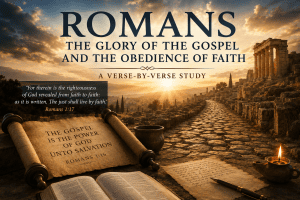
Want to do a deeper dive in the study of Romans? Get my book, Romans: The Glory of the Gospel and the Obedience of Faith, by making your choice of platforms below:
Dr. Alan Holden has served in pastoral ministry for more than 35 years, preaching and teaching the Bible in churches across the United States. He holds a Doctor of Ministry from Luther Rice Seminary and a Master of Divinity from The Southern Baptist Theological Seminary. Through What’s It Mean?, he seeks to help readers understand the meaning of Scripture and grow in their walk with Christ. He is currently the pastor of Lake Saunders Baptist Church in Tavares, FL.