







Romans 1 teaches that every person stands in need of God’s salvation because all humanity has rejected Him. Yet God has not left us without hope. Through Jesus Christ, He offers forgiveness, righteousness, and eternal life to everyone who believes. The Gospel is not merely good advice—it is God’s power to rescue sinners and transform lives. The question Romans 1 asks each of us is simple: Will we trust in our own righteousness, or will we trust in the righteousness God freely offers through His Son?
Prefer to watch instead of read? Watch the video below:
Key Text:
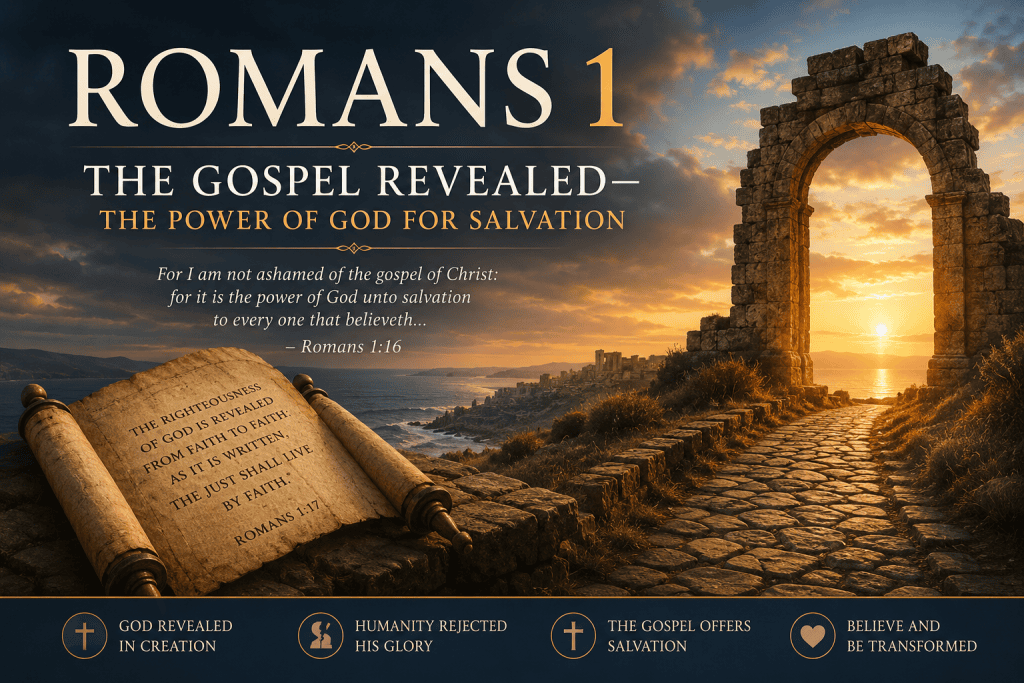
“For I am not ashamed of the gospel of Christ: for it is the power of God unto salvation to every one that believeth…” — Romans 1:16 (KJV)
Introduction
If someone asked you to summarize Christianity in one sentence, what would you say?
The Apostle Paul gives us the answer in Romans. More than any other New Testament book, Romans explains what God has done through Jesus Christ to save sinners. Chapter one serves as the grand introduction to this remarkable letter. Paul introduces himself, explains his mission, declares the power of the Gospel, and describes humanity’s desperate need for salvation.
Before we can appreciate the beauty of God’s grace, we must understand the depth of our need. Romans 1 does exactly that.
Paul Introduces Himself (Romans 1:1–7)
Paul begins by identifying himself as:
“A servant of Jesus Christ, called to be an apostle, separated unto the gospel of God.”
Three descriptions define his life.
A Servant
The Greek word means bondservant—one who willingly belongs to another. Paul no longer lived for himself. Jesus Christ was his Master.
Every Christian should ask:
Who is truly directing my life?
Christianity is not simply believing certain facts about Jesus. It is surrendering our lives to His lordship.
An Apostle
Paul did not appoint himself.
God called him.
His authority rested not in popularity or education but in God’s commission.
Separated Unto the Gospel
Notice what Paul was separated to, not merely what he was separated from.
God calls believers away from sin so they may dedicate themselves to His work.
The Christian life is not merely avoiding evil—it is pursuing God’s purposes.
The Gospel Was God’s Plan All Along (Romans 1:2–6)
The Gospel did not begin in Bethlehem.
It did not begin at Calvary.
It did not begin with the apostles.
Paul reminds us the Gospel was:
“Promised afore by his prophets in the holy scriptures.”
Throughout the Old Testament God prepared the world for Christ.
The sacrifices…
The prophets…
The promises to Abraham…
The covenant with David…
All pointed toward Jesus.
God’s plan of redemption has never changed.
Jesus Christ Is the Center of the Gospel (Romans 1:3–4)
Paul summarizes the Gospel in two great truths.
Christ Became Man
Jesus was:
“Made of the seed of David according to the flesh.”
Jesus truly became human.
He entered our world.
Jesus experienced hunger, weariness, temptation, grief, and suffering.
Because He became like us, He can sympathize with us.
Christ Is the Son of God
Jesus was also:
“Declared to be the Son of God with power…by the resurrection from the dead.”
The resurrection is God’s public declaration that Jesus is exactly who He claimed to be.
Without the resurrection, Christianity collapses.
Because Christ lives, our hope is secure.
Grace Produces Obedience (Romans 1:5)
One of the great themes of Romans appears immediately.
Paul says believers have received:
“Grace and apostleship, for obedience to the faith.”
Grace does not encourage careless living.
Grace transforms people into obedient followers of Christ.
Saving faith always produces a changed life.
Obedience does not earn salvation.
It demonstrates genuine salvation.
Paul Longs to Encourage Believers (Romans 1:8–15)
Paul had never visited Rome.
Yet he loved these believers deeply.
Several characteristics stand out.
He Prayed Constantly
Paul thanked God for their testimony.
Healthy churches become known for their faith.
He Desired Fellowship
Paul wanted to encourage them.
Notice something beautiful:
Paul expected mutual encouragement.
Even the great apostle knew he needed fellowship with other believers.
Christianity was never intended to be lived in isolation.
He Was Eager to Preach
Paul declared:
“I am ready to preach the gospel…”
His enthusiasm had not faded after years of ministry.
The Gospel never grows old.
The Great Theme of Romans (Romans 1:16–17)
These two verses summarize the entire book.
“I Am Not Ashamed”
Paul had been imprisoned.
Beaten.
Rejected.
Mocked.
Yet he never apologized for the Gospel.
Why?
Because the Gospel possesses divine power.
The world offers advice.
The Gospel offers salvation.
The world modifies behavior.
The Gospel changes hearts.
The Power of God
The Gospel is not merely information.
It is God’s power working in those who believe.
People are not saved by clever arguments.
They are saved when God’s Spirit works through the message of Christ.
Salvation Is Available to Everyone
Paul says:
“To every one that believeth.”
The invitation is universal.
Jew or Gentile.
Rich or poor.
Educated or uneducated.
Young or old.
Anyone who believes may be saved.
The Righteousness of God
Human beings cannot make themselves righteous.
God provides righteousness through faith in Jesus Christ.
This is the heart of justification.
We stand accepted before God—not because of what we have done—but because of what Christ has done.
Why Humanity Needs the Gospel (Romans 1:18–23)
Beginning in verse 18, Paul explains why salvation is necessary.
God’s wrath is revealed against human sin.
This is not uncontrolled anger.
It is God’s holy response to evil.
Everyone Knows God Exists
Creation itself reveals God’s existence.
The heavens…
The earth…
Life…
Conscience…
No one can honestly claim there is absolutely no evidence for God.
Creation continually points to its Creator.
Humanity Rejected God
Instead of worshiping the Creator, people worshiped created things.
Idolatry is exchanging God’s glory for something less.
Modern idols may not be carved statues.
They may be:
- Money
- Success
- Pleasure
- Politics
- Entertainment
- Self
Whenever something replaces God as our highest affection, it becomes an idol.
The Consequences of Rejecting God (Romans 1:24–32)
Three times Paul writes:
“God gave them up…”
This is one of Scripture’s most sobering phrases.
When people continually reject God, He allows them to experience the consequences of their choices.
Sin always promises freedom.
Instead, it produces slavery.
Notice the downward progression.
People reject truth.
Truth is exchanged for lies.
Sin becomes celebrated.
Hearts become hardened.
Eventually people approve of evil rather than merely practicing it.
This is not simply the story of ancient Rome.
It describes every society that turns away from God.
What Romans 1 Means for Us Today
Romans 1 speaks powerfully to our generation.
The Gospel Still Saves
Our culture has changed.
Technology has changed.
People have not.
Every generation needs the same Savior.
Truth Still Matters
Our world often teaches that truth is relative.
God declares otherwise.
His truth never changes.
Sin Still Destroys
Ignoring God’s commands never produces freedom.
God’s instructions are given because He loves us.
Grace Still Changes Lives
No sinner is beyond God’s reach.
The same Gospel that transformed Paul can transform anyone who believes.
Living Romans 1
Ask yourself these questions this week:
- Am I living as Christ’s servant or my own master?
- Am I ashamed to speak about Jesus?
- Have I trusted in God’s righteousness instead of my own?
- Are there modern idols competing for my devotion?
- Is my life demonstrating the obedience that flows from genuine faith?
Romans reminds us that the Gospel is not merely something we believe once.
It is the power that transforms how we live every day.
Final Thoughts
Romans begins with two great realities.
God has provided salvation through Jesus Christ.
Every person desperately needs that salvation.
The Gospel is not one message among many. It is the message of hope for a lost world. Paul was not ashamed because he knew its power. May we have the same confidence today, boldly proclaiming Christ in both our words and our lives.
As we continue through Romans, we will see God’s magnificent plan unfold—from humanity’s sin to Christ’s sacrifice, from justification by faith to the victorious Christian life in the Spirit. The journey begins here, with the glorious Gospel that is still “the power of God unto salvation.”
Enjoy simple, Bible-centered teaching? Receive a short Daily Devotion by email and spend a few minutes each day in God’s Word. For more information, CLICK HERE.
Continue studying Romans: Explore our complete chapter-by-chapter guide to the Book of Romans, including humanity’s sin to Christ’s sacrifice, from justification by faith to the victorious Christian life in the Spirit, and the law of love–OR go:
Forward to Romans 2>>
<<Back to Bible Passages
Want to do a deeper dive in the study of Romans? Get my book, Romans: The Glory of the Gospel and the Obedience of Faith, by making your choice of platforms below:
Dr. Alan Holden has served in pastoral ministry for more than 35 years, preaching and teaching the Bible in churches across the United States. He holds a Doctor of Ministry from Luther Rice Seminary and a Master of Divinity from The Southern Baptist Theological Seminary. Through What’s It Mean?, he seeks to help readers understand the meaning of Scripture and grow in their walk with Christ. He is currently the pastor of Lake Saunders Baptist Church in Tavares, FL.