






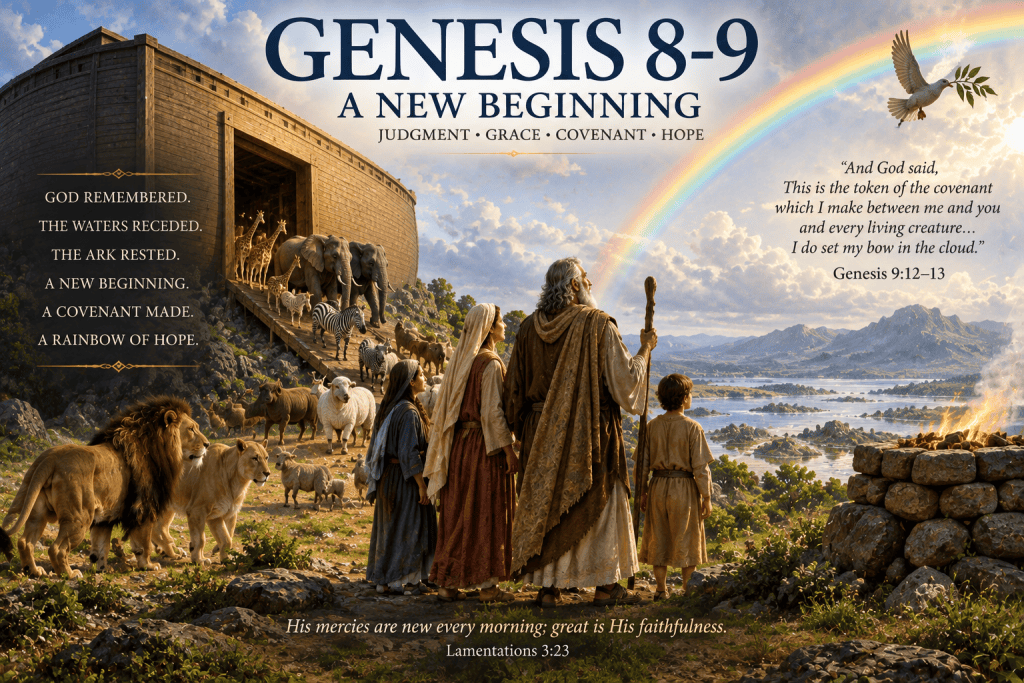
Genesis 8–9 — A New Beginning: God’s Covenant with Noah
Key Scriptures: Genesis 8:1–22; Genesis 9:1–29; Isaiah 54:9–10; Matthew 24:37–39; 1 Peter 3:20–21; 2 Peter 3:5–7
“And God remembered Noah, and every living thing, and all the cattle that was with him in the ark.” — Genesis 8:1
Genesis 7 ends with water covering the earth.
The old world had passed under God’s judgment. Noah, his family, and the animals remained safely inside the ark while the waters prevailed for 150 days.
Then Genesis 8 begins:
“And God remembered Noah.”
Those are beautiful words.
They do not mean God had forgotten where Noah was and suddenly remembered him.
In Scripture, when God “remembers,” it often means that He turns His attention toward someone in order to act according to His promise.
God had not forgotten Noah for a single moment.
The same God who protected Noah through the judgment would now bring him safely into a new beginning.
Genesis 8–9 is a story of remembrance, restoration, worship, covenant, and hope.
The storm ends.
The waters recede.
Noah leaves the ark.
An altar is built.
God makes a covenant.
And a rainbow appears in the clouds.
God Remembered Noah
Genesis 8:1 says:
“And God remembered Noah.”
Imagine Noah’s circumstances.
He had been inside the ark for months.
Outside was nothing but water.
The familiar world had disappeared.
Noah could not see what God was doing.
He could not control the waters.
Noah could not make the earth dry.
All he could do was wait.
But while Noah waited:
God remembered Noah.
There are times in our lives when God seems silent.
We pray, but circumstances do not immediately change.
We wait for:
- an answer.
- healing.
- direction.
- a door to open.
During those seasons, we may wonder whether God has forgotten us.
Genesis 8 reminds us:
God does not forget His people.
We may not see what He is doing.
But God is still at work.
God Sent a Wind
Genesis continues:
“And God made a wind to pass over the earth, and the waters asswaged.” — Genesis 8:1
The fountains of the deep were stopped, the rain ceased, and the waters gradually began to recede.
Notice that the process took time.
God could have removed the water instantly.
But He did not.
The waters decreased gradually.
That is often how God works in our lives.
Sometimes He changes circumstances immediately.
At other times, He works slowly.
We prefer instant answers.
God often teaches us through patient waiting.
Faith means trusting God not only for the outcome but also during the process.
The Ark Rested
Genesis 8:4 says:
“And the ark rested in the seventh month, on the seventeenth day of the month, upon the mountains of Ararat.”
The ark had been carried by the waters.
Now it rested.
But Noah still could not immediately leave.
The waters continued decreasing.
Eventually the tops of the mountains became visible.
Noah waited another forty days before opening the window of the ark.
Waiting had become part of Noah’s journey of faith.
He waited:
- while building the ark.
- for the Flood to come.
- while the waters prevailed.
Now he waited for the earth to become habitable again.
Faith sometimes requires us to move, but at others times to stand.
And sometimes faith requires us simply to wait.
The Raven and the Dove
Noah first sent out a raven.
Then he sent out a dove.
The dove found no resting place and returned to the ark.
Noah waited seven more days.
He sent the dove again.
This time:
“Lo, in her mouth was an olive leaf pluckt off.” — Genesis 8:11
Imagine what that little leaf must have meant to Noah.
Life was returning.
Vegetation was growing.
The waters were disappearing.
The long judgment was ending.
That olive leaf became a small sign of a much larger reality:
A new beginning was coming.
Sometimes God gives us small signs of His work before we see the whole answer.
A conversation changes.
A door begins to open.
Strength starts returning.
A relationship begins healing.
The situation is not completely resolved.
But we see an olive leaf.
And that small evidence encourages us to keep trusting God.
Noah Waited for God’s Word
After the dove failed to return, Noah removed the covering of the ark and saw that the ground was drying.
But he still did not leave.
That is significant.
Noah had entered the ark because God told him to enter.
He would leave when God told him to leave.
Genesis 8:15–16 says:
“And God spake unto Noah, saying, Go forth of the ark.”
Then Noah went out.
Noah did not allow impatience to replace obedience.
That is an important lesson.
Sometimes we correctly recognize that circumstances are changing but move ahead of God’s direction.
Noah waited.
When God said:
- build, Noah built.
- come, Noah entered.
- go forth, Noah left.
Faith listens for God’s Word.
A New World
Noah stepped from the ark into a very different world.
Imagine that moment.
For months he had seen nothing beyond the inside of the ark and the waters outside.
Now his feet touched dry ground again.
His family stood with him.
The animals emerged.
The sky stretched overhead.
Humanity had been given a new beginning.
What would Noah do first?
Build a house?
Plant crops?
Explore the land?
No.
The first thing Scripture records is worship.
Noah Built an Altar
Genesis 8:20 says:
“And Noah builded an altar unto the LORD.”
Before Noah built something for himself, he built something for God.
He offered sacrifices upon the altar.
Noah recognized that his survival was not merely the result of good construction.
God had saved him.
His first response was gratitude and worship.
That should challenge us.
How often do we pray desperately during a crisis and then forget to worship when the crisis passes?
We ask God for help.
God answers.
Then we rush back into ordinary life.
Noah did not.
When his feet touched dry ground, he remembered the One who had brought him there.
Deliverance should produce worship.
God’s Promise Concerning the Earth
Following Noah’s sacrifice, God said:
“I will not again curse the ground any more for man’s sake.” — Genesis 8:21
Then God promised:
“While the earth remaineth, seedtime and harvest, and cold and heat, and summer and winter, and day and night shall not cease.” — Genesis 8:22
The regular rhythms of life would continue:
- Seedtime.
- Harvest.
- Cold.
- Heat.
- Summer.
- Winter.
- Day.
- Night.
We experience these rhythms so regularly that we easily take them for granted.
But Genesis tells us that their continuation reflects God’s faithfulness.
Every sunrise reminds us:
God keeps His world.
Every season reminds us:
God remains faithful.
Be Fruitful and Multiply
Genesis 9 begins with words resembling those spoken to Adam and Eve:
“And God blessed Noah and his sons, and said unto them, Be fruitful, and multiply, and replenish the earth.” — Genesis 9:1
Humanity was beginning again.
The Flood had judged human wickedness, but it had not removed humanity’s sinful nature.
God nevertheless graciously commissioned Noah’s family to fill the earth.
Human beings were again given responsibility within God’s creation.
But the world after the Flood would not simply be Eden restored.
Sin remained.
Genesis 8:21 acknowledges that:
“The imagination of man’s heart is evil from his youth.”
The Flood changed the world.
It did not change the human heart.
That would require a greater work of God.
The Sanctity of Human Life
Genesis 9 contains an extremely important statement about human life.
God says:
“Whoso sheddeth man’s blood, by man shall his blood be shed.”
Then God explains why murder is so serious:
“For in the image of God made he man.” — Genesis 9:6
We first encountered the image of God in Genesis 1.
Now we learn something important.
The Fall did not erase it.
The Flood did not erase it.
Human beings still bear God’s image.
Therefore, human life possesses unique dignity and value.
Our value does not depend upon age.
It does not depend upon:
- intelligence.
- physical ability.
- economic usefulness.
- whether other people consider us important.
Human life has value because God made humanity in His image.
That truth should shape the way we treat every person.
God Established His Covenant
Then God spoke to Noah and his sons:
“And I, behold, I establish my covenant with you, and with your seed after you.” — Genesis 9:9
A covenant is a binding promise or agreement.
This covenant extended beyond Noah.
It included his descendants and even the living creatures of the earth.
God promised:
“Neither shall all flesh be cut off any more by the waters of a flood.” — Genesis 9:11
Never again would God destroy the earth with a Flood as He had in Noah’s day.
God did not make this promise because humanity had suddenly become trustworthy.
He made the promise because God is faithful.
The security of the covenant rested upon the character of the One who made it.
The Rainbow
God gave Noah a sign of His covenant:
“I do set my bow in the cloud, and it shall be for a token of a covenant between me and the earth.” — Genesis 9:13
The rainbow would become a visible reminder of God’s promise.
Think about when rainbows appear.
They appear when sunlight shines through moisture.
In other words, the sign of God’s covenant appears in connection with the very thing that had once brought judgment.
Noah could see storm clouds gathering again.
Rain could begin falling.
Perhaps memories of the Flood would return.
Then a rainbow could appear.
And Noah could remember:
God has made a promise.
The rainbow was not based upon Noah’s feelings.
It was based upon God’s Word.
“I Will Remember My Covenant”
God says:
“And I will remember my covenant.” — Genesis 9:15
Again, this does not mean God might otherwise forget.
The language emphasizes God’s commitment to act faithfully according to His promise.
The rainbow therefore points us toward something much greater than a beautiful natural phenomenon.
It reminds us of the faithfulness of God.
Our circumstances and emotions change.
People change.
Nations change.
Generations come and go.
God remains faithful.
Noah’s Failure
We might wish Genesis 9 ended with the rainbow.
It does not.
The chapter concludes with a troubling episode involving Noah and his sons.
Noah planted a vineyard.
He drank the wine.
Noah became drunk and lay uncovered inside his tent.
Ham saw his father’s nakedness and told his brothers.
Shem and Japheth respectfully walked backward and covered their father without looking upon him.
The story eventually leads to Noah’s pronouncements concerning Canaan, Shem, and Japheth.
The details have generated considerable discussion, but one lesson is unmistakable.
Noah was not perfect.
The man who built the ark could still sin.
Noah, who walked with God, could still fail.
The Flood had washed the earth.
It had not washed sin from the human heart.
Noah Needed Grace Too
This prevents us from turning Noah into a flawless hero.
The Bible does not hide the failures of its major characters.
Noah became drunk.
Abraham would lie.
Jacob would deceive.
Moses would disobey.
David would commit terrible sins.
Peter would deny Jesus.
Why does Scripture show us these failures?
Because the Bible is ultimately not the story of great people saving themselves through their goodness.
It is the story of a gracious God saving sinners.
Noah needed grace before the Flood.
He needed grace after the Flood.
And so do we.
A New Beginning Was Not Enough
Genesis 8–9 teaches us something profound about humanity’s problem.
God essentially gave the human race a fresh start.
Only Noah’s family remained.
If humanity’s problem were merely bad surroundings, this should have solved it.
But sin quickly appeared again.
Why?
Because our deepest problem is not around us.
It is within us.
Humanity needs more than a new environment.
We need new hearts.
That points us toward the promise God would later give through Ezekiel:
“A new heart also will I give you, and a new spirit will I put within you.” — Ezekiel 36:26
And ultimately it points us toward Jesus Christ.
What Genesis 8–9 Means for Us
1. God Does Not Forget His People
Noah waited inside the ark, but God remembered him.
When God seems silent, silence does not mean abandonment.
Keep trusting Him.
2. God’s Work Sometimes Requires Waiting
The rain stopped before Noah could leave the ark.
Waters had to recede.
The ground had to dry.
Noah had to wait.
Do not assume that God is doing nothing simply because His work is taking longer than you expected.
3. Deliverance Should Lead to Worship
Noah’s first recorded act after leaving the ark was building an altar.
When God brings us through difficulty, our response should include gratitude.
4. Human Life Is Sacred
Genesis 9 grounds the value of human life in the image of God.
Every human being deserves dignity because every human being bears the Creator’s image.
5. God Keeps His Promises
The rainbow reminds us of God’s covenant faithfulness.
God’s promises do not depend upon our moods or circumstances.
They depend upon His character.
6. A New Environment Cannot Fix an Old Heart
Noah entered a cleansed world.
Sin entered with him.
Humanity’s deepest need is spiritual transformation.
7. Even Faithful People Can Fall
Noah walked with God and still failed.
Past faithfulness does not make us immune to present temptation.
We must continue depending upon God’s grace.
From the Ark to the Cross
Genesis 8–9 gives humanity a new beginning.
But it is not the final new beginning.
The earth had been washed by water.
Yet sin remained.
Noah had been saved through judgment.
Yet Noah remained a sinner.
A greater salvation was needed.
And a greater Savior was coming.
Jesus Christ did what Noah could never do.
He lived without sin.
Jesus took the judgment sinners deserved.
He died upon the cross.
Christ rose from the dead.
And through Him, God does more than improve our circumstances.
He makes us new.
Paul writes:
“If any man be in Christ, he is a new creature.” — 2 Corinthians 5:17
Noah stepped from the ark into a new world.
The Christian receives something even greater.
New life in Christ.
The rainbow reminds us that God keeps His promises.
And the cross gives us the greatest evidence of that faithfulness.
God promised redemption.
He sent His Son.
Christ died for sinners.
And Christ rose again.
Everyone who trusts Him receives eternal life.
The God who remembered Noah has not forgotten us.
The Lord who kept His covenant after the Flood still keeps His Word today.
Storm clouds may come.
Circumstances may change.
We may have seasons when we cannot see what God is doing.
But we can still trust Him.
Because God remembers, God restores, and God keeps His promises.
WIM Takeaway
Genesis 8–9 teaches us that God remembered Noah, brought him safely through judgment, and gave humanity a new beginning. The rainbow became the sign of God’s covenant promise, reminding us that our hope rests not upon human faithfulness but upon the faithfulness of God.
Questions for Reflection
- What does the statement “God remembered Noah” teach us about God’s care for His people?
- What can Noah’s long wait inside the ark teach us about trusting God’s timing?
- Why do you think Noah’s first recorded action after leaving the ark was to build an altar?
- How does Genesis 9 establish the value and dignity of human life?
- What does the rainbow teach us about God’s covenant faithfulness?
- Why didn’t the Flood solve humanity’s problem with sin?
- What does Noah’s failure after the Flood teach us about our continued need for grace?
- Is there an area of your life where you need to trust God’s promise even though you cannot yet see what He is doing?
- How does the new beginning offered through Jesus surpass Noah’s new beginning after the Flood?
<<Back to the Book of Genesis
Dr. Alan Holden has served in pastoral ministry for more than 35 years, preaching and teaching the Bible in churches across the United States. He holds a Doctor of Ministry from Luther Rice Seminary and a Master of Divinity from The Southern Baptist Theological Seminary. Through What’s It Mean?, he seeks to help readers understand the meaning of Scripture and grow in their walk with Christ. He is currently the pastor of Lake Saunders Baptist Church in Tavares, FL.