






Genesis 10–11 — The Nations and the Tower of Babel
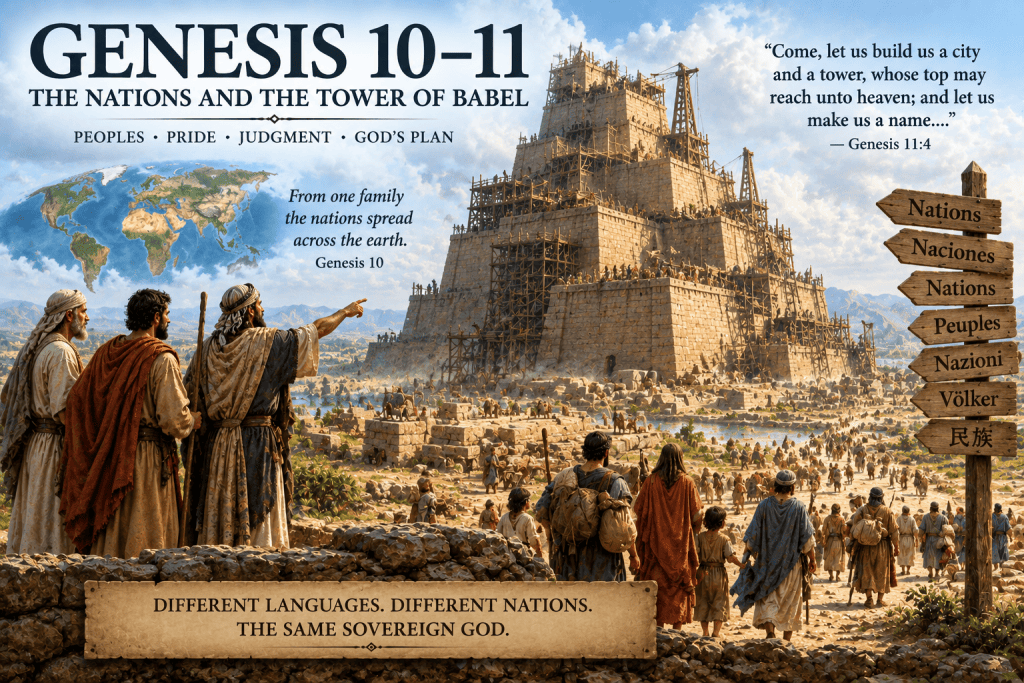
Key Scriptures: Genesis 10:1–32; Genesis 11:1–9; Acts 2:1–12; Acts 17:26; Revelation 7:9–10
“Therefore is the name of it called Babel; because the LORD did there confound the language of all the earth.” — Genesis 11:9
Genesis 10 and 11 explain how the descendants of Noah spread across the earth after the Flood.
Chapter 10 gives us a list of nations.
Genesis 11 tells us why those nations were scattered.
At first glance, these chapters may seem like ancient geography and genealogy.
But they reveal several important truths.
God rules over the nations.
Human pride always seeks independence from God.
God opposes rebellion.
And even when humanity scatters, God continues moving history toward redemption.
The Table of Nations
Genesis 10 records the descendants of Noah’s three sons:
Shem, Ham, and Japheth.
Their families spread into different regions and became the ancestors of many peoples and nations.
This chapter is sometimes called the Table of Nations.
Its purpose is not merely to give us a family tree.
Chapter 10 shows that all the nations of the earth ultimately came from one human family.
Acts 17:26 later says that God:
“Hath made of one blood all nations of men for to dwell on all the face of the earth.”
That truth has enormous importance.
Different peoples have different languages, cultures, customs, and histories.
But Scripture teaches that humanity shares a common origin.
We belong to one human family.
Japheth’s Descendants
Genesis 10 begins with the descendants of Japheth.
His family spread broadly into regions that would eventually be associated with peoples to the north and west of Israel.
The chapter names families, lands, coastlands, and peoples.
The details remind us that the Bible is rooted in real history.
God’s story did not unfold in a mythological world.
It unfolded among real people, in real places, through real generations.
Ham’s Descendants
Genesis then traces the descendants of Ham.
Among these names we encounter several important peoples and places that will appear later in the Bible:
- Egypt.
- Canaan.
- Cush.
- Babel.
- Nineveh.
Some of the nations descended from Ham would later become strong enemies of Israel.
But Genesis 10 reminds us that even Israel’s enemies were still part of the larger human family descended from Noah.
Nimrod
Genesis 10 introduces a man named Nimrod.
He is described as:
“A mighty one in the earth.” — Genesis 10:8
His kingdom included Babel.
He is associated with early centers of political power and city-building.
Scripture does not give us a detailed biography of Nimrod, but his appearance is important because Babel soon becomes the setting for humanity’s united rebellion against God.
Genesis is showing us that human beings were not only spreading geographically.
They were also developing cities, kingdoms, and systems of power.
Civilization was advancing.
But the human heart remained unchanged.
Shem’s Descendants
Genesis 10 also traces the family line of Shem.
This line is especially important because the biblical story will soon narrow from the nations of the world to one family.
From Shem’s descendants will come Abraham.
From Abraham will come Israel.
And through Israel, eventually, will come Jesus Christ.
So even while Genesis 10 describes many nations, God is quietly preparing the line through which His redemptive promise will continue.
One Language
Genesis 11 begins:
“And the whole earth was of one language, and of one speech.” — Genesis 11:1
Humanity still shared a common language.
As people migrated, they came to the land of Shinar.
There they decided to build.
At first, building a city does not sound sinful.
The problem is revealed in their motive.
They said:
“Go to, let us build us a city and a tower, whose top may reach unto heaven.” — Genesis 11:4
Then they added:
“And let us make us a name.”
That is the heart of the problem.
“Let Us Make Us a Name”
The builders of Babel wanted significance apart from God.
They wanted:
- security apart from God.
- fame apart from God.
- unity apart from God.
- to build something so impressive that future generations would remember them.
Their goal was:
“Let us make us a name.”
This is one of humanity’s oldest temptations.
We want to be:
- noticed.
- admired.
- remembered.
We want to build something that proves our importance.
But there is a great difference between using our abilities for God’s glory and using them to glorify ourselves.
Babel was not ultimately about architecture.
It was about pride.
Human Pride Builds Towers
The spirit of Babel did not disappear when the tower stopped.
It still appears wherever human beings say, in effect:
- “We do not need God.”
- “We will define truth for ourselves.”
- “We will build our own security.”
- “We will create our own identity.”
- “We will determine our own destiny.”
The materials change.
The pride does not.
Some people build towers with:
- money.
- education.
- careers.
- political power.
- popularity.
- possessions.
- religious reputation.
Anything can become a tower when we use it to exalt ourselves instead of honoring God.
They Did Not Want to Be Scattered
The people also said:
“Lest we be scattered abroad upon the face of the whole earth.” — Genesis 11:4
This directly resisted God’s earlier command.
God had told humanity to:
“Be fruitful, and multiply, and replenish the earth.” — Genesis 9:1
God said spread out.
Humanity said stay together.
God gave them a mission.
They chose their own plan.
The problem was not cooperation.
Their problem was rebellion.
Unity is not automatically good.
People can unite around evil as easily as they can unite around good.
Babel was a united society moving in the wrong direction.
The LORD Came Down
Genesis 11:5 says:
“And the LORD came down to see the city and the tower.”
There is almost a touch of holy irony here.
The builders thought their tower was reaching toward heaven.
Yet God still had to “come down” to see it.
What seemed enormous to humanity was small before God.
Human pride often looks impressive from the ground.
It looks much smaller from heaven.
Nothing Would Restrain Them
God said:
“Now nothing will be restrained from them, which they have imagined to do.” — Genesis 11:6
This does not mean human beings could become all-powerful.
It means that united rebellion could rapidly increase wickedness.
God intervened to restrain humanity.
Sometimes God’s judgment takes the form of limiting what sinful humanity can accomplish.
A barrier can be mercy.
Disruption can be protection.
A closed door can prevent greater destruction.
We do not always recognize God’s restraint as grace.
But sometimes God prevents us from doing what we would later regret.
God Confused Their Language
God said:
“Let us go down, and there confound their language, that they may not understand one another’s speech.” — Genesis 11:7
Suddenly the common language was lost.
Communication broke down.
Cooperation became difficult.
The building project stopped and the very thing they wanted to avoid happened.
They were scattered.
Genesis 11:8 says:
“So the LORD scattered them abroad from thence upon the face of all the earth.”
God’s purpose prevailed.
Humanity could resist Him.
But they could not defeat Him.
Babel and Babylon
The city became known as Babel.
Later in Scripture, Babylon develops into a powerful symbol of human civilization organized in rebellion against God.
From Genesis to Revelation, Babylon often represents pride, false worship, political power, luxury, and opposition to God.
The spirit of Babel says:
“Let us make us a name.”
The life of faith says:
“Let us glorify the name of the LORD.”
That contrast runs through the Bible.
God Is Not Against Cities
We should be careful not to conclude that Genesis 11 condemns cities, technology, architecture, or human achievement.
Scripture does not teach that.
The problem was not bricks–the problem was the heart.
God gave human beings creativity.
He gave us intelligence.
God gave us the ability to organize and build.
Those abilities can serve good purposes.
The question is:
Whose glory are we seeking?
Human achievement becomes dangerous when it becomes a substitute for dependence upon God.
Babel and Pentecost
The story of Babel has an interesting connection with Acts 2.
At Babel, human pride led to divided languages and scattering.
At Pentecost, the Holy Spirit enabled people from many nations to hear the mighty works of God in their own languages.
Acts 2 does not erase all language differences.
Instead, God works through those differences to proclaim the Gospel.
At Babel, people said:
“Let us make us a name.”
At Pentecost, believers proclaimed the name of Jesus Christ.
Babel magnifies humanity.
Pentecost magnifies God.
God Loves the Nations
Genesis 10–11 explains how the nations spread.
But God never forgot them.
His plan would soon focus on Abraham.
Yet even then, God would tell Abraham:
“In thee shall all families of the earth be blessed.” — Genesis 12:3
God chose one family in order to bring blessing to all families.
The Gospel would eventually go to every nation.
Jesus commanded:
“Go ye therefore, and teach all nations.” — Matthew 28:19
Revelation gives us the final picture:
“A great multitude, which no man could number, of all nations, and kindreds, and people, and tongues.” — Revelation 7:9
The Bible begins with the nations scattered.
It ends with people from the nations worshiping God together.
Human Greatness Is Temporary
The builders of Babel wanted to create something unforgettable.
Yet today we do not know their individual names.
Ironically, they said:
“Let us make us a name.”
And Scripture leaves them nameless.
But immediately after Babel, Genesis begins tracing the line that will lead to Abraham.
God will later tell Abraham:
“I will make thy name great.” — Genesis 12:2
Do you see the contrast?
At Babel:
“Let us make us a name.”
To Abraham:
“I will make thy name great.”
One is self-exaltation.
The other is God’s blessing.
The surest path to significance is not promoting ourselves.
It is faithfully following God.
Pride Always Reaches Up
Pride says:
- “I can rise high enough.”
- “I can become important enough.”
- “I can build enough.”
- “I can achieve enough.”
- “I can control enough.”
The Gospel takes us in the opposite direction.
Philippians 2 tells us that Jesus humbled Himself.
He did not grasp for earthly glory.
Jesus took the form of a servant.
He became obedient unto death, even the death of the cross.
Then:
“God also hath highly exalted him.” — Philippians 2:9
Babel says:
Climb higher and make yourself great.
Jesus says:
Humble yourself and trust God.
What Genesis 10–11 Means for Us
1. All Humanity Shares a Common Origin
Genesis 10 reminds us that the nations belong to one human family.
Every person bears God’s image.
2. God Rules Over the Nations
Nations rise and fall.
Borders change.
Kingdoms appear and disappear.
God remains sovereign over history.
3. Pride Can Hide Behind Achievement
The tower itself was not the central problem.
The motive was.
We must ask why we pursue the things we pursue.
4. Unity Is Not Always Righteous
The people at Babel were united.
They were also rebelling against God.
Unity must be built around truth.
5. God Can Restrain Human Evil
The confusion of languages limited humanity’s united rebellion.
God sometimes prevents evil by limiting human power.
6. God’s Purposes Cannot Be Defeated
The people tried to avoid scattering.
God scattered them anyway.
His purposes ultimately prevail.
7. God’s Plan Includes Every Nation
Genesis 10 begins with many nations.
The Gospel eventually goes to every nation.
God’s redemptive plan is global.
What Tower Are You Building?
Babel is not merely an ancient story.
It asks a very personal question.
What are you building your life around?
Are you:
- trying to make a name for yourself?
- measuring your worth by what you accomplish?
- seeking security in money, position, reputation, or possessions?
- building something impressive while leaving God out of the plans?
Jesus asked:
“For what shall it profit a man, if he shall gain the whole world, and lose his own soul?” — Mark 8:36
A tower can be impressive and still be spiritually empty.
Better to build a smaller life with God than a massive monument without Him.
From Babel to Abraham
Genesis 11 does not end the biblical story.
After Babel, Scripture begins tracing the descendants of Shem.
Name after name appears.
Eventually we come to:
Terah.
Then:
Abram.
The focus is narrowing.
Nations have been scattered.
Now God will call one man.
Through that man He will form one nation.
Through that nation He will send one Savior.
And through that Savior He will bring the Gospel back to the nations.
The confusion of Babel is not the end.
Redemption is coming.
From Every Tongue
At Babel, languages divided humanity.
In Revelation, those many languages become part of the beauty of worship.
People from every nation and tongue stand before the throne.
They are not united because they built a tower.
These people are united because they were redeemed by the Lamb.
Humanity’s greatest unity will never come from politics, economics, technology, or human organization.
True and lasting unity is found in Jesus Christ.
Babel tried to reach heaven from earth.
The Gospel tells us something far greater:
Heaven came down to us.
The Son of God entered our world.
He took our humanity.
Jesus died for our sins.
He rose again.
And through Him, people from every tribe, nation, people, and language can become one family.
WIM Takeaway
Genesis 10–11 teaches us that God rules over the nations and opposes human pride. At Babel, people tried to make a name for themselves and resist God’s purpose, but God scattered them. Yet His redemptive plan continued, ultimately bringing the Gospel of Jesus Christ to people from every nation and language.
Questions for Reflection
- What does Genesis 10 teach us about the common origin of humanity?
- Why was the Tower of Babel offensive to God?
- What did the people mean when they said, “Let us make us a name”?
- How can human achievement become an expression of pride?
- Why is unity not automatically a good thing?
- In what ways can God’s restraint actually be an act of mercy?
- How does Pentecost contrast with Babel?
- What “tower” are people tempted to build today?
- How does Revelation 7 show the ultimate fulfillment of God’s plan for the nations?
- Are you trying to make your own name great, or are you seeking to glorify God’s name?
<<Back to the Book of Genesis
Dr. Alan Holden has served in pastoral ministry for more than 35 years, preaching and teaching the Bible in churches across the United States. He holds a Doctor of Ministry from Luther Rice Seminary and a Master of Divinity from The Southern Baptist Theological Seminary. Through What’s It Mean?, he seeks to help readers understand the meaning of Scripture and grow in their walk with Christ. He is currently the pastor of Lake Saunders Baptist Church in Tavares, FL.