






Genesis 6–7 — Noah and the Flood: Judgment and Grace
Key Scriptures: Genesis 6:1–22; Genesis 7:1–24; Matthew 24:37–39; Hebrews 11:7; 1 Peter 3:20; 2 Peter 2:5
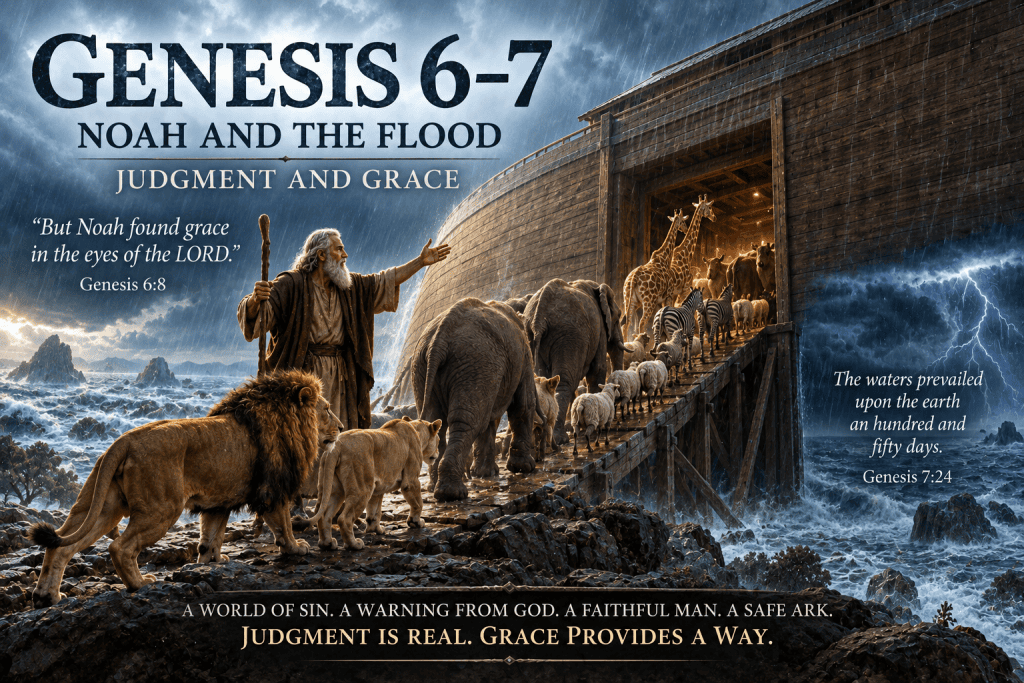
“But Noah found grace in the eyes of the LORD.” — Genesis 6:8
Genesis began with a perfect world.
God created humanity in His image and placed Adam and Eve in a beautiful garden. Everything God made was “very good.”
Then sin entered.
Adam and Eve disobeyed God.
Cain murdered Abel.
Violence spread.
Human beings increasingly turned away from their Creator.
By Genesis 6, sin had become so widespread that Scripture gives us one of the saddest descriptions of humanity anywhere in the Bible:
“And GOD saw that the wickedness of man was great in the earth.” — Genesis 6:5
Judgment was coming.
God would send a Flood upon the earth.
Yet Genesis 6–7 is not merely a story about judgment.
It is also a story about grace.
One sentence shines like a light in the darkness:
“But Noah found grace in the eyes of the LORD.”
The World Became Corrupt
Genesis 6 describes a world increasingly dominated by wickedness.
Verse 5 says:
“Every imagination of the thoughts of his heart was only evil continually.”
Notice how thoroughly sin had affected humanity.
It affected people’s actions, thoughts, and hearts.
And it was not occasional.
It was continual.
The problem was deeper than bad behavior.
Something was wrong inside the human heart.
Jesus would later say:
“For from within, out of the heart of men, proceed evil thoughts.” — Mark 7:21
We often try to solve humanity’s problems by changing external circumstances.
Better laws may restrain some evil.
Education may correct some ignorance.
Economic conditions may relieve some suffering.
All of those things can have value.
But none can solve humanity’s deepest problem.
The human heart needs redemption.
The Sons of God and the Daughters of Men
Genesis 6:1–4 contains one of the more difficult passages in Genesis.
We read:
“The sons of God saw the daughters of men that they were fair; and they took them wives of all which they chose.”
The passage also mentions the Nephilim, translated “giants” in the King James Version.
Bible students have offered several interpretations of the “sons of God.”
Some understand them to be fallen angelic beings.
Others understand them as descendants of Seth who intermarried with the ungodly line of Cain.
Still others have understood the expression as referring to powerful rulers who took women for themselves.
Faithful interpreters have disagreed over the details.
Therefore, we should be cautious about claiming more certainty than Scripture gives us.
What is perfectly clear is the larger point of the passage:
Human wickedness was increasing dramatically.
Genesis quickly moves from this difficult passage to God’s assessment of the world:
“The wickedness of man was great in the earth.”
That is the central issue.
God Saw the Wickedness
Genesis 6:5 begins with two important words:
“God saw.”
People may have accepted the violence around them as normal.
God did not.
People may have ignored wickedness.
God did not.
People may have believed they could live however they pleased without consequences.
They could not.
God sees what happens in His world.
Nothing escapes His attention.
Psalm 33:13 says:
“The LORD looketh from heaven; he beholdeth all the sons of men.”
That truth can be frightening when we are living in rebellion against God.
But it can also be comforting when we are suffering injustice.
God sees both.
He sees the sin committed in secret.
And He sees the suffering no one else notices.
God’s Heart Was Grieved
Genesis 6:6 says:
“And it repented the LORD that he had made man on the earth, and it grieved him at his heart.”
This does not mean God suddenly discovered that creating humanity had been a mistake.
Scripture consistently presents God as knowing the end from the beginning.
The language communicates God’s genuine grief over human sin.
Sin is not merely the breaking of an impersonal rule.
Rather, sin grieves the God who created us.
We often think about what sin does to us.
It brings consequences, damages relationships, and produces guilt.
But Genesis reminds us that sin is ultimately an offense against God.
David understood this when he prayed:
“Against thee, thee only, have I sinned.” — Psalm 51:4
Judgment Was Coming
God announced:
“I will destroy man whom I have created from the face of the earth.” — Genesis 6:7
Those words are severe.
But we should remember what God had patiently witnessed.
The earth was filled with corruption and violence.
Genesis 6:11 says:
“The earth also was corrupt before God, and the earth was filled with violence.”
God’s judgment did not come because He was cruel.
It came because He is holy and just.
We sometimes ask:
“How can a loving God judge sin?”
But we could also ask:
“How could a righteous God look forever upon violence, cruelty, murder, oppression, and wickedness and never judge it?”
A God who never judges evil would not be good.
God’s holiness means sin matters.
His justice means evil will not continue forever.
But Noah Found Grace
Then comes one of the great turning points in Genesis:
“But Noah found grace in the eyes of the LORD.” — Genesis 6:8
The world was wicked.
But Noah.
Violence filled the earth.
But Noah.
Judgment was coming.
But Noah found grace.
That word grace deserves our attention.
Noah was not saved because he was powerful.
He was not saved because he was wealthy.
Noah was not saved because he had earned God’s favor.
He found grace.
Grace means God’s undeserved favor.
That theme will eventually run throughout the entire Bible.
Noah found grace.
Abraham believed God.
Israel received mercy.
David received forgiveness.
And ultimately:
“The law was given by Moses, but grace and truth came by Jesus Christ.” — John 1:17
From Genesis to Revelation, salvation rests upon the grace of God.
Noah Walked with God
Genesis then describes Noah:
“Noah was a just man and perfect in his generations, and Noah walked with God.” — Genesis 6:9
We have heard those words before.
Genesis 5 said:
“Enoch walked with God.”
Now:
“Noah walked with God.”
Noah lived in an extremely wicked culture.
But he did not have to become like the culture around him.
Neither do we.
It is possible:
<ul>
- to walk with God when many others do
not.</li>
- to remain faithful when society c
hanges.</li>
- to believe God’s Word
when others mock it.
Noah’s surroundings were corrupt.
But Noah still walked with God.
God Told Noah to Build an Ark
The Lord told Noah:
“Make thee an ark of gopher wood.” — Genesis 6:14
God gave Noah specific instructions concerning the ark’s construction.
It would be enormous, contain rooms, be covered with pitch inside and outside, and have multiple levels.
And God told Noah why it was necessary:
“I, even I, do bring a flood of waters upon the earth.” — Genesis 6:17
Imagine receiving that command.
Noah was asked to construct a massive vessel because God said a judgment was coming.
There was only one reason to begin building.
Noah believed God.
Noah’s Faith Produced Obedience
Hebrews 11:7 explains:
“By faith Noah, being warned of God of things not seen as yet, moved with fear, prepared an ark.”
Noah believed God’s warning before he saw the Flood.
That is faith.
Faith does not require seeing before believing.
Instead, faith trusts the One who has spoken.
Noah’s faith also produced action.
He did not say: “I believe a Flood is coming,” and then continue with life as usual.
Noah picked up his tools and started building.
Genesis 6:22 says:
“Thus did Noah; according to all that God commanded him, so did he.”
That is one of the finest descriptions of obedience in Scripture.
God spoke.
Noah believed and obeyed.
Faith that never affects our actions is not biblical faith.
The Ark Was God’s Provision
God announced the judgment.
But God also provided the way of escape.
The ark was not Noah’s idea.
God designed it, commanded it, told Noah how to build it.
Noah’s responsibility was to trust God enough to enter the provision God supplied.
That becomes an important picture of salvation.
We do not invent our own way back to God.
God provides the way.
Jesus said:
“I am the way, the truth, and the life: no man cometh unto the Father, but by me.” — John 14:6
The question is not whether we can design a better ark.
The question is whether we will trust the salvation God has provided.
“Come Thou and All Thy House”
Genesis 7 begins:
“And the LORD said unto Noah, Come thou and all thy house into the ark.” — Genesis 7:1
Notice the word:
“Come.”
God did not merely tell Noah, “Go into the ark.”
He invited him to come.
There is something beautiful about that language.
God was calling Noah into the place of safety He had provided.
Throughout Scripture, God continues to call people to come.
Isaiah says:
“Come now, and let us reason together.” — Isaiah 1:18
Jesus says:
“Come unto me, all ye that labour and are heavy laden.” — Matthew 11:28
Revelation ends with the invitation:
“Whosoever will, let him take the water of life freely.” — Revelation 22:17
God’s invitation is still:
Come.
Noah Entered the Ark
Noah entered with his family.
The animals entered according to God’s instructions.
Then Genesis 7:16 gives us a significant detail:
“And the LORD shut him in.”
Noah did not close the final door.
God did.
The same God who announced judgment secured Noah inside the place of safety.
Outside the ark was judgment.
Inside the ark was safety.
The difference was not that Noah’s family was strong enough to survive the Flood.
They survived because they were inside God’s provision.
The Flood Came
Then the rain began.
“The fountains of the great deep” were broken up.
“The windows of heaven were opened.”
Rain fell for forty days and forty nights.
The waters increased.
The ark rose.
Eventually:
“All the high hills, that were under the whole heaven, were covered.” — Genesis 7:19
The judgment God had warned about arrived.
For years, Noah had built.
For years, his ark stood as a visible testimony that he believed God’s warning.
Then one day the opportunity to enter ended.
The door closed.
And judgment came.
Jesus Compared the Flood to His Return
Christ referred to Noah when teaching about His future coming.
“But as the days of Noe were, so shall also the coming of the Son of man be.” — Matthew 24:37
<p>Jesus explained that people were eating, drinking, marrying, and carrying on ordinary life:
“Until the day that Noe entered into the ark.”
Then:
“the flood came, and took them all away.”
Their ordinary activities were not themselves the problem.
The problem was that they lived as though God’s warning did not matter.
Life continued normally right up until judgment arrived.
Jesus’ point is clear:
Do not confuse God’s patience with God’s absence.
God may delay judgment.
That does not mean judgment will never come.
Noah Was a Preacher of Righteousness
Peter calls Noah:
“a preacher of righteousness.” — 2 Peter 2:5
Noah’s life and words testified to his generation.
Every board placed into the ark proclaimed:
God has spoken.
Every day Noah continued building proclaimed:
I believe Him.
The ark itself became a sermon.
We do not know how many people mocked Noah.
Scripture does not record their conversations.
But we know the result.
Only Noah and those with him in the ark were preserved.
Noah remained faithful even though the majority went another direction.
Truth is not determined by a vote.
If the whole world disagrees with God, God is still right.
The Waters Prevailed
Genesis 7 ends:
“And the waters prevailed upon the earth an hundred and fifty days.” — Genesis 7:24
That is where the chapter leaves us.
Water everywhere.
The old world under judgment.
Noah and his family inside the ark.
But the story is not over.
Genesis 8 will begin with some of the most comforting words in the Flood account:
“And God remembered Noah.”
Judgment is real.
But so is grace.
What Genesis 6–7 Means for Us
1. Sin Is More Serious Than We Think
Genesis 6 shows how deeply sin can corrupt individuals and societies.
God does not treat evil as insignificant.
Neither should we.
2. God Sees What Happens in His World
Human beings may hide sin from one another.
Nothing is hidden from God.
God sees wickedness.
He also sees those who faithfully walk with Him.
3. God Is Both Holy and Gracious
The Flood demonstrates God’s judgment.
The ark demonstrates God’s grace.
We should never emphasize one while ignoring the other.
The God who judges sin also provides salvation.
4. We Can Walk with God in a Wicked Generation
Noah could not control his culture.
He could control whether he followed God.
The same is true for us.
We may not be able to change the whole world.
But we can faithfully walk with God within it.
5. Genuine Faith Produces Obedience
Noah believed God enough to build the ark.
Biblical faith changes what we do.
If we truly believe God, our lives will increasingly reflect that belief.
6. God’s Warnings Should Be Taken Seriously
The Flood did not come immediately.
But it came.
God’s patience should lead us to repentance, not complacency.
7. God Provides the Way of Salvation
Noah did not save himself.
God provided the ark.
In the same way, we cannot save ourselves from sin.
God has provided salvation through Jesus Christ.
The Ark and Jesus Christ
We should be careful not to make every detail of the ark symbolize something.
But the central comparison is powerful.
Judgment was coming.
God provided a place of safety.
Noah believed God.
He entered God’s provision.
And he was saved through the judgment.
The Gospel presents us with an even greater salvation.
Sin has brought us under judgment.
We cannot rescue ourselves.
But God has provided a Savior.
Jesus took our judgment upon Himself at the cross.
He died.
Jesus was buried.
And He rose again.
Now the Gospel invitation goes throughout the world:
Come to Christ.
Not because:
- we deserve salvation.
- we have lived perfectly.
- we are better than everyone else.
But because:
“By grace are ye saved through faith.” — Ephesians 2:8
Genesis 6 says:
“Noah found grace.”
Thousands of years later, sinners still come to God the same way.
By grace.
The world of Noah reminds us that God judges sin.
The ark reminds us that God provides salvation.
And the cross shows us how far God was willing to go to save sinners.
Judgment is real.
Grace is greater.
And the safest place anyone can be is in Christ.
WIM Takeaway
Genesis 6–7 teaches us that God takes sin seriously and will judge wickedness, but He also extends grace and provides salvation. Noah believed God’s warning, obeyed His Word, entered the ark, and was preserved through the judgment. In the same way, God calls us to trust the salvation He has provided through Jesus Christ.
Questions for Reflection
- What does Genesis 6 teach us about the seriousness of sin?
- Why is God’s judgment of the world consistent with His holiness and goodness?
- What does the statement “Noah found grace” teach us about salvation?
- How was Noah able to walk with God in such a wicked culture?
- What does Noah’s construction of the ark teach us about the relationship between faith and obedience?
- Why is the statement “the LORD shut him in” significant?
- What warning did Jesus draw from the days of Noah?
- In what ways does the ark help us understand God’s provision of salvation through Christ?
- What would it look like for you to “walk with God” in your generation?
<<Back to the Book of Genesis
Dr. Alan Holden has served in pastoral ministry for more than 35 years, preaching and teaching the Bible in churches across the United States. He holds a Doctor of Ministry from Luther Rice Seminary and a Master of Divinity from The Southern Baptist Theological Seminary. Through What’s It Mean?, he seeks to help readers understand the meaning of Scripture and grow in their walk with Christ. He is currently the pastor of Lake Saunders Baptist Church in Tavares, FL.