







Work: What’s It Mean?
Key Scriptures: Genesis 1:26–28; Genesis 2:15; Proverbs 14:23; Ecclesiastes 9:10; Colossians 3:22–24; 2 Thessalonians 3:10–12; Ephesians 4:28. Each of these verses offers profound insight into the meaning and purpose of work in our lives.
Most of us spend a tremendous portion of our lives working.
We labor to earn a living.
We:
- do tasks around the house.
- care for children or aging parents.
- volunteer at church.
- mow grass, prepare meals, repair things, keep records, teach classes, answer phones, manage businesses, and perform thousands of other tasks.
Because work can be difficult, we sometimes think of it merely as a necessary burden—something we endure until the weekend or until retirement.
But the Bible gives work a much greater significance.
Work is part of God’s design for human life.
The important question is not merely:
“What do I do for a living?”
The better question is:
“How can I honor God through the work He has given me to do?”
First, God Is a Worker
The Bible begins with God at work.
“In the beginning God created the heaven and the earth” (Genesis 1:1).
Throughout Genesis 1, God creates, separates, forms, fills, orders, blesses, and evaluates His creation.
At the end of His creative work:
“God saw every thing that he had made, and, behold, it was very good” (Genesis 1:31).
Labor, therefore, is not something beneath God.
God works.
Jesus said:
“My Father worketh hitherto, and I work” (John 5:17).
When human beings engage in honest, useful, productive work, we reflect something of the God who created us.
Second, Work Existed Before Sin
People sometimes say that work resulted from the Fall.
That is not quite correct.
Before Adam and Eve sinned, Genesis tells us:
“And the LORD God took the man, and put him into the garden of Eden to dress it and to keep it” (Genesis 2:15).
Adam had a job before he had a sin problem.
God gave him responsibility.
He was to cultivate and care for the garden.
Therefore, work itself is good.
Sin did not create work.
Sin made work difficult.
After Adam sinned, God said:
“Cursed is the ground for thy sake; in sorrow shalt thou eat of it all the days of thy life” (Genesis 3:17).
Now labor involves frustration.
Machines break.
Plans fail.
Crops die.
Businesses struggle.
Employees disappoint employers.
Employers disappoint employees.
Bodies become tired.
Projects do not always turn out as planned.
The frustration we experience in work reminds us that we live in a fallen world.
But the difficulty of labor does not remove the dignity of work.
Third, Work Has Dignity
Our culture often measures the importance of employment by salary, education, prestige, or authority.
God does not.
There is dignity in honest work.
A physician has valuable work.
So does the person who cleans the physician’s office.
A business owner has valuable work.
So does the employee who unloads the truck.
A pastor has valuable employment.
So does the person who cleans the church building.
The Bible does not divide honest occupations into important labor and insignificant work.
Paul says:
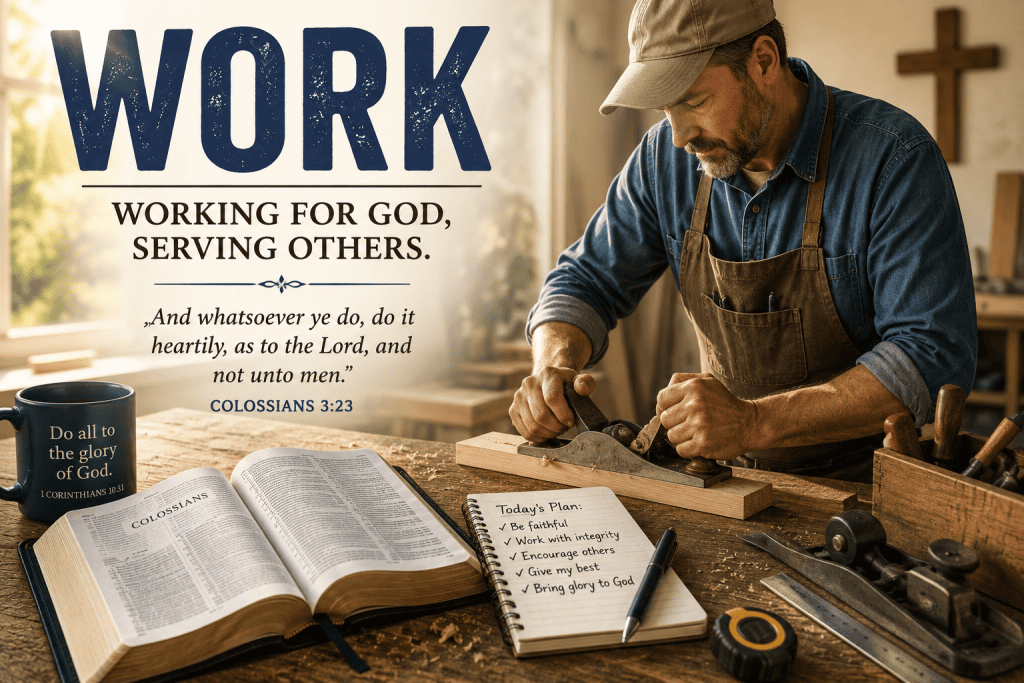
“And whatsoever ye do, do it heartily, as to the Lord, and not unto men” (Colossians 3:23).
Notice that word again:
Whatsoever.
Whatever honest task God places before us can become an act of service to Him.
Fourth, Work Is More Than a Paycheck
We obviously work because we need income.
Paul writes:
“If any would not work, neither should he eat” (2 Thessalonians 3:10).
There is nothing unspiritual about working to provide for ourselves and our families.
But toil accomplishes more than earning money.
Through employment we provide useful goods and services.
We:
- help other people.
- care for God’s creation.
- develop skills.
- solve problems.
- support our families.
- contribute to our communities.
- provide resources for generosity.
Paul tells believers:
“Let him labour, working with his hands the thing which is good, that he may have to give to him that needeth” (Ephesians 4:28).
That gives employment another purpose.
We work not merely so that we can have, but so that we can give.
Fifth, Christians Should Be Good Workers
A Christian’s faith should affect the quality of his work.
Christians should be known for:
- honesty.
- dependability.
- punctuality.
- integrity.
- respect.
- effort.
- keeping our word.
- doing what we agreed to do.
Paul told Christian servants:
“Obey in all things your masters according to the flesh; not with eyeservice, as menpleasers; but in singleness of heart, fearing God” (Colossians 3:22).
“Eyeservice” means working hard only when somebody is watching.
We understand that temptation.
The boss walks into the room, and suddenly everybody looks busy!
The Christian should work differently.
Why?
Because even when the supervisor is absent, God is present.
Our ultimate audience is the Lord.
Sixth, Work Can Become Worship
We normally think of worship as what happens in church.
We:
- sing hymns.
- pray.
- listen to Scripture.
- hear a sermon.
Those certainly are acts of worship.
But worship is larger than Sunday morning.
Paul writes:
“Whether therefore ye eat, or drink, or whatsoever ye do, do all to the glory of God” (1 Corinthians 10:31).
If eating and drinking can glorify God, so can repairing a car.
So can:
- preparing a meal.
- teaching a child.
- balancing a ledger.
- mowing a lawn.
- caring for a patient.
- building a house.
- answering a telephone.
When we perform honest work faithfully and thankfully before God, ordinary work becomes an opportunity for worship.
Seventh, Work Provides Opportunities for Witness
Many Christians spend more waking hours around coworkers than around members of their church.
That makes the workplace an important mission field.
Your coworkers observe you.
They notice:
- how you handle pressure.
- whether you gossip.
- whether you cheat.
- how you respond when someone treats you unfairly.
- whether your Christianity makes any difference on Monday morning.
Jesus said:
“Let your light so shine before men, that they may see your good works, and glorify your Father which is in heaven” (Matthew 5:16).
Sometimes the strongest Christian witness at work begins with simply being a person of integrity.
Do excellent work.
Treat people well.
Keep your promises.
Refuse dishonest practices.
Show compassion.
Then, when God gives an opportunity, explain the reason for the hope that is in you.
Eighth, Work Can Become an Idol
Work is good.
But good things can become idols.
Some people find their entire identity in their occupation.
Ask, “Who are you?” and they immediately answer with their job title.
But Christians must remember:
You are not what you do.
Your deepest identity is not:
- Manager.
- Teacher.
- Mechanic.
- Pastor.
- Business owner.
- Homemaker.
- Retiree.
Your deepest identity is found in Jesus Christ.
Work becomes dangerous when it replaces God.
If our job receives all our time, affection, energy, and attention while God and family receive whatever remains, something has become disordered.
We should work diligently.
But we should never worship our job.
Ninth, Laziness Is Not a Christian Virtue
While Scripture warns against making work an idol, it also warns against laziness.
Proverbs says:
“In all labour there is profit: but the talk of the lips tendeth only to penury” (Proverbs 14:23).
There is a difference between talking about what we intend to do and actually doing it.
Proverbs repeatedly points us toward diligence, planning, responsibility, and perseverance.
Christians should not expect other people to carry responsibilities we are capable of carrying ourselves.
When God gives us ability and opportunity to serve, we should use them faithfully.
Tenth, But Rest Is Also Biblical
Hard work does not mean endless labor.
God built a rhythm of labor and rest into creation.
After six days of creation, God rested on the seventh day—not because He was exhausted, but to establish a pattern.
Human beings have limits.
We need:
- sleep.
- rest.
- worship.
- time with family.
- moments when we stop producing and simply enjoy God’s goodness.
Sometimes we wear exhaustion like a badge of honor.
“I’m so busy.”
“I haven’t had a day off.”
“I worked seventy hours this week.”
That may occasionally be necessary, but constant exhaustion is not necessarily evidence of faithfulness.
Rest reminds us of something important:
The world keeps turning when we stop working.
God is God.
We are not.
Eleventh, What About Retirement?
Retirement changes our employment, but does not eliminate our usefulness.
A person may retire from a career.
A Christian never retires from serving God.
Retirement may actually provide opportunities that were impossible during years of full-time employment.
You may have more time:
- to pray.
- to serve your church.
- to mentor younger people.
- to care for family.
- to volunteer.
- to study Scripture.
- to encourage someone who is lonely.
The question in retirement should not simply be:
“What do I want to do with the rest of my life?”
It can become:
“Lord, how can I use this season for You?”
Twelveth, Sometimes We Cannot Work
There are seasons when illness, disability, unemployment, age, caregiving responsibilities, or circumstances prevent a person from working in the way he would like.
We should be careful not to measure someone’s worth by his productivity.
A person’s value does not come from a paycheck.
Human beings possess dignity because God created them in His image.
A person who cannot work is no less valuable before God than the person laboring sixty hours each week.
Neither should someone going through unemployment assume that he has lost his purpose.
A job may disappear.
God does not.
Continue:
- seeking His direction.
- doing what you can.
- serving where opportunities exist.
Trust God during the uncertainty.
Thirthteenth, What About Work We Do Not Enjoy?
Not everyone has his dream job.
Sometimes work is simply labor.
Perhaps:
- the job is repetitive.
- the supervisor is difficult.
- the salary is disappointing.
- you once imagined doing something entirely different.
Ecclesiastes says:
“Whatsoever thy hand findeth to do, do it with thy might” (Ecclesiastes 9:10).
There may be legitimate reasons to seek another job.
But until God opens another door, we can still honor Him where we are.
Faithfulness is not limited to ideal circumstances.
Sometimes God does some of His greatest work in us while we are doing work we would never have chosen for ourselves.
Fourteenth, Jesus Understands Work
We sometimes forget that Jesus spent most of His earthly life outside the public spotlight.
Before His public ministry, Jesus was known as:
“the carpenter” (Mark 6:3).
Think about that.
The Son of God worked with His hands.
He:
- measured.
- shaped.
- built.
- repaired.
- dealt with customers.
- experienced tired muscles.
For years, the One who created the universe performed ordinary work in an ordinary town.
That tells us something beautiful.
There is no shame in ordinary employment faithfully performed.
Jesus dignified labor by participating in it.
Fifthteenth, Our Work Will Not Last Forever
No matter how successful our career becomes, eventually someone else will occupy our office.
Someone else will:
- use our tools.
- sit at our desk.
- take our position.
That realization can either depress us or free us.
Our ultimate purpose is not to build a career that lasts forever.
It is to live faithfully before the God who does.
Paul writes:
“Knowing that of the Lord ye shall receive the reward of the inheritance: for ye serve the Lord Christ” (Colossians 3:24).
That changes everything.
Your:
- employer may never recognize your effort.
- customers may never appreciate you.
- family may overlook much of what you do.
But God sees.
No faithful service offered to Christ is wasted.
Sixteenth, What’s It Mean for Me?
Work is more than earning a paycheck.
It is one of the ways we serve God and serve one another.
So when you begin your work, remember:
Work honestly and diligently.
Treat people with dignity.
Keep your word.
Provide for those God has entrusted to you.
Use what you earn generously.
Rest when you need to rest.
Never allow your occupation to become your identity.
And above all:
Do your work for Jesus Christ.
Tomorrow morning you may not walk into your dream job.
You may walk into an office, kitchen, classroom, workshop, store, hospital, construction site, church, or simply another day of household chores.
Whatever God places before you, remember Paul’s words:
“And whatsoever ye do, do it heartily, as to the Lord, and not unto men” (Colossians 3:23).
Your work matters.
Not because every:
- task is exciting.
- job is prestigious.
- everyone notices.
Your work matters because you can offer it to God.
<<Back to the Teaching Library
Dr. Alan Holden has served in pastoral ministry for more than 35 years, preaching and teaching the Bible in churches across the United States. He holds a Doctor of Ministry from Luther Rice Seminary and a Master of Divinity from The Southern Baptist Theological Seminary. Through What’s It Mean?, he seeks to help readers understand the meaning of Scripture and grow in their walk with Christ. He is currently the pastor of Lake Saunders Baptist Church in Tavares, FL.