







Calling: What’s It Mean?
Key Scriptures: Matthew 4:18–22; Romans 8:28–30; 1 Corinthians 1:26–31; Ephesians 2:10; Ephesians 4:1; Colossians 3:17; 1 Peter 2:9
When Christians hear the word calling, we often think about pastors, missionaries, evangelists, or other people whom God has called into vocational ministry.
But the Bible presents calling as something much bigger.
Every Christian has been called.
God calls us to salvation, to holiness, to service, and to a life that glorifies Jesus Christ. Within that larger calling, God gives each believer particular opportunities, abilities, responsibilities, and places of service.
The important question is not simply, “What do I want to do with my life?”
The better question is:
“Lord, what do You want to do with the life You have given me?”
First, What Is a Calling?
In Scripture, calling begins with God.
We do not first discover God. God seeks us.
Then God calls us through the Gospel to repent, believe in Jesus Christ, and follow Him.
Paul writes:
“God is faithful, by whom ye were called unto the fellowship of his Son Jesus Christ our Lord” (1 Corinthians 1:9).
Christian calling, therefore, is God’s invitation and command to belong to Christ and live for His purposes.
That distinction is important.
Your calling is bigger than your occupation.
A person may retire from a career, lose a job, change professions, move to another community, or enter a new season of life without losing his calling.
Our circumstances change.
Our calling to follow Christ remains.
Second, Jesus Calls Us to Follow Him
One of the clearest pictures of calling appears beside the Sea of Galilee.
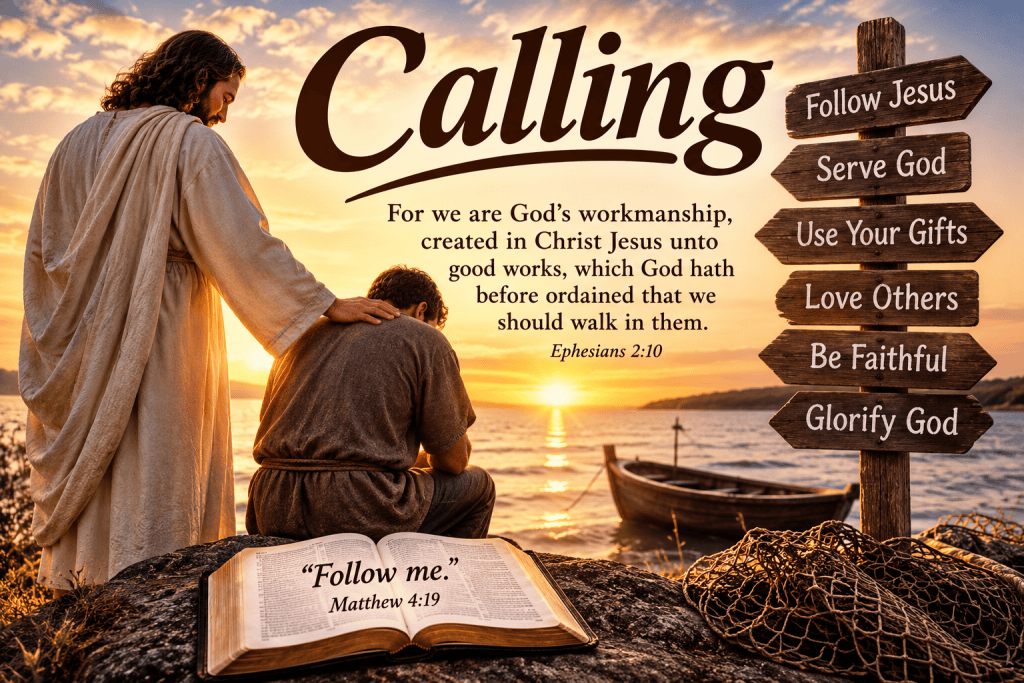
Peter and Andrew were fishermen. Jesus approached them and said:
“Follow me, and I will make you fishers of men” (Matthew 4:19).
Notice what came first.
Jesus did not begin by giving them a detailed explanation of everything they would accomplish.
He simply said:
“Follow me.”
That is where every Christian calling begins.
Before God calls us to a particular task, ministry, occupation, or responsibility, He calls us to Himself.
Sometimes we become so concerned about discovering God’s plan that we overlook the clearest part of His plan.
Follow Jesus today.
Obey what you already know.
Walk faithfully with Him.
Then trust Him with tomorrow.
Third, We Are Called to Salvation
The first and greatest calling is the Gospel call.
Paul writes:
“Who hath saved us, and called us with an holy calling, not according to our works, but according to his own purpose and grace” (2 Timothy 1:9).
God’s calling does not begin with what we can accomplish for Him.
It begins with what Christ has accomplished for us.
Jesus died for our sins.
He rose from the dead.
God calls sinners to repent and believe the Gospel.
We come to Christ not because we have earned His favor, but because He offers salvation by grace.
That means Christian calling can never become a source of pride.
Whatever God allows us to accomplish, we begin as sinners saved by grace.
Fourth, We Are Called to Holiness
God does not merely call us out of something.
He calls us into something.
Peter writes:
“But as he which hath called you is holy, so be ye holy in all manner of conversation” (1 Peter 1:15).
God calls believers away from the old life of sin and toward a life that reflects the character of Christ.
Our calling, therefore, is not merely about what we do.
It is also about who we are becoming.
A person can accomplish impressive things and still neglect his relationship with God.
We sometimes become so focused on our assignment that we forget our character.
God is interested in both.
He calls us to serve Him faithfully, but He also calls us to become more like Jesus.
Fifth, We Are Called to Serve
Ephesians 2:10 says:
“For we are his workmanship, created in Christ Jesus unto good works, which God hath before ordained that we should walk in them.”
God saves us for a purpose.
Every Christian has opportunities to serve.
Some:
- preach.
- teach.
- sing.
- encourage.
- give.
- lead.
- care for children.
- visit the sick.
- prepare meals.
- repair buildings.
- serve quietly behind the scenes where few people ever notice.
The church sometimes makes the mistake of dividing Christians into two groups: ministers and everybody else.
The New Testament does not make that distinction so sharply.
Pastors have a particular calling and responsibility, but every Christian is a servant of Jesus Christ.
You may never stand behind a pulpit.
You still have a ministry.
Sixth, Calling Is Bigger Than a Career
We often ask young people:
“What are you going to be when you grow up?”
Usually, we mean, “What occupation will you choose?”
But your occupation is only one part of your life.
A Christian may be called to work as a teacher, mechanic, physician, carpenter, farmer, accountant, truck driver, homemaker, business owner, or countless other occupations.
Paul writes:
“And whatsoever ye do in word or deed, do all in the name of the Lord Jesus” (Colossians 3:17).
The Christian does not have to work in a church building to serve God.
Your:
- workplace can become a place of ministry.
- home can become a place of ministry.
- neighborhood can become a place of ministry.
- retirement years can become a season of ministry.
The question is not simply:
“Do I have a Christian job?”
The question is:
“Am I serving Christ where He has placed me?”
Seventh, How Do I Discover My Calling?
This is where many Christians struggle.
They want God to send a letter from Heaven saying:
Here is exactly what I want you to do for the next thirty years.
Usually, God does not work that way.
He leads us step by step.
Several things can help us recognize His direction.
Start with Scripture
God will never call you to something that contradicts His Word.
The Bible already reveals much of God’s will.
You do not need:
- to pray about whether God wants you to be honest.
- a sign to determine whether you should forgive.
- a vision to know whether you should love your neighbor.
Begin with what God has already said.
Pray for Wisdom
James writes:
“If any of you lack wisdom, let him ask of God” (James 1:5).
Bring your decisions before God.
Ask Him:
- to open the right doors and close the wrong ones.
- to expose selfish motives.
- to give you wisdom rather than simply confirming what you already want.
Consider Your Gifts
God gives believers different abilities and spiritual gifts.
Romans 12 and 1 Corinthians 12 describe a variety of gifts within the church.
What:
- has God equipped you to do?
- do other mature Christians recognize in you?
- does your service seem to bear fruit?
Your abilities do not automatically determine your calling, but they can provide important clues.
Look at the Opportunities God Provides
Sometimes God’s calling becomes clear through an opportunity.
A need appears, a door opens, someone asks for help, or a responsibility comes your way.
We can spend so much time searching for God’s mysterious plan that we miss the opportunity standing directly in front of us.
Faithfulness often begins with the next thing God has placed before us.
Eighth, Calling Does Not Mean Easy
We sometimes assume that if God calls us to something, everything will fall neatly into place.
Tell that to Moses, Jeremiah, to Paul, or to the disciples.
God’s calling may lead through opposition, disappointment, sacrifice, uncertainty, and suffering.
Paul wrote:
“I press toward the mark for the prize of the high calling of God in Christ Jesus” (Philippians 3:14).
A difficult road does not necessarily mean you have taken the wrong road.
Sometimes obedience is difficult precisely because it requires faith.
The question is not:
“Is this easy?”
The question is:
“Is this where God wants me to be?”
Ninth, Sometimes God Redirects Our Calling
There are seasons in life.
A person may faithfully serve God in one way for twenty years and then find that God opens another door.
That does not mean the first calling failed.
It may simply mean that one assignment ended and another began.
Acts 16 gives an interesting example. Paul intended to preach in certain areas, but God redirected him toward Macedonia.
Paul had the right mission—preaching the Gospel—but God changed the location.
Sometimes God changes our circumstances without changing our purpose.
- A job ends.
- Children leave home.
- Health changes.
- Retirement comes.
- A ministry closes.
- A new opportunity appears.
In those moments, we should not assume:
“God is finished with me.”
Instead, ask:
“Lord, how do You want me to serve You now?”
Tenth, There Is No Retirement from Following Jesus
The world often measures usefulness by productivity.
God measures faithfulness.
Age does not cancel your calling.
Retirement does not cancel your calling.
Physical limitations do not cancel your calling.
You may not be able to serve in the same ways you once did, but as long as God gives you life, there are ways to glorify Him.
You can:
- pray.
- encourage.
- teach.
- give.
- mentor younger believers.
- share what God has taught you.
- tell someone about Jesus.
- demonstrate patience, faith, gratitude, and hope.
Some of the most important ministry a Christian ever performs may happen in the later chapters of life.
Eleventh, Do Not Compare Your Calling with Someone Else’s
Peter once asked Jesus about John’s future.
Jesus essentially told Peter that John’s assignment was none of his concern.
Then Jesus said:
“Follow thou me” (John 21:22).
That is good advice.
Comparison is dangerous.
Someone else’s ministry may be larger, abilities may seem greater, or someone else’s opportunities may appear more exciting.
But God has not called you to live someone else’s life.
He has called you to be faithful with your life.
You are responsible for the opportunities, gifts, resources, relationships, and responsibilities God has entrusted to you.
Faithfulness matters more than fame.
Twelveth, Ordinary Faithfulness Is a Calling
We sometimes imagine that God’s calling must involve something dramatic.
Go overseas.
Start a ministry.
Write a book.
Preach to thousands.
Sometimes it does.
Often it looks much more ordinary.
Care for your family.
Keep your word.
Work honestly.
Help your neighbor.
Teach a Sunday school class.
Encourage someone who is discouraged.
Pray for someone who is suffering.
Share the Gospel with a friend.
Serve your church.
Do the next right thing.
Much of the Christian life consists of ordinary faithfulness performed for an extraordinary God.
Jesus said:
“He that is faithful in that which is least is faithful also in much” (Luke 16:10).
Never underestimate what God can accomplish through a lifetime of small acts of obedience.
Thirthteenth, What’s It Mean for Me?
You may wonder:
“What is God’s calling for my life?”
Begin with what you already know.
God calls you to:
- Jesus Christ.
- salvation.
- holiness.
- love Him and love others.
- serve.
- faithfulness.
Then, within that greater calling, He gives you particular assignments.
Some last a lifetime.
Others last a season.
You do not have to understand the entire journey before taking the next step.
When Jesus called Peter and Andrew, He did not hand them a map explaining everything ahead.
He said:
“Follow me.”
And they followed.
Perhaps that is the best way to understand calling.
You do not have to know everything God will ask you to do tomorrow.
You simply need to be faithful to what He asks you to do today.
Listen to His Word.
Walk with Christ.
Use what He has given you.
Serve where He has placed you.
Trust Him when the road changes.
And remember:
Your calling is not primarily about finding something important to do.
It is about belonging to Jesus Christ and faithfully following Him wherever He leads.
<<Back to the Teaching Library
Dr. Alan Holden has served in pastoral ministry for more than 35 years, preaching and teaching the Bible in churches across the United States. He holds a Doctor of Ministry from Luther Rice Seminary and a Master of Divinity from The Southern Baptist Theological Seminary. Through What’s It Mean?, he seeks to help readers understand the meaning of Scripture and grow in their walk with Christ. He is currently the pastor of Lake Saunders Baptist Church in Tavares, FL.