






New Creation: What’s It Mean?
Key Scriptures: Isaiah 65:17; Romans 8:18–23; 2 Corinthians 5:17; 2 Peter 3:13; Revelation 21:1–5; Revelation 22:1–5
The Christian story begins with creation.
“In the beginning God created the heaven and the earth.”
— Genesis 1:1
God looked upon everything He had made and declared it “very good” (Genesis 1:31). There was no sin, suffering, disease, death, sorrow, or separation from God.
Then sin entered the world.
Adam and Eve rebelled against God, and creation came under the curse. Sin damaged our relationship with God, with one another, and even with the created world itself. Pain, suffering, decay, and death became part of human experience.
But the Bible does not end with a ruined creation.
It ends with a new creation.
John writes:
“And I saw a new heaven and a new earth: for the first heaven and the first earth were passed away.”
— Revelation 21:1
God’s plan of redemption is larger than rescuing individual souls from judgment. Through Jesus Christ, God is restoring what sin has broken.
The Bible begins with creation.
It ends with new creation.
And Jesus Christ stands at the center of it all.
First, What Is the New Creation?
The phrase “new creation” describes God’s work of making all things new through Jesus Christ.
It has both a present and a future meaning.
Something happens now when a person trusts Christ.
Paul writes:
“Therefore if any man be in Christ, he is a new creature: old things are passed away; behold, all things are become new.”
— 2 Corinthians 5:17
Salvation is not simply God improving the old person.
God gives us new life.
We receive a new relationship with God, a new heart, a new purpose, and a new identity in Christ.
But that work has not yet reached its final completion.
We still:
- live in bodies that grow old.
- struggle with sin.
- attend funerals.
- experience sickness, disappointment, grief, and pain.
The new creation has begun, but it has not yet been completed.
One day it will be.
Second, Creation Is Waiting
Human beings are not the only ones affected by sin.
Creation itself suffers under the curse.
Paul writes:
“For we know that the whole creation groaneth and travaileth in pain together until now.”
— Romans 8:22
That is a remarkable picture.
Creation groans.
Disease, disasters, decay, suffering, and death remind us that the world we know is not the world as God originally intended it to be.
But creation’s groaning is not hopeless.
Paul compares it to childbirth.
Childbirth involves pain, but the pain is leading toward something wonderful.
Creation is waiting for redemption.
Paul continues:
“And not only they, but ourselves also… groan within ourselves, waiting for the adoption, to wit, the redemption of our body.”
— Romans 8:23
Christians groan too.
We:
- feel the weakness of these bodies.
- experience temptation.
- watch people we love suffer.
- bury friends and family members.
Something inside us says:
This is not the way things are supposed to be.
And Scripture answers:
You are right.
Something better is coming.
Third, God Promised a New Heaven and New Earth
The promise of new creation did not suddenly appear in Revelation.
Centuries earlier, God spoke through Isaiah:
“For, behold, I create new heavens and a new earth: and the former shall not be remembered, nor come into mind.”
— Isaiah 65:17
Peter later repeated that hope:
“Nevertheless we, according to his promise, look for new heavens and a new earth, wherein dwelleth righteousness.”
— 2 Peter 3:13
Notice what characterizes this coming world:
Righteousness dwells there.
Today righteousness often seems like a stranger in this world.
Sin appears everywhere.
But in God’s new creation, righteousness will be completely at home.
There will be no rebellion against God.
No:
- injustice.
- corruption.
- temptation.
- evil.
God will make everything right.
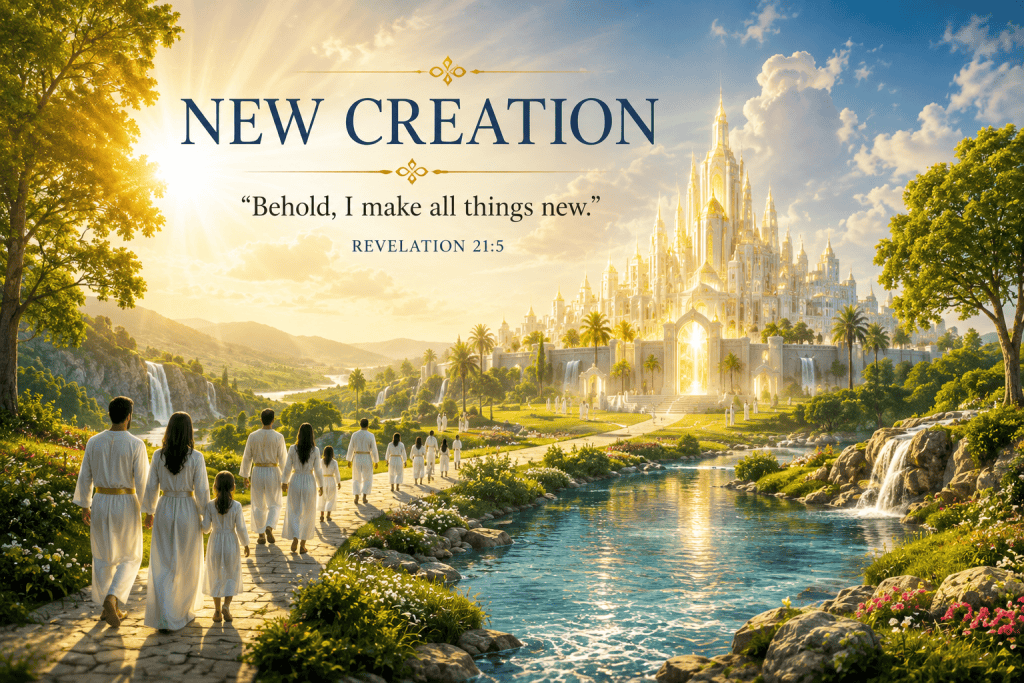
Fourth, “Behold, I Make All Things New”
Near the end of the Bible, John receives a magnificent vision:
“And I saw a new heaven and a new earth.”
— Revelation 21:1
Then John sees the New Jerusalem coming down from God out of heaven.
A voice declares:
“Behold, the tabernacle of God is with men, and he will dwell with them.”
— Revelation 21:3
This is the heart of the new creation.
God will dwell with His people.
Throughout Scripture, God continually moves toward humanity.
He walked with Adam and Eve in Eden.
He dwelt among Israel in the Tabernacle.
His glory filled the Temple.
Jesus came as Emmanuel—“God with us.”
The Holy Spirit now dwells within believers.
But in the new creation, God’s presence will be experienced in its fullness forever.
John says:
“And they shall see his face.”
— Revelation 22:4
That may be one of the greatest promises in all of Scripture.
We will see Him.
Fifth, No More Death
Revelation 21 contains words that Christians have read beside countless hospital beds and gravesides:
“And God shall wipe away all tears from their eyes; and there shall be no more death.”
— Revelation 21:4
Imagine those words.
No more death.
Death has haunted humanity since Genesis 3.
Every:
- generation experiences it.
- family eventually faces it.
- cemetery testifies that something is terribly wrong with our world.
But death will not have the final word.
Jesus will.
Paul declares:
“The last enemy that shall be destroyed is death.”
— 1 Corinthians 15:26
At the resurrection, Christ will completely defeat this ancient enemy.
The new creation will have no cemeteries.
There will be no funeral homes.
No graves.
No final goodbyes.
Death itself will be gone.
Sixth, No More Sorrow or Pain
John continues:
“Neither sorrow, nor crying, neither shall there be any more pain.”
— Revelation 21:4
Think about everything contained in those words.
No:
- cancer.
- dementia.
- arthritis.
- heart disease.
- depression.
- broken bodies.
- tragic accidents.
- loneliness.
- betrayal.
- grieving parents.
- suffering children.
- tears caused by sin.
God does not merely promise to help us cope with suffering forever.
He promises that suffering itself will end.
The Christian hope is not merely that tomorrow might be better.
Our hope is that Jesus Christ is making all things new.
Seventh, The Curse Will Be Gone
Revelation 22 brings us back to Genesis.
John sees the river of the water of life and the tree of life. Then he writes:
“And there shall be no more curse.”
— Revelation 22:3
That statement connects the end of the Bible with its beginning.
Genesis 3 introduced the curse.
Revelation 22 removes it.
In Genesis, humanity loses access to the tree of life.
In Revelation, the tree of life appears again.
Humanity is driven from God’s presence in Genesis.
God’s people see His face in Revelation.
In Genesis, death enters the human story.
In Revelation, death disappears forever.
What sin ruined, Christ restores.
The Bible is the story of God bringing His creation from Eden lost to something even greater—creation redeemed.
Eighth, Jesus Makes the New Creation Possible
None of this happens because humanity eventually learns to fix itself.
We cannot educate sin out of the human heart.
Technology cannot eliminate evil.
Governments cannot create paradise.
Money cannot purchase eternal life.
Human progress cannot conquer death.
The new creation comes through Jesus Christ.
At the cross, Jesus dealt with the very thing that ruined creation—sin.
Peter writes:
“Who his own self bare our sins in his own body on the tree.”
— 1 Peter 2:24
Then Jesus rose from the dead.
His resurrection was not merely an amazing miracle. It was the beginning of something new.
The risen Christ is the guarantee that death will not win.
Because Jesus lives, everyone who belongs to Him will live.
His resurrection points forward to our resurrection and ultimately to the renewal of creation itself.
Ninth, New Creation Begins in Us Now
Although the complete new creation awaits the future, God has already begun His work in believers.
Paul says:
“If any man be in Christ, he is a new creature.”
— 2 Corinthians 5:17
The Christian life is therefore a preview of what God intends to do with the universe.
God takes sinners and makes them new.
He replaces hatred with love.
Pride with humility.
Selfishness with generosity.
Despair with hope.
Bondage with freedom.
Spiritual death with spiritual life.
We are not yet everything we will become.
But God has already begun His work.
The Holy Spirit is changing us into the likeness of Christ.
One day that transformation will be complete.
Tenth, Our Future Is Physical
Sometimes Christians speak about eternity as though we will spend forever floating among clouds as disembodied spirits.
That is not the Bible’s final picture.
The Christian hope includes resurrection.
Jesus rose bodily from the grave, and believers will also be raised.
Paul writes:
“For this corruptible must put on incorruption, and this mortal must put on immortality.”
— 1 Corinthians 15:53
God created human beings as both physical and spiritual creatures.
His final plan does not abandon His creation.
He redeems it.
Our eternal future is resurrection life in God’s renewed creation, living forever in His presence.
That is far richer than the popular picture of simply “going to heaven.”
Eleventh, the New Creation Changes How We Live Today
Future hope should produce present faithfulness.
If God is making all things new, then our lives should already reflect His coming kingdom.
We should:
- pursue holiness because righteousness will characterize the world to come.
- love people because God’s kingdom is a kingdom of love.
- care for those who suffer because suffering does not represent God’s final purpose.
- proclaim the Gospel because people need to know the Savior who makes all things new.
- hold earthly possessions loosely because this present world is temporary.
- never surrender to despair.
Christians are people of hope.
Twelveth, Hope When Life Hurts
The doctrine of new creation becomes especially precious during difficult seasons.
When your body grows weaker, remember:
A resurrection body is coming.
When someone you love dies in Christ, remember:
Death is not the end.
When evil seems to triumph, remember:
Righteousness will dwell in God’s new creation.
When the world seems hopelessly broken, remember:
Jesus has not abandoned His world.
When tears fill your eyes, remember:
God Himself will wipe them away.
Christian hope does not pretend that suffering is painless.
It declares that suffering is temporary.
Thirthteenth, What Does New Creation Mean for the Christian?
New creation means that sin does not get the last word.
Death does not get the last word.
Cancer does not get the last word.
Sorrow does not get the last word.
Satan does not get the last word.
Jesus does.
The One seated upon the throne declares:
“Behold, I make all things new.”
— Revelation 21:5
Not some things.
All things.
Questions for Reflection
- How does the promise of a new heaven and new earth change the way I view the troubles of this life?
- Do I think of salvation only as going to heaven, or do I understand the biblical hope of resurrection and new creation?
- What areas of my life is God making new right now?
- How should the promise of future righteousness affect the way I live today?
- Am I placing too much hope in things that belong only to this present world?
- Who needs to hear the hope of the Gospel from me?
- What part of Revelation 21–22 gives me the greatest hope?
Final Thought
The Bible begins with a garden where humanity enjoyed fellowship with God.
It ends with a city where redeemed humanity lives forever in His presence.
Between those two scenes stands a cross and an empty tomb.
Jesus entered our broken creation, bore our sin, defeated death, and rose again.
And because He lives, the story is moving toward a glorious conclusion.
A day is coming when there will be no more curse, no more death, no more sorrow, and no more pain.
God will dwell with His people.
We will see His face.
And the One who sits upon the throne will declare:
“Behold, I make all things new.”
That is the Christian hope.
That is the promise of New Creation.
<<Back to the Teaching Library
Dr. Alan Holden has served in pastoral ministry for more than 35 years, preaching and teaching the Bible in churches across the United States. He holds a Doctor of Ministry from Luther Rice Seminary and a Master of Divinity from The Southern Baptist Theological Seminary. Through What’s It Mean?, he seeks to help readers understand the meaning of Scripture and grow in their walk with Christ. He is currently the pastor of Lake Saunders Baptist Church in Tavares, FL.