







Love: What’s It Mean?
Key Scriptures: John 3:16; John 13:34–35; 1 Corinthians 13:1–13; Romans 5:8; 1 John 4:7–11, 19; Matthew 22:37–40. These passages all center around the meaning and importance of love.
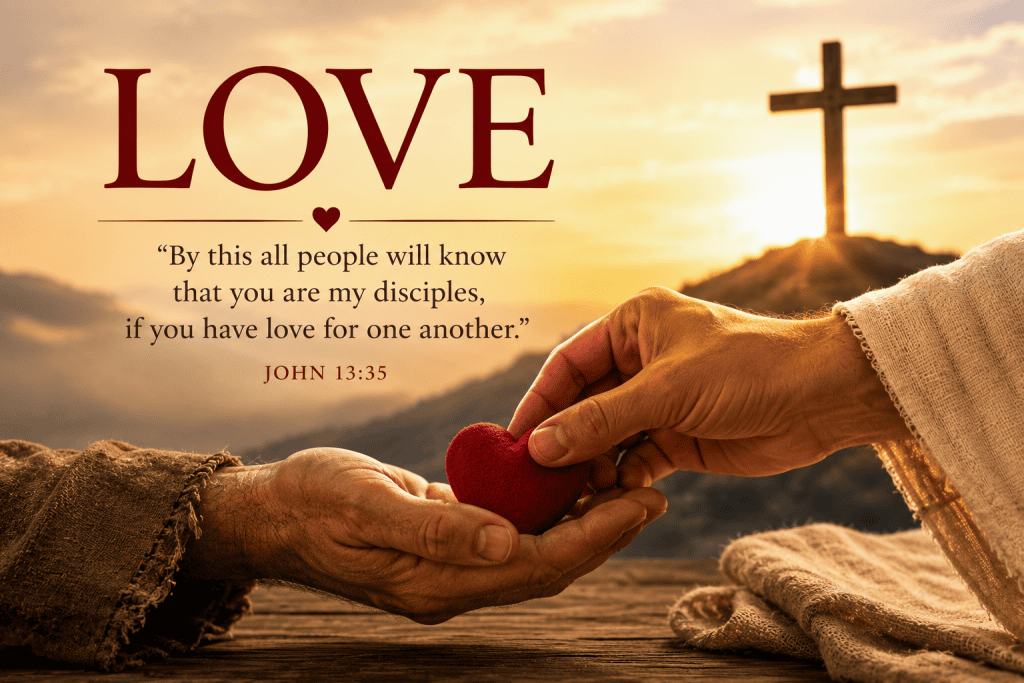
Few words are used more often—and understood less clearly—than love.
We say we love our spouse, our children, our church, our country, our favorite food, and a good cup of coffee. The same word can describe everything from deep devotion to simple enjoyment.
Our culture usually treats love as a feeling. According to that understanding, we “fall in love,” and sometimes we “fall out of love.” Love lasts as long as the feelings last.
But biblical charity is much deeper.
The Bible presents love as something rooted in the very character of God.
“God is love.”
— 1 John 4:8
Love is not merely something God does.
Love is part of who God is.
If we want to understand love, therefore, we must begin with God.
And nowhere do we see God’s charity more clearly than at the cross of Jesus Christ.
God Is Love
John makes one of the simplest and most profound statements in Scripture:
“God is love.”
— 1 John 4:8
This does not mean that charity is God. It means that God’s nature is perfectly loving.
Everything God does is consistent with His holy character.
His love is not sentimental.
It is:
- Holy.
- Truthful.
- Faithful.
- Righteous.
- Sacrificial.
God never has to choose between being loving and being holy. His love is always holy, and His holiness is never separated from His love.
This is important because our culture sometimes defines compassion as approving everything another person wants.
Biblical charity does not work that way.
A loving parent does not allow a child to play in traffic simply because the child wants to.
Sometimes love:
- comforts.
- encourages.
- gives.
- warns.
- says yes.
- must say no.
True charity always seeks what is genuinely good for the other person.
God Loved Us First
Christian love does not begin with our love for God.
It begins with God’s compassion for us.
John writes:
“We love him, because he first loved us.”
— 1 John 4:19
God did not wait for us to become lovable.
He loved us while we were sinners.
Paul writes:
“But God commendeth his love toward us, in that, while we were yet sinners, Christ died for us.”
— Romans 5:8
That little phrase “while we were yet sinners” is important.
Christ did not die for good people who needed a little help.
He died for sinners.
We had rebelled against God, His commands, and had chosen our own way.
Yet God loved us.
That does not mean God ignored our sin.
His love did something about it.
The Cross Defines Love
If someone asks, “What does compassion look like?” the Christian can point to the cross.
John writes:
“Hereby perceive we the love of God, because he laid down his life for us.”
— 1 John 3:16
Jesus did more than talk about compassion.
He:
- demonstrated it.
- left the glory of heaven.
- became human.
- served.
- touched lepers.
- welcomed sinners.
- fed the hungry.
- forgave His enemies.
- And ultimately, He gave His life.
Jesus said:
“Greater love hath no man than this, that a man lay down his life for his friends.”
— John 15:13
Biblical compassion gives.
That is why John 3:16 begins:
“For God so loved the world, that he gave his only begotten Son.”
God loved, so God gave.
Compassion that never gives anything, sacrifices anything, or costs anything is a poor imitation of biblical love.
The cross teaches us that real love is willing to sacrifice for the good of another.
Charity Is More Than a Feeling
Feelings are important.
God created us with emotions. Affection, compassion, tenderness, and joy are wonderful parts of loving relationships.
But feelings alone cannot sustain biblical love.
Feelings change.
Some mornings you wake up feeling wonderful.
Other mornings you do not want to talk to anybody until after your second cup of coffee.
If love depended entirely upon feelings, marriages, families, friendships, and churches would constantly collapse.
Biblical charity includes commitment.
It chooses to seek another person’s good even when doing so is difficult.
That is why Scripture can command us to love.
Jesus said:
“Thou shalt love thy neighbour as thyself.”
— Matthew 22:39
You cannot command someone to have a particular emotion on demand.
But you can command someone to act lovingly.
Charity becomes visible through our choices.
Charity Is Patient
Perhaps the best-known biblical description of compassion appears in 1 Corinthians 13.
Paul begins:
“Charity suffereth long, and is kind.”
— 1 Corinthians 13:4
“Charity” in the King James Version refers to love.
Charity is patient.
That sounds beautiful until God gives us someone with whom we need to practice patience.
It is easy to love people who never inconvenience us, disagree with us, irritate us, disappoint us, or hurt us.
But those people are difficult to find.
Biblical charity becomes visible precisely when relationships become difficult.
Charity gives people room to grow.
It does not explode at every irritation.
It remembers how patient God has been with us.
Charity Is Kind
Paul immediately adds:
“And is kind.”
— 1 Corinthians 13:4
Kindness is charity in work clothes.
It:
- notices.
- helps.
- speaks gently.
- encourages.
- serves.
- sees someone carrying a burden and asks, “Can I help?”
We sometimes imagine that serving God requires doing something spectacular.
Often the most Christlike thing we can do is something very ordinary.
Make the phone call.
Visit the lonely person.
Prepare the meal.
Send the note.
Listen to someone who needs to talk.
Forgive.
Encourage.
Help.
Charity often looks remarkably ordinary.
But God sees it.
Charity Is Not Self-Centered
Paul continues:
“Charity envieth not; charity vaunteth not itself, is not puffed up.”
— 1 Corinthians 13:4
Sin naturally turns our attention inward.
What do I want?
How does this affect me?
Why didn’t they recognize me?
Why does that person have something I don’t have?
Charity:
- turns our attention outward.
- rejoices when someone else succeeds.
- does not need to be the center of attention.
- does not constantly keep score.
- does not manipulate people to get its own way.
Paul says charity:
“Seeketh not her own.”
— 1 Corinthians 13:5
Jesus modeled this perfectly.
He said:
“For even the Son of man came not to be ministered unto, but to minister.”
— Mark 10:45
Compassion asks:
How can I serve?
Charity Does Not Keep a Record of Wrongs
First Corinthians 13:5 says love:
“Thinketh no evil.”
The idea includes refusing to keep a running account of wrongs committed against us.
Some people have excellent memories when it comes to other people’s failures.
They can remember what someone said seventeen years ago, where they were standing, what they were wearing, and possibly what the weather was that day.
Charity does not maintain a spiritual filing cabinet filled with ammunition for the next argument.
This does not mean pretending that sin never happened.
Forgiveness does not make evil good.
Trust may need to be rebuilt.
Consequences may remain.
But charity refuses to make bitterness a permanent residence in the heart.
Why?
Because Christians live by forgiveness.
God has forgiven us in Christ.
And forgiven people should become forgiving people.
Love Rejoices in Truth
Biblical charity never requires abandoning truth.
Paul writes that charity:
“Rejoiceth not in iniquity, but rejoiceth in the truth.”
— 1 Corinthians 13:6
Our culture often separates love from truth.
We are told that loving someone means affirming whatever that person believes, desires, or chooses.
But Scripture joins love and truth together.
Truth without charity can become harsh.
Charity without truth becomes sentimental.
Jesus perfectly demonstrated both.
John describes Him as:
“Full of grace and truth.”
— John 1:14
Christians should strive for the same balance.
We should never use “truth” as an excuse for cruelty.
Neither should we use “love” as an excuse for avoiding truth.
Real love cares enough to tell the truth—and loves enough to tell it graciously.
Charity Bears, Believes, Hopes, and Endures
Paul gives four beautiful descriptions:
“Beareth all things, believeth all things, hopeth all things, endureth all things.”
— 1 Corinthians 13:7
Charity:
- does not give up easily.
- bears burdens.
- hopes for restoration.
- believes God can change people.
- remains faithful during difficult seasons.
This does not mean allowing abuse, enabling destructive behavior, or pretending serious problems do not exist.
Biblical charity can:
- establish boundaries.
- confront sin.
- seek help.
But compassion does not delight in another person’s failure.
It hopes for redemption.
Love Your Neighbor
Jesus was once asked which commandment was greatest.
He answered:
“Thou shalt love the Lord thy God with all thy heart, and with all thy soul, and with all thy mind.”
— Matthew 22:37
Then He added:
“Thou shalt love thy neighbour as thyself.”
— Matthew 22:39
Love for God and compassion for people belong together.
We cannot separate them.
John makes the point very strongly:
“He that loveth not his brother whom he hath seen, how can he love God whom he hath not seen?”
— 1 John 4:20
Our Christianity becomes visible in the way we treat people.
Not merely people:
- we like.
- who agree with us.
- who can do something for us.
Our neighbor is whoever God places within reach of our compassion.
Love Your Enemies
Then Jesus goes even further.
“Love your enemies, bless them that curse you, do good to them that hate you.” — Matthew 5:44
That may be one of the hardest commands Jesus ever gave.
Loving our friends is natural.
Loving our enemies requires grace.
Jesus demonstrated this from the cross.
As His enemies crucified Him, He prayed:
“Father, forgive them.”
— Luke 23:34
Christians do not love enemies because enemies deserve compassion.
We love because we received love when we did not deserve it either.
Grace received becomes grace extended.
Charity Identifies Christ’s Disciples
Jesus gave His disciples a new commandment:
“That ye love one another; as I have loved you.”
— John 13:34
Then He said:
“By this shall all men know that ye are my disciples, if ye have love one to another.”
— John 13:35
Notice what Jesus did not say.
He did not say the world would recognize His disciples primarily by their buildings, programs, music, traditions, denominational labels, or theological vocabulary.
Those things may have their place.
But Jesus said the identifying mark of His followers should be compassion.
Imagine the testimony of a church where people genuinely love one another.
Where:
- the strong help the weak.
- older believers encourage younger believers.
- disagreements do not become warfare.
- forgiveness is practiced.
- lonely people find family.
- hurting people find compassion.
- sinners hear both truth and grace.
That kind of church makes the Gospel visible.
Charity Must Be Demonstrated
John writes:
“Let us not love in word, neither in tongue; but in deed and in truth.”
— 1 John 3:18
It is easy to say, “I love you.”
The real question is:
What does my life demonstrate?
Charity:
- visits.
- listens.
- gives.
- forgives.
- encourages.
- serves.
- protects.
- tells the truth.
- prays.
- sacrifices.
- stays faithful.
- is not merely something Christians talk about.
It is something Christians do.
Charity Never Fails
Paul eventually says:
“Charity never faileth.”
— 1 Corinthians 13:8
Many things we consider important today will eventually disappear.
Our:
- possessions will pass to someone else.
- accomplishments will fade from memory.
- bodies will return to the dust.
Even spiritual gifts belong to this present age.
But love continues.
Paul concludes 1 Corinthians 13:
“And now abideth faith, hope, charity, these three; but the greatest of these is charity.”
— 1 Corinthians 13:13
Why is love the greatest?
Because charity belongs to eternity.
Faith will become sight.
Hope will become reality.
But love will continue forever.
What Does Love Mean for the Christian?
Love means looking at the cross and seeing how God has loved us.
Then it means allowing that compassion to flow through us toward others.
Charity is not primarily asking:
How do I feel about this person?
It asks:
How can I seek this person’s good?
Charity is patient when patience is difficult.
Kind when kindness costs something.
Forgiving when we have been wounded.
Generous when we could keep everything for ourselves.
Truthful when silence would be easier.
Faithful when walking away would be more convenient.
Jesus did not merely tell us to love.
He showed us how.
Questions for Reflection
- Do I define love according to Scripture or according to the culture around me?
- Is there someone with whom God is asking me to practice greater patience?
- Am I holding onto a record of someone’s past wrongs?
- Do I speak truth with love, or do I tend toward harshness or avoidance?
- How am I practically demonstrating love to my family, church, and neighbors?
- Is there someone I consider an enemy whom I need to begin praying for?
- Would people recognize that I follow Jesus by the way I love others?
Final Thought
If you want to know what love looks like, do not begin with a dictionary.
Look at Jesus:
- washing His disciples’ feet.
- touching the leper.
- welcoming sinners.
- weeping beside Lazarus’s tomb.
- forgiving His enemies.
And finally, look at the cross.
There God demonstrated compassion in its clearest form.
“Herein is love, not that we loved God, but that he loved us, and sent his Son.”
— 1 John 4:10
We love because He:
- first loved us.
- forgave us.
- He served us.
- gave Himself for us.
And when the world sees that kind of love among God’s people, it catches a glimpse of Jesus.
That is love.
<<Back to the Teaching Library
Dr. Alan Holden has served in pastoral ministry for more than 35 years, preaching and teaching the Bible in churches across the United States. He holds a Doctor of Ministry from Luther Rice Seminary and a Master of Divinity from The Southern Baptist Theological Seminary. Through What’s It Mean?, he seeks to help readers understand the meaning of Scripture and grow in their walk with Christ. He is currently the pastor of Lake Saunders Baptist Church in Tavares, FL.