






Genesis 1 — In the Beginning: God Creates the World
Key Scriptures: Genesis 1:1–31; John 1:1–3; Colossians 1:16–17; Hebrews 11:3
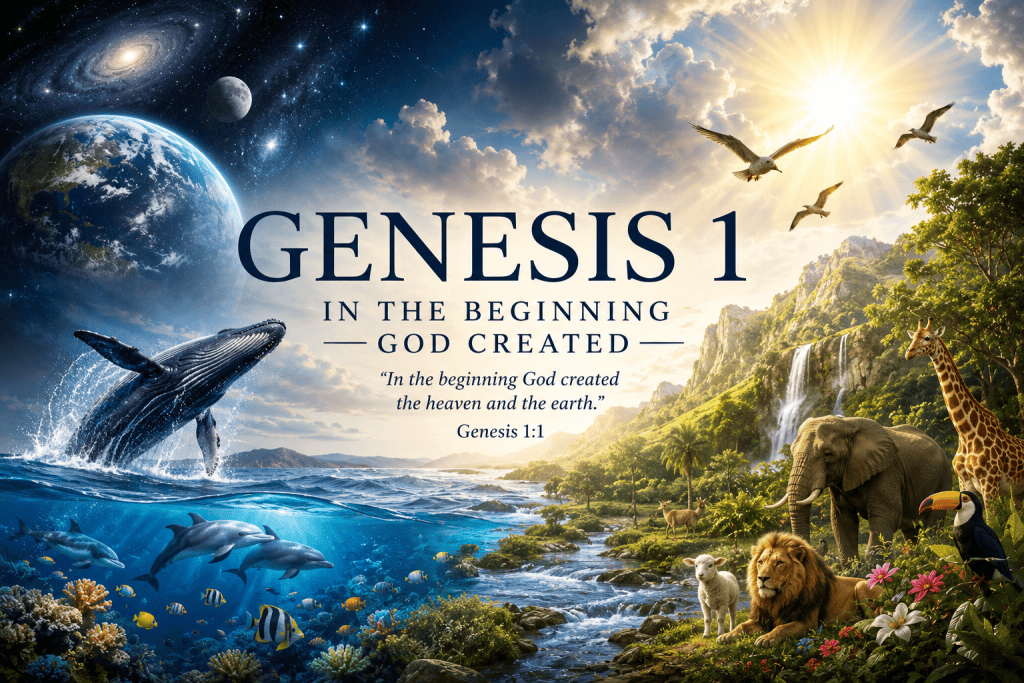
“In the beginning God created the heaven and the earth.” — Genesis 1:1
The Bible does not begin by trying to prove that God exists. It begins with God.
“In the beginning God…”
Before there were stars in the heavens, oceans upon the earth, trees in the forests, or human beings walking upon the ground, God was already there.
Genesis 1 introduces us to the Creator and answers one of humanity’s most fundamental questions: Where did everything come from?
The biblical answer is wonderfully simple.
God created it.
Everything we see ultimately owes its existence to Him. Creation is not an accident. Humanity is not meaningless. Life has purpose because the universe came from the wisdom, power, and will of God.
In the Beginning God
Genesis begins:
“In the beginning God created the heaven and the earth.” — Genesis 1:1
Those first ten words establish the foundation for everything that follows in Scripture.
God existed before creation.
God did not emerge from the universe. The universe came from God.
Psalm 90:2 declares:
“Before the mountains were brought forth, or ever thou hadst formed the earth and the world, even from everlasting to everlasting, thou art God.”
Everything else has a beginning.
God does not.
Before matter existed, God was already there. Prior to time as we know it began, God was. Even before the first star burned in the heavens, God preexisted.
That means God is not merely part of our world.
He is Lord over it.
God Created Everything
Genesis 1 describes God’s creation in an orderly progression.
Day One — Light
God said:
“Let there be light: and there was light.” — Genesis 1:3
God separated the light from the darkness and called the light Day and the darkness Night.
Notice the power of God’s Word.
God speaks, and creation responds.
Day Two — The Heavens
God separated the waters and established the firmament—the expanse of the heavens.
The world was taking shape according to God’s design.
Day Three — Land and Vegetation
God gathered the waters so that dry land appeared.
Then He commanded the earth to produce grass, plants, and fruit-bearing trees.
Again, God created order, abundance, and life.
Day Four — Sun, Moon, and Stars
God placed lights in the heavens to govern day and night and to mark seasons, days, and years.
Genesis simply says:
“He made the stars also.” — Genesis 1:16
Think about that statement.
The heavens contain an unimaginable number of stars, yet Scripture describes their creation almost in passing.
The universe that overwhelms our imagination did not overwhelm God.
Day Five — Fish and Birds
God filled the waters with living creatures and the skies with birds.
The seas that had been empty now swarmed with life.
The skies that had been silent now filled with movement.
God blessed these creatures and commanded them to multiply.
Day Six — Animals and Humanity
God created the animals that live upon the land.
Then something remarkable happened.
God said:
“Let us make man in our image, after our likeness.” — Genesis 1:26
Human beings were not merely another animal added to creation.
God gave humanity a unique place within His creation.
Created in the Image of God
Genesis 1:27 declares:
“So God created man in his own image, in the image of God created he him; male and female created he them.”
This truth gives every human life tremendous value.
Our worth does not come from wealth, intelligence, education, appearance, productivity, age, social position, or physical ability.
Human life has value because human beings bear the image of God.
Men and women possess the ability to reason, communicate, make moral decisions, form relationships, exercise creativity, and know their Creator.
God also gave humanity responsibility over creation:
“Be fruitful, and multiply, and replenish the earth, and subdue it.” — Genesis 1:28
Human beings were created to live under God’s authority while exercising responsible stewardship over the world He made.
We are not the owners of creation.
We are its caretakers.
God Said — And It Happened
One phrase repeatedly appears throughout Genesis 1:
“And God said…”
God said, “Let:
- there be light.”
- there be a firmament.”
- the earth bring forth grass.”
- there be lights.”
- the waters bring forth abundantly.”
- the earth bring forth the living creature.”
Creation responds to the command of its Creator.
Psalm 33:9 summarizes it beautifully:
“For he spake, and it was done; he commanded, and it stood fast.”
God does not struggle to create.
He does not need raw materials supplied by someone else.
He speaks.
And creation obeys.
Hebrews 11:3 tells us:
“Through faith we understand that the worlds were framed by the word of God.”
The God who speaks creation into existence possesses unlimited power.
That should change the way we think about the problems we bring to Him.
Nothing we face is greater than the God who said, “Let there be light.”
Creation Reveals the Creator
We can learn something about an artist by studying his artwork.
In the same way, creation tells us something about its Creator.
Psalm 19:1 says:
“The heavens declare the glory of God; and the firmament sheweth his handywork.”
Look at the stars on a clear night.
Watch waves roll onto a beach.
Listen to rain falling through trees.
Study the complexity of the human body.
Hold a newborn child.
Creation continually points beyond itself toward the One who made it.
Paul writes:
“For the invisible things of him from the creation of the world are clearly seen.” — Romans 1:20
Creation does not tell us everything we need to know about God. For salvation, we need God’s revelation in Scripture and ultimately in Jesus Christ.
But creation tells us unmistakably:
There is a Creator, and He is powerful.
God Saw That It Was Good
Another statement appears repeatedly throughout Genesis 1:
“And God saw that it was good.”
Light was good.
Land and vegetation were good.
The heavenly lights were good.
The creatures of the sea and sky were good.
The animals were good.
Then, after creating humanity, God looked upon everything He had made.
Genesis 1:31 says:
“And God saw every thing that he had made, and, behold, it was very good.”
This is important because the world we experience today is not exactly the world described at the end of Genesis 1.
We experience sickness, suffering, violence, disasters, hatred, aging, and death.
Someone might ask, “If God created the world, why is the world such a mess?”
Genesis answers that question too.
But not in chapter 1.
Genesis 1 tells us how God created the world.
Genesis 3 will tell us what went wrong.
God’s original creation was very good.
Sin brought corruption into God’s good world.
Jesus and Creation
Genesis 1 becomes even more remarkable when we read it alongside the New Testament.
John begins his Gospel with language deliberately reminding us of Genesis:
“In the beginning was the Word, and the Word was with God, and the Word was God.” — John 1:1
Then John tells us:
“All things were made by him; and without him was not any thing made that was made.” — John 1:3
The Word is Jesus Christ.
Paul says of Christ:
“For by him were all things created, that are in heaven, and that are in earth, visible and invisible.” — Colossians 1:16
Jesus did not begin His existence in Bethlehem.
The baby lying in the manger was the eternal Son of God through whom the universe was created.
The hands that would someday be nailed to a cross were the hands of our Creator.
And the One who created life came into His creation to give us eternal life.
What Genesis 1 Means for Us
Genesis 1 is not simply information about the distant past. Its truths affect how we live today.
1. Your Life Has Purpose
If everything happened accidentally, ultimate purpose becomes difficult to explain.
But if God created us, our lives have meaning.
You are here because God created humanity for His purposes.
Our first question should therefore not be:
“What do I want to do with my life?”
A better question is:
“God, what did You create me to do?”
2. Every Person Has Value
Every human being bears God’s image.
That includes the unborn child, the elderly person, the disabled person, the poor person, the wealthy person, the powerful person, and the forgotten person.
Christians should treat human life with dignity because human beings bear the image of God.
3. Creation Belongs to God
Psalm 24:1 declares:
“The earth is the LORD’S, and the fulness thereof.”
Everything ultimately belongs to God.
Our:
- possessions belong to Him.
- abilities belong to Him.
- time belongs to Him.
Even our bodies belong to Him.
We are stewards of what God has entrusted to us.
4. God Is Bigger Than Our Problems
Sometimes our problems appear enormous because we have allowed our view of God to become too small.
Genesis 1 corrects our perspective.
Look at the:
- heavens.
- earth.
- oceans.
- stars.
Then remember:
God made them.
The God who created the universe is not confused by your situation or overwhelmed by your problem.
5. We Owe Our Creator Worship
Creation should lead us to worship.
We do not worship creation.
We worship the Creator.
Revelation 4:11 declares:
“Thou art worthy, O Lord, to receive glory and honour and power: for thou hast created all things.”
Genesis begins by establishing the most basic relationship in existence:
He is the Creator. We are His creatures.
When we understand that relationship, life begins to fall into its proper order.
The Beginning of the Story
Genesis 1 introduces us to a world without sin, suffering, or death.
God:
- created.
- blessed.
- provided.
And God looked upon everything He had made and declared it very good.
But the story will soon take a tragic turn.
Humanity will rebel against its Creator. Sin will enter the human experience. Death will follow.
Yet even then, God will not abandon His creation.
The Creator will become the Redeemer.
The Bible begins:
“In the beginning God…”
And that is still the best place for us to begin.
Before our:
- plans.
- opinions.
- fears.
- questions.
Begin with God.
Finally, WIM Takeaway
Genesis 1 teaches us that God created everything by His power and according to His purpose. Because He is our Creator, our lives have meaning, every human life has value, and God alone deserves our worship.
Questions for Reflection
- What does Genesis 1 teach you about the character and power of God?
- How should being created in God’s image affect the way you see yourself?
- How should it affect the way you treat other people?
- What part of God’s creation most reminds you of His greatness?
- Is there a problem in your life that seems smaller when you remember the power of the Creator?
- What would change if you began each day with the thought, “My life belongs to God”?
<<Back to the Book of Genesis
Dr. Alan Holden has served in pastoral ministry for more than 35 years, preaching and teaching the Bible in churches across the United States. He holds a Doctor of Ministry from Luther Rice Seminary and a Master of Divinity from The Southern Baptist Theological Seminary. Through What’s It Mean?, he seeks to help readers understand the meaning of Scripture and grow in their walk with Christ. He is currently the pastor of Lake Saunders Baptist Church in Tavares, FL.