






Introduction
John 8 is one of the most powerful chapters in the Gospel of John. It reveals both the mercy and majesty of Jesus Christ. In this chapter, Jesus forgives a guilty sinner, proclaims Himself to be the Light of the World, teaches about true freedom, and makes one of the clearest declarations of His deity.
The chapter repeatedly contrasts light and darkness, truth and deception, faith and unbelief.
At its heart is a vital question:
Will we walk in the light of Christ, or remain in the darkness of sin?
The Woman Caught in Adultery (John 8:1–11)
Early in the morning, Jesus was teaching in the Temple when the scribes and Pharisees interrupted Him.
They brought a woman accused of adultery and placed her before the crowd.
They asked:
“Moses in the law commanded us, that such should be stoned: but what sayest thou?” (John 8:5)
Their goal was not justice but entrapment.
If Jesus rejected the Law, they could accuse Him of opposing Moses. If He approved execution, they could portray Him as lacking obedience to the Law of Moses. According to the Mosaic Law, both participants in adultery were subject to the same punishment (Leviticus 20:10; Deuteronomy 22:22). Yet only the woman was dragged before Jesus. If she had truly been caught in the act, the man should have been standing beside her. This reveals the hypocrisy of the religious leaders. They were not motivated by a desire to uphold God’s Law or pursue righteousness. Instead, they were exploiting the situation in an effort to trap Jesus and undermine His ministry. The woman was merely a pawn in their scheme.
Jesus responded by stooping down and writing on the ground.
Then He spoke words that have echoed through history:
“He that is without sin among you, let him first cast a stone at her.” (John 8:7)
One by one, the accusers departed.
Finally Jesus asked:
“Woman, where are those thine accusers?”
When she replied that none remained, Jesus said:
“Neither do I condemn thee: go, and sin no more.” (John 8:11)
What This Teaches Us
Jesus did not excuse her sin.
He extended grace while calling her to repentance.
The gospel always combines:
- Truth and mercy
- Forgiveness and transformation
- Compassion and holiness
Christ receives sinners but never leaves them unchanged.
Jesus Declares: “I Am the Light of the World” (John 8:12–20)
Following this event, Jesus made another of John’s great “I Am” statements:
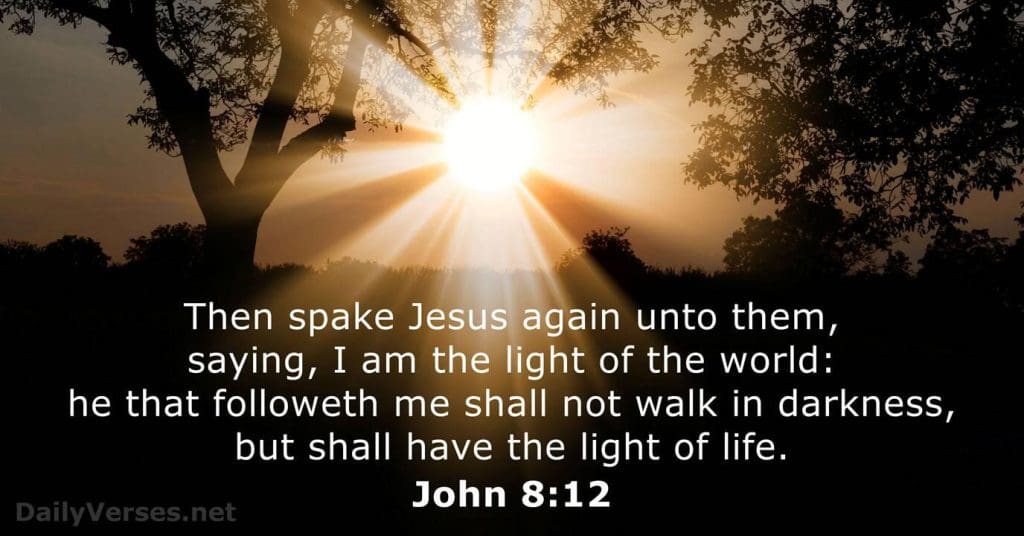
“I am the light of the world: he that followeth me shall not walk in darkness, but shall have the light of life.” (John 8:12)
This declaration likely occurred during the Feast of Tabernacles, when large lamps illuminated the Temple courts.
Against that backdrop, Jesus claimed to be the true source of spiritual light.
What Does Light Represent?
Throughout Scripture, light symbolizes:
- God’s presence
- Truth
- Holiness
- Guidance
- Salvation
Darkness represents:
- Sin
- Ignorance
- Evil
- Spiritual blindness
Jesus was claiming to be the One who reveals God and guides people into truth.
Why We Need the Light
Humanity lives in spiritual darkness apart from Christ.
We may know many facts, possess education, and achieve success, yet remain blind regarding eternal realities.
Only Jesus can illuminate the path to God.
Warning About Unbelief (John 8:21–30)
Jesus warned His listeners:
“If ye believe not that I am he, ye shall die in your sins.” (John 8:24)
These are sobering words.
The greatest issue in life is not wealth, health, or status.
The greatest issue is what a person does with Jesus Christ.
The religious leaders believed they knew God, yet they rejected the One whom God had sent.
Lesson for Today
Religious activity alone cannot save.
Salvation comes through faith in Christ.
People are not saved by:
- Church attendance
- Good works
- Family heritage
- Religious knowledge
They are saved by trusting Jesus as Lord and Savior.
The Truth Will Make You Free (John 8:31–36)
Jesus addressed those who professed belief and said:
“If ye continue in my word, then are ye my disciples indeed.” (John 8:31)
Then He made one of the most famous statements in Scripture:
“Ye shall know the truth, and the truth shall make you free.” (John 8:32)
The people objected because they considered themselves free descendants of Abraham.
Jesus explained that everyone who practices sin is enslaved by it.
True freedom is not political freedom or personal independence.
True freedom is freedom from:
- Sin’s guilt
- Sin’s power
- Sin’s condemnation
Jesus then declared:
“If the Son therefore shall make you free, ye shall be free indeed.” (John 8:36)
The World’s False Freedom
The world often defines freedom as doing whatever we want.
Jesus defines freedom as being delivered from the bondage that destroys us.
Only Christ offers genuine liberty.
Children of Abraham—or Children of the Devil? (John 8:37–47)
The conversation became increasingly confrontational.
The religious leaders boasted of their descent from Abraham.
Jesus replied that true children of Abraham would demonstrate Abraham’s faith.
Instead, they sought to kill Him.
Jesus then made a startling statement:
“Ye are of your father the devil.” (John 8:44)
Why?
Because they rejected God’s truth.
Jesus described Satan as:
- A murderer
- A liar
- The father of lies
The contrast is clear:
- Jesus speaks truth.
- Satan promotes deception.
Every person ultimately follows one of those voices.
Lesson for Today
Spiritual heritage cannot replace personal faith.
Every believer must personally trust and obey Christ.
Before Abraham Was, I Am (John 8:48–59)
The chapter reaches its dramatic climax when Jesus declares:
“Before Abraham was, I am.” (John 8:58)
This statement goes far beyond claiming to be older than Abraham.
Jesus deliberately used the divine name revealed to Moses at the burning bush.
When God spoke to Moses in Exodus 3:14, He said:
“I AM THAT I AM.”
Jesus was identifying Himself with the eternal God of Israel.
The religious leaders immediately understood His claim.
They picked up stones to kill Him for what they considered blasphemy.
Yet Jesus was not committing blasphemy.
He was revealing the truth.
Why This Matters
Christianity is not just the teachings of a great moral leader.
The gospel rests on the identity of Jesus.
He is:
- Fully God
- Fully man
- Eternal
- Savior
- Lord
If Jesus is not God, His claims collapse.
If Jesus is God, every person must respond to Him.
What John 8 Means for Us Today
1. Jesus Offers Grace to Sinners
The woman caught in adultery reminds us that no one is beyond God’s mercy.
2. Jesus Is the Light We Need
The world offers many voices but little truth.
Christ alone illuminates the path to eternal life.
3. Freedom Is Found in Christ
Sin promises freedom but produces bondage.
Jesus breaks the chains.
4. Truth Matters
The battle between truth and deception continues today.
Believers must anchor themselves in God’s Word.
5. Jesus Is God
The declaration “I Am” leaves no room for a merely human Jesus.
He is the eternal Son of God.
Conclusion
John 8 presents a Savior who is both compassionate and powerful.
He forgives the guilty woman.
Jesus exposes religious hypocrisy.
He offers freedom to captives.
And He shines light into darkness.
Most importantly, He reveals Himself as the eternal “I AM.”
The chapter calls every reader to step out of darkness and into the light of Christ.
Those who trust Him discover forgiveness, truth, freedom, and eternal life.
The question remains:
Will you walk in the light of the world, or remain in the darkness?
Jesus invites all who believe in Him to experience the freedom and life that only He can provide.
<<Back to John 7 OR Forward to John 9>>
<<Back to Gospel of John
For more insights to the Gospel of John, order Pastor Alan’s book, Come and See, from the links below.
Dr. Alan Holden has served in pastoral ministry for more than 35 years, preaching and teaching the Bible in churches across the United States. He holds a Doctor of Ministry from Luther Rice Seminary and a Master of Divinity from The Southern Baptist Theological Seminary. Through What’s It Mean?, he seeks to help readers understand the meaning of Scripture and grow in their walk with Christ. He is currently the pastor of Lake Saunders Baptist Church in Tavares, FL.