







Introduction
John 7 is a chapter filled with questions, controversy, and division. As Jesus attends the Feast of Tabernacles in Jerusalem, people debate His identity. Some believe He is the Messiah. Others reject Him. Religious leaders seek to arrest Him. Even His own brothers struggle to believe in Him.
At the center of the chapter stands a question that every person must answer:
Who is Jesus?
John 7 reveals that neutrality is impossible. The claims of Christ force people to choose whether they will believe or reject Him.
Unbelief in His Own Family (John 7:1–9)
As the Feast of Tabernacles approached, Jesus’ brothers encouraged Him to go publicly to Jerusalem and demonstrate His miracles.
They said:
“If thou do these things, shew thyself to the world.” (John 7:4)
John then records a surprising statement:
“For neither did his brethren believe in him.” (John 7:5)
His brothers had grown up with Him. They had witnessed His character and heard His teaching. Yet familiarity did not automatically produce faith.
Jesus responded that His time had not yet come. Throughout John’s Gospel, Jesus operates according to the Father’s timing, not human expectations.
Lesson for Today
Being close to spiritual things does not guarantee genuine faith.
Many people attend church, hear sermons, and know Bible stories without truly trusting Christ.
Faith requires a personal response.
Jesus Arrives at the Feast (John 7:10–13)
Rather than traveling publicly, Jesus went quietly to Jerusalem.
The city buzzed with speculation.
Some asked:
“Where is he?”
Opinions varied widely:
- Some said He was a good man.
- Others claimed He deceived the people.
- Many were afraid to speak openly because of the religious authorities.
The same division exists today.
People admire Jesus as:
- A teacher
- A prophet
- A moral example
But Jesus did not come just to be admired. He came to be believed and obeyed.
The Source of Jesus’ Authority (John 7:14–24)
In the middle of the feast, Jesus began teaching in the Temple.
The religious leaders were amazed because Jesus had not received formal rabbinical training.
They asked how He possessed such knowledge.
Jesus answered:
“My doctrine is not mine, but his that sent me.” (John 7:16)
His authority came directly from the Father.
Jesus then exposed the hypocrisy of His critics. They claimed to defend God’s law while plotting to kill the One sent by God.
Lesson for Today
Truth is not determined by popularity, tradition, or credentials alone.
The ultimate test is whether a teaching comes from God and aligns with His Word.
Is This the Messiah? (John 7:25–36)
As Jesus taught, the people became increasingly divided.
Some wondered:
“Is not this he, whom they seek to kill?”
Others questioned how Jesus could be the Messiah because they believed they knew where He came from.
Yet they failed to understand His true origin.
Jesus declared:
“I know him: for I am from him, and he hath sent me.” (John 7:29)
Again, John emphasizes Jesus’ heavenly origin.
He is not merely a man from Nazareth.
He is the eternal Son sent by the Father.
Though some sought to arrest Him, no one could touch Him because His hour had not yet come.
Lesson for Today
God remains sovereign even when opposition seems overwhelming.
Nothing can thwart His plans.
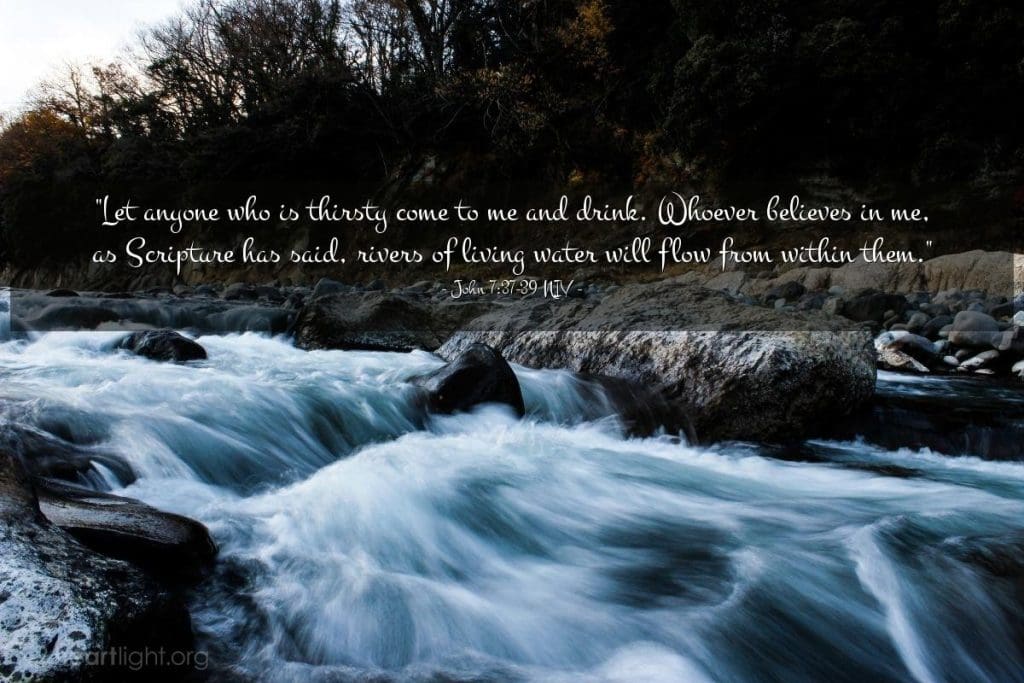
Rivers of Living Water (John 7:37–39)
This is one of the most beautiful invitations in the entire Bible.
On the final day of the feast, Jesus stood and cried out:
“If any man thirst, let him come unto me, and drink.” (John 7:37)
The Feast of Tabernacles included a ceremony in which water was poured out to commemorate God’s provision in the wilderness.
Against that backdrop Jesus made a stunning claim.
He declared Himself to be the source of true spiritual satisfaction.
Then He said:
“He that believeth on me… out of his belly shall flow rivers of living water.” (John 7:38)
John explains that Jesus was speaking about the Holy Spirit, who would be given after Christ’s glorification.
What Does This Mean?
Jesus does not merely satisfy spiritual thirst.
He transforms believers into channels through which God’s life and blessing flow to others.
The Holy Spirit:
- Indwells believers
- Empowers service
- Produces spiritual fruit
- Provides guidance and comfort
- Glorifies Christ
The Christian life is not meant to be spiritually dry.
God intends His people to experience the overflowing presence of His Spirit.
Division Over Jesus (John 7:40–44)
The crowd responded in different ways.
Some declared:
“Of a truth this is the Prophet.”
Others said:
“This is the Christ.”
Still others rejected Him because they misunderstood biblical prophecy and His origins.
John highlights a recurring theme:
“There was a division among the people because of him.” (John 7:43)
Jesus always creates a response.
People may disagree about many things, but they cannot remain indifferent to Christ forever.
The Failure to Arrest Jesus (John 7:45–52)
The Temple officers returned empty-handed after being sent to arrest Jesus.
When questioned, they gave a remarkable answer:
“Never man spake like this man.” (John 7:46)
Even those assigned to arrest Him were captivated by His words.
The religious leaders responded with anger and contempt.
Only Nicodemus—the same man who visited Jesus in John 3—spoke cautiously in His defense.
Though his faith was still developing, Nicodemus showed courage by standing against the crowd.
Lesson for Today
Following Christ often requires standing apart from popular opinion.
True discipleship demands courage.
What John 7 Means for Us Today
1. Jesus Demands a Decision
The people in Jerusalem could not avoid the question of Christ’s identity.
Neither can we.
Every person must decide who Jesus is.
2. God’s Timing Is Perfect
Jesus repeatedly declared that His hour had not yet come.
God’s plans unfold according to His schedule, not ours.
3. Only Christ Satisfies Spiritual Thirst
People search everywhere for meaning and fulfillment.
Jesus alone offers living water that satisfies forever.
4. The Holy Spirit Changes Lives
Believers are not meant merely to survive spiritually.
The Spirit empowers them to flourish and bless others.
5. Opposition Does Not Stop God’s Purposes
Despite constant hostility, Jesus continued His mission until the Father’s plan was fulfilled.
The same God still reigns today.
Conclusion
John 7 presents Jesus standing in the Temple courts amid confusion, controversy, and unbelief.
Some rejected Him.
Others questioned Him.
Some believed Him.
Yet His invitation remains unchanged:
“If any man thirst, let him come unto me, and drink.”
The world still searches for satisfaction in countless places. Jesus alone offers living water for thirsty souls.
The question raised throughout John 7 remains the most important question any person can answer:
Who is Jesus?
Your answer determines not only how you live today, but where you will spend eternity.
<<Back to John 6 OR Forward to John 8>>
<<Back to Gospel of John
For more insights to the Gospel of John, order Pastor Alan’s book, Come and See, from the links below.
Dr. Alan Holden has served in pastoral ministry for more than 35 years, preaching and teaching the Bible in churches across the United States. He holds a Doctor of Ministry from Luther Rice Seminary and a Master of Divinity from The Southern Baptist Theological Seminary. Through What’s It Mean?, he seeks to help readers understand the meaning of Scripture and grow in their walk with Christ. He is currently the pastor of Lake Saunders Baptist Church in Tavares, FL.