







Introduction
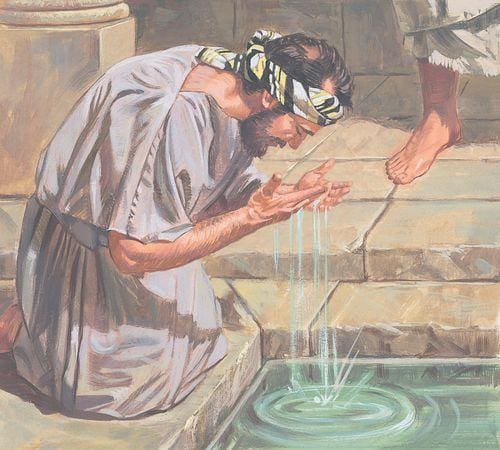
John 9 records one of the most remarkable miracles in the ministry of Jesus—the healing of a man born blind. Yet this chapter is about far more than physical sight. It is a powerful lesson about spiritual blindness and spiritual vision.
As the story unfolds, the blind man gains both physical and spiritual sight, while the religious leaders become increasingly blind to the truth standing before them.
John 9 teaches that seeing Jesus clearly is not primarily a matter of eyesight. It is a matter of faith.
The central question of the chapter is this:
Who is truly blind?
A Man Born Blind (John 9:1–5)
As Jesus passed by, He encountered a man who had been blind from birth.
The disciples immediately asked a theological question:
“Master, who did sin, this man, or his parents, that he was born blind?” (John 9:2)
In that culture, many assumed suffering was always the direct result of a specific sin.
Jesus rejected that assumption.
He answered:
“Neither hath this man sinned, nor his parents: but that the works of God should be made manifest in him.” (John 9:3)
Jesus was not saying the man had never sinned. Rather, He was teaching that this particular blindness was not a direct punishment for a specific wrongdoing.
Lessons About Suffering
This passage reminds us that suffering is not always the result of personal sin.
Sometimes God permits difficulties in order to:
- Display His power
- Deepen faith
- Strengthen character
- Accomplish His purposes
Not every “why” question receives a complete answer, but believers can trust God’s wisdom even when they do not understand His plans.
The Miracle at the Pool of Siloam (John 9:6–12)
Jesus spat on the ground, made clay, and applied it to the man’s eyes.
Then He instructed him:
“Go, wash in the pool of Siloam.” (John 9:7)
The man obeyed.
When he washed, he returned seeing.
Imagine the wonder of that moment.
For the first time in his life:
- He saw the sky
- He saw people
- He saw colors
- He saw the world around him
The miracle astonished everyone who knew him.
Some questioned whether he was truly the same man.
His simple response was:
“I am he.” (John 9:9)
The Importance of Obedience
The man did not fully understand what Jesus was doing.
He simply obeyed.
Faith often begins the same way.
God may not explain every detail, but He calls us to trust and obey.
The Pharisees Investigate (John 9:13–34)
Instead of celebrating the miracle, the religious leaders focused on a different issue.
Jesus had healed the man on the Sabbath.
To them, breaking their traditions seemed more important than acknowledging God’s power.
The Pharisees questioned:
- The healed man
- His parents
- The circumstances of the miracle
Yet the more they investigated, the stronger the man’s testimony became.
At first he called Jesus:
“A man that is called Jesus.” (John 9:11)
Later he described Him as:
“A prophet.” (John 9:17)
His understanding continued to grow.
A Powerful Testimony
When pressured by the Pharisees, the healed man declared:
“One thing I know, that, whereas I was blind, now I see.” (John 9:25)
This remains one of the greatest testimonies in Scripture.
He did not possess advanced theological training.
He simply testified to what Jesus had done.
Lesson for Today
Every believer can share the same kind of testimony.
You may not have answers to every question, but you can tell others how Christ has changed your life.
The Blindness of the Religious Leaders (John 9:35–41)
The great irony of the chapter is that the blind man sees while the religious leaders remain blind.
The man received sight.
The Pharisees rejected the evidence before their eyes.
They possessed:
- Religious knowledge
- Biblical education
- Social influence
Yet they failed to recognize the Messiah.
Spiritual blindness is far more dangerous than physical blindness.
A person can have perfect eyesight and still be unable to see spiritual truth.
The Man Meets Jesus Again (John 9:35–38)
After the Pharisees cast him out of the synagogue, Jesus sought him out.
This is a beautiful reminder of Christ’s care for those who suffer rejection because of Him.
Jesus asked:
“Dost thou believe on the Son of God?” (John 9:35)
The man replied:
“Who is he, Lord, that I might believe on him?”
Jesus answered:
“Thou hast both seen him, and it is he that talketh with thee.” (John 9:37)
The man’s response was immediate:
“Lord, I believe.”
Then he worshiped Jesus.
Notice his spiritual journey:
- He knew Jesus as a man.
- He recognized Him as a prophet.
- He trusted Him as Lord.
That is the goal of every believer—to move beyond mere knowledge and enter into worship.
Spiritual Sight and Spiritual Blindness
Throughout John 9, two groups move in opposite directions.
The Blind Man
He moves from darkness to light.
His faith grows stronger with each encounter.
He ends by worshiping Jesus.
The Pharisees
They move from skepticism to outright rejection.
Despite overwhelming evidence, they refuse to believe.
They end the chapter more spiritually blind than when it began.
The Danger of Pride
Pride often blinds people to God’s truth.
The Pharisees believed they already knew everything.
As a result, they could not recognize the One standing before them.
Humility opens the door to faith.
Pride closes it.
What John 9 Means for Us Today
1. God Can Use Difficult Circumstances
The man’s blindness became a stage upon which God’s glory was displayed.
God often works through our struggles in ways we cannot see at the moment.
2. Obedience Leads to Blessing
The man obeyed Christ’s command before experiencing the miracle.
Faith trusts God even when the outcome is not yet visible.
3. Your Testimony Matters
The healed man’s testimony was simple but powerful.
Every Christian has a story of God’s grace to share.
4. Spiritual Blindness Is Real
Many people reject Christ not because of insufficient evidence but because they refuse to believe.
5. Jesus Seeks Those Who Trust Him
After the man was rejected by others, Jesus found him.
The Savior still seeks those who place their faith in Him.
Conclusion
John 9 begins with a blind beggar and ends with a worshiper.
The man who once lived in darkness encountered Jesus and received both physical and spiritual sight.
Meanwhile, the religious leaders remained trapped in unbelief.
The chapter reminds us that the greatest miracle is not seeing with our eyes but seeing with faith.
Jesus still opens blind eyes today.
He reveals truth to those willing to trust Him.
The question John 9 leaves with every reader is simple:
Do you truly see Jesus for who He is?
Those who do discover that He is the Light of the World, the Son of God, and the Savior who brings sight to the spiritually blind.
<<Back to John 8 OR Forward to John 10>>
<<Back to Gospel of John
For more insights to the Gospel of John, order Pastor Alan’s book, Come and See, from the links below.
Dr. Alan Holden has served in pastoral ministry for more than 35 years, preaching and teaching the Bible in churches across the United States. He holds a Doctor of Ministry from Luther Rice Seminary and a Master of Divinity from The Southern Baptist Theological Seminary. Through What’s It Mean?, he seeks to help readers understand the meaning of Scripture and grow in their walk with Christ. He is currently the pastor of Lake Saunders Baptist Church in Tavares, FL.