






Christian Ethics: What’s It Mean?
Key Scriptures: Romans 12:1–2; Micah 6:8; Matthew 22:37–40; John 14:15; 1 Corinthians 10:31; Colossians 3:17; James 1:22
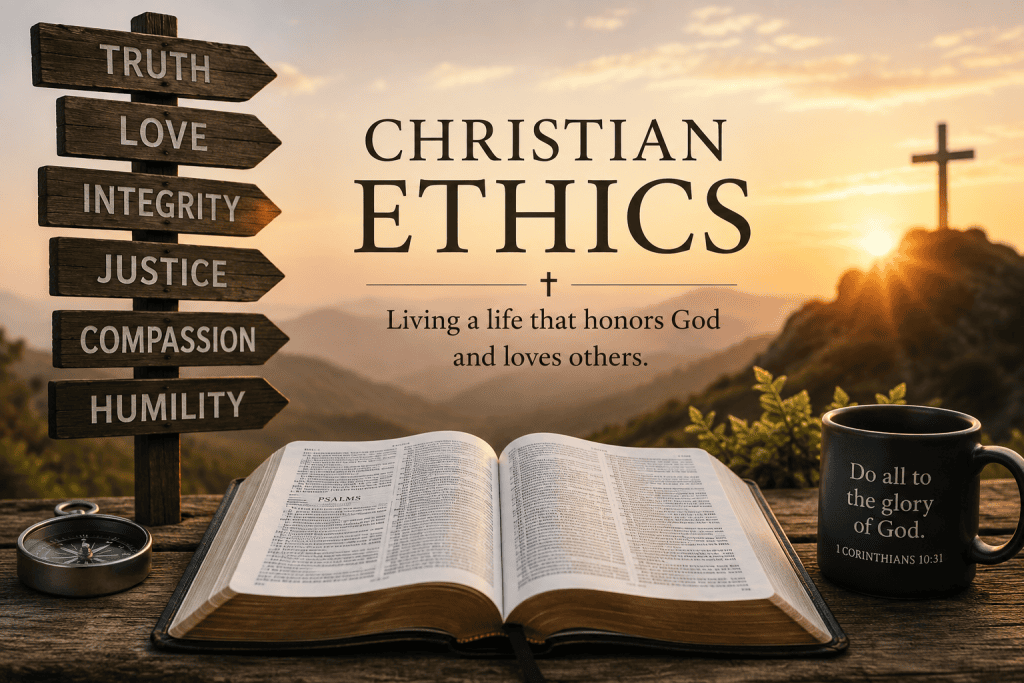
Christian ethics answers a practical question every believer faces: How should a follower of Jesus Christ live?
The Bible does more than tell us what to believe. It tells us how our faith should shape our character, choices, relationships, work, words, money, sexuality, priorities, and treatment of other people. Christian ethics takes the truth we believe and applies it to the life we live.
Paul writes:
“And whatsoever ye do, do it heartily, as to the Lord, and not unto men” (Colossians 3:23).
Christian ethics is not merely a collection of rules about right and wrong. It is living every area of life under the lordship of Jesus Christ.
First, What Are Christian Ethics?
The word ethics refers to the principles that guide our decisions about right and wrong, good and evil, and how we ought to live.
Everyone lives by some ethical standard. The question is not whether we have one, but where our standard comes from.
Our culture often determines right and wrong according to personal preference, popular opinion, political ideology, or changing social values. The Christian begins somewhere else.
We begin with God.
God’s character defines what is good. God’s Word reveals His will. Jesus Christ shows us what righteous living looks like.
Therefore, Christian ethics asks more than:
“What do I want to do?”
It asks:
“What does God want me to do?”
Second, God Is the Foundation of Christian Ethics
Christian morality does not begin with a rulebook. It begins with the character of God.
God is holy (Isaiah 6:3).
>God is righteous (Psalm 11:7).
>God is just (Deuteronomy 32:4).
>God is truthful (Titus 1:2).
>God is loving (1 John 4:8).
>God is merciful (Ephesians 2:4).
Because God is:
- holy, holiness is good.
- is truthful, lying is wrong.
- is just, injustice is wrong.
- loving, selfish cruelty contradicts His character.
God does not invent morality arbitrarily. Goodness flows from who God is.
The Christian therefore does not ask culture to define righteousness. We look to the God who created us.
Third, Scripture Is Our Authority
Paul tells Timothy:
“All scripture is given by inspiration of God, and is profitable for doctrine, for reproof, for correction, for instruction in righteousness” (2 Timothy 3:16).
Scripture gives believers an objective standard.
Human opinions change. Cultural standards change. What society condemns in one generation may be celebrated in another. But God’s truth does not shift with public opinion.
That does not mean the Bible provides a specific verse for every modern situation. Scripture does not directly mention social media, artificial intelligence, modern medicine, automobiles, or thousands of other circumstances we face.
Instead, Scripture gives us commands, principles, examples, and wisdom that enable us to evaluate new situations faithfully.
The question becomes:
“What biblical truth applies to this decision?”
Fourth, Jesus Summarized Christian Ethics with Love
A lawyer once asked Jesus which commandment was greatest. Jesus answered:
“Thou shalt love the Lord thy God with all thy heart, and with all thy soul, and with all thy mind.”
Then He added:
“Thou shalt love thy neighbour as thyself” (Matthew 22:37, 39).
These two commands provide the framework for Christian ethics.
Love God. Love people.
But biblical love is not merely an emotion. Love seeks what is genuinely good for another person according to God’s truth.
Jesus said:
“If ye love me, keep my commandments” (John 14:15).
Love and obedience belong together.
We cannot claim that love permits us to disregard God’s commands. Neither should we use God’s commands as an excuse to treat people harshly.
Christian ethics holds truth and love together.
Fifth, the Christian Life Is More Than Rule-Keeping
One danger in discussing Christian ethics is reducing Christianity to a list of “do’s” and “don’ts.”
The Gospel is not:
Behave better so God will accept you.
The Gospel is:
God saves sinners by grace through faith in Jesus Christ, and that salvation produces a changed life.
Paul writes:
“For by grace are ye saved through faith… Not of works” (Ephesians 2:8–9).
But the next verse says:
“For we are his workmanship, created in Christ Jesus unto good works” (Ephesians 2:10).
Good works do not produce salvation.
Good works proceed from salvation.
We do not obey God to earn His grace. We obey because we have received His grace.
Sixth, the Holy Spirit Changes Our Character
Christian ethics is impossible to separate from the work of the Holy Spirit.
God does not simply hand us commandments and tell us to try harder. He places His Spirit within believers and begins changing us from the inside.
Galatians 5:22–23 describes the fruit of the Spirit:
- Love
- Joy
- Peace
- Longsuffering
- Gentleness
- Goodness
- Faith
- Meekness
- Temperance
Notice that Christian morality concerns character as well as conduct.
God is not merely interested in whether we avoid:
- murder–He deals with hatred.
- adultery–He deals with lust.
- theft–He deals with greed.
Jesus consistently moved beyond outward behavior to the condition of the heart.
Christian ethics therefore asks not only:
“What did I do?”
but also:
“What kind of person am I becoming?”
Seventh, Christian Ethics Applies to Everyday Life
Sometimes Christians think of ethics only when discussing controversial subjects. But Christian ethics touches ordinary life every day.
It affects:
- how we speak to our spouse.
- whether we keep our promises.
- how honestly we conduct business.
- how we treat employees and employers.
- what we watch and read.
- how we use money.
- how we behave when nobody is watching.
- what we post online.
- whether we forgive those who hurt us.
- how we treat the poor, elderly, vulnerable, stranger, and unborn.
- how we use power and influence.
Paul gives us a wonderfully simple principle:
“Whether therefore ye eat, or drink, or whatsoever ye do, do all to the glory of God” (1 Corinthians 10:31).
That little word whatsoever covers a great deal of territory.
There is no part of the Christian life that stands outside God’s authority.
Eighth, What About Difficult Decisions?
Not every moral decision is simple.
Sometimes two biblical principles seem to pull us in different directions. Sometimes Scripture gives us a clear principle but leaves us to determine how best to apply it.
When facing a difficult ethical decision, ask several questions:
- What does Scripture clearly teach?
- Does this choice honor God?
- Does it demonstrate love toward others?
- Would this require me to violate a biblical command?
- What motives are driving my decision?
- How will my choice affect other people?
- Can I do this with a clear conscience before God?
- Can I sincerely pray for God’s blessing upon this decision?
James reminds us:
“If any of you lack wisdom, let him ask of God” (James 1:5).
Prayer, Scripture, Christian wisdom, and the guidance of the Holy Spirit help believers navigate difficult situations.
Ninth, Christian Freedom Has Limits
Some matters are not directly commanded or forbidden in Scripture. Christians sometimes reach different conclusions about these issues.
Romans 14 addresses disagreements among sincere believers concerning matters of conscience.
Christian freedom, however, does not mean:
“I can do whatever I want.”
Instead, Christian freedom asks:
“How can I use my freedom in a way that honors Christ and helps others?”
Paul writes:
“Let us therefore follow after the things which make for peace, and things wherewith one may edify another” (Romans 14:19).
Mature Christians do not constantly ask, “How much can I get away with?”
They ask, “What will best glorify God?”
Tenth, Christian Ethics and the World Around Us
Christians live in societies whose moral values may differ sharply from Scripture.
Jesus did not call us to withdraw completely from the world. Neither did He call us to imitate it.
He called us to be salt and light (Matthew 5:13–16).
That requires courage.
There will be times when following Christ puts believers at odds with popular opinion. Our responsibility is neither to become hostile toward the world nor to surrender biblical truth to gain its approval.
We must:
- speak truth with grace.
- oppose evil without becoming hateful.
- defend righteousness while remembering that sinners need the same grace that saved us.
The Christian’s goal is not simply to win arguments.
Our goal is to represent Christ.
Eleventh, When We Fail
No Christian perfectly lives according to God’s standards.
We sometimes speak when we should remain silent or remain silent when we should speak.
We:
- act selfishly.
- make foolish decisions.
- fail to love our neighbors.
- compromise.
- sin.
Christian ethics must always remain connected to the Gospel.
John writes:
“If we confess our sins, he is faithful and just to forgive us our sins, and to cleanse us from all unrighteousness” (1 John 1:9).
Failure does not give us permission to lower God’s standard.
Neither should failure drive the believer into hopelessness.
We confess our sin, receive God’s forgiveness, learn from our failure, and continue walking with Christ.
Grace does not make holiness unnecessary.
Grace makes holiness possible.
Twelveth, the Goal Is Christlikeness
Romans 12:2 says:
“And be not conformed to this world: but be ye transformed by the renewing of your mind.”
That is the heart of Christian ethics.
God is transforming us.
Our:
-
-
- thinking changes,
- desires change,
- priorities change,
- relationships change, and
- behavior changes.
-
Slowly, sometimes painfully, and never perfectly in this life, the Holy Spirit shapes believers into the likeness of Jesus Christ.
The ultimate question of Christian ethics is therefore not merely:
“Is this allowed?”
A better question is:
“Does this help me live like Jesus?”
Thirthteenth, What’s It Mean for Me?
Christian ethics means that following Jesus affects everything.
Faith is not something we practice only on Sunday morning. Jesus is Lord on Monday morning too.
Before making a decision, ask:
What does God’s Word say?
Will this honor Jesus Christ?
Am I acting from love or selfishness?
Will this help or harm others?
Can I thank God for this choice?
Would I be comfortable if other believers knew about it?
Does this decision reflect the character of Christ?
The world may tell us to follow our hearts.
Jesus tells us:
“Follow me” (Matthew 4:19).
That is Christian ethics in its simplest form.
We follow Jesus by trusting His Word, imitating His character, love what He loves, and reject what He calls evil.
And when we fail, we return to His grace and continue walking with Him.
Christian ethics is not merely learning the difference between right and wrong.
It is learning to live every day with Jesus Christ as Lord.
<<Back to the Teaching Library
Dr. Alan Holden has served in pastoral ministry for more than 35 years, preaching and teaching the Bible in churches across the United States. He holds a Doctor of Ministry from Luther Rice Seminary and a Master of Divinity from The Southern Baptist Theological Seminary. Through What’s It Mean?, he seeks to help readers understand the meaning of Scripture and grow in their walk with Christ. He is currently the pastor of Lake Saunders Baptist Church in Tavares, FL.