







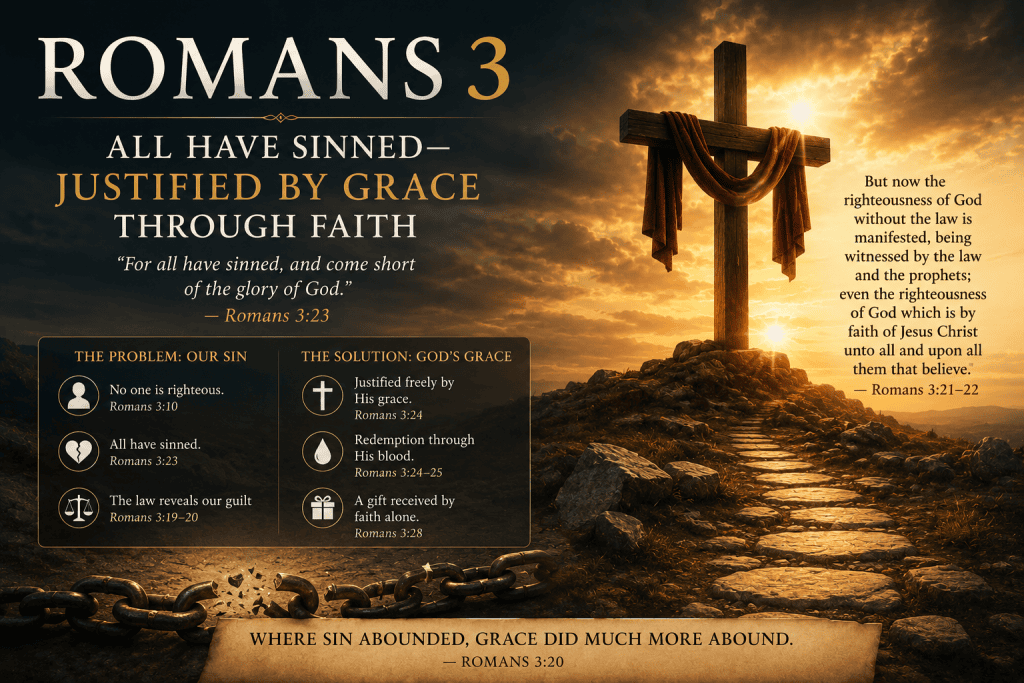
Romans 3 teaches that no one can earn salvation because every person has sinned and fallen short of God’s glory. God’s Law exposes our guilt but cannot remove it. Through the death and resurrection of Jesus Christ, God offers forgiveness, righteousness, and justification as a free gift of grace to everyone who believes. Our hope rests not in our goodness, but in the finished work of Christ on the cross.
Read the article below or watch the video here:
Key Text: Romans 3
“For all have sinned, and come short of the glory of God.” — Romans 3:23 (KJV)
Introduction
Romans 3 contains some of the most important verses in all of Scripture.
If Romans 1 revealed humanity’s rebellion and Romans 2 exposed the emptiness of religion, Romans 3 reaches an unmistakable conclusion:
Every person is guilty before God.
At first, that sounds like discouraging news. But Paul is preparing us for the greatest announcement ever made. Before we can appreciate the cure, we must understand the disease. Before we can celebrate God’s grace, we must recognize our desperate need for it.
Romans 3 moves us from the courtroom of God’s justice to the cross of Jesus Christ, where mercy triumphs over judgment.
God’s Faithfulness Never Fails (Romans 3:1–8)
Paul begins by answering an obvious question.
If being Jewish cannot save a person, what advantage did Israel have?
His answer is clear:
“Much every way.”
God entrusted Israel with His Word.
They received His covenants, His promises, His prophets, and His Law. These were tremendous privileges.
Yet privilege does not guarantee salvation.
Paul also reminds us that even when people are unfaithful, God remains faithful.
“Let God be true, but every man a liar.” (Romans 3:4)
People may reject God’s truth.
Cultures may redefine morality.
Societies may abandon biblical values.
But God’s truth never changes.
His faithfulness is not determined by human opinion.
The Whole World Is Guilty Before God (Romans 3:9–20)
Paul now delivers his verdict.
“We have before proved both Jews and Gentiles, that they are all under sin.”
No one escapes.
Religious people.
Irreligious people.
Good citizens.
Criminals.
Everyone stands guilty before a holy God.
Paul supports his conclusion with a series of Old Testament quotations.
No One Is Righteous
“There is none righteous, no, not one.”
Humanity often believes people are basically good.
Scripture says otherwise.
Compared to one another, some appear more moral.
Compared to God’s holiness, every one of us falls short.
No One Naturally Seeks God
Paul writes:
“There is none that seeketh after God.”
Left to ourselves, we pursue our own desires rather than God’s will.
It is God’s grace that awakens our hearts and draws us to Himself.
Sin Affects Every Part of Our Lives
Paul describes:
- Corrupt speech
- Deceitful lips
- Violent actions
- Proud hearts
- Minds that ignore God
Sin is not merely something we do.
It is a condition that affects our entire being.
Like poison spreading through the body, sin touches every part of human life.
The Purpose of God’s Law (Romans 3:19–20)
Many people believe they can earn God’s favor by keeping His commandments.
Paul explains why that cannot happen.
“By the deeds of the law there shall no flesh be justified.”
The Law was never intended to save us.
Instead, it reveals our need for salvation.
Imagine looking into a mirror.
The mirror shows dirt on your face.
But the mirror cannot wash you.
God’s Law functions the same way.
It exposes our sin but cannot remove our guilt.
Only Christ can do that.
The Righteousness of God Revealed (Romans 3:21–22)
These two words mark one of the greatest turning points in the Bible:
“But now…”
Human effort has failed.
Religion has failed.
Morality has failed.
But now God has revealed another way.
It is:
“The righteousness of God…by faith of Jesus Christ unto all and upon all them that believe.”
This is the heart of the Gospel.
God does not ask us to produce our own righteousness.
He provides His righteousness through Jesus Christ.
Salvation is not achieved.
It is received.
All Have Sinned (Romans 3:23)
Perhaps no verse is quoted more often than this one:
“For all have sinned, and come short of the glory of God.”
Notice two important truths.
All Have Sinned
No exceptions.
The pastor.
The businessman.
The student.
The retiree.
Every one of us has violated God’s holy standard.
We Fall Short
Paul does not merely say we sinned in the past.
He says we continually fall short.
Even our best efforts cannot bridge the gap between sinful humanity and a holy God.
That is why we need a Savior.
Justified Freely by His Grace (Romans 3:24–26)
Here we encounter one of the richest words in Scripture:
Justified.
To justify means to declare righteous.
It is a legal term.
Imagine standing in a courtroom.
The evidence proves your guilt.
The Judge then announces:
“Not guilty.”
How can that happen?
Because Jesus paid the penalty in your place.
Paul says we are:
“Justified freely by his grace through the redemption that is in Christ Jesus.”
Three beautiful truths appear here.
Grace
Salvation is God’s gift.
It cannot be earned.
Redemption
Jesus paid the price to purchase our freedom from sin.
His blood accomplished what we never could.
Propitiation
Paul explains that Christ became the sacrifice that satisfied God’s righteous wrath.
At the cross:
Justice was satisfied.
Mercy was extended.
Love was displayed.
No other religion offers such hope.
There Is No Room for Boasting (Romans 3:27–31)
If salvation comes entirely through grace, who deserves the credit?
Only God.
Paul asks:
“Where is boasting then?”
His answer:
“It is excluded.”
No Christian can boast,
“I earned heaven.”
No church can claim,
“We saved ourselves.”
Every believer stands before God only because of His amazing grace.
Faith does not compete with good works.
Rather, genuine faith produces good works.
Obedience becomes the grateful response of those who have already been saved.
What Romans 3 Means for Us Today
Romans 3 speaks directly to our generation.
Stop Trusting Yourself
Our culture encourages self-confidence.
The Gospel calls us to Christ-confidence.
We cannot save ourselves.
Stop Comparing Yourself to Others
Someone else’s failures do not erase our own.
God measures us against His perfect holiness.
Receive God’s Gift
Salvation is not something we achieve through effort.
It is received through faith.
Live in Gratitude
When we realize the price Jesus paid, obedience becomes an act of love rather than obligation.
Grace motivates holiness.
Living Romans 3
Ask yourself these questions this week:
- Have I admitted that I am a sinner before God?
- Am I trusting Christ alone for my salvation?
- Have I stopped trying to earn God’s acceptance?
- Does gratitude for God’s grace shape how I live?
- Am I sharing this wonderful Gospel with others?
The greatest news in the world is that God has provided exactly what we could never provide ourselves.
Final Thoughts
Romans 3 is the turning point of the Gospel.
Paul proves beyond any doubt that every person is guilty before God.
Then he announces God’s astonishing solution.
Jesus Christ has done for us what we could never do for ourselves.
He lived the perfect life, died a sacrificial death, and rose victorious over the grave.
Now everyone who trusts Him is justified freely by grace.
No wonder Martin Luther called Romans “the chief part of the New Testament.”
No wonder believers throughout history have found peace in these words.
The message of Romans 3 is not merely that we are sinners.
It is that God loves sinners enough to provide a perfect Savior.
Enjoy simple, Bible-centered teaching? Receive a short Daily Devotion by email and spend a few minutes each day in God’s Word. For more information, CLICK HERE.
Continue studying Romans: Explore our complete chapter-by-chapter guide to the Book of Romans, including humanity’s sin to Christ’s sacrifice, from justification by faith to the victorious Christian life in the Spirit, and the law of love–OR go:
<<Back to Romans 2 OR Forward to Romans 4>>
<<Back to Bible Passages
Want to do a deeper dive in the study of Romans? Get my book, Romans: The Glory of the Gospel and the Obedience of Faith, by making your choice of platforms below:
Dr. Alan Holden has served in pastoral ministry for more than 35 years, preaching and teaching the Bible in churches across the United States. He holds a Doctor of Ministry from Luther Rice Seminary and a Master of Divinity from The Southern Baptist Theological Seminary. Through What’s It Mean?, he seeks to help readers understand the meaning of Scripture and grow in their walk with Christ. He is currently the pastor of Lake Saunders Baptist Church in Tavares, FL.