






Daniel 2: What Did Nebuchadnezzar’s Dream Mean?
 Introduction
Daniel 2 records one of the most remarkable prophetic revelations in the entire Bible. In this chapter, Nebuchadnezzar II has a troubling dream that none of the wise men of Babylon can interpret. God then reveals the dream and its meaning to Daniel.
The dream reveals the rise and fall of world empires and the ultimate establishment of God’s eternal kingdom.
Daniel 2 teaches a central truth of Scripture:
God rules over history and establishes His kingdom in His time.
The King’s Troubling Dream (Daniel 2:1–13)
In the second year of Nebuchadnezzar’s reign, the king had a dream that troubled him deeply.
He summoned the wise men of Babylon:
- magicians
- astrologers
- sorcerers
- Chaldeans
But the king made an unusual demand.
He required them not only to interpret the dream but also to tell him what the dream was.
If they could not reveal both the dream and the interpretation, they would be executed.
The wise men protested that no human could do such a thing.
“There is not a man upon the earth that can show the king’s matter.” (Daniel 2:10)
Their admission revealed the weakness of pagan wisdom.
Human wisdom cannot reveal the secrets of God.
Daniel Seeks God in Prayer (Daniel 2:14–23)
When the decree went out to execute the wise men, Daniel responded with wisdom and faith.
Daniel requested time from the king.
Then he gathered his friends:
- Shadrach
- Meshach
- Abednego
Together they prayed for God to reveal the mystery.
That night God revealed the dream to Daniel in a vision.
Daniel immediately praised God:
“Blessed be the name of God for ever and ever: for wisdom and might are his.”
Daniel recognized that God controls history, kings, and kingdoms.
The Dream of the Great Statue (Daniel 2:31–35)
Daniel then described the king’s dream.
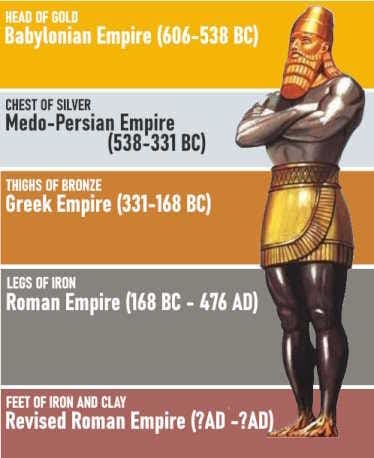
Nebuchadnezzar saw a massive statue made of different materials:
| Part of Statue | Material |
| Head | Gold |
| Chest and arms | Silver |
| Belly and thighs | Bronze |
| Legs | Iron |
| Feet | Iron mixed with clay |
While the king watched, a stone cut without human hands struck the statue at its feet.
The entire statue collapsed and turned to dust.
The stone then became a great mountain that filled the whole earth.
The Meaning of the Statue (Daniel 2:36–43)
Daniel explained that the statue represented successive world empires.
The Head of Gold
This represented the kingdom of Babylon.
Daniel told the king:
“Thou art this head of gold.” (Daniel 2:38)
Babylon was a powerful and glorious empire.
The Chest and Arms of Silver
This represented the Medo-Persian Empire, which later conquered Babylon.
The two arms symbolize the Medes and Persians ruling together.
The Belly and Thighs of Bronze
This represents the empire of Alexander the Great and the Greek kingdom.
The Greeks conquered the Persian Empire and spread Greek culture across the ancient world.
The Legs of Iron
This symbolizes the Roman Empire, known for its strength and military power.
Rome crushed its enemies like iron crushing weaker metals.
The Feet of Iron and Clay
The final stage of the statue is a divided kingdom.
Iron and clay do not mix well, symbolizing instability and division.
Many scholars see this as representing a future confederation of nations connected to the legacy of Rome.
The Stone and the Eternal Kingdom (Daniel 2:44–45)
The most important part of the dream is the stone cut without human hands.
This stone represents God’s kingdom.
The stone destroys all earthly kingdoms and becomes a mountain filling the earth.
This prophecy points to the reign of Jesus Christ.
Unlike earthly empires, Christ’s kingdom:
- is established by God
- will never be destroyed
- will rule forever
Every human empire eventually falls.
But God’s kingdom is eternal.
Nebuchadnezzar’s Response (Daniel 2:46–49)
After hearing the interpretation, Nebuchadnezzar was overwhelmed.
The king fell before Daniel and said:
“Of a truth it is, that your God is a God of gods, and a Lord of kings.”
The king promoted Daniel to a high position in Babylon.
Daniel also secured positions for his friends in the Babylonian government.
Even in exile, God elevated His faithful servants.
Spiritual Lessons from Daniel 2
1. God controls history.
Kings and nations rise and fall according to God’s plan.
2. Human wisdom cannot reveal God’s truth.
The wise men of Babylon failed, but God revealed the mystery to Daniel.
3. Prayer invites God’s intervention.
Daniel and his friends prayed, and God answered.
4. God’s kingdom will outlast every human empire.
Babylon, Persia, Greece, and Rome have all fallen.
But God’s kingdom will endure forever.
What Daniel 2 Reveals About God
Daniel 2 teaches that God is:
- Sovereign over nations
- The revealer of mysteries
- The ruler of history
- The builder of an eternal kingdom
History is not random.
God is directing it toward the day when Christ’s kingdom fills the earth.
Reflection Questions
- Why did God reveal the dream to Daniel instead of the wise men of Babylon?
- What does the statue teach us about the temporary nature of earthly power?
- How should believers live knowing that God’s kingdom will ultimately rule the earth?
Conclusion
Daniel 2 reminds us that the kingdoms of this world are temporary.
Babylon, Persia, Greece, and Rome all rose to power and eventually fell.
But the kingdom of God is different.
The stone that struck the statue represents a kingdom that will never be destroyed.
One day the rule of Christ will replace every earthly empire, and His kingdom will fill the whole earth.
<<Back to Bible Passages
Back to Book of Daniel Page–>CLICK HERE
Dr. Alan Holden has served in pastoral ministry for more than 35 years, preaching and teaching the Bible in churches across the United States. He holds a Doctor of Ministry from Luther Rice Seminary and a Master of Divinity from The Southern Baptist Theological Seminary. Through What’s It Mean?, he seeks to help readers understand the meaning of Scripture and grow in their walk with Christ. He is currently the pastor of Lake Saunders Baptist Church in Tavares, FL.
For more insights to the Book of Daniel, order Pastor Alan’s book from the links below.
Related Bible Studies