Daniel 3: Can Your Faith Stand the Fire?

Daniel 3: Can Your Faith Stand the Fire?

Daniel 3

Introduction

Daniel 3 records one of the most powerful demonstrations of faith in the Old Testament. Three Jewish men—Shadrach, Meshach, and Abednego—refused to bow to a golden idol commanded by the king of Babylon.

Their refusal placed them in direct conflict with Nebuchadnezzar II, the most powerful ruler of the ancient world.

Rather than compromise their faith, they were thrown into a blazing furnace.

But God intervened in a miraculous way.

Daniel 3 teaches a timeless truth:

True faith obeys God even when obedience is dangerous.

The Golden Image (Daniel 3:1–7)

King Nebuchadnezzar constructed a massive golden statue on the plain of Dura in Babylon.

The statue was approximately:

  • 90 feet high
  • 9 feet wide

The King told government officials from across the empire to attend the dedication ceremony.

When music played, everyone was required to fall down and worship the image.

The king issued a severe warning:

Anyone who refused to bow would be immediately thrown into a fiery furnace.

This decree was not just political loyalty—it was forced religious worship.

The Accusation Against the Hebrews (Daniel 3:8–12)

Some Babylonian officials reported that certain Jewish men refused to bow to the image.

These men were:

  • Shadrach
  • Meshach
  • Abednego

These men served in high government positions but remained loyal to the God of Israel.

The accusers reminded the king:

“These men, O king, have not regarded thee: they serve not thy gods.”

Their loyalty to God placed them at odds with the king’s command.

The King’s Furious Demand (Daniel 3:13–18)

Nebuchadnezzar summoned the three men and gave them another chance.

If they bowed to the image, they would be spared.

If not, they would be thrown into the furnace.

Then the king issued a challenge:

“Who is that God that shall deliver you out of my hands?”

The response of the three men is one of the greatest statements of faith in Scripture.

They replied:

“Our God whom we serve is able to deliver us… but if not… we will not serve thy gods.”

Their faith rested on two convictions:

  1. God had the power to deliver them.
  2. Even if He chose not to, they would still obey Him.

True faith trusts God’s power and submits to His will.

The Fiery Furnace (Daniel 3:19–23)

The king became furious.

He ordered the furnace heated seven times hotter than usual.

The flames were so intense that the soldiers who carried the men to the furnace were killed by the heat.

Shadrach, Meshach, and Abednego fell bound into the fire.

From a human perspective, their fate seemed certain.

The Fourth Man in the Fire (Daniel 3:24–27)

As the king looked into the furnace, he was astonished.

Instead of three men, he saw four men walking in the fire.

And they were unharmed.

Nebuchadnezzar said:

“The form of the fourth is like the Son of God.”

The flames had not harmed them.

Their clothes were not burned.

There was not even the smell of smoke on them.

God had protected them completely.

Many interpreters believe the fourth figure was a pre-incarnate appearance of Jesus Christ.

God did not remove them from the trial.

He walked with them in it.

The King’s Response (Daniel 3:28–30)

Nebuchadnezzar publicly acknowledged the power of the God of Israel.

He declared:

“Blessed be the God of Shadrach, Meshach, and Abednego.”

The king also promoted the three men to higher positions in the province of Babylon.

God honored their faithfulness.

Spiritual Lessons from Daniel 3

1. Faith sometimes requires courageous resistance.

The three men refused to compromise their devotion to God.

2. True faith trusts God regardless of the outcome.

They believed God could deliver them—but they obeyed Him even if He did not.

3. God is present with His people in trials.

The Lord did not prevent the furnace, but He walked with them in the fire.

4. Faithful obedience can influence unbelievers.

Their courage caused the king himself to acknowledge the power of God.

What Daniel 3 Reveals About God

This chapter reveals that God is:

  • worthy of exclusive worship
  • powerful to deliver His people
  • present in the midst of suffering
  • able to glorify Himself through faithful believers

God is not absent during trials.

Often, His presence is most clearly seen in the fire.

Reflection Questions

  1. What pressures today tempt believers to compromise their faith?
  2. Why is the phrase “But if not…” such a powerful statement of faith?
  3. How can believers remain faithful when obedience brings hardship?

Conclusion

Daniel 3 teaches that faithfulness to God may lead into the fire—but believers never face the fire alone.

Shadrach, Meshach, and Abednego refused to bow to an idol because they served the one true God.

Their story reminds us that obedience to God is always the right choice, even when it comes at great cost.

And when believers walk through the fire, God walks with them.

<<Back to Bible Passages

Book of Daniel Page–>CLICK HERE


Dr. Alan Holden has served in pastoral ministry for more than 35 years, preaching and teaching the Bible in churches across the United States. He holds a Doctor of Ministry from Luther Rice Seminary and a Master of Divinity from The Southern Baptist Theological Seminary. Through What’s It Mean?, he seeks to help readers understand the meaning of Scripture and grow in their walk with Christ. He is currently the pastor of Lake Saunders Baptist Church in Tavares, FL.


For more insights to the Book of Daniel, order Pastor Alan’s book from the links below.


Related Bible Studies

Daniel 1 Explained: How Does One Stand Firm in a Pagan Culture?

Daniel 1 Explained: How Does One Stand Firm in a Pagan Culture?

Daniel 1Introduction

The Book of Daniel begins with a crisis of faith. In Daniel 1, Jerusalem has fallen to Babylon, the temple treasures have been taken, and young Jewish men have been deported to serve in the court of a pagan king.

Among them is Daniel.

Daniel chapter 1 teaches an important lesson for believers today: God’s people must remain faithful even when living in a hostile culture.

The Babylonian Captivity (Daniel 1:1-2)

Nebuchadnezzar II invaded Jerusalem and carried many Jews into exile.

This fulfilled God’s warnings to Israel through the prophets.

The Babylonians did three things:

  1. They captured the city.
  2. They took temple treasures.
  3. They deported the best young men.

Babylon wanted to re-educate and reshape the future leaders of Israel.

The Attempt to Reprogram Daniel (Daniel 1:3-7)

The Babylonian king selected young men who were:

  • intelligent
  • physically strong
  • noble in background
  • capable of leadership

Daniel and his friends were placed in a three-year training program in Babylonian culture.

They were given:

  • new education
  • new food
  • new names
  • new identity

The goal was assimilation.

Daniel’s Hebrew name honored God, but his Babylonian name Belteshazzar honored a pagan deity.

The Babylonians wanted Daniel to forget the God of Israel.

Daniel’s Decision (Daniel 1:8)

Daniel made a decisive choice.

“But Daniel purposed in his heart that he would not defile himself.”

This is one of the most important statements in the chapter.

Daniel did not wait until he faced temptation.

He decided beforehand that he would obey God.

True faith begins with a settled conviction.

God Honors Faithfulness (Daniel 1:9-20)

Daniel requested permission to eat simple food instead of the king’s meat.

After ten days:

  • Daniel and his friends looked healthier
  • God gave them knowledge and wisdom
  • Daniel received understanding in visions and dreams

When the king examined them, they were ten times better than the others.

Faithfulness to God does not weaken a person.

It strengthens them.

Spiritual Lessons from Daniel 1

Faithfulness begins with a decision of the heart.

Daniel purposed before temptation came.

The world will always try to reshape believers.

Babylon tried to change Daniel’s identity.

God honors those who honor Him.

Daniel remained faithful, and God exalted him.

Young believers can make a powerful difference.

Daniel was likely a teenager when this happened.

What Daniel 1 Reveals About God

This chapter reminds us that:

  • God rules over nations.
  • God protects His people.
  • God rewards faithfulness.

Even in exile, God was still in control.

Reflection Questions

  1. What pressures today try to reshape a believer’s identity?
  2. Why is it important to decide beforehand to obey God?
  3. How can Christians remain faithful in a secular culture?

Conclusion

Daniel 1 teaches that faithfulness to God is possible even in the most hostile environments.

Daniel lived in Babylon but refused to become Babylonian.

Believers today face similar challenges. The world may pressure us to conform, but like Daniel, we must purpose in our hearts to remain faithful to God.

<<Back to Bible Passages

Back to Book of Daniel Page–>CLICK HERE


Dr. Alan Holden has served in pastoral ministry for more than 35 years, preaching and teaching the Bible in churches across the United States. He holds a Doctor of Ministry from Luther Rice Seminary and a Master of Divinity from The Southern Baptist Theological Seminary. Through What’s It Mean?, he seeks to help readers understand the meaning of Scripture and grow in their walk with Christ. He is currently the pastor of Lake Saunders Baptist Church in Tavares, FL.


For more insights to the Book of Daniel, order Pastor Alan’s book from the links below.


Related Bible Studies

Daniel 2: What Did Nebuchadnezzar’s Dream Mean?

Daniel 2: What Did Nebuchadnezzar’s Dream Mean?

Daniel 2Introduction

Daniel 2 records one of the most remarkable prophetic revelations in the entire Bible. In this chapter, Nebuchadnezzar II has a troubling dream that none of the wise men of Babylon can interpret. God then reveals the dream and its meaning to Daniel.

The dream reveals the rise and fall of world empires and the ultimate establishment of God’s eternal kingdom.

Daniel 2 teaches a central truth of Scripture:

God rules over history and establishes His kingdom in His time.

The King’s Troubling Dream (Daniel 2:1–13)

In the second year of Nebuchadnezzar’s reign, the king had a dream that troubled him deeply.

He summoned the wise men of Babylon:

  • magicians
  • astrologers
  • sorcerers
  • Chaldeans

But the king made an unusual demand.

He required them not only to interpret the dream but also to tell him what the dream was.

If they could not reveal both the dream and the interpretation, they would be executed.

The wise men protested that no human could do such a thing.

“There is not a man upon the earth that can show the king’s matter.” (Daniel 2:10)

Their admission revealed the weakness of pagan wisdom.

Human wisdom cannot reveal the secrets of God.

Daniel Seeks God in Prayer (Daniel 2:14–23)

When the decree went out to execute the wise men, Daniel responded with wisdom and faith.

Daniel requested time from the king.

Then he gathered his friends:

  • Shadrach
  • Meshach
  • Abednego

Together they prayed for God to reveal the mystery.

That night God revealed the dream to Daniel in a vision.

Daniel immediately praised God:

“Blessed be the name of God for ever and ever: for wisdom and might are his.”

Daniel recognized that God controls history, kings, and kingdoms.

The Dream of the Great Statue (Daniel 2:31–35)

Daniel then described the king’s dream.

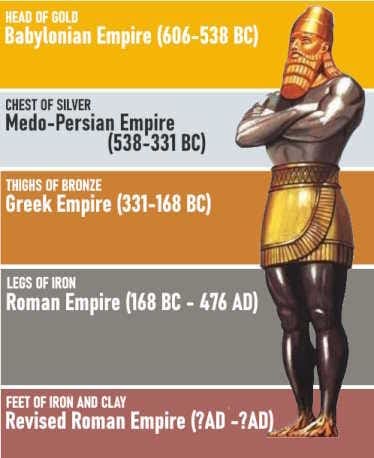
Nebuchadnezzar saw a massive statue made of different materials:

Part of Statue Material
Head Gold
Chest and arms Silver
Belly and thighs Bronze
Legs Iron
Feet Iron mixed with clay

While the king watched, a stone cut without human hands struck the statue at its feet.

The entire statue collapsed and turned to dust.

The stone then became a great mountain that filled the whole earth.

The Meaning of the Statue (Daniel 2:36–43)

Daniel explained that the statue represented successive world empires.

The Head of Gold

This represented the kingdom of Babylon.

Daniel told the king:

“Thou art this head of gold.” (Daniel 2:38)

Babylon was a powerful and glorious empire.

The Chest and Arms of Silver

This represented the Medo-Persian Empire, which later conquered Babylon.

The two arms symbolize the Medes and Persians ruling together.

The Belly and Thighs of Bronze

This represents the empire of Alexander the Great and the Greek kingdom.

The Greeks conquered the Persian Empire and spread Greek culture across the ancient world.

The Legs of Iron

This symbolizes the Roman Empire, known for its strength and military power.

Rome crushed its enemies like iron crushing weaker metals.

The Feet of Iron and Clay

The final stage of the statue is a divided kingdom.

Iron and clay do not mix well, symbolizing instability and division.

Many scholars see this as representing a future confederation of nations connected to the legacy of Rome.

The Stone and the Eternal Kingdom (Daniel 2:44–45)

The most important part of the dream is the stone cut without human hands.

This stone represents God’s kingdom.

The stone destroys all earthly kingdoms and becomes a mountain filling the earth.

This prophecy points to the reign of Jesus Christ.

Unlike earthly empires, Christ’s kingdom:

  • is established by God
  • will never be destroyed
  • will rule forever

Every human empire eventually falls.

But God’s kingdom is eternal.

Nebuchadnezzar’s Response (Daniel 2:46–49)

After hearing the interpretation, Nebuchadnezzar was overwhelmed.

The king fell before Daniel and said:

“Of a truth it is, that your God is a God of gods, and a Lord of kings.”

The king promoted Daniel to a high position in Babylon.

Daniel also secured positions for his friends in the Babylonian government.

Even in exile, God elevated His faithful servants.

Spiritual Lessons from Daniel 2

1. God controls history.

Kings and nations rise and fall according to God’s plan.

2. Human wisdom cannot reveal God’s truth.

The wise men of Babylon failed, but God revealed the mystery to Daniel.

3. Prayer invites God’s intervention.

Daniel and his friends prayed, and God answered.

4. God’s kingdom will outlast every human empire.

Babylon, Persia, Greece, and Rome have all fallen.

But God’s kingdom will endure forever.

What Daniel 2 Reveals About God

Daniel 2 teaches that God is:

  • Sovereign over nations
  • The revealer of mysteries
  • The ruler of history
  • The builder of an eternal kingdom

History is not random.

God is directing it toward the day when Christ’s kingdom fills the earth.

Reflection Questions

  1. Why did God reveal the dream to Daniel instead of the wise men of Babylon?
  2. What does the statue teach us about the temporary nature of earthly power?
  3. How should believers live knowing that God’s kingdom will ultimately rule the earth?

Conclusion

Daniel 2 reminds us that the kingdoms of this world are temporary.

Babylon, Persia, Greece, and Rome all rose to power and eventually fell.

But the kingdom of God is different.

The stone that struck the statue represents a kingdom that will never be destroyed.

One day the rule of Christ will replace every earthly empire, and His kingdom will fill the whole earth.

<<Back to Bible Passages

Back to Book of Daniel Page–>CLICK HERE


Dr. Alan Holden has served in pastoral ministry for more than 35 years, preaching and teaching the Bible in churches across the United States. He holds a Doctor of Ministry from Luther Rice Seminary and a Master of Divinity from The Southern Baptist Theological Seminary. Through What’s It Mean?, he seeks to help readers understand the meaning of Scripture and grow in their walk with Christ. He is currently the pastor of Lake Saunders Baptist Church in Tavares, FL.


For more insights to the Book of Daniel, order Pastor Alan’s book from the links below.


Related Bible Studies

Matthew 5 Explained: The Meaning of the Sermon on the Mount

Matthew 5 Explained: The Sermon on the Mount
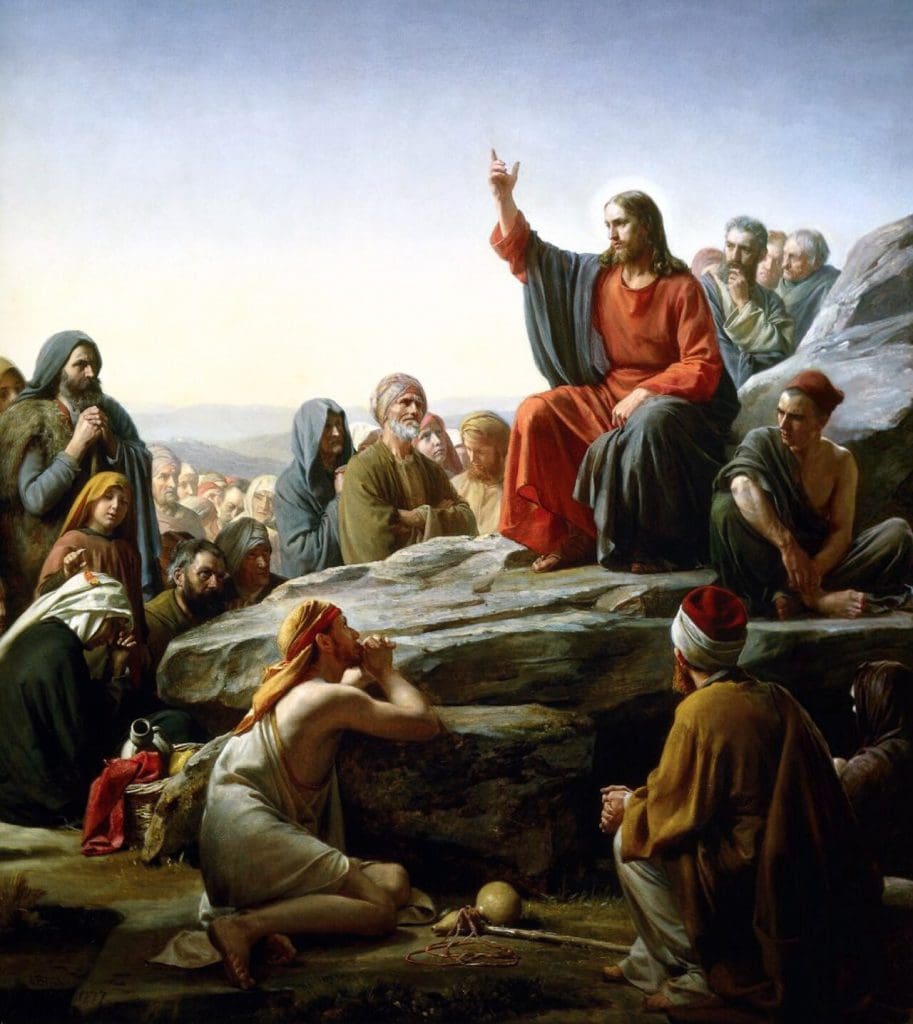
The Sermon on the Mount by Carl Bloch (1834-1890).

Matthew 5 Explained: The Meaning of the Sermon on the Mount

Introduction

Matthew 5 begins the most famous sermon ever preached—the Sermon on the Mount. In this chapter, Jesus Christ explains what true righteousness looks like in the Kingdom of Heaven.

The religious leaders of Jesus’ day emphasized external religion—rules, traditions, and appearances. But Jesus teaches that God is concerned with something deeper: the condition of the heart.

Matthew 5 reveals the character of those who truly belong to God’s kingdom.

“Except your righteousness shall exceed the righteousness of the scribes and Pharisees, ye shall in no case enter into the kingdom of heaven.”
— Matthew 5:20

In other words, Jesus is not calling for more religion, but for true transformation.

The Beatitudes: The Character of Kingdom Citizens

(Matthew 5:1–12)

The chapter opens with the Beatitudes. The word beatitude means blessing or deep spiritual joy.

Jesus describes the inner qualities that mark those who belong to Him.

Blessed Are the Poor in Spirit

“Blessed are the poor in spirit: for theirs is the kingdom of heaven.” (Matthew 5:3)

To be poor in spirit means recognizing our spiritual poverty before God. It is the opposite of pride. Salvation begins when we realize we cannot save ourselves.

Blessed Are Those Who Mourn

This mourning refers to grief over sin. Those who see their sin clearly will seek God’s forgiveness and comfort.

Blessed Are the Meek

Meekness is strength under control. It is humility that submits to God rather than insisting on its own way.

Blessed Are Those Who Hunger and Thirst for Righteousness

True believers develop a deep desire to know God and live rightly before Him.

Just as the body craves food and water, the believer longs for holiness.

Blessed Are the Merciful

Those who have received God’s mercy naturally show mercy to others.

Blessed Are the Pure in Heart

God is not impressed with outward religion if the heart remains corrupt. Purity of heart means sincerity, integrity, and devotion to God.

Blessed Are the Peacemakers

Peacemakers bring reconciliation—both between people and between sinners and God.

Blessed Are Those Who Are Persecuted

Those who live faithfully for Christ will eventually face opposition.

Yet Jesus declares that such people are blessed, because they belong to the kingdom of heaven.

Salt and Light: The Influence of Believers

(Matthew 5:13–16)

After describing the character of believers, Jesus explains their influence in the world.

You Are the Salt of the Earth

Salt had several important uses in the ancient world:

  • It preserved food from decay
    • It added flavor
    • It symbolized purity

Believers serve a similar purpose in society. Their presence restrains moral decay and preserves truth.

But Jesus warns that salt that loses its saltiness becomes useless. Likewise, a believer who compromises with the world loses spiritual influence.

You Are the Light of the World

Light exposes darkness and guides people to safety.

Jesus compares believers to:

“A city that is set on a hill.”

Such a city cannot be hidden. The lives of believers should shine in such a way that others see God through them.

“Let your light so shine before men, that they may see your good works, and glorify your Father which is in heaven.” (Matthew 5:16)

Jesus and the Law

(Matthew 5:17–20)

Some people believed Jesus was rejecting the Old Testament law. He corrected that misunderstanding immediately.

“Think not that I am come to destroy the law, or the prophets: I am not come to destroy, but to fulfil.” (Matthew 5:17)

Jesus fulfilled the law in several ways:

  • He perfectly obeyed it
    • He fulfilled its prophecies
    • He completed its purpose

The Old Testament law ultimately pointed forward to Christ.

Yet Jesus also warns that the righteousness of the scribes and Pharisees was not enough. Their religion focused on outward behavior but neglected the heart.

True righteousness begins inside.

The Heart Behind the Commandments

(Matthew 5:21–48)

Jesus then explains the deeper meaning of several commandments.

The religious leaders had reduced God’s law to mere rule-keeping. Jesus reveals that the law addresses the heart itself.

Anger and Murder

The commandment says:

“Thou shalt not kill.”

But Jesus teaches that uncontrolled anger and hatred are the seeds of murder. God cares about the attitudes that lead to sinful actions.

Lust and Adultery

The law forbids adultery. Yet Jesus shows that lustful thoughts violate God’s standard as well.

Sin begins in the heart long before it appears in outward behavior.

Divorce

Jesus teaches that marriage was intended to be a lifelong covenant. Casual divorce had become common in His day, but it was never God’s design.

Oaths and Truthfulness

People often used elaborate vows to convince others they were telling the truth.

Jesus teaches that believers should be known for simple honesty:

“Let your communication be, Yea, yea; Nay, nay.”

A Christian’s word should always be trustworthy.

Revenge and Retaliation

The law permitted courts to enforce justice—“an eye for an eye.” But individuals were not meant to take revenge.

Jesus calls His followers to respond with grace rather than retaliation.

Love Your Enemies

Perhaps the most challenging command in the chapter is this:

“Love your enemies.”

God shows kindness even to those who reject Him. Followers of Christ must reflect that same love.

Jesus concludes with a powerful challenge:

“Be ye therefore perfect, even as your Father which is in heaven is perfect.” (Matthew 5:48)

This does not mean sinless perfection. It means believers should strive for complete maturity and Christlike character.

What’s the Meaning of Matthew 5?

Matthew 5 teaches that God desires transformed hearts, not merely religious behavior.

True righteousness includes:

  • humility before God
    • repentance over sin
    • mercy toward others
    • purity of heart
    • faithfulness even in persecution

These qualities do not come from human effort alone. They are the result of a life changed by the grace of God.

Jesus calls His followers to live differently—to shine as salt and light in a dark world.

Final Reflection

Matthew 5 challenges us to examine ourselves honestly.

Do we simply practice religion, or have we experienced genuine transformation?

The message of the Sermon on the Mount reminds us that the kingdom of heaven belongs to those whose hearts have been changed by Christ.

<<Back to Bible Passages


Dr. Alan Holden has served in pastoral ministry for more than 35 years, preaching and teaching the Bible in churches across the United States. He holds a Doctor of Ministry from Luther Rice Seminary and a Master of Divinity from The Southern Baptist Theological Seminary. Through What’s It Mean?, he seeks to help readers understand the meaning of Scripture and grow in their walk with Christ. He is currently the pastor of Lake Saunders Baptist Church in Tavares, FL.


If this article helped you, you may enjoy the Free 7-Day Eternal Life Devotional.


Download the Free 7-Day Devotional

What Does Jesus Walking on Water Mean?

What Does Jesus Walking on Water Mean?

Matthew 14:22–33

jesus saves
“Lord, Save Me!”


After Jesus fed five thousand, the crowd was electrified. They had witnessed supernatural provision and began to conspire to make Jesus an earthly king (John 6:15). Their enthusiasm, however, was misguided. Christ did not come to lead a political revolution but to establish a spiritual kingdom. Recognizing the danger of misplaced expectations, Jesus immediately dismissed the multitude and sent His disciples across the Sea of Galilee. He would not allow either the crowd or the disciples to be swept into a movement that misunderstood His mission.

Christ Is on the Mountain

While the disciples went to sea, Jesus went to prayer. This contrast is striking and instructive. Though surrounded by great needs and endless ministry opportunities, Christ deliberately withdrew to be alone with the Father. He chose solitude not from weakness, but from spiritual wisdom. Prayer was His renewal, His communion, His strength.

He was alone.
He was alone praying.
He was long at prayer.

The Gospel tells us He began praying in the evening and remained until the fourth watch of the night—between three and six in the morning. Jesus, the Son of God, demonstrated the necessity of secret prayer (Matthew 6:6). If He required communion with the Father, how much more do we?

When the disciples went to sea, Jesus went to prayer. Their journey would soon prove why that mattered.

The Disciples at Sea

The disciples obeyed Christ’s command and launched their boat under fair skies. Obedience did not guarantee calm waters. Midway across the sea, a violent storm arose. Darkness surrounded them, and the winds battered their vessel. The same men who had experienced Christ’s power before now found themselves in distress without His physical presence.

The last time they faced a storm, Jesus was asleep in the boat. He only needed to be awakened. This time, He was not visibly with them at all.

Yet they did not turn back. They continued rowing toward the other side because obedience does not expire when circumstances change. Troubles and difficulties may disturb us in our duty, but they must not drive us from it. Faith presses forward even when the sky grows black and the winds howl.

Jesus Walks on the Water

At the darkest hour—just before dawn—Jesus came to them, walking upon the water. What they feared most became the very path upon which Christ approached them. Yet instead of relief, terror filled their hearts. They cried out, thinking they had seen a ghost.

Then came the voice that calms every storm of the soul:

“Be of good cheer.”
“It is I.”
“Be not afraid.”

The phrase “It is I” can also be understood as “I AM,” echoing the divine name. The One walking upon the waves was not merely a teacher or prophet—He was God in the flesh.

Peter’s Boldness and Struggle

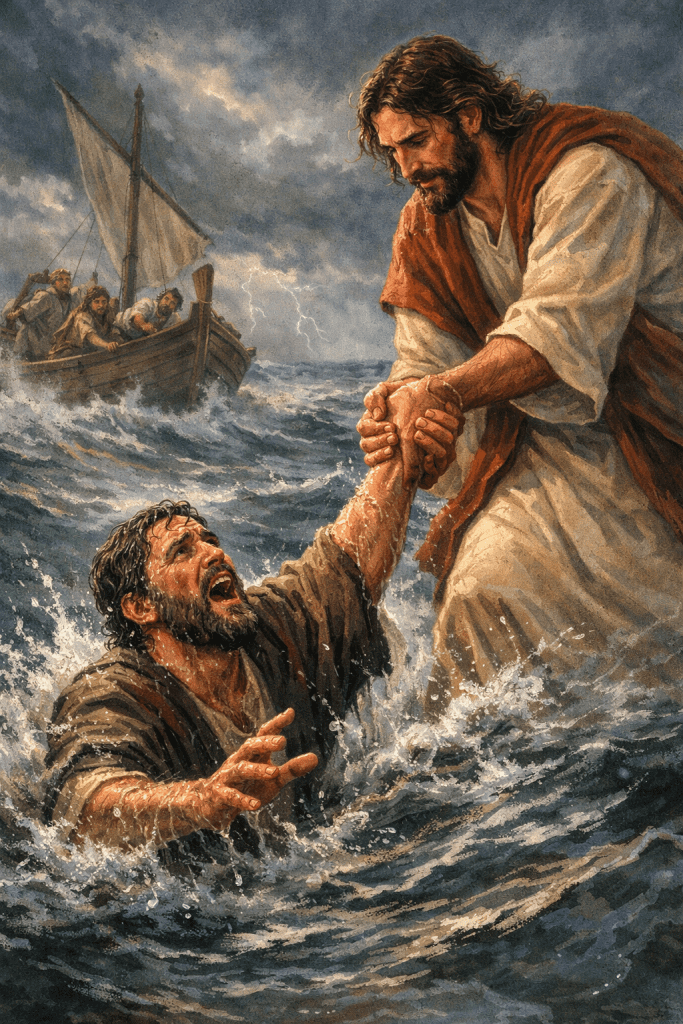
Peter responded with characteristic courage: “Lord, if it be Thou, bid me come unto Thee on the water.” Christ answered with a single word: “Come.”

Peter stepped out of the boat. For a moment, faith triumphed over fear. As long as his eyes were fixed on Jesus, he walked above the storm. But when he shifted his attention to the wind and waves, fear invaded his heart. The cause of his fear was the boisterous wind. The effect of his fear was that he began to sink.

Yet Peter did the right thing in the wrong moment—he prayed. His prayer was short but powerful: “Lord, save me!”

Christ’s Grace

Immediately, Jesus stretched forth His hand and caught him. Grace was swift. Mercy was near. Deliverance was certain. Christ saved Peter, then gently rebuked him: “O thou of little faith, wherefore didst thou doubt?” The rebuke was not rejection; it was correction. The same hand that rescues also refines.

Conclusion

When Jesus and Peter entered the boat, the storm ceased. Christ could have walked directly to shore, but He chose instead to return with His disciples. His presence brought peace. Their fear turned to worship, and their confession rang clear: “Truly Thou art the Son of God.”

This passage asks searching questions of every believer:

Are we fair-weather Christians—faithful only when skies are clear?
Do we abandon obedience when storms arise?
Do we focus on waves instead of the Savior?

While we struggle on the tempestuous sea of life, Christ is on the mountain interceding for us. And in His perfect timing, He comes—sometimes walking upon the very troubles that threaten to overwhelm us. The call remains the same: Come. The question is whether we will trust Him enough to step out in faith.

<<Back to Bible Passages


Dr. Alan Holden has served in pastoral ministry for more than 35 years, preaching and teaching the Bible in churches across the United States. He holds a Doctor of Ministry from Luther Rice Seminary and a Master of Divinity from The Southern Baptist Theological Seminary. Through What’s It Mean?, he seeks to help readers understand the meaning of Scripture and grow in their walk with Christ. He is currently the pastor of Lake Saunders Baptist Church in Tavares, FL.


If this article helped you, you may enjoy the Free 7-Day Eternal Life Devotional.

Download the Free 7-Day Devotional

What Does the Transfiguration of Jesus Mean?

What Does the Transfiguration of Jesus Mean?

Matthew 17:1–9

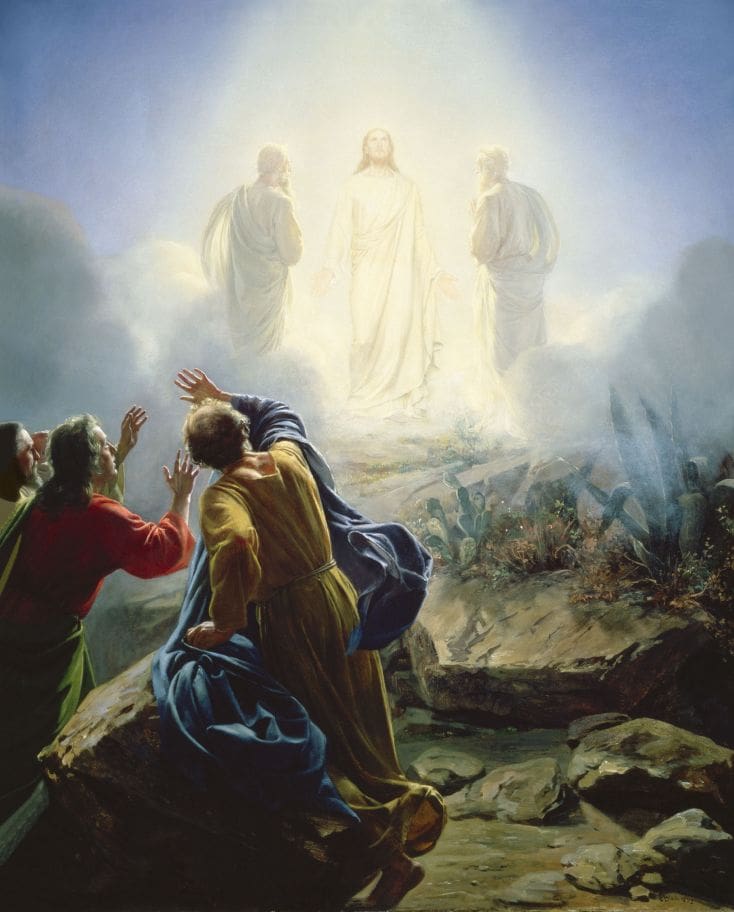
Transfiguration of Jesus by Carl Bloch
The Transfiguration by Carl Bloch (1834-1890)
This work is in the public domain in its country of origin and other countries and areas where the copyright term is the author’s life plus 100 years or fewer. This work has been identified as being free of known restrictions under copyright law, including all related and neighboring rights.


The Transfiguration of Jesus is one of the most majestic and revealing moments in the earthly ministry of Christ. For a brief moment, the veil of His humanity was drawn back, and His divine glory shone openly before chosen witnesses. This event was not merely spectacular—it was deeply theological, affirming who Jesus is and why His words must be heard above all others.

The Circumstances of the Transfiguration (Matthew 17:1)

The Time

Matthew records that the Transfiguration occurred six days after Jesus revealed to His disciples that He would soon suffer and die (Matthew 16:21). Luke’s Gospel mentions about eight days. The two accounts harmonize easily:

  • The day Jesus revealed His death
  • Six full days between
  • The day of the Transfiguration

1 + 6 + 1 = 8 days

Rather than contradicting each other, the Gospel writers are measuring from slightly different reference points, much like we sometimes do today.

The Place — A Mountain

Scripture simply says “a high mountain,” though many identify it with Mount Miron. The exact location is less important than its symbolism:

  • A solitary place — away from the crowds and distractions
  • A sublime place — lifted above the world below

Mountains in Scripture often serve as meeting places between God and man. Elevation here reflects revelation.

The Witnesses — Peter, James, and John

Jesus chose three disciples to witness this moment. Their presence was not random.

  • Jewish law established that truth is confirmed “in the mouth of two or three witnesses.”
  • These three formed Christ’s inner circle.

They were present at:

  • The raising of Jairus’ daughter (Mark 5:37)
  • The Transfiguration
  • The agony in the Garden of Gethsemane (Matthew 26)

They saw Christ’s power, glory, and suffering—a full spectrum of His mission.

The Manner of the Transfiguration (Matthew 17:2)

Matthew writes that “His face did shine as the sun.” Christ did not become something He was not; rather, He revealed what He always was. The servant’s veil was lifted, and the form of God shone through (Philippians 2:6).

Scripture repeatedly associates God with light:

  • “God is light” (1 John 1:5)
  • He “dwells in the light” (1 Timothy 6:16)
  • He “covers Himself with light as with a garment” (Psalm 104:2)

Even His clothing became radiant. Matthew Henry observed that Moses’ reflected glory could be hidden behind a veil, but Christ’s glory emanated from within, illuminating even His garments. Moses reflected glory; Jesus possessed it.

The Companions of the Transfiguration (Matthew 17:3)

Two figures appeared beside Christ: Moses and Elijah.

Why Moses and Elijah?

They represent the Law and the Prophets, the entire Old Testament witness pointing to Christ. Their lives share remarkable parallels with Jesus:

  • Both fasted forty days and nights.
  • Both performed miracles.
  • Both departed earthly life under mysterious circumstances.

Moses died but his burial place was never found, and Scripture even records a spiritual dispute over his body (Jude). Elijah was taken into heaven in a chariot of fire without tasting death.

Luke tells us they spoke with Jesus about His coming “decease”—literally, His exodus. Just as Moses led Israel out of bondage, Christ would soon lead humanity out of the bondage of sin through His death and resurrection.

Peter’s Confusion (Matthew 17:4)

Peter, overwhelmed, exclaimed, “Lord, it is good for us to be here,” and suggested building three tabernacles—one for each figure. His intention was sincere, but his understanding was flawed. By proposing equal honor, he unintentionally placed Jesus on the same level as Moses and Elijah. The moment required correction, and heaven responded immediately.

The Bright Cloud and the Voice (Matthew 17:5)

A bright cloud overshadowed them, and a voice declared:

“This is My beloved Son… Hear Him!”

Under the Old Covenant, God often appeared in thick darkness—at Sinai, in the temple, in scenes of awe and trembling. Here, under grace, the cloud is bright. The symbolism is profound:

  • The Old Testament emphasized law, fear, and distance.
  • The New Testament reveals light, love, and nearness.

The command “Hear Him” shifts authority unmistakably to Christ. The Law and the Prophets prepared the way; the Son is the final Word.

The Fright of the Disciples (Matthew 17:6–8)

The disciples fell on their faces in terror at the voice of God. Yet the same Jesus who shone with divine brilliance now approached them with tender compassion.

  • What He did: He touched them.
  • What He said: “Arise, and be not afraid.”

When they lifted their eyes, they saw only Jesus. Moses and Elijah left. The message was clear: prophets serve their time, but Christ remains forever. He is “the same yesterday, today, and forever” (Hebrews 13).

Conclusion

The Transfiguration proclaims several enduring truths:

  • Jesus is God in human form. His glory is intrinsic, not borrowed.
  • The saints live beyond death.
  • Moses and Elijah were recognized by name, reminding us that identity continues in heaven.
  • Two paths to glory are pictured:
    • Moses represents believers who enter heaven through death.
    • Elijah represents believers translated at Christ’s return.
  • Above all, we must hear Jesus. His voice carries final authority.

The mountain scene fades, the cloud lifts, and the disciples descend—but they descend changed. They have seen the King in His beauty. The Transfiguration is not merely a spectacle of light; it is a revelation of supremacy. Christ is not one voice among many. He is the Beloved Son. And heaven’s command still stands:

“Hear Him!”

<<Back to Bible Passages


Dr. Alan Holden has served in pastoral ministry for more than 35 years, preaching and teaching the Bible in churches across the United States. He holds a Doctor of Ministry from Luther Rice Seminary and a Master of Divinity from The Southern Baptist Theological Seminary. Through What’s It Mean?, he seeks to help readers understand the meaning of Scripture and grow in their walk with Christ. He is currently the pastor of Lake Saunders Baptist Church in Tavares, FL.


If this article helped you, you may enjoy the Free 7-Day Eternal Life Devotional.

Download the Free 7-Day Devotional

What Happened in the Garden of Gethsemane? The Meaning of Jesus’ Agony

What Happened in the Garden of Gethsemane? The Meaning of Jesus’ Agony

Matthew 26:36–46

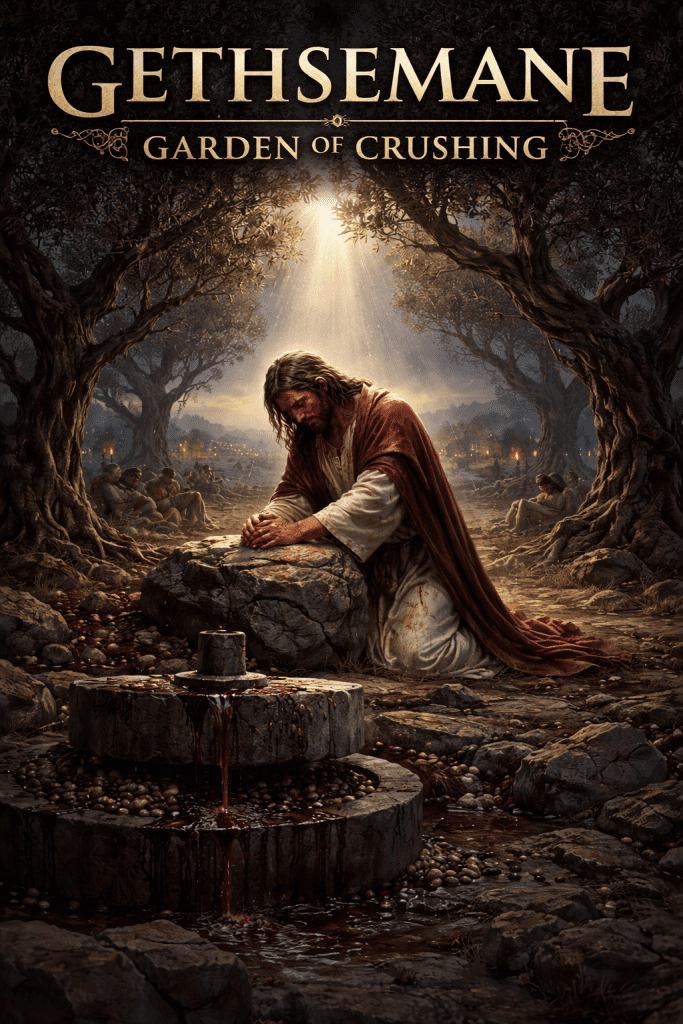
Gethsemane: Garden of Crushing

In the closing hours before His arrest, Jesus entered a quiet olive grove outside Jerusalem known as Gethsemane. What appeared to be a secluded place of prayer was, in reality, the scene of profound spiritual conflict. Here, beneath the shadow of ancient trees, the Son of God bore the crushing weight of humanity’s sin. Jesus prayed in the Garden of Gethsemane because He felt the full burden of what lay ahead—the suffering, the separation, and the sacrifice required to redeem the world.

What Is Gethsemane?

Gethsemane was an olive grove at the foot of the Mount of Olives outside Jerusalem where Jesus prayed on the night He was arrested. The name comes from a Hebrew expression meaning “oil press,” a fitting picture of the crushing suffering Christ endured before the cross.

The Place

Verse 36 tells us that Jesus came with His disciples “unto a place called Gethsemane.” The name Gethsemane means “olive press.” In ancient times, olives were crushed under heavy stones until precious oil flowed out. The symbolism is striking. In this garden, the Lord Jesus would be spiritually pressed and bruised so that the oil of salvation might flow freely to all who believe.

Scripture repeatedly notes significant events occurring in “a place called…” as if God is marking the path of redemption with divine signposts:

  • Jesus was betrayed in a place called Gethsemane (Matthew 26:36).
  • He was condemned in a place called Gabbatha (John 19:13).
  • He was crucified in a place called Golgotha (John 19:17).
  • He was buried in a garden (John 19:41).
  • Now, He has gone to prepare a place for His people in heaven (John 14:3).

From the olive press to the eternal dwelling, the journey of Christ reveals God’s deliberate plan to rescue sinners and prepare a home for the redeemed.

The Company — Verses 36–37

Jesus did not enter the garden alone. Eleven disciples accompanied Him, though Judas had already departed to betray Him. At the entrance, Jesus left most of the disciples and took Peter, James, and John farther into the garden. These three had witnessed His glory on the Mount of Transfiguration; now they would glimpse His sorrow in Gethsemane.

He instructed them, “Tarry here, and watch with Me.” Yet even with close friends nearby, Jesus walked farther still to pray alone. There are moments in life—and certainly in redemption—where no human companion can fully share the burden. The Savior faced the deepest anguish of His mission in solitude.

The Agony — Verse 38

Matthew records that Jesus began to be “sorrowful and very heavy,” declaring, “My soul is exceeding sorrowful, even unto death.” Luke adds that His sweat became like great drops of blood falling to the ground (Luke 22:44). This was not mere fear of physical pain. Many martyrs have faced death with calm resolve. Christ’s agony reached deeper.

In Gethsemane, Jesus confronted the spiritual horror of bearing the sins of the world. He foresaw:

  • The treachery of Judas.
  • The denials of Peter.
  • The malice of religious leaders.
  • The cruelty of Roman execution.

More than these, He anticipated the moment when He would carry humanity’s iniquity and experience the righteous judgment of God against sin. Jesus engaged the powers of darkness (Luke 22:53), standing at the threshold of the cross where divine justice and divine mercy would meet.

Jesus returned to His disciples and found them asleep. He had asked them to watch; instead, they slumbered. His soul was in agony, even unto death, yet their eyes were heavy. The contrast is sobering—Christ alert and burdened, His followers unaware and weary.

The Petition — Verse 39

Jesus then withdrew again to pray. The gospel writer describes His posture: “He fell on His face.” This is the posture of total surrender and deep humility. His prayer reveals both His humanity and His obedience:

  • His title for God: “O My Father!”
  • His request: “If it be possible, let this cup pass from Me.”
  • His submission: “Nevertheless, not as I will, but as Thou wilt.”

The “cup” symbolized the full measure of suffering and divine wrath against sin. Jesus did not rebel against the Father’s will; rather, He expressed the genuine anguish of His human nature while perfectly submitting to the divine plan. He prayed this prayer three times. The first time He asked if the cup might pass. By the second and third prayers, His words reflected full acceptance. The struggle moved from anguish to resolve. The pressing produced obedience; the crushing released redemption.

The Rebuke — Verses 40–41

Returning again, Jesus found the disciples asleep. Their failure was simple yet serious: they slept when they should have prayed. Yet Christ’s response was correction and compassion.

He rebuked them gently: “Could ye not watch with Me one hour?”
He counseled them wisely: “Watch and pray, that ye enter not into temptation.”
He excused them kindly: “The spirit indeed is willing, but the flesh is weak.”

Though disappointed, He did not cast them aside. He understood human frailty. Even in His deepest sorrow, He extended grace. The lesson is timeless—spiritual vigilance requires prayer, for good intentions alone cannot overcome weak flesh.

The Trial Begins — Verses 45–46

Finally, Jesus declared, “The hour is at hand… Rise, let us be going.” The time for prayer had prepared Him for the time of suffering. The disciples, who slept instead of praying, would soon scatter in fear. Christ, who prayed instead of sleeping, stood ready to face betrayal, arrest, and crucifixion.

The garden reveals a powerful truth: Christ was prepared because He prayed. The disciples were unprepared because they slept. Prayer did not remove the cross, but it strengthened the Savior to endure it. In Gethsemane, the Son of God accepted the crushing load of sin so that sinners might receive the oil of salvation. The olive press of sorrow became the birthplace of hope.

What took place in that quiet garden echoes through eternity. There, Jesus chose obedience over escape, submission over resistance, and love over self-preservation. Because He endured the crushing, all who trust Him may experience forgiveness, peace, and the promise of a prepared place with Him forever.

What Gethsemane Means for Believers

Gethsemane reminds us that salvation was not easy. Jesus willingly faced the crushing weight of sin so that sinners could be forgiven. Because He endured the cup of suffering, believers receive the cup of salvation.

When Christians face trials, they remember that their Savior has already walked the path of suffering before them.

<<Back to Bible Passages


Dr. Alan Holden has served in pastoral ministry for more than 35 years, preaching and teaching the Bible in churches across the United States. He holds a Doctor of Ministry from Luther Rice Seminary and a Master of Divinity from The Southern Baptist Theological Seminary. Through What’s It Mean?, he seeks to help readers understand the meaning of Scripture and grow in their walk with Christ. He is currently the pastor of Lake Saunders Baptist Church in Tavares, FL.


If this article helped you, you may enjoy the Free 7-Day Eternal Life Devotional.

Download the Free 7-Day Devotional

Why Did Judas Betray Jesus? — What It Means for Christians Today

The Betrayal of Jesus — What It Means for Christians Today

Matthew 26:14–16, 47–56 describes the betrayal of Jesus.

Betrayal of Jesus
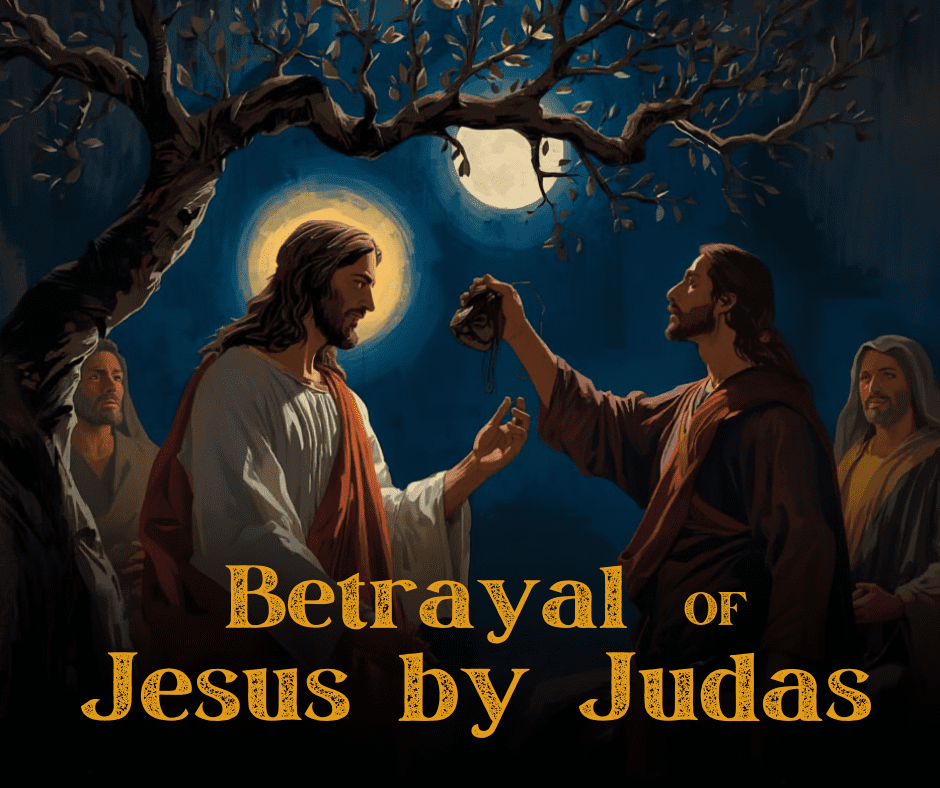
The betrayal of Jesus by Judas for 30 pieces of silver.

The betrayal of Jesus Christ is one of the most painful scenes in all of Scripture. It is not painful merely because of the injustice, but because of the intimacy. Jesus was not betrayed by a stranger, an enemy army, or a distant critic. He was betrayed by a man who had walked beside Him for three years—a man who heard His teaching, saw His miracles, and shared His meals. The story forces us to examine not only Judas, but our own hearts as we reflect on the betrayal of Jesus.

Before we look at the details, we must remember a vital truth: Jesus was not a helpless victim. He willingly gave Himself. The betrayal did not surprise Him, nor did it overpower Him. It fulfilled the Scriptures and revealed the depth of His love.

Who Was Judas Iscariot?

Judas was not an outsider. He was one of the twelve disciples personally chosen by Jesus. He had the same opportunities as Peter, John, and the others. Yet Scripture reveals that proximity to Christ does not guarantee loyalty to Christ. The betrayal of Jesus by Judas was shocking because Judas had every possible opportunity for devotion.

Jesus referred to Judas in sobering terms. In John 6:70–71, He called him “a devil,” indicating the spiritual darkness that had taken root in his heart. In John 17:12, Jesus called him “the son of perdition,” a phrase describing one headed toward destruction. Judas reminds us that outward association with religion can hide inward rebellion. A person may stand near holy things and still resist the Holy One.

Why Did Judas Betray Jesus?

The betrayal began not with soldiers, but with a question. Judas went to the chief priests and asked, “What will you give me to betray Him?” His loyalty had a price. He did not stumble into sin by accident; he negotiated it. He promised, “I will deliver Him to you,” turning friendship into a transaction.

This moment exposes the danger of a divided heart. When devotion to Christ competes with love for gain, recognition, or advantage, compromise soon follows. Judas teaches us that betrayal begins long before the public act; it begins with private willingness.

What Do Thirty Pieces of Silver Mean?

The chief priests agreed to pay Judas thirty pieces of silver—the price of a common slave according to Exodus 21:32. The Son of God was valued at the cost of damaged property. Yet even this humiliation fulfilled prophecy, as Zechariah 11:12 foretold the same amount centuries earlier. Clearly, the betrayal of Jesus was significant long before the moment in the garden.

From that moment, Judas searched for an opportunity to deliver Jesus quietly. Sin often waits for convenience. It looks for the moment when resistance is weakest and accountability is absent. The tragedy is not only the price Judas accepted, but the value he placed on Christ.

The Arrest of Jesus

When the moment came, a mixed crowd arrived in the garden. The traitor led Roman soldiers and officers from the high priest—religious authority joined with political power. They carried swords and clubs, prepared for resistance, though Jesus had shown none.

They even brought a warrant from the Sanhedrin, the Jewish Supreme Court. Everything looked official, legal, and orderly. Yet legality does not equal righteousness. History repeatedly shows that injustice can wear the clothing of authority.

The Plan and the Deceit

Judas provided a sign: a kiss. In that culture, a kiss was a gesture of affection and respect. He twisted a symbol of love into an instrument of betrayal. He greeted Jesus with, “Hail, Master!” and then kissed Him—the most painful hypocrisy imaginable.

This is the nature of deceit. It often disguises itself with polite words and friendly gestures. The danger is not only open hostility, but false loyalty that conceals selfish motives. Incidentally, Christians today still reflect on the betrayal of Jesus as a warning against such hypocrisy.

The Master’s Response

Jesus answered Judas with a single word: “Friend.” Even in betrayal, Christ spoke with calm dignity. He asked, in essence, “Why have you come?” His response reveals both sorrow and sovereignty. He wasn’t panicked nor vengeful; He remained in control.

At that moment, Peter reacted differently. According to John 18:10, he drew one of the two swords the disciples possessed and struck the servant of the high priest, cutting off his ear. Peter’s intention may have been courage, but his action was misguided. He exposed the other disciples to danger and misunderstood Christ’s mission.

Jesus immediately corrected him: “Put your sword back in its place.” The kingdom of God would not be advanced by violence. As later written in 2 Corinthians 10:3–4, the weapons of our warfare are spiritual, not carnal. Jesus reminded them that He could summon twelve legions of angels—tens of thousands of heavenly warriors—but He chose obedience instead. The Scriptures had to be fulfilled. Redemption required surrender, not resistance.

Why Did the Disciples Flee?

In the final scene, the disciples fled. Their fear overtook their promises. This was their sin, and it added to Christ’s suffering. He stood alone—abandoned by friends, rejected by leaders, and delivered by a traitor.

Yet in that loneliness, the purpose of God shone clearly. Christ, as the sacrifice for sins, was abandoned. Christ, as the Savior of souls, stood alone. No human ally could share the burden of redemption. Only He could drink that cup.

What Does the Betrayal of Christ Mean for Us Today?

The betrayal of Christ is not merely a historical account; it is a spiritual mirror. Judas warns us about divided loyalty. Peter warns us about impulsive zeal without understanding. The fleeing disciples warn us about fear. Jesus, however, shows us steadfast obedience, mercy toward betrayers, and unwavering commitment to God’s plan.

We may never sell Christ for silver, but we are tempted to compromise Him for convenience, approval, or comfort. The passage calls us to examine our hearts, strengthen our faith, and remain true in moments of pressure.

Above all, it reveals the love of Christ. He knew the betrayal was coming, yet He still called Judas “friend.” He knew the cross awaited Him, yet He walked forward willingly. The betrayal did not defeat Him—it displayed the depth of His grace. Ultimately, the betrayal of Jesus reveals both the darkness of human sin and the light of divine mercy.

<<Back to Bible Passages


Dr. Alan Holden has served in pastoral ministry for more than 35 years, preaching and teaching the Bible in churches across the United States. He holds a Doctor of Ministry from Luther Rice Seminary and a Master of Divinity from The Southern Baptist Theological Seminary. Through What’s It Mean?, he seeks to help readers understand the meaning of Scripture and grow in their walk with Christ. He is currently the pastor of Lake Saunders Baptist Church in Tavares, FL.


If this article helped you, you may enjoy the Free 7-Day Eternal Life Devotional.

Download the Free 7-Day Devotional

What Is the Meaning of the Crucifixion?

What Is the Meaning of the Crucifixion?

crucifixion
What is the meaning of the crucifixion of Jesus?

Introduction

Today we stand at the most solemn courtroom in history—not a courtroom of marble and pillars, but a place of injustice, cruelty, and eternal consequence. The sentence passed against Jesus Christ was not merely a legal verdict; it was the turning point of redemption—marked forever by the crucifixion. Heaven watched. Hell trembled. God offered mercy to humanity through the suffering of the innocent Son of God.

I. The Sentence Passed Against Jesus

A. Barabbas Released — Christ Delivered Up

Barabbas, a known criminal, a rebel, and a murderer, was released. Jesus—the sinless Son of God—was condemned. This was not accidental; it was substitution. Barabbas represents us. Guilty humanity walked free while Christ was delivered up.

Christ was delivered so that we might be delivered. The innocent for the guilty. The righteous for the unrighteous. Justice satisfied, mercy extended.

B. Jesus Scourged by Roman Soldiers

The Roman scourging was brutal beyond imagination. Jewish law limited lashes to forty minus one, but Roman soldiers had no such restraint. Flesh was torn, bone sometimes exposed, blood poured freely.

Yet Scripture had spoken centuries earlier:

  • Psalm 129:3 – “The plowers plowed upon my back.”

  • Isaiah 50:6 – “I gave my back to the smiters.”

  • Isaiah 53:5 – “By His stripes we are healed.”

This was not random cruelty. This was prophecy fulfilled. The suffering of Christ was written into the pages of eternity before the world began.

C. Delivered to Be Crucified

The blood of the beating was not sufficient to accomplish redemption. The scourging revealed cruelty; the cross revealed atonement. Only the blood of the cross made peace between God and man.

Colossians 1:20 declares that peace came “through the blood of His cross.”
Not merely blood shed—but blood sacrificed. Not pain alone—but substitutionary death.

II. The Barbarous Treatment of Jesus

Roman law often delayed execution for ten days after sentencing. Jesus was not granted ten minutes. While preparations for His execution were being made, He was beaten, mocked, and humiliated.

A. The Place — The Common Hall

This was the house of justice turned into a chamber of injustice. The Governor’s hall became the theater of cruelty.

B. What the Soldiers Did

1. They Stripped Him
Shame entered the world through sin in Genesis 3:7. When Christ came to bear sin, He bore shame. The One clothed in heavenly glory was stripped naked for us.

2. The Scarlet Robe
Our sins are as scarlet and crimson. When they draped Him in scarlet, they unknowingly portrayed truth—He was bearing our sins in His own body.

3. The Crown of Thorns

  • Thorns came because of sin (Genesis 3:18).

  • Christ became a curse for us.

  • Like Abraham’s ram caught in a thicket (Genesis 22:13), Jesus was our substitute.

  • A crown of thorns declared His kingdom was not of this world.

4. A Reed in His Hand – a mock scepter.
5. Mocked Royalty – “Hail, King of the Jews!”
6. They Spat Upon Him – Instead of kissing the Son, they spat on Him.
7. They Beat Him with the Reed – The mock scepter became an instrument of violence.

This was humanity at its worst—and Christ at His most loving.

III. The Conveyance to Execution

Jesus was led away “as a lamb to the slaughter.” He did not resistor call heavenly angels. He walked willingly.

Roman soldiers compelled Simon of Cyrene to carry the cross—not out of compassion, but to hasten the execution. Even in this, Christ shows us the cost of discipleship: “Take up your cross and follow Me.”

Charles Spurgeon once reflected that when we see Christ shamed, we see what sin deserves—and we also see how deeply Christ loved us.

IV. The Place of Crucifixion — Golgotha

Golgotha, “the place of the skull,” called Calvary in Latin, lay near a busy road to Jerusalem. It was public, humiliating, and intentional. Executions were warnings.

But what Rome intended as intimidation, God used as invitation.

V. The Malicious Treatment of Jesus

A. The Bitter Drink

They offered wine mixed with vinegar and gall—sour and bitter.

  • It symbolized the bitterness of sin (Deuteronomy 29:18).

  • It symbolized the wrath of God against sin.

  • Jesus tasted it—He took the bitterness.

  • Yet He refused the opiate—He would not numb the pain. Redemption would not be dulled.

B. Dividing His Garments

Psalm 22:18 foretold it precisely.
Not true of David—true of David’s greater Son.

C. They Watched Him

They guarded Him lest anyone rescue Him. Ironically, they were witnessing the rescue of the world.

D. The Title Over His Head

His “crime”: King of the Jews.
The charge was mockery. The truth was majesty.

E. Crucified Between Two Thieves

Isaiah 53:12 declared He would be numbered with transgressors. Between two thieves, He appeared the worst of criminals—yet He was the Savior of sinners.

F. Mocked and Reviled

They hurled insults, wagged their heads, and ridiculed Him. The One who formed their tongues endured their blasphemies.

VI. The Frowns of Heaven — Darkness

At His birth, extraordinary light filled the sky. At His death, extraordinary darkness covered the land.

A pagan observer once remarked that either the God of nature was suffering or the world itself was collapsing. In truth, the Creator was bearing creation’s sin.

Jesus cried, “My God, My God, why have You forsaken Me?” quoting Psalm 22:1. He experienced the separation sin causes (Isaiah 59:2). As Spurgeon said, Christ was treated as a sinner though He never sinned.

VII. The Death of Jesus

A. A Loud Voice

His death was not a whisper—it was a proclamation. Redemption was announced to heaven and earth.

B. He Yielded Up His Spirit

Jesus surrendered of His own freewill. His soul separated from His body. He truly died.

C. The Payment of Our Sin Debt

His death was not symbolic—it was substitutionary. By faith His sacrifice paid our debt, removed our guilt, and secured our peace.

Conclusion

The crucifixion of Jesus became the pardon offered to us. What looked like defeat was divine victory. The cross was not the end—it was the opening of the door to salvation.

When we behold Christ scourged, mocked, and crucified, we see two truths at once:
the horror of sin and the depth of God’s love.

We receive forgiveness because Jesus died.

He died so we could live.

The sentence passed against Jesus becomes our pardon. To explore the full message of salvation, read The Gospel: What’s It Mean?

<<Back to Bible Passages


Dr. Alan Holden has served in pastoral ministry for more than 35 years, preaching and teaching the Bible in churches across the United States. He holds a Doctor of Ministry from Luther Rice Seminary and a Master of Divinity from The Southern Baptist Theological Seminary. Through What’s It Mean?, he seeks to help readers understand the meaning of Scripture and grow in their walk with Christ. He is currently the pastor of Lake Saunders Baptist Church in Tavares, FL.


If this article helped you, you may enjoy the Free 7-Day Eternal Life Devotional.

Download the Free 7-Day Devotional

What Does Bethlehem Mean?

What Does Bethlehem Mean?

Bethlehem, a small town steeped in biblical history, carries a beautiful and profound meaning: “House of Bread.” Long before the birth of Jesus, God was already shaping a story of provision, humility, and grace.

Isn’t it fitting that Jesus—the true Bread of Heaven—was born in Bethlehem? The One who would later say, “I am the bread of life,” entered the world not in a palace or surrounded by wealth, but wrapped in cloths and laid in a manger—an animal feeding trough. From the very beginning, God made it clear that His salvation would come in humility, not splendor.

This was no accident. In the House of Bread, God offered the Bread of Heaven freely. Not reserved for kings, scholars, or the religious elite, but placed within reach of shepherds—ordinary men working the night shift. Strangers from distant lands would later come seeking Him as well. Bethlehem declared that this Bread was for everyone.

Jesus did not come to be admired from a distance. He came to be received. Bread must be eaten to give life, and Christ invites the world not merely to observe Him, but to trust Him, believe in Him, and be nourished by Him. He feeds weary souls with forgiveness, restores the broken with grace, and gives eternal life to all who come to Him by faith.

From the quiet streets of Bethlehem, God issued an open invitation that still stands today: “Come, all who are hungry.” The Bread of Heaven has been given. The table is set. The gift is free.

In Bethlehem—the House of Bread—God showed the world that His salvation is near, accessible, and offered in love. 💛


Dr. Alan Holden has served in pastoral ministry for more than 35 years, preaching and teaching the Bible in churches across the United States. He holds a Doctor of Ministry from Luther Rice Seminary and a Master of Divinity from The Southern Baptist Theological Seminary. Through What’s It Mean?, he seeks to help readers understand the meaning of Scripture and grow in their walk with Christ. He is currently the pastor of Lake Saunders Baptist Church in Tavares, FL.


If this article helped you, you may enjoy the Free 7-Day Eternal Life Devotional.

Download the Free 7-Day Devotional