






A Simple, Biblical Explanation of God’s Warning to Jerusalem
Ezekiel chapters 4 and 5 contain some of the most unusual actions in the Bible. Through these chapters, we see the Judgment of Jerusalem foretold, as God tells Ezekiel to act out the coming destruction of Jerusalem through dramatic signs and illustrations.
Why?
Because the people had stopped listening.
For years God had spoken through prophets, warnings, and Scripture, but the nation continued in rebellion, idolatry, and spiritual corruption. Now God uses visual object lessons to show the seriousness of what is coming.
The message is clear:
Sin brings real consequences.
These chapters remind us that God is patient, but He is also holy and just.
Ezekiel Builds a Model of Jerusalem
Ezekiel 4:1–3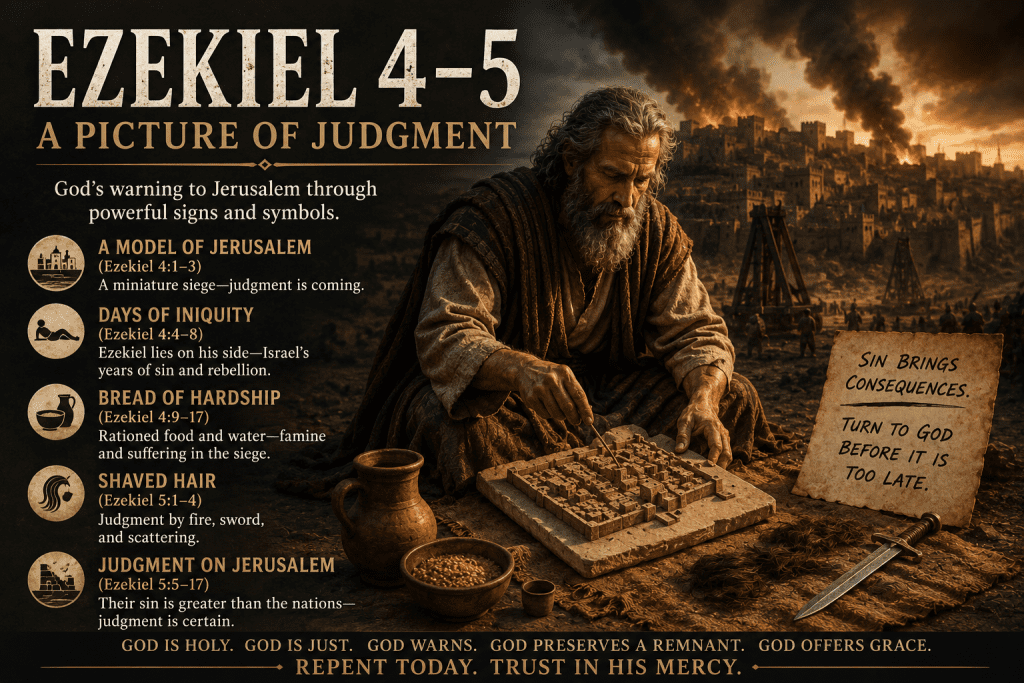
God tells Ezekiel to take a clay tile and draw the city of Jerusalem on it. Then he is to build a miniature siege against the city.
This acted out the Babylonian attack that was coming.
The people still believed Jerusalem was safe because it was God’s city and contained the Temple. They assumed judgment could never happen there.
But the people had confused religious appearance with true obedience.
Simple Explanation
Religious symbols do not protect people who continually reject God.
The people trusted in the city instead of trusting in God.
Application
Many people today trust:
- Church attendance
- Religious background
- Traditions
- Good intentions
But God desires genuine repentance and faith—not empty religion.
Ezekiel Lies on His Side
Ezekiel 4:4–8
God next commands Ezekiel to lie on his side for a specific number of days:
- 390 days for Israel
- 40 days for Judah
These days symbolized years of rebellion and sin.
This was a vivid picture that God had patiently endured generations of disobedience.
Illustration
It is like a parent warning a rebellious child over and over again, only to finally bring discipline after years of patience.
Important Truth
God’s judgment is never impulsive.
He warns repeatedly before judgment comes.
The Bread of Hardship
Ezekiel 4:9–17
God instructs Ezekiel to eat rationed food and drink limited water while lying under the burden of the symbolic siege.
This represented the famine and suffering Jerusalem would experience during Babylon’s attack.
Food would become scarce.
Fear would spread.
The city would suffer terribly.
Simple Explanation
Sin eventually affects every area of life.
What began as spiritual rebellion would eventually lead to national devastation.
Application
Sin promises freedom but eventually produces bondage and destruction.
A person may ignore God for years and think there are no consequences—but eventually sin leaves scars.
The Shaved Hair
Ezekiel 5:1–4
God tells Ezekiel to shave his hair and beard with a sword.
For a Jewish priest, this would have been shocking and humiliating.
The hair was divided into three parts:
- One-third burned
- One-third struck with the sword
- One-third scattered into the wind
This symbolized the coming judgment on Jerusalem:
- Some would die by famine and fire
- Some by violence
- Some would be scattered into exile
Only a small remnant would survive.
Illustration
The hair blowing in the wind pictures lives scattered and broken because of rebellion against God.
Simple Explanation
Sin always scatters what God desires to preserve.
Jerusalem’s Greater Sin
Ezekiel 5:5–17
God says something deeply tragic:
Jerusalem had become more wicked than the surrounding nations.
The city chosen to display God’s glory had instead dishonored Him before the world.
That is why judgment would come.
Important Truth
Greater spiritual privilege brings greater responsibility.
The people knew God’s truth—but rejected it.
Application
It is dangerous to hear God’s Word repeatedly while refusing to obey it.
Knowledge without repentance hardens the heart.
Ezekiel 4–5 and the Gospel
These chapters show us an uncomfortable truth:
God takes sin seriously.
Modern culture often treats sin lightly:
- “It’s not a big deal.”
- “Everybody does it.”
- “God understands.”
But Ezekiel reminds us that sin leads to judgment.
That is why the Gospel is such good news.
Jesus Christ came to bear the judgment that sinners deserve.
At the cross:
- God’s justice was satisfied
- God’s mercy was offered
- Forgiveness became available
The same God who warns about judgment also offers salvation through Christ.
What Ezekiel 4–5 Means for Us Today
1. Sin Is Serious
Sin is not harmless or small.
Unchecked sin eventually destroys lives, families, and nations.
2. God Warns Before Judgment
These dramatic signs were acts of mercy.
God was giving people time to repent.
3. Religion Cannot Replace Obedience
Jerusalem had the Temple but lacked repentance.
Outward religion without inward surrender is empty.
4. God Is Patient
The long symbolic days show God’s incredible patience with rebellion.
But patience should lead us to repentance—not complacency.
5. God Always Preserves a Remnant
Even in judgment, God preserved a small remnant of people.
God never abandons His purposes completely.
Conclusion
Ezekiel 4–5 is a sobering picture of judgment.
The strange signs, rationed food, siege imagery, and scattered hair all communicate one truth:
Sin has consequences.
Yet even in these hard chapters, we still see the mercy of God. He warned the people before judgment came, called them to repentance, and as a result, preserved a remnant.
And today, God still warns people lovingly through His Word.
The message of Ezekiel remains relevant:
Do not ignore God’s warnings.
Turn to Him while there is still time.
Because the same God who judges sin also offers grace through Jesus Christ.
<<Back to Bible Passages
For more insights to the Book of Ezekiel, order Pastor Alan’s book from the links below.
Dr. Alan Holden has served in pastoral ministry for more than 35 years, preaching and teaching the Bible in churches across the United States. He holds a Doctor of Ministry from Luther Rice Seminary and a Master of Divinity from The Southern Baptist Theological Seminary. Through What’s It Mean?, he seeks to help readers understand the meaning of Scripture and grow in their walk with Christ. He is currently the pastor of Lake Saunders Baptist Church in Tavares, FL.