







A Simple, Biblical Explanation of Ezekiel’s Calling
God calls Ezekiel as a prophet after he sees the overwhelming vision of God’s glory in chapter 1. God also calls Ezekiel a watchman to warn people of impending danger.
Ezekiel is called to speak God’s message to a rebellious people.
This was not an easy assignment. God tells Ezekiel from the beginning that many people will refuse to listen. They are stubborn, rebellious, and spiritually hard-hearted.
Yet God still sends him.
That teaches us an important truth:
God calls His servants to be faithful—not necessarily successful in the eyes of the world.
God Calls Ezekiel to Stand
Ezekiel 2:1–2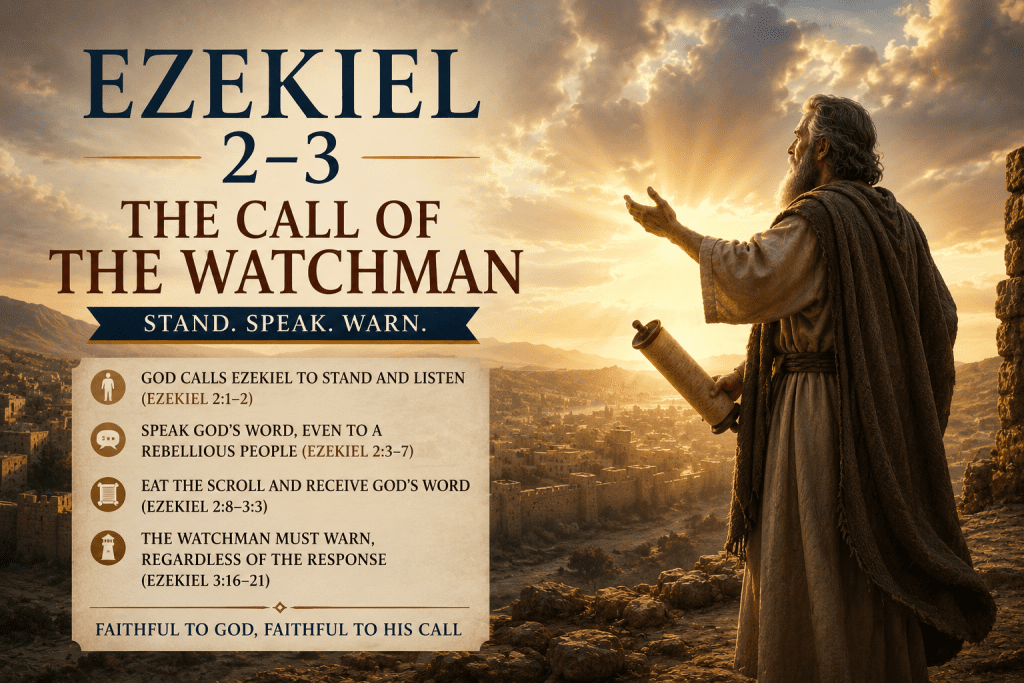
God says to Ezekiel:
“Son of man, stand upon thy feet, and I will speak unto thee.”
The phrase “son of man” emphasizes Ezekiel’s humanity and weakness compared to the greatness of God.
Ezekiel had fallen on his face before God’s glory in chapter 1. Now God raises him up and strengthens him by His Spirit.
Simple Explanation
God never calls us to serve Him in our own strength.
The same God who calls also empowers.
Application
Many believers feel inadequate when God calls them to serve, witness, teach, or lead.
That feeling is normal.
God uses weak people who depend on Him.
A Rebellious People
Ezekiel 2:3–7
God tells Ezekiel that Israel is rebellious and stubborn. They have resisted God for generations.
Imagine hearing this on your very first day of ministry:
- The people are hard-hearted
- They may reject you
- They may refuse to listen
Yet God says:
“You shall speak My words unto them.”
Illustration
It is like a watchman warning people about a coming storm while many ignore him and continue with life as normal.
The watchman’s responsibility is to sound the warning.
Simple Explanation
Success is not measured by popularity.
Faithfulness is measured by obedience.
Do Not Fear Their Faces
Ezekiel 2:6
God repeatedly tells Ezekiel:
“Do not be afraid.”
Fear is one of the greatest obstacles to speaking truth.
People fear:
- Rejection
- Criticism
- Conflict
- Losing approval
But Ezekiel could not allow fear to silence God’s message.
Application
Many Christians remain silent today because they fear what others may think.
But truth spoken in love is still necessary.
Eating the Scroll
Ezekiel 2:8–3:3
God gives Ezekiel a scroll filled with lamentation, mourning, and judgment and tells him to eat it.
This strange picture carries a powerful meaning.
Before Ezekiel could speak God’s Word, he had to first receive it into himself.
God’s message had to become part of him.
Interestingly, although the scroll contained difficult words of judgment, Ezekiel says it tasted sweet like honey.
Why?
Because God’s Word is always good, even when it confronts sin.
Application
You cannot effectively share God’s truth if you are not first feeding on it yourself.
The servant of God must first listen before speaking.
The Hardness of Human Hearts
Ezekiel 3:4–11
God tells Ezekiel that the problem is not language or communication.
The problem is the human heart.
The people are unwilling to hear God.
This is still true today.
Many people do not reject God because the truth is unclear. They reject it because they do not want to surrender to it.
Illustration
A doctor may clearly explain a diagnosis, but a patient can still refuse treatment.
The issue is not understanding—it is willingness.
The Watchman
Ezekiel 3:16–21
This becomes the central image of the chapter.
God appoints Ezekiel as a watchman.
In ancient cities, a watchman stood on the wall watching for danger. If an enemy approached, he sounded the alarm.
If he failed to warn the people, their blood would be on his hands.
God applies this picture spiritually.
Ezekiel’s responsibility was to warn people about sin and judgment.
Important Truth
Ezekiel was not responsible for how people responded.
He was responsible to speak.
That is a critical difference.
The Watchman and the Gospel
This passage speaks powerfully to believers today.
Through Jesus Christ, we know:
- Judgment is real
- Salvation is available
- Eternity matters
Like Ezekiel, believers are called to share truth faithfully.
Not angrily.
Not arrogantly.
But lovingly and courageously.
The church is not called to entertain the world into comfort while ignoring eternity.
We are called to speak truth with compassion.
What Ezekiel 2–3 Means for Us Today
1. God Uses Ordinary People
Ezekiel was not a celebrity or political leader.
He was an ordinary man called by God.
God still uses ordinary people today.
2. Faithfulness Matters More Than Popularity
The world often measures success by numbers, applause, and approval.
God measures faithfulness by obedience.
3. God’s Word Must First Change Us
Before Ezekiel spoke the scroll, he ate it.
God’s truth must first live in us before it flows through us.
4. Silence Can Be Dangerous
The watchman who stays silent fails in his responsibility.
The church must lovingly proclaim truth while there is still time.
5. Fear Cannot Control Us
God repeatedly told Ezekiel:
“Do not be afraid.”
Truth often requires courage.
Conclusion
Ezekiel 2–3 reminds us that serving God is not always easy.
People may resist the truth.
They may reject the message.
They may harden their hearts.
But God still calls His people to stand, speak, and remain faithful.
Before Ezekiel became a preacher to the people, he first became a servant who listened to God.
And that remains the pattern today.
God is still looking for watchmen:
Men and women who will stand faithfully, speak truth courageously, and trust God with the results.
<<Back to Bible Passages
For more insights to the Book of Ezekiel, order Pastor Alan’s book from the links below.
Dr. Alan Holden has served in pastoral ministry for more than 35 years, preaching and teaching the Bible in churches across the United States. He holds a Doctor of Ministry from Luther Rice Seminary and a Master of Divinity from The Southern Baptist Theological Seminary. Through What’s It Mean?, he seeks to help readers understand the meaning of Scripture and grow in their walk with Christ. He is currently the pastor of Lake Saunders Baptist Church in Tavares, FL.