







Introduction
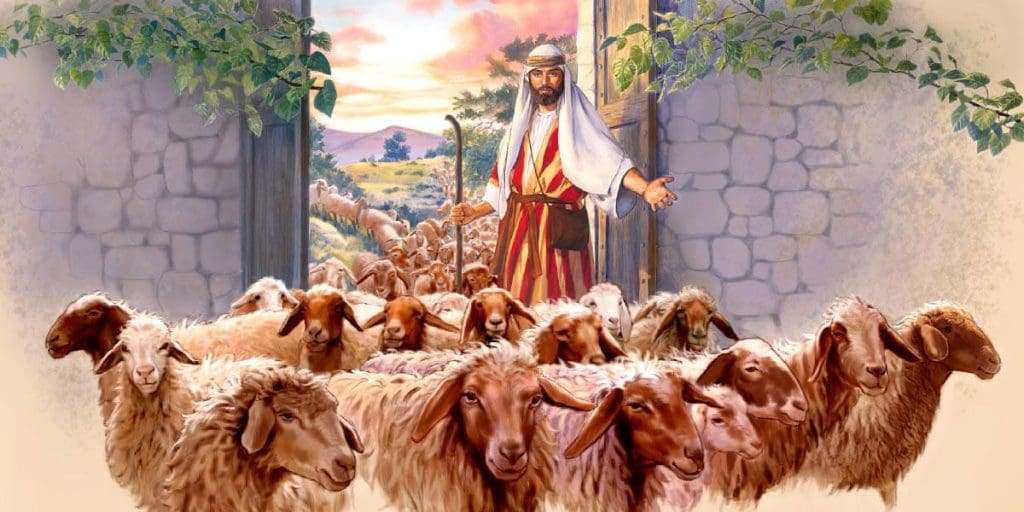
John 10 contains one of the most beloved images in all of Scripture: Jesus as the Good Shepherd. Drawing upon a familiar scene from everyday life in ancient Israel, Jesus reveals His love, care, sacrifice, and authority over His people.
The chapter follows directly after John 9. The religious leaders had rejected the man born blind and cast him out of the synagogue. In contrast, Jesus sought him, cared for him, and brought him into God’s flock. The contrast between false shepherds and the true Shepherd forms the heart of John 10.
This chapter answers an important question:
Who is Jesus to those who believe in Him?
He is the Good Shepherd who knows His sheep, protects them, provides for them, and lays down His life for them.
The Sheepfold and the Shepherd (John 10:1–6)
Jesus begins with a parable about sheep and shepherds.
In biblical times, shepherds often gathered multiple flocks into a common sheepfold at night. A gatekeeper guarded the entrance, and in the morning each shepherd would call his own sheep.
The sheep recognized their shepherd’s voice and followed him.
Jesus contrasts the true shepherd with thieves and robbers.
Characteristics of the True Shepherd
- He enters through the proper door.
- He calls his sheep by name.
- He leads rather than drives them.
- His sheep know his voice.
Characteristics of False Shepherds
- They seek personal gain.
- They deceive and exploit.
- They do not genuinely care for the sheep.
The Pharisees failed to understand the meaning because they were among the false shepherds Jesus was describing.
Jesus Is the Door (John 10:7–10)
Jesus then explains the parable by making another of John’s great “I Am” statements:
“I am the door of the sheep.” (John 10:7)
A shepherd sometimes slept across the entrance of the sheepfold, becoming the living gate that protected the flock.
Jesus declares that He is the only entrance into salvation.
“By me if any man enter in, he shall be saved.” (John 10:9)
What Does the Door Provide?
Those who enter through Christ receive:
- Salvation
- Security
- Protection
- Spiritual nourishment
Jesus then contrasts His mission with that of Satan:
“The thief cometh not, but for to steal, and to kill, and to destroy.” (John 10:10)
By contrast:
“I am come that they might have life, and that they might have it more abundantly.”
Abundant Life
Abundant life does not necessarily mean wealth or an easy life.
It means:
- A restored relationship with God
- Purpose and meaning
- Spiritual joy
- Eternal life
- The presence of Christ
Only Jesus can provide this kind of life.
Jesus the Good Shepherd (John 10:11–18)
Jesus now reveals the central theme of the chapter:
“I am the good shepherd.” (John 10:11)
This is one of the most comforting descriptions of Christ in the Bible.
The Good Shepherd Sacrifices Himself
Jesus says:
“The good shepherd giveth his life for the sheep.”
Unlike a hired servant who runs away when danger comes, the Good Shepherd willingly lays down His life.
This points directly to the cross.
Jesus would soon die in the place of sinners.
The Good Shepherd Knows His Sheep
Jesus declares:
“I know my sheep, and am known of mine.” (John 10:14)
This knowledge is personal.
Christ knows:
- Our struggles
- Our fears
- Our weaknesses
- Our needs
He knows every believer individually.
The Good Shepherd Has Other Sheep
Jesus also says:
“Other sheep I have, which are not of this fold.” (John 10:16)
This refers to Gentiles who would later believe the gospel.
God’s plan has always included people from every tribe, nation, and language.
The result would be:
“One fold, and one shepherd.”
The Voluntary Sacrifice of Christ (John 10:17–18)
Jesus makes a remarkable statement:
“No man taketh it from me, but I lay it down of myself.” (John 10:18)
His death would not be an accident.
Nor would it be a defeat.
Jesus willingly offered Himself for the salvation of His people.
He also declared His authority to take His life again.
This points to His resurrection.
The Cross Was God’s Plan
The crucifixion was not proof that Jesus lost control.
It was proof that He remained in complete control.
The Shepherd willingly became the Lamb.
Division Over Jesus (John 10:19–21)
As throughout John’s Gospel, Jesus’ teaching produced division.
Some said:
“He hath a devil, and is mad.”
Others responded:
“Can a devil open the eyes of the blind?”
People still respond to Jesus in different ways.
Some reject Him.
Others believe Him.
No one remains neutral forever.
The Feast of Dedication (John 10:22–30)
Later, during the Feast of Dedication (Hanukkah), Jesus walked in Solomon’s Porch.
The religious leaders demanded:
“If thou be the Christ, tell us plainly.”
Jesus answered that His works already testified to His identity.
Their problem was not lack of evidence.
Their problem was unbelief.
The Marks of Christ’s Sheep
Jesus describes His followers:
“My sheep hear my voice, and I know them, and they follow me.” (John 10:27)
True believers:
- Hear Christ’s voice through His Word
- Trust Him
- Follow Him
Eternal Security
Jesus then offers one of the greatest promises in Scripture:
“And I give unto them eternal life; and they shall never perish.” (John 10:28)
He continues:
“Neither shall any man pluck them out of my hand.”
Believers are secure because they are held by both the Son and the Father.
Our salvation ultimately rests on God’s power, not our own.
“I and My Father Are One” (John 10:30–42)
The chapter reaches its climax when Jesus declares:
“I and my Father are one.” (John 10:30)
The religious leaders immediately picked up stones.
Why?
Because they understood exactly what Jesus meant.
He was claiming equality with God.
Jesus was not merely saying that He and the Father agreed.
He was declaring unity of nature and essence.
The Jewish leaders accused Him of blasphemy because they recognized His claim to deity.
The Central Question
John repeatedly confronts readers with the same issue:
Who is Jesus?
If He is merely a man, His claims are outrageous.
If He is God, then every person must bow before Him.
What John 10 Means for Us Today
1. Jesus Is the Only Way of Salvation
He is the Door through which sinners enter God’s flock.
2. Jesus Knows and Loves His People
Believers are not anonymous faces in a crowd.
The Shepherd knows each sheep by name.
3. Christ Sacrificed Himself for Us
The cross reveals the depth of God’s love.
4. Believers Are Secure in Christ
No force can remove God’s children from His hand.
5. Jesus Is Fully God
The Good Shepherd is not merely a teacher or prophet.
He is the divine Son of God.
Conclusion
John 10 paints a beautiful portrait of Jesus Christ.
He is the Door through whom salvation comes.
Jesus is the Good Shepherd who knows His sheep.
He is the Savior who lays down His life for the flock.
Jesus is the Son who is one with the Father.
In a world filled with false voices and unreliable guides, Jesus remains the Shepherd who never fails.
His sheep hear His voice, trust His leadership, and follow Him.
The invitation of John 10 is simple:
Listen to the voice of the Good Shepherd and follow Him wherever He leads.
<<Back to John 9 OR Forward to John 11>>
<<Back to Gospel of John
For more insights to the Gospel of John, order Pastor Alan’s book, Come and See, from the links below.
Dr. Alan Holden has served in pastoral ministry for more than 35 years, preaching and teaching the Bible in churches across the United States. He holds a Doctor of Ministry from Luther Rice Seminary and a Master of Divinity from The Southern Baptist Theological Seminary. Through What’s It Mean?, he seeks to help readers understand the meaning of Scripture and grow in their walk with Christ. He is currently the pastor of Lake Saunders Baptist Church in Tavares, FL.