







Introduction
John 6 is one of the most important chapters in the Gospel of John. It contains two of Jesus’ most famous miracles—the feeding of the five thousand and walking on the water—and one of His most profound teachings: “I am the Bread of Life” (John 6:35).
The chapter challenges readers to move beyond seeking Jesus merely for what He can provide and to trust Him as the One who gives eternal life. Many followed Jesus because of the miracles. Few followed Him because of who He truly was.
John 6 asks every reader a vital question: Are you following Jesus for His gifts, or are you following Him because He is the Son of God?
The Feeding of the Five Thousand (John 6:1–15)
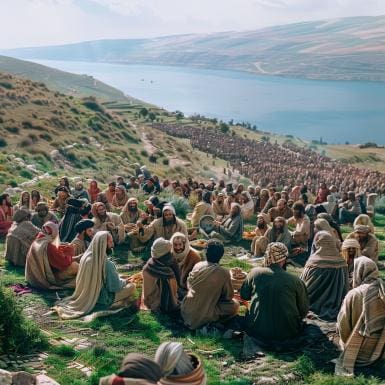
A large crowd followed Jesus because they had seen His miracles. As evening approached, the disciples worried about feeding thousands of people gathered in a remote location.
A boy offered five barley loaves and two fish. Humanly speaking, it was not enough. Yet Jesus took the small offering, gave thanks, and distributed the food.
The result was astonishing:
- More than five thousand men were fed
- Everyone ate until satisfied
- Twelve baskets of leftovers remained
This miracle demonstrates several truths:
Jesus Meets Human Needs
The Lord cares about physical needs as well as spiritual needs. He saw the hunger of the crowd and responded with compassion.
Little Becomes Much in God’s Hands
The boy’s lunch seemed insignificant. Yet when placed in Jesus’ hands, it became more than enough.
Jesus Is Greater Than Moses
The miracle reminded the people of the manna God provided in the wilderness. John wants readers to see that Jesus is greater than Moses because He is the source of true heavenly bread.
Jesus Walks on Water (John 6:16–21)
After feeding the crowd, Jesus sent His disciples across the Sea of Galilee.
A strong storm arose, and the disciples struggled against the wind and waves. Suddenly they saw Jesus walking on the water toward them.
Imagine their fear and amazement.
Jesus spoke these comforting words:
“It is I; be not afraid.” (John 6:20)
The phrase “It is I” can also be translated “I AM,” echoing God’s divine name revealed in the Old Testament.
This miracle teaches that:
- Jesus has authority over nature.
- Jesus comes to His followers in the middle of life’s storms.
- Faith grows when we recognize Christ’s presence in difficult circumstances.
Believers today can find comfort knowing that no storm is beyond the power of Christ.
Seeking the Wrong Bread (John 6:22–34)
The next day the crowd searched for Jesus.
At first this appears admirable, but Jesus exposed their true motives.
He told them:
“Ye seek me, not because ye saw the miracles, but because ye did eat of the loaves, and were filled.” (John 6:26)
The people wanted another free meal. They were interested in temporary satisfaction rather than eternal truth.
How often do people approach God the same way?
Many seek:
- Financial blessings
- Physical healing
- Success
- Comfort
Yet Jesus calls people to seek something greater—the salvation of their souls.
Jesus: The Bread of Life (John 6:35–59)
This section contains the first of John’s seven great “I Am” statements.
Jesus declared:
“I am the bread of life: he that cometh to me shall never hunger; and he that believeth on me shall never thirst.” (John 6:35)
Bread was a staple food in the ancient world. Without it, people could not survive.
Jesus uses this image to teach that spiritual life is impossible apart from Him.
Physical Bread vs. Spiritual Bread
The manna in the wilderness sustained Israel temporarily.
Jesus provides eternal life.
The manna:
- Came from heaven
- Sustained physical life
- Lasted one day at a time
Jesus:
- Came from heaven
- Gives eternal life
- Fully satisfies the soul
What Does It Mean to Eat His Flesh and Drink His Blood?
Jesus used vivid language that shocked His audience.
He was not teaching cannibalism. Rather, He was teaching complete faith and dependence upon Him.
Just as bread becomes part of the body when eaten, Christ must be personally received through faith.
Salvation is not gained by admiring Jesus from a distance. It comes through trusting Him completely.
Many Disciples Turn Away (John 6:60–66)
When Jesus finished teaching, many followers became offended.
They said:
“This is an hard saying; who can hear it?” (John 6:60)
As long as Jesus multiplied bread, the crowds were enthusiastic.
When He demanded faith, commitment, and surrender, many left.
John records one of the saddest verses in the Gospel:
“From that time many of his disciples went back, and walked no more with him.” (John 6:66)
This reminds us that genuine discipleship is costly.
Following Christ involves more than enjoying blessings. It means trusting Him even when His teachings challenge us.
Peter’s Great Confession (John 6:67–71)
After many departed, Jesus turned to the Twelve and asked:
“Will ye also go away?”
Peter answered with one of the greatest statements of faith in Scripture:
“Lord, to whom shall we go? thou hast the words of eternal life.” (John 6:68)
Peter did not claim to understand everything.
He simply knew there was nowhere else to turn.
That remains true today.
No philosophy, religion, government, or human achievement can provide eternal life.
Only Jesus can.
What John 6 Means for Us Today
1. Jesus Is Enough
Many people spend their lives searching for satisfaction in money, success, relationships, or possessions.
Only Christ can satisfy the deepest hunger of the soul.
2. God Can Use Small Offerings
The boy’s lunch reminds us that God specializes in using ordinary people and small resources for extraordinary purposes.
3. Christ Is Present in Our Storms
The disciples learned that Jesus comes to His people in the middle of fear and uncertainty.
4. True Faith Goes Beyond Miracles
Many wanted miracles but rejected the Messiah.
Authentic faith trusts Jesus because of who He is.
5. Eternal Life Is Found Only in Christ
Peter’s confession remains the answer for every generation:
“Lord, to whom shall we go?”
There is no other Savior.
Conclusion
John 6 presents Jesus as the miraculous Provider, the Master of creation, and the Bread of Life.
The crowds wanted bread for a day. Jesus offered life forever.
Some walked away because His message was difficult. Peter stayed because he recognized the truth: only Jesus has the words of eternal life.
The same choice confronts every reader today. Will we seek temporary satisfaction, or will we trust the One who alone can satisfy our souls forever?
When we come to Christ in faith, we discover that the Bread of Life never runs out.
<<Back to John 5 OR Forward to John 7>>
<<Back to Gospel of John
For more insights to the Gospel of John, order Pastor Alan’s book, Come and See, from the links below.
Dr. Alan Holden has served in pastoral ministry for more than 35 years, preaching and teaching the Bible in churches across the United States. He holds a Doctor of Ministry from Luther Rice Seminary and a Master of Divinity from The Southern Baptist Theological Seminary. Through What’s It Mean?, he seeks to help readers understand the meaning of Scripture and grow in their walk with Christ. He is currently the pastor of Lake Saunders Baptist Church in Tavares, FL.