







Introduction
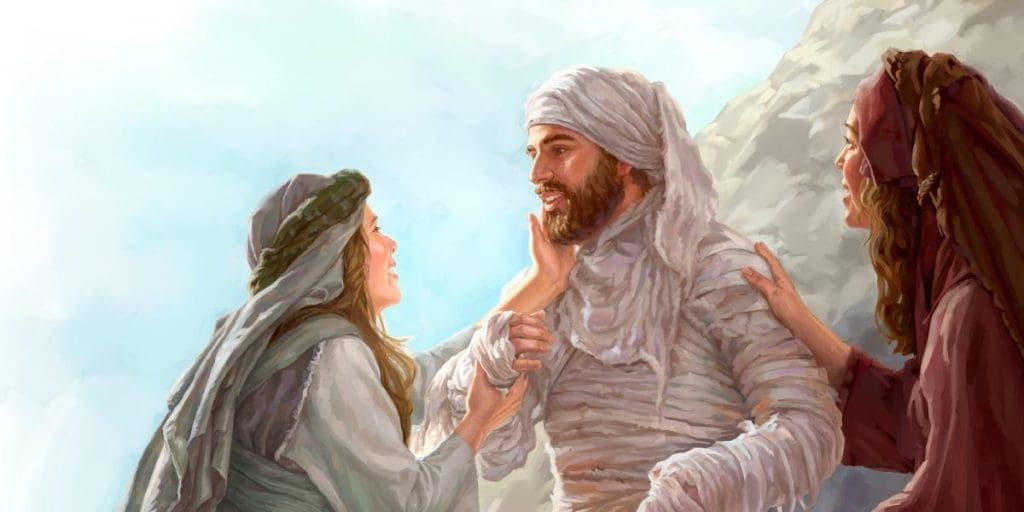
John 11 records one of the greatest miracles in the ministry of Jesus—the raising of Lazarus from the dead. This event serves as the climactic sign in John’s Gospel before Jesus enters Jerusalem for His final week.
The chapter reveals the power of Christ over death, His deep compassion for those who suffer, and His identity as the source of eternal life.
John 11 answers one of humanity’s greatest questions:
What hope is there in the face of death?
Jesus provides the answer:
“I am the resurrection, and the life.” (John 11:25)
Because of who He is, death does not have the final word.
The Death of Lazarus (John 11:1–16)
The chapter opens with troubling news.
Lazarus of Bethany, the brother of Mary and Martha, had become seriously ill.
The sisters sent a message to Jesus:
“Lord, behold, he whom thou lovest is sick.” (John 11:3)
Notice the confidence in their request.
They knew Jesus loved Lazarus.
Surely He would come immediately.
Yet Jesus did something unexpected.
He stayed where He was for two more days.
From a human perspective, His delay seems difficult to understand.
But Jesus explained:
“This sickness is not unto death, but for the glory of God.” (John 11:4)
God’s Timing Is Different
Mary and Martha wanted an immediate answer.
Jesus had a greater purpose.
Often believers struggle when God appears to delay.
Yet His delays are not His denials.
God’s timing is always perfect, even when we cannot understand it.
Jesus Arrives in Bethany (John 11:17–27)
By the time Jesus arrived, Lazarus had been dead for four days.
Martha met Him first and said:
“Lord, if thou hadst been here, my brother had not died.” (John 11:21)
Her words reveal both sorrow and faith.
She believed Jesus could have healed Lazarus.
What she did not yet understand was that Jesus intended something even greater.
Jesus assured her:
“Thy brother shall rise again.”
Martha thought He was speaking about the future resurrection.
Then Jesus made one of the greatest declarations in all of Scripture:
“I am the resurrection, and the life: he that believeth in me, though he were dead, yet shall he live.” (John 11:25)
This is the fifth of John’s great “I Am” statements.
What Does It Mean?
Jesus does not merely give resurrection.
He is the Resurrection.
Jesus does not merely offer life.
He is the Life.
Every hope of eternal life rests in Him.
Jesus Weeps (John 11:28–37)
Mary soon arrived at Jesus’ feet.
Overcome with grief, she repeated Martha’s words:
“Lord, if thou hadst been here, my brother had not died.”
As Jesus observed the sorrow around Him, John records the shortest verse in the Bible:
“Jesus wept.” (John 11:35)
Though brief, these words reveal profound truth.
Why Did Jesus Weep?
Jesus knew He would raise Lazarus moments later.
Yet He still wept.
His tears demonstrate:
- His compassion
- His humanity
- His love for His friends
- His grief over the effects of sin and death
This is one of the most comforting truths in Scripture.
The Savior is not distant from our pain.
He enters into it.
When believers suffer, Christ understands.
Lazarus Raised from the Dead (John 11:38–44)
Jesus came to the tomb.
It was a cave sealed by a stone.
He commanded:
“Take ye away the stone.”
Martha hesitated.
Lazarus had been dead four days.
Decay had already begun.
Yet Jesus reminded her to believe.
After praying to the Father, Jesus cried out:
“Lazarus, come forth.” (John 11:43)
Immediately, Lazarus emerged from the tomb still wrapped in grave clothes.
Death itself obeyed the voice of Christ.
The Power of Christ
This miracle demonstrates that Jesus possesses authority over:
- Disease
- Nature
- Demons
- Sin
- Death
The One who called Lazarus from the grave will one day call all believers from their graves.
The Reactions to the Miracle (John 11:45–57)
Many who witnessed the miracle believed in Jesus.
Others reported the event to the religious leaders.
Rather than celebrating the miracle, the chief priests and Pharisees became alarmed.
They feared:
- Losing influence
- Losing political power
- Losing control
As a result, they began plotting Jesus’ death.
Ironically, the miracle that demonstrated Jesus’ power over death accelerated the events that would lead to His own crucifixion.
Caiaphas’ Unintended Prophecy
The high priest Caiaphas declared:
“It is expedient for us, that one man should die for the people.” (John 11:50)
Though spoken with evil intentions, God used his words prophetically.
Jesus would indeed die for His people.
But not for the reasons Caiaphas imagined.
Christ would die as the sacrifice for sin.
The Major Themes of John 11
1. Jesus Is the Resurrection and the Life
The central message of the chapter is that life is found in Christ.
Death is not stronger than the Savior.
2. God’s Delays Have Purpose
Jesus delayed His arrival because He intended to reveal God’s glory.
Believers can trust God even when answers seem slow in coming.
3. Christ Understands Our Pain
Jesus wept.
The Son of God enters into human suffering with compassion and love.
4. Faith Trusts God Beyond What It Can See
Martha struggled to understand.
Yet Jesus called her to believe before she saw the miracle.
Faith often works the same way today.
5. Death Is Not the End
For believers, death is not a final destination.
Because Christ lives, His people will live also.
What John 11 Means for Us Today
When Grief Comes
John 11 reminds us that grief is not a sign of weak faith.
Even Jesus wept.
Believers can mourn honestly while still trusting God.
When God Seems Late
Mary and Martha believed Jesus arrived too late.
Yet Jesus was working according to a greater plan.
God is never late.
When Facing Death
The world views death as the end.
Christians view death through the lens of the resurrection.
Because Jesus conquered the grave, believers possess eternal hope.
When Faith Is Tested
Jesus repeatedly called Martha and Mary to trust Him.
Faith grows when we learn to rely on God’s promises rather than our circumstances.
Conclusion
John 11 stands as one of the most hope-filled chapters in the Bible.
Jesus delayed, but He was not absent.
He wept, but He was not powerless.
He stood before a sealed tomb and demonstrated His authority over death itself.
The raising of Lazarus points forward to an even greater event—the resurrection of Jesus Christ.
Because Jesus is the Resurrection and the Life, all who trust in Him have the promise of eternal life.
The question Jesus asked Martha remains for every reader today:
“Believest thou this?” (John 11:26)
Those who answer with faith discover that death is not the end, because the Savior who called Lazarus from the grave still reigns today.
<<Back to John 10 OR Forward to John 12>>
<<Back to Gospel of John
For more insights to the Gospel of John, order Pastor Alan’s book, Come and See, from the links below.
Dr. Alan Holden has served in pastoral ministry for more than 35 years, preaching and teaching the Bible in churches across the United States. He holds a Doctor of Ministry from Luther Rice Seminary and a Master of Divinity from The Southern Baptist Theological Seminary. Through What’s It Mean?, he seeks to help readers understand the meaning of Scripture and grow in their walk with Christ. He is currently the pastor of Lake Saunders Baptist Church in Tavares, FL.