






Jesus Christ in the Book of Genesis
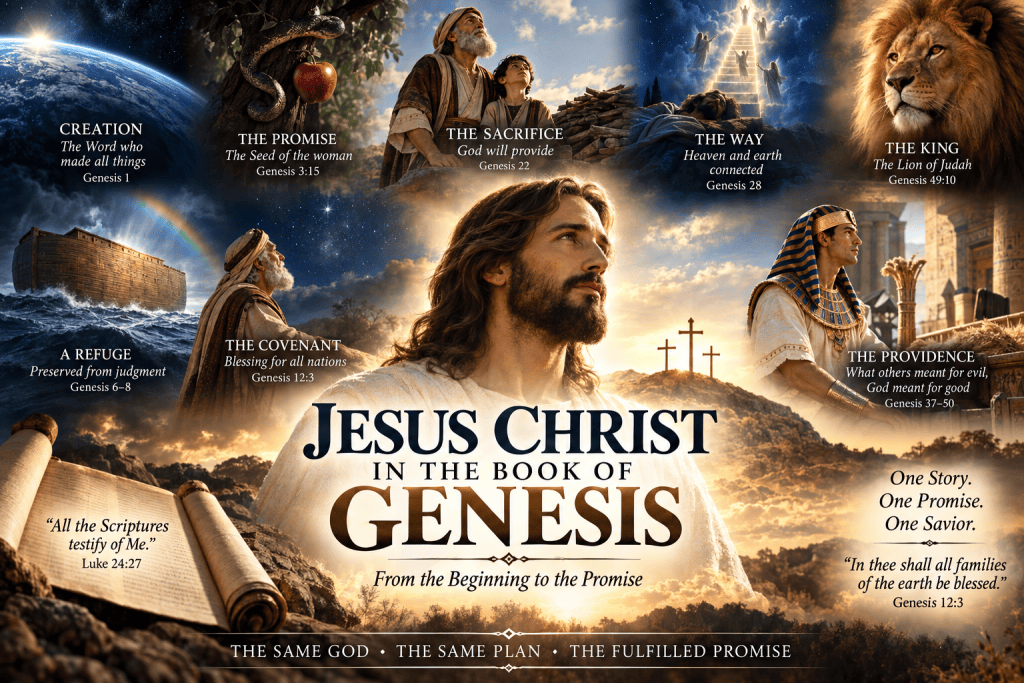
Key Scriptures: Genesis 3:15; Genesis 12:3; Genesis 22:8; Genesis 28:12; Genesis 49:10; John 1:1–3; John 8:56; Galatians 3:16; Revelation 5:5
“Your father Abraham rejoiced to see my day: and he saw it, and was glad.” — John 8:56
Jesus was born in Bethlehem.
But the story of Jesus does not begin in Bethlehem.
It begins in Genesis.
From the opening words of Scripture, the Bible begins preparing us for Jesus Christ.
Genesis tells us why we need a Savior.
It introduces the promise of a Savior.
Genesis traces the family through whom the Savior would come.
And through people, events, promises, sacrifices, and patterns, Genesis begins pointing toward the One who would eventually redeem fallen humanity.
Therefore, if we read Genesis carefully, we discover that Jesus Christ stands at the center of the story from the very beginning.
Jesus Was There “In the Beginning”
Genesis begins:
“In the beginning God created the heaven and the earth.” — Genesis 1:1
The New Testament tells us that Jesus Christ was involved in that creation.
John deliberately echoes Genesis:
“In the beginning was the Word, and the Word was with God, and the Word was God.” — John 1:1
Then John says:
“All things were made by him; and without him was not any thing made that was made.” — John 1:3
Jesus did not begin His existence in Bethlehem.
The eternal Son existed before creation.
Jesus Is the Creator
Paul says of Christ:
“For by him were all things created, that are in heaven, and that are in earth.” — Colossians 1:16
The baby lying in Bethlehem’s manger was the eternal Son through whom the universe was made.
The hands that would one day be nailed to a cross were the hands through which creation came into being.
Genesis begins with creation.
The New Testament reveals Christ as Creator.
Creation Was Good
Genesis repeatedly says:
“And God saw that it was good.”
Then, after creating humanity:
“God saw every thing that he had made, and, behold, it was very good.” — Genesis 1:31
The world God created was not filled with death, violence, corruption, and suffering.
Something happened.
Genesis 3 explains what went wrong.
And when we understand Genesis 3, we understand why Jesus had to come.
Sin Entered the World
God placed Adam and Eve in Eden.
They enjoyed fellowship with Him.
But the serpent tempted Eve.
Adam and Eve disobeyed God.
Sin entered human experience.
With sin came:
- Shame.
- Fear.
- Separation.
- Pain.
- Conflict.
- And death.
Romans later explains:
“By one man sin entered into the world, and death by sin.” — Romans 5:12
Genesis explains the problem.
The Gospel provides the answer.
The First Promise of the Savior
Immediately after the Fall, God spoke to the serpent:
“And I will put enmity between thee and the woman, and between thy seed and her seed.” — Genesis 3:15
Then came the promise:
“It shall bruise thy head, and thou shalt bruise his heel.”
Christians have traditionally called this the protoevangelium—the first announcement of the Gospel.
Humanity had fallen.
But God immediately announced that a Deliverer would come.
The Seed of the Woman
The wording is striking.
The coming Deliverer would be associated with:
“Her seed.”
As the rest of Scripture unfolds, this promise becomes increasingly clear.
A descendant of the woman would eventually defeat the serpent.
The serpent would wound Him.
But He would crush the serpent’s head.
The battle would cost the Savior dearly.
But the Savior would win.
Jesus Defeated the Serpent
At the cross, Jesus suffered.
He was wounded.
Jesus died.
For a moment, it looked as though evil had won.
But Jesus rose from the dead.
Through His death and resurrection, Christ defeated sin and death and guaranteed Satan’s ultimate destruction.
Hebrews says that through death Christ would:
“Destroy him that had the power of death, that is, the devil.” — Hebrews 2:14
The promise of Genesis 3:15 begins its fulfillment at the cross and resurrection and reaches its final completion when evil is forever defeated.
God Covered Adam and Eve
After Adam and Eve sinned, they realized they were naked.
They attempted to cover themselves with fig leaves.
But their own covering was inadequate.
Then Genesis says:
“Unto Adam also and to his wife did the LORD God make coats of skins, and clothed them.” — Genesis 3:21
God provided what they could not adequately provide for themselves.
A Covering God Provides
We should be careful not to build more symbolism into the passage than Scripture itself gives us.
Nevertheless, a biblical pattern begins to emerge.
Sin produces shame.
Human beings attempt to cover themselves.
God provides the covering.
Later, Scripture reveals that sinners cannot make themselves righteous.
God must provide righteousness.
Through Christ, God does exactly that.
Cain and Abel
Genesis 4 introduces Cain and Abel.
Both brought offerings to God.
But Hebrews tells us:
“By faith Abel offered unto God a more excellent sacrifice than Cain.” — Hebrews 11:4
Abel approached God by faith.
Cain did not.
The difference was deeper than the physical objects they brought.
The issue involved the heart and faith.
Abel’s Blood Cried from the Ground
Cain murdered Abel.
Then God said:
“The voice of thy brother’s blood crieth unto me from the ground.” — Genesis 4:10
Hebrews later makes an interesting comparison.
It speaks of Jesus:
“And to the blood of sprinkling, that speaketh better things than that of Abel.” — Hebrews 12:24
Abel’s blood cried out concerning injustice.
Christ’s shed blood provides forgiveness and reconciliation.
Noah and the Ark
By Genesis 6, humanity had become deeply corrupt.
God announced judgment through the Flood.
But Scripture says:
“Noah found grace in the eyes of the LORD.” — Genesis 6:8
God instructed Noah to build an ark.
When judgment came, those inside the ark were preserved.
The Ark and Salvation
The ark gives us a powerful biblical picture of refuge from judgment.
God provided the way of escape.
Noah trusted God’s warning.
He entered the ark.
God preserved him.
In the Gospel, Christ is our refuge from the judgment of sin.
We should not force every detail of the ark into an allegory.
But the broad pattern is unmistakable:
Judgment is coming. God provides salvation. Faith receives God’s provision.
The Door of the Ark
Genesis says:
“And the LORD shut him in.” — Genesis 7:16
Noah was secure inside God’s appointed refuge.
Jesus later said:
“I am the door: by me if any man enter in, he shall be saved.” — John 10:9
Again, we should not claim Genesis explicitly identifies the ark’s door as a prophecy of Christ.
Rather, the pattern of God’s provided refuge helps us understand the greater salvation eventually revealed in Jesus.
Babel and the Nations
Genesis 11 describes humanity gathering at Babel.
The people said:
“Let us make us a name.”
Human pride sought greatness apart from God.
God confused their language and scattered them across the earth.
The nations were divided.
But God was not finished with the nations.
In the very next chapter, He called Abraham.
Abraham and the Promise
God told Abraham:
“In thee shall all families of the earth be blessed.” — Genesis 12:3
This is one of the great promises of Scripture.
God’s plan was never merely about one family receiving private blessings.
Through Abraham’s family, blessing would eventually reach:
All families of the earth.
How?
The New Testament answers.
The Promised Seed Is Christ
Paul writes:
“Now to Abraham and his seed were the promises made.”
Then he explains:
“And to thy seed, which is Christ.” — Galatians 3:16
Jesus is the promised descendant of Abraham through whom blessing reaches the nations.
Matthew therefore begins the genealogy of Jesus with these words:
“Jesus Christ, the son of David, the son of Abraham.” — Matthew 1:1
Genesis is already moving toward Jesus.
Abraham Believed God
Genesis 15 contains another foundational Gospel truth.
“And he believed in the LORD; and he counted it to him for righteousness.” — Genesis 15:6
Abraham was not declared righteous because he lived a flawless life.
Genesis makes his failures clear.
He was counted righteous through faith.
Paul uses Abraham as the great Old Testament example of justification by faith.
Salvation Has Always Been by Grace Through Faith
Romans 4 quotes Genesis 15:6.
Paul explains:
“Abraham believed God, and it was counted unto him for righteousness.” — Romans 4:3
Abraham looked forward in faith to God’s promise.
Christians look back to the completed work of Christ.
The basis of salvation is God’s grace.
And the means by which we receive it is faith.
Melchizedek
Genesis 14 introduces one of Scripture’s most mysterious figures.
After Abraham rescued Lot, he met:
“Melchizedek king of Salem.”
Genesis calls Melchizedek:
“The priest of the most high God.” — Genesis 14:18
He was both:
King.
And:
Priest.
That combination becomes important later.
Melchizedek Points Toward Christ
Psalm 110 says of the coming Messiah:
“Thou art a priest for ever after the order of Melchizedek.”
Hebrews applies this directly to Jesus.
Christ is our eternal High Priest.
He is also King.
Therefore, Melchizedek provides an early biblical pattern of the King-Priest ultimately fulfilled in Jesus.
Was Melchizedek Jesus?
Some Christians have suggested that Melchizedek was a preincarnate appearance of Christ.
Others understand him as a historical king-priest whose life foreshadowed Christ.
Hebrews emphasizes the comparison between Melchizedek and Jesus rather than explicitly identifying them as the same person.
Therefore, it is wiser not to be dogmatic where Scripture is not.
What is clear is this:
Melchizedek points us toward Jesus, our eternal King and High Priest.
Abraham and Isaac
Genesis 22 contains one of the clearest Old Testament patterns preparing us for the Gospel.
God tested Abraham.
He told him to take:
“Thy son, thine only son Isaac, whom thou lovest.”
Isaac was the promised son.
Through Isaac, God’s covenant promises would continue.
Yet Abraham was told to offer him.
The Father and the Beloved Son
The language catches our attention.
“Thy son, thine only son… whom thou lovest.”
Later, the New Testament says:
“For God so loved the world, that he gave his only begotten Son.” — John 3:16
Isaac is not Jesus.
Abraham is not God the Father.
But the pattern helps prepare us to understand the Gospel.
- A father.
- A beloved son.
- A sacrifice.
- A mountain.
- And God’s provision.
Isaac Carried the Wood
Genesis says Abraham placed the wood upon Isaac.
Isaac carried the wood toward the place of sacrifice.
Centuries later, Jesus would carry His cross toward Calvary.
Again, we should not force every detail.
But the similarities are difficult to miss.
“Where Is the Lamb?”
Isaac asked:
“Behold the fire and the wood: but where is the lamb for a burnt offering?” — Genesis 22:7
Abraham answered:
“My son, God will provide himself a lamb for a burnt offering.” — Genesis 22:8
That sentence echoes through the rest of Scripture.
Where is the Lamb?
God Provided a Ram
At the crucial moment, God stopped Abraham.
Then Abraham saw a ram caught in a thicket.
Genesis says Abraham offered the ram:
“In the stead of his son.”
That is substitution.
The ram died.
Isaac lived.
One took the place of another.
Jesus Is Our Substitute
The Gospel announces a far greater substitution.
Jesus took the place of sinners.
Isaiah had prophesied:
“The LORD hath laid on him the iniquity of us all.” — Isaiah 53:6
Paul wrote:
“Christ died for our sins according to the scriptures.” — 1 Corinthians 15:3
The substitute at Moriah prepares us to understand the Substitute at Calvary.
God Will Provide
Abraham named the place:
“Jehovah-jireh.”
The LORD will provide.
At Moriah, God provided a substitute for Isaac.
At Calvary, God provided His Son for us.
John the Baptist saw Jesus and declared:
“Behold the Lamb of God, which taketh away the sin of the world.” — John 1:29
The question of Genesis 22 receives its ultimate answer in Jesus.
Where is the Lamb?
Jesus is the Lamb.
Jacob’s Ladder
Genesis 28 records Jacob fleeing from home.
One night he slept with a stone for a pillow.
Then he dreamed.
He saw:
“A ladder set up on the earth, and the top of it reached to heaven.”
Angels were ascending and descending upon it.
Heaven and earth were connected.
Jesus Explained Jacob’s Ladder
Centuries later, Jesus spoke to Nathanael:
“Hereafter ye shall see heaven open, and the angels of God ascending and descending upon the Son of man.” — John 1:51
Jesus deliberately used the language of Jacob’s dream.
Jesus is the true meeting place between heaven and earth.
He is the way sinners come to God.
Jesus Is the Way to God
Jesus said:
“I am the way, the truth, and the life: no man cometh unto the Father, but by me.” — John 14:6
Jacob saw a ladder.
The New Testament reveals the greater reality.
We do not climb our way to God through religion, morality, ritual, or human effort.
God comes to us through Christ.
Babel and Bethel
There is a fascinating contrast.
At Babel, humanity said:
Let us build upward toward heaven.
At Bethel, God provided the connection between heaven and earth.
Babel pictures human religion:
We will reach God.
Bethel points toward grace:
God provides the way.
Jesus is that way.
Jacob Wrestles with God
Genesis 32 records Jacob wrestling through the night with a mysterious man.
Jacob later named the place Peniel:
“For I have seen God face to face, and my life is preserved.” — Genesis 32:30
Hosea 12 later describes Jacob wrestling with the angel.
Christians have sometimes understood this encounter as a preincarnate appearance of Christ.
That interpretation is possible, but the text does not explicitly say, “This was Christ.”
Therefore, we should remain careful.
The central truth is that Jacob encountered God and came away transformed.
Judah and the Coming King
Genesis 49 brings us to another major Messianic promise.
Jacob gathered his sons.
When he came to Judah, he said:
“Judah is a lion’s whelp.” — Genesis 49:9
Then:
“The sceptre shall not depart from Judah.” — Genesis 49:10
The sceptre represents kingship.
The promised ruler would come through Judah.
The Promise Narrows Again
Follow the line.
Genesis 3:
The Seed of the woman.
Genesis 12:
The Seed of Abraham.
Then:
Isaac.
Then:
Jacob.
Genesis 49:
Judah.
Later Scripture narrows the promise again:
David.
Finally:
Jesus Christ.
God is gradually revealing the identity of the coming King.
The Lion of Judah
Revelation uses Jacob’s ancient imagery when it announces:
“Behold, the Lion of the tribe of Juda… hath prevailed.” — Revelation 5:5
Who is the Lion?
Jesus Christ.
Genesis 49 points forward across centuries toward the King of Kings.
Joseph
Finally, we come to Joseph.
Joseph is never explicitly called a type of Christ in the New Testament in the same way that Adam is.
Therefore, we should be careful not to turn every detail of Joseph’s life into prophecy.
Nevertheless, Joseph’s life contains remarkable patterns that remind Christians of Jesus.
Joseph Was the Beloved Son
Jacob loved Joseph deeply.
Jesus is the beloved Son of the Father.
At Jesus’ baptism, the Father declared:
“This is my beloved Son, in whom I am well pleased.” — Matthew 3:17
Joseph Was Rejected by His Brothers
Joseph’s brothers hated him.
They rejected him and sold him.
Jesus likewise:
“Came unto his own, and his own received him not.” — John 1:11
Joseph Was Sold
Judah suggested selling Joseph.
Jesus was betrayed for silver.
Again, the details are not identical.
But both stories contain betrayal by those close to them.
Joseph Suffered Unjustly
Joseph was falsely accused.
He was imprisoned despite his innocence.
Jesus was also falsely accused.
Pilate ultimately declared:
“I find no fault in him.” — John 19:4
Yet Jesus was crucified.
Joseph Descended Before He Was Exalted
Joseph’s life moved downward:
- From favored son.
- To pit.
- To slavery.
- To prison.
Then suddenly upward:
- From prison.
- To Pharaoh’s court.
- To ruler over Egypt.
Jesus likewise humbled Himself.
Philippians says:
“He humbled himself, and became obedient unto death, even the death of the cross.” — Philippians 2:8
Then:
“Wherefore God also hath highly exalted him.” — Philippians 2:9
Joseph Provided Bread
During the famine, people came to Joseph for food.
Pharaoh told them:
“Go unto Joseph.”
Joseph opened the storehouses.
Through him, people lived.
Jesus provides something infinitely greater.
He said:
“I am the bread of life: he that cometh to me shall never hunger.” — John 6:35
Joseph provided bread that preserved physical life.
Jesus gives eternal life.
Joseph Saved Those Who Rejected Him
Joseph’s brothers rejected him.
Years later, Joseph became the means God used to save their lives.
That is a striking pattern.
Humanity rejected Jesus.
Yet through the death of the rejected Christ, salvation is offered to sinners.
Peter told the people of Jerusalem that they had rejected Jesus.
Yet he also offered them forgiveness through the same Christ.
That is grace.
Joseph Forgave His Brothers
When Joseph finally revealed himself, his brothers were terrified.
But Joseph said:
“Come near to me, I pray you.” — Genesis 45:4
He:
- forgave them.
- nourished them.
- protected them.
- brought them near.
Jesus does something infinitely greater for sinners.
Through Christ, those who were far from God can be brought near.
“God Meant It Unto Good”
Joseph summarized his life:
“Ye thought evil against me; but God meant it unto good.” — Genesis 50:20
That principle reaches its greatest expression at the cross.
Human beings intended evil against Jesus.
Yet through that evil act, God accomplished redemption.
The Cross Is the Greatest Example of Providence
Peter said of Jesus:
“Him, being delivered by the determinate counsel and foreknowledge of God, ye have taken… and slain.” — Acts 2:23
Human beings were responsible.
God was sovereign.
The crucifixion was evil.
God used it for the greatest good imaginable:
Our salvation.
Adam and Jesus
Genesis also prepares us for Christ through Adam.
Adam stands at the beginning of fallen humanity.
Jesus comes as what Paul calls:
“The last Adam.” — 1 Corinthians 15:45
The first Adam disobeyed.
Jesus obeyed.
Through Adam came death.
But through Christ comes life.
Two Representatives
Romans 5 places Adam and Christ side by side.
Adam’s disobedience brought condemnation.
Christ’s obedience provides righteousness.
Paul writes:
“For as by one man’s disobedience many were made sinners, so by the obedience of one shall many be made righteous.” — Romans 5:19
Genesis tells us what the first Adam did.
The Gospel tells us what the last Adam accomplished.
The First Adam Was Tested in a Garden
Adam faced temptation in Eden.
He failed.
Jesus also faced temptation.
He remained obedient.
Later, in another garden—Gethsemane—Jesus prayed:
“Not my will, but thine, be done.” — Luke 22:42
Where Adam chose disobedience, Christ chose obedience.
Genesis Explains Why We Need Jesus
Without Genesis, much of the Gospel would be difficult to understand.
Why is the world broken?
Genesis.
Why do people die?
Genesis.
Why are human beings sinners?
Genesis.
Why do we need a substitute?
Genesis begins the pattern.
Why does Scripture speak about a promised Seed?
Genesis.
Why does Jesus come through Abraham, Israel, and Judah?
Genesis.
The Gospel’s roots reach deeply into the first book of the Bible.
Genesis Is Not Primarily a Book of Heroes
We sometimes teach Genesis as though its main purpose were:
- “Be brave like Abraham.”
- “Work hard like Joseph.”
- “Have faith like Noah.”
Those lessons can have value.
But look closely.
Noah failed.
Abraham failed.
Isaac failed.
Jacob failed.
Judah failed.
Joseph was faithful in many remarkable ways, but he could not solve humanity’s deepest problem.
Genesis needs someone greater than its human characters.
We Need a Better Adam
Adam failed.
Jesus obeyed.
We Need a Better Ark
Noah’s ark saved people temporarily from physical judgment.
Jesus saves eternally.
We Need a Greater Melchizedek
Melchizedek was a king-priest.
Jesus is our eternal King and High Priest.
We Need a Greater Isaac
Isaac was spared.
Jesus was given.
Romans says:
“He that spared not his own Son, but delivered him up for us all.” — Romans 8:32
We Need the True Ladder
Jacob saw the connection between heaven and earth.
Jesus is the true way to the Father.
We Need the Lion of Judah
Earthly kings fail.
Jesus reigns forever.
We Need Someone Greater Than Joseph
Joseph saved his family from famine.
Jesus saves His people from sin.
Genesis keeps pointing forward.
The Scarlet Thread of Redemption
From Genesis onward, a redemptive thread runs through Scripture:
- The Seed.
- The covenant.
- The sacrifice.
- The substitute.
- The promise.
- The King.
- The blessing of the nations.
- The Savior.
The Bible gradually unfolds what God promised after humanity fell.
Jesus is not God’s emergency response to an unexpected problem.
Redemption was part of God’s purpose from the beginning.
Jesus Said the Scriptures Point to Him
After His resurrection, Jesus spoke with two disciples on the road to Emmaus.
Luke says:
“Beginning at Moses and all the prophets, he expounded unto them in all the scriptures the things concerning himself.” — Luke 24:27
“Moses” includes Genesis.
Jesus taught His disciples to read the Old Testament as part of the story that finds its fulfillment in Him.
Read Genesis with Christ in View
That does not mean we should turn every tree, stone, tent, well, or camel into a secret symbol of Jesus.
That kind of interpretation can go beyond Scripture.
Instead, we should follow the connections the Bible itself gives us.
Look for:
- Promises.
- Covenants.
- Sacrifices.
- Substitution.
- Kingship.
- Priesthood.
- Faith.
- Grace.
- Redemption.
- And the promised Seed.
Those themes genuinely lead us toward Christ.
Jesus Is the Promised Seed
Genesis 3 promises Him.
Chapter 12 traces His family.
Genesis 22 pictures substitution.
Chapter 28 anticipates the meeting of heaven and earth.
Genesis 49 identifies His royal tribe.
And the rest of Scripture continues revealing Him.
Jesus Is the Blessing for the Nations
God promised Abraham:
“In thee shall all families of the earth be blessed.”
That promise reaches fulfillment through Jesus.
Revelation looks forward to people:
“Of all nations, and kindreds, and people, and tongues.” — Revelation 7:9
The promise given to Abraham reaches around the world.
From Eden to the New Creation
Genesis begins with a garden.
Revelation ends with a restored creation.
Genesis introduces the tree of life.
Revelation shows the tree of life again.
Genesis introduces the serpent.
Revelation shows his final defeat.
Genesis introduces the curse.
Revelation says:
“And there shall be no more curse.” — Revelation 22:3
What connects Genesis to Revelation?
God’s redemptive work through Jesus Christ.
The Bible Begins and Ends with Jesus
Genesis says:
“In the beginning God created.”
John tells us Christ was there.
Revelation ends with Jesus saying:
“Surely I come quickly.”
From creation to new creation, Jesus stands at the center of God’s redemptive story.
What Jesus in Genesis Means for Us
1. Jesus Is More Than a Great Teacher
He is the eternal Son through whom all things were created.
2. Jesus Is God’s Answer to the Fall
Genesis 3 introduces sin and immediately begins pointing toward the Deliverer.
3. Salvation Is God’s Provision
Adam could not adequately cover his shame.
Isaac needed a substitute.
Noah needed God’s ark.
Sinners need God’s Savior.
4. Salvation Is Received by Faith
Abraham:
“Believed in the LORD; and he counted it to him for righteousness.”
The Gospel calls us to trust Christ.
5. Jesus Is Our Substitute
The ram died instead of Isaac.
Jesus died for sinners.
6. Jesus Is Our High Priest and King
Melchizedek points toward the One who perfectly fulfills both offices.
7. Jesus Is the Way to the Father
Jacob saw heaven and earth connected.
Jesus said:
“I am the way.”
8. Jesus Is the Lion of Judah
The sceptre promised in Genesis finds its ultimate fulfillment in Christ.
9. Jesus Gives Life to Those Who Rejected Him
Joseph preserved those who had rejected him.
Christ offers salvation to sinners who rebelled against God.
10. God’s Providence Is Stronger Than Human Evil
Joseph said:
“God meant it unto good.”
The cross proves this truth beyond question.
The Question Genesis Leaves Us With
Genesis gives us creation.
But creation falls.
Genesis gives us Adam.
But Adam sins.
Genesis gives us Noah.
But Noah cannot permanently fix humanity.
Genesis gives us Abraham.
But Abraham fails.
Genesis gives us Isaac.
But Isaac is imperfect.
Genesis gives us Jacob.
But Jacob deceives.
Genesis gives us Judah.
But Judah needs grace.
Genesis gives us Joseph.
But Joseph dies.
Genesis keeps making us look for Someone greater.
Someone Greater Is Coming
- A better Adam.
- A perfect Substitute.
- An eternal Priest.
- A righteous King.
- A Savior.
- The promised Seed.
- The Lion of Judah.
- The Lamb of God.
- Jesus Christ.
From “In the Beginning” to “It Is Finished”
Genesis begins:
“In the beginning.”
At Calvary, Jesus declares:
“It is finished.” — John 19:30
The redemption promised after the Fall was accomplished at the cross:
- The price was paid.
- The sacrifice was offered.
- The Lamb had come.
But Even the Cross Was Not the End
Jesus rose from the dead.
The Seed of the woman was wounded.
But the serpent did not win.
Christ conquered death.
And one day He will return.
Then everything broken by sin will finally be made right.
The Story That Began in Genesis Ends in Victory
The Bible begins with creation.
Then comes the Fall.
But God’s story does not end with the Fall.
It moves toward redemption.
And finally:
Restoration.
Jesus Christ is the center of that story.
WIM Takeaway
Jesus Christ did not suddenly appear in God’s plan when He was born in Bethlehem. From the opening chapters of Genesis, God was already revealing His plan of redemption. Jesus is the eternal Creator, the promised Seed of the woman, the Seed of Abraham through whom the nations are blessed, our perfect Substitute, our eternal King and High Priest, the true way between heaven and earth, and the Lion of Judah. Joseph’s story even prepares us to understand how God can use rejection and suffering to bring salvation. Therefore, when we read Genesis, we are not merely reading ancient history. We are reading the beginning of the Gospel story that finds its fulfillment in Jesus Christ.
Questions for Reflection
- What does John 1 teach us about Jesus’ role in creation?
- Why is Genesis 3 essential for understanding why humanity needs a Savior?
- How does Genesis 3:15 point toward the coming defeat of the serpent?
- What can God’s covering of Adam and Eve teach us about our need for God’s provision?
- How does Noah’s ark help us understand the idea of refuge from judgment?
- How is God’s promise to Abraham ultimately fulfilled through Christ?
- What does Abraham’s faith teach us about justification?
- How does Melchizedek point toward Jesus as King and High Priest?
- What does the ram offered instead of Isaac teach us about substitution?
- How does Jesus interpret Jacob’s ladder in John 1:51?
- Why is Genesis 49:10 important for understanding Jesus as the King from Judah?
- What similarities between Joseph and Jesus help us understand rejection, suffering, and exaltation?
- Why should we avoid turning every detail of Genesis into an allegory about Jesus?
- How does Genesis prepare us for the Gospel?
- After studying the entire book of Genesis, what have you learned about Jesus that you did not see as clearly before?
<<Back to the Book of Genesis
Dr. Alan Holden has served in pastoral ministry for more than 35 years, preaching and teaching the Bible in churches across the United States. He holds a Doctor of Ministry from Luther Rice Seminary and a Master of Divinity from The Southern Baptist Theological Seminary. Through What’s It Mean?, he seeks to help readers understand the meaning of Scripture and grow in their walk with Christ. He is currently the pastor of Lake Saunders Baptist Church in Tavares, FL.