







Genesis 50 — God Meant It for Good: The Providence of God
Key Scriptures: Genesis 50:1–26; Romans 8:28; Psalm 105:16–22; Hebrews 11:22
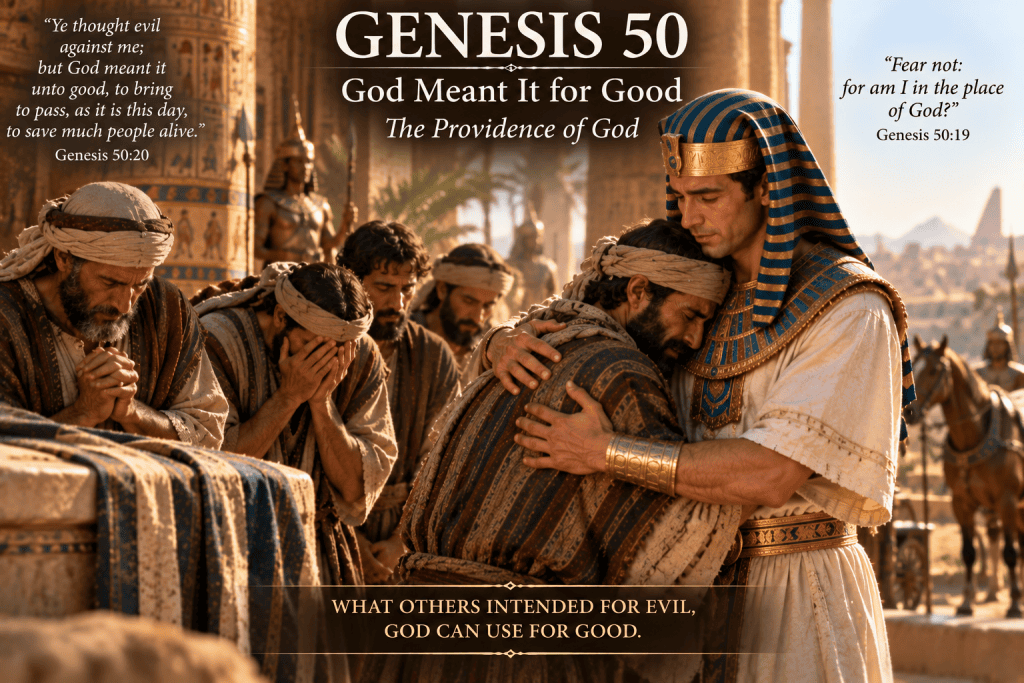
“But as for you, ye thought evil against me; but God meant it unto good.” — Genesis 50:20
Genesis began with life.
But it ends with death:
- It began in a garden.
- It ends with a coffin in Egypt.
- It began with God creating a perfect world.
- It ends with God’s people living outside the Promised Land.
At first, that may sound like a sad ending.
But Genesis 50 is not a chapter of hopelessness.
It is a chapter of faith.
Jacob dies believing God’s promise.
Joseph dies believing God’s promise.
The family remains in Egypt believing God’s promise.
And through it all, one truth stands above the entire story:
God is working:
- Even when people act wickedly.
- Even when circumstances make no sense.
- Even when God’s promises seem delayed.
God remains sovereign.
Jacob Died in Egypt
Genesis 49 ended with Jacob’s death.
Chapter 50 begins with Joseph responding:
“And Joseph fell upon his father’s face, and wept upon him, and kissed him.” — Genesis 50:1
Joseph had lost his father.
The reunion he had waited so long to experience was over.
Once again, Joseph wept.
Genesis does not present tears as weakness.
Joseph loved his father.
Therefore, he grieved.
Faith Does Not Eliminate Grief
Believers grieve:
- We miss people we love.
- We feel the emptiness created by death.
Faith does not require pretending loss does not hurt.
Paul later wrote that Christians:
“Sorrow not, even as others which have no hope.” — 1 Thessalonians 4:13
Notice he did not say:
Do not sorrow.
He said we do not sorrow without hope.
Christian grief contains tears.
But it also contains hope.
Jacob Was Embalmed
Joseph commanded the Egyptian physicians to embalm Jacob.
The process took forty days.
Egypt then mourned Jacob for seventy days.
This is remarkable.
Jacob entered Egypt as an elderly shepherd.
Yet when he died, the nation mourned him.
God had given Jacob’s family extraordinary favor in Egypt.
Joseph Remembered His Promise
After the mourning period, Joseph approached Pharaoh’s household.
He explained that Jacob had made him swear to bury him in Canaan.
Joseph asked permission to go.
Pharaoh answered:
“Go up, and bury thy father, according as he made thee swear.” — Genesis 50:6
Joseph had made a promise.
Now he kept it.
Integrity does not end when keeping a promise becomes inconvenient.
A Great Company Traveled to Canaan
Joseph went to bury Jacob.
Pharaoh’s servants accompanied him.
The elders of Pharaoh’s household and the elders went.
Joseph’s brothers went.
Chariots and horsemen went.
Genesis says:
“And it was a very great company.” — Genesis 50:9
Jacob’s burial became a major event.
Jacob Was Buried in the Promised Land
They carried Jacob to the cave of Machpelah.
That was the burial place Abraham had purchased centuries earlier.
Abraham and Sarah were there.
Isaac and Rebekah were there.
Leah was there.
Now Jacob joined them.
Why did burial in Canaan matter so much?
Because Jacob believed God’s promise.
Jacob Died in Egypt but Believed in Canaan
Jacob had lived his final seventeen years in Egypt.
Egypt had provided:
- Safety.
- Food.
- Family reunion.
- Land.
But Egypt was not the promised destination.
Jacob wanted his burial to testify:
God will bring this family back.
His grave became a statement of faith.
Faith Can Speak After We Die
The way we live can continue speaking after we are gone:
- Our children remember.
- Our grandchildren remember.
- Church members remember.
- Friends remember.
The question is not merely:
“What possessions will I leave?”
A better question is:
“What testimony will I leave?”
Jacob left a testimony:
God keeps His promises.
The Brothers Became Afraid
After Jacob’s death, Joseph’s brothers became frightened.
They said:
“Joseph will peradventure hate us, and will certainly requite us all the evil which we did unto him.” — Genesis 50:15
Apparently, they wondered whether Joseph had only treated them kindly because Jacob was alive.
Now that their father was gone, perhaps Joseph would seek revenge.
Their old guilt returned.
Guilt Has a Long Memory
Joseph had already:
- forgiven them.
- provided for them.
- reconciled with them.
Yet they still feared punishment.
That is what guilt often does.
It whispers:
“You are still going to pay.”
“Forgiveness cannot really be true.”
“Your past will eventually catch you.”
The brothers struggled to believe the grace they had received.
Sometimes We Struggle to Believe We Are Forgiven
Christians can do the same thing with God:
- We confess a sin.
- We ask forgiveness.
- We believe Christ died for us.
Yet months or years later, we still punish ourselves.
We think:
“Surely God is still holding this against me.”
But Scripture says:
“If we confess our sins, he is faithful and just to forgive us our sins.” — 1 John 1:9
When God forgives, we should learn to rest in His grace.
The Brothers Sent a Message
The brothers told Joseph that Jacob had instructed him to forgive them.
Then they came before Joseph and said:
“Behold, we be thy servants.” — Genesis 50:18
Once again, Joseph’s brothers bowed before him.
The dreams from Genesis 37 had been fulfilled completely.
But Joseph did not celebrate their humiliation.
He wept.
Joseph Wept Again
Genesis says:
“And Joseph wept when they spake unto him.”
Why?
- Perhaps because he realized they still doubted his forgiveness.
- Perhaps because the old wounds were painful.
- Perhaps because he saw their fear.
The text does not explain every emotion.
But Joseph’s tears remind us that forgiveness does not erase memory.
He remembered.
Joseph simply refused to seek revenge.
“Am I in the Place of God?”
Joseph told them:
“Fear not: for am I in the place of God?” — Genesis 50:19
That question reveals Joseph’s understanding of justice.
Joseph had great authority.
But he was not God.
He would not place himself on God’s throne.
Revenge belongs ultimately to the Lord.
Paul later wrote:
“Vengeance is mine; I will repay, saith the Lord.” — Romans 12:19
Forgiveness becomes easier when we stop trying to be judge, jury, and executioner.
We Are Not God
When someone hurts us, we often want to make sure they pay.
Joseph understood something important:
That is God’s responsibility.
- We can establish boundaries.
- We can pursue lawful justice when necessary.
- We can speak truth.
- We can protect people from harm.
But personal vengeance belongs to God.
Then Comes Genesis 50:20
Joseph said:
“But as for you, ye thought evil against me; but God meant it unto good.”
This may be the great theological summary of Joseph’s life.
Notice what Joseph did not say.
He did not say:
“You meant good.”
They did not.
He did not say:
“What happened wasn’t evil.”
It was.
He did not say:
“It doesn’t matter.”
It mattered deeply.
Joseph said:
“Ye thought evil.”
Then:
“God meant it unto good.”
The Same Event Had Two Intentions
The brothers had an intention.
God had an intention.
The brothers intended harm.
God intended preservation.
The brothers wanted Joseph gone.
God sent Joseph ahead.
The brothers saw a troublesome dreamer.
God saw the future governor of Egypt.
Human evil was real.
Divine providence was greater.
Providence Does Not Call Evil Good
This distinction is essential.
When we say God works through difficult circumstances, we are not saying evil is good.
Betrayal is still evil.
Abuse is still evil.
Dishonesty is still evil.
Cruelty is still evil.
Injustice is still evil.
God does not need to redefine evil in order to defeat it.
He is powerful enough to bring good out of evil.
Joseph Could See the Story Differently Now
Think about Joseph at seventeen.
Thrown into a pit.
He could not see Genesis 50.
- Joseph in Potiphar’s house could not see it.
- Joseph falsely accused could not see it.
- Joseph in prison could not see it.
- Joseph forgotten by the butler could not see it.
But now Joseph could look backward.
The pieces formed a picture.
We Understand Providence Backward
We usually live life forward.
But we understand much of God’s providence backward.
Years later we may say:
- “Now I understand why that door closed.”
- “Now I see how that difficulty prepared me.”
- “Now I understand why God moved me.”
- “Now I see how that person affected my life.”
But sometimes we never receive a full explanation in this life.
Faith trusts God even then.
Romans 8:28
Paul later wrote:
“And we know that all things work together for good to them that love God.” — Romans 8:28
Paul did not say all things are good.
He said they work together for good.
There is a difference.
God takes pieces we would never choose and works them into His larger purpose.
God Is the Master Weaver
Imagine the back side of a tapestry.
Threads cross in every direction.
Some appear tangled.
The colors seem out of place.
Nothing seems to make sense.
Then turn the tapestry over.
A picture appears.
Our lives often feel like the back side.
We see loose threads.
God sees the finished design.
The Pit Was Part of the Picture
Joseph probably would never have chosen the pit:
- But the pit led to the caravan.
- The caravan led to Egypt.
- Egypt led to Potiphar.
- Potiphar’s house led to prison.
- Prison led to the butler.
- The butler led to Pharaoh.
- Pharaoh placed Joseph over Egypt.
- Joseph stored grain.
- The famine brought his brothers.
- The family was preserved.
One event connected to another.
What Looked Like Detours Were Part of the Road
Joseph’s life seemed full of detours.
But God knew the route.
Sometimes what we call a detour is part of God’s providential road.
That does not mean every choice we make is wise.
Nor does it mean every event is directly caused by God in the same way.
It means nothing lies beyond His sovereign ability to redeem and use.
“To Save Much People Alive”
Joseph explained God’s purpose:
“To bring to pass, as it is this day, to save much people alive.” — Genesis 50:20
God’s plan was larger than Joseph.
Joseph’s suffering became part of God’s provision for many people.
Sometimes God uses our difficult experiences to equip us to help others.
Your Pain May Become Someone Else’s Help
A person who has grieved may become especially compassionate toward the grieving.
Someone who has experienced financial hardship may understand people in need.
A person who has endured betrayal may minister wisely to the wounded.
Someone who has survived failure may know how to encourage another person who has fallen.
God does not waste surrendered pain.
Joseph Comforted His Brothers
Joseph continued:
“Now therefore fear ye not: I will nourish you, and your little ones.” — Genesis 50:21
Then Scripture says:
“And he comforted them, and spake kindly unto them.”
That is forgiveness in action.
Joseph did not merely say:
“I won’t hurt you.”
He said:
“I will help you.”
Forgiveness Can Become Kindness
Joseph moved beyond non-retaliation.
He nourished their families.
Joseph comforted them.
He spoke kindly.
That is a high form of grace.
Paul wrote:
“Be ye kind one to another, tenderhearted, forgiving one another.” — Ephesians 4:32
Biblical forgiveness changes the way we treat people.
Joseph Lived to See His Grandchildren
Joseph remained in Egypt.
He lived to be 110 years old.
Joseph saw Ephraim’s children to the third generation.
He also saw descendants of Manasseh.
The seventeen-year-old boy thrown into a pit lived long enough to see generations of God’s faithfulness.
Joseph Was Preparing to Die
Eventually Joseph knew his life was ending.
He gathered his family and said:
“I die.”
But Joseph’s next words are more important:
“And God will surely visit you.” — Genesis 50:24
Joseph was dying.
God was not.
Leaders die.
Generations pass.
God’s promises continue.
“God Will Surely Visit You”
Joseph knew Egypt was not Israel’s permanent home.
He told his family:
“God will surely visit you, and bring you out of this land.”
Joseph looked toward the Exodus.
Moses had not been born.
The burning bush was centuries away.
Pharaoh’s oppression had not yet begun.
But Joseph believed God would bring Israel home.
Faith Sees Beyond the Coffin
Joseph was approaching death.
Yet he spoke about the future.
That is biblical faith.
Death does not cancel God’s promises.
Hebrews 11:22 says:
“By faith Joseph, when he died, made mention of the departing of the children of Israel; and gave commandment concerning his bones.”
He died believing the Exodus would come.
Joseph Gave Instructions About His Bones
He made Israel swear:
“Ye shall carry up my bones from hence.”
Why?
Because Joseph belonged to the promise.
Egypt was good to him and gave him:
- Authority.
- A wife.
- Children.
- Wealth.
- Honor.
But Egypt was not home.
Joseph wanted his bones carried to Canaan when God brought Israel out.
Joseph’s Coffin Became a Sermon
Genesis ends:
“So Joseph died, being an hundred and ten years old… and he was put in a coffin in Egypt.” — Genesis 50:26
That seems like a strange way to end the book.
A coffin.
But Joseph’s coffin preached a message.
Every time an Israelite saw it, the coffin could remind them:
We are leaving someday.
God promised.
Joseph believed Him.
Four Hundred Years Later
Generations passed.
Eventually Israel became enslaved.
A Pharaoh arose who did not know Joseph.
The people suffered.
But God had not forgotten.
Then Moses came.
The plagues fell.
Passover night arrived.
Israel left Egypt.
And Exodus 13:19 tells us:
“And Moses took the bones of Joseph with him.”
Joseph had been right.
God visited His people.
God’s Promises Outlive Us
Joseph never saw the Exodus.
But he believed in it.
That challenges our short-term thinking.
Some things we pray for may not be completed during our lifetime.
Often ministry seeds may grow after we are gone.
Some people we teach may influence generations we will never meet.
Faithfulness is still worthwhile.
Genesis Begins with Creation
Now consider the whole book.
Genesis 1:
“In the beginning God created the heaven and the earth.”
God created everything good.
Human beings bore His image.
They lived in fellowship with Him.
Then sin entered.
Genesis Shows What Sin Did
Adam and Eve rebelled.
Cain killed Abel.
Violence filled the earth.
The Flood came.
Babel rose.
Families struggled.
Abraham failed.
Isaac failed.
Jacob deceived.
Judah sinned.
Joseph’s brothers betrayed him.
Genesis is brutally honest about humanity.
Sin damages everything it touches.
But Grace Keeps Appearing
Yet sin never gets the final word:
- After the Fall came the promise of the Seed.
- After judgment came Noah’s ark.
- After Babel came Abraham’s call.
- After barrenness came Isaac.
- After Jacob’s failures came transformation.
- After Joseph’s pit came preservation.
Grace keeps appearing.
Genesis Is a Book of Beginnings
Genesis gives us the beginnings of:
- Creation.
- Humanity.
- Marriage.
- Sin.
- Death.
- Nations.
- Languages.
- Covenant.
- Israel.
And the unfolding promise of redemption.
But Genesis does not finish the story.
It points forward.
The Seed Is Coming
God promised in Genesis 3:15 that the Seed of the woman would crush the serpent.
Then the promise narrowed.
Abraham’s seed.
Isaac.
Jacob.
Judah.
Genesis 49 spoke of the sceptre belonging to Judah.
The story is moving toward a King.
Jesus Is the Answer Genesis Anticipates
The New Testament opens:
“The book of the generation of Jesus Christ, the son of David, the son of Abraham.” — Matthew 1:1
Genesis asked:
Who is the promised Seed?
The Gospel answers:
Jesus.
Joseph Points Us Toward Christ
Joseph’s story contains a pattern that prepares us for Jesus:
- The beloved son was rejected.
- He suffered unjustly.
- He descended into humiliation.
- Then he was exalted.
- Through his suffering, others received life.
Yet Jesus is infinitely greater than Joseph.
Joseph saved people from famine.
Jesus saves sinners from eternal death.
The Greatest Example of Genesis 50:20 Is the Cross
At the cross, human beings acted wickedly:
- Jesus was betrayed.
- Falsely accused.
- Mocked.
- Beaten.
- Crucified.
Yet God used the worst act of human history to accomplish the greatest act of redemption.
Peter said:
“Him, being delivered by the determinate counsel and foreknowledge of God, ye have taken… and slain.” — Acts 2:23
Human evil.
Divine purpose.
The cross is Genesis 50:20 on the grandest scale.
What People Meant for Evil, God Used for Salvation
Satan wanted Christ destroyed.
Religious leaders wanted Him silenced.
Rome crucified Him.
But God used the cross to provide salvation.
Then Jesus rose from the dead.
Evil did not win.
God did.
That Is Why Christians Have Hope
Our hope is not that nothing bad will happen.
Joseph’s life destroys that illusion.
Our hope is greater.
Nothing that happens can defeat God’s ultimate purpose for His people.
Romans 8 continues beyond verse 28:
“If God be for us, who can be against us?” — Romans 8:31
What Genesis 50 Means for Us
1. Faith Does Not Eliminate Grief
Joseph wept for Jacob.
Believers can grieve deeply while still possessing hope.
2. Keep Your Promises
Joseph honored his commitment concerning Jacob’s burial.
Integrity matters even in difficult seasons.
3. Leave a Testimony of Faith
Jacob’s burial in Canaan testified that he still believed God’s promise.
4. Do Not Let Old Guilt Defeat Present Grace
Joseph’s brothers struggled to believe they were truly forgiven.
Receive the forgiveness God gives.
5. Refuse Personal Vengeance
Joseph asked:
“Am I in the place of God?”
Leave ultimate judgment with the Lord.
6. Call Evil What It Is
Joseph said:
“Ye thought evil against me.”
Forgiveness does not require denying reality.
7. Believe God Is Greater Than Evil
“But God meant it unto good.”
Providence means evil cannot overturn God’s ultimate purpose.
8. Look for God’s Hand When Looking Back
Joseph eventually saw connections he could not see during the suffering.
9. Let Forgiveness Become Kindness
Joseph nourished, comforted, and spoke kindly to his brothers.
10. Trust God’s Promises Beyond Your Lifetime
Joseph died believing Israel would leave Egypt.
11. Remember That This World Is Not Home
Joseph prospered in Egypt but still wanted his bones carried to Canaan.
12. Keep Looking Toward Christ
Genesis ends with promises still awaiting fulfillment.
Jesus is the center toward which those promises move.
When Something Evil Has Happened to You
Genesis 50:20 does not ask you to pretend it was good.
Joseph did not.
You may be able to say:
- “What happened to me was wrong.”
- “That betrayal was wrong.”
- “That injustice was wrong.”
- “That loss hurt.”
But faith adds another sentence:
“God is not finished.”
Don’t Put a Period Where God Has Put a Comma
The pit looked like the end.
It wasn’t.
Slavery looked like the end.
It wasn’t.
Prison looked like the end.
It wasn’t.
Jacob’s bloody coat looked like the end.
It wasn’t.
Joseph’s story repeatedly teaches us:
Do not judge the whole story from the chapter you are living today.
God Is Still Writing
You may not understand the present chapter.
Perhaps it contains disappointment.
- Loss.
- Waiting.
- Uncertainty.
- Loneliness.
- Financial difficulty.
- Family problems.
- Or unanswered prayer.
You do not need to understand every detail to trust the Author.
Providence Does Not Mean We Understand Everything
Joseph eventually understood much of his story.
We may not.
Some questions will remain unanswered this side of heaven.
Faith is not possessing every explanation.
It is trusting God’s character when the explanation has not arrived.
We Know the Character of the Author
God is:
- good.
- wise.
- sovereign.
- faithful.
- keeps His promises.
Therefore, when we cannot trace His hand, we can still trust His heart.
From “In the Beginning” to “God Meant It for Good”
Genesis begins:
“In the beginning God.”
Genesis ends with Joseph’s confidence that God will surely visit His people.
That is a fitting summary of the entire book:
- God was there at the beginning.
- God was there in the garden.
- God was there after the Fall.
- God was there through the Flood.
- God was there with Abraham.
- God was there with Isaac.
- God was there with Jacob.
- God was there with Joseph.
And God would still be there when the next chapter of redemption began.
The Story Continues
Genesis ends with Joseph in a coffin.
But the Bible does not end there.
Turn the page.
Exodus begins.
God has another chapter.
That is true of Scripture.
And sometimes it is true of our lives.
What feels like an ending may simply be the place where God begins something new.
WIM Takeaway
Genesis 50 teaches one of the greatest truths in Scripture: human beings may intend evil, but God remains sovereign enough to bring good from what they intended for harm. Joseph never called his brothers’ actions good. Instead, he recognized that their evil could not defeat God’s purpose. God used Joseph’s suffering to preserve his family and save many lives. Therefore, we can forgive without denying the past, grieve without losing hope, and face uncertain circumstances knowing that God is still working. The God who was faithful from Genesis 1 through Genesis 50 is still faithful today.
Questions for Reflection
- What does Joseph’s grief over Jacob teach us about faith and mourning?
- Why was Jacob’s burial in Canaan an act of faith?
- Why did Joseph’s brothers become afraid after Jacob died?
- How can guilt make it difficult to believe we have been forgiven?
- What did Joseph mean when he asked, “Am I in the place of God?”
- Why is Genesis 50:20 so important for understanding providence?
- What is the difference between saying evil is good and saying God can bring good from evil?
- What events in Joseph’s life looked like setbacks but later became part of God’s larger purpose?
- Why do we often understand providence better when looking backward?
- How did Joseph demonstrate forgiveness through his actions?
- Why did Joseph want his bones carried from Egypt?
- How did Joseph’s coffin become a testimony of faith?
- How does Joseph’s life point us toward Jesus Christ?
- How is the cross the greatest example of God bringing redemption through human evil?
- Is there a painful chapter in your life where you need to remember, “God is not finished”?
<<Back to the Book of Genesis
Dr. Alan Holden has served in pastoral ministry for more than 35 years, preaching and teaching the Bible in churches across the United States. He holds a Doctor of Ministry from Luther Rice Seminary and a Master of Divinity from The Southern Baptist Theological Seminary. Through What’s It Mean?, he seeks to help readers understand the meaning of Scripture and grow in their walk with Christ. He is currently the pastor of Lake Saunders Baptist Church in Tavares, FL.