






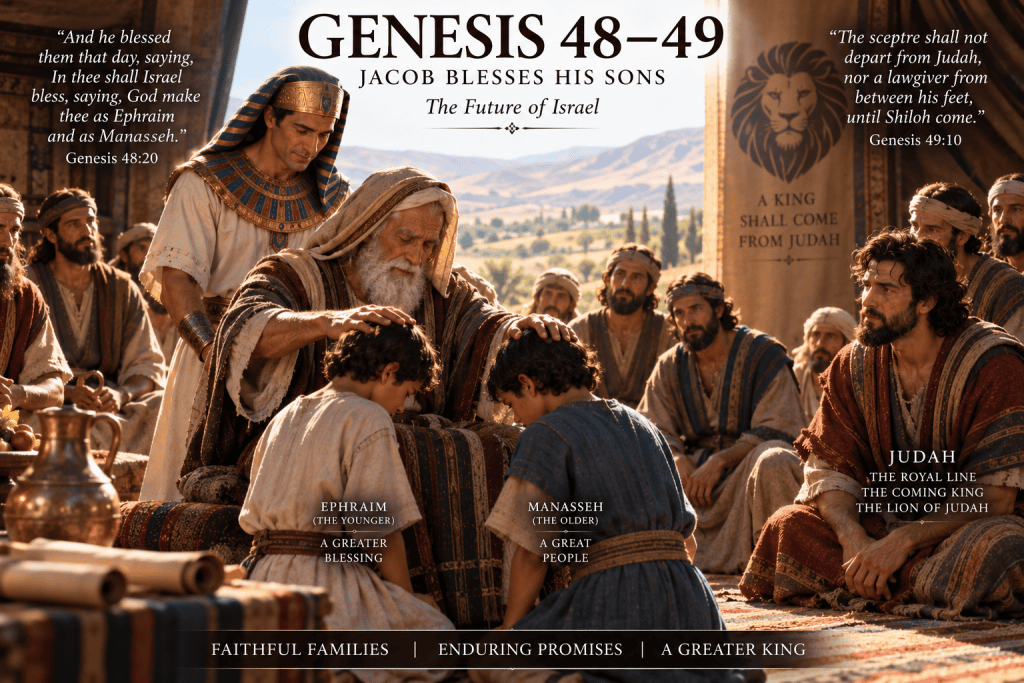
Genesis 48–49 — Jacob Blesses His Sons: The Future of Israel
Key Scriptures: Genesis 48:1–22; Genesis 49:1–33; Hebrews 11:21; Revelation 5:5; Revelation 19:16
“The sceptre shall not depart from Judah… until Shiloh come; and unto him shall the gathering of the people be.” — Genesis 49:10
Genesis 48–49 brings us near the end of Jacob’s life.
The young man who once struggled for his father’s blessing is now an old man giving blessings to the next generation.
That alone tells us something about grace.
Jacob had spent much of his early life grasping.
Now he was giving.
He once deceived to receive a blessing.
Now he blessed by faith.
God had changed him.
Moreover, Jacob looked beyond his children and grandchildren. By faith, he saw something of what God would do through generations he would never live to see.
Joseph Heard That Jacob Was Sick
Genesis 48 begins:
“And it came to pass after these things, that one told Joseph, Behold, thy father is sick.”
Joseph immediately went to see Jacob.
He brought his two sons:
Manasseh and Ephraim.
These boys had been born in Egypt.
Their mother was Egyptian.
They had grown up surrounded by Egyptian culture.
Yet Jacob was about to give them a place among the covenant family.
Jacob Remembered God’s Promise
When Joseph arrived, Jacob gathered his strength and sat upon the bed.
Then he looked backward.
He remembered when God appeared to him at Luz, or Bethel.
Jacob said:
“God Almighty appeared unto me at Luz in the land of Canaan, and blessed me.” — Genesis 48:3
Then Jacob repeated the promise:
“Behold, I will make thee fruitful, and multiply thee, and I will make of thee a multitude of people.”
Near the end of his life, Jacob still remembered what God had said.
Remember God’s Promises
Jacob had experienced many things since Bethel:
- Marriage.
- Children.
- Conflict.
- Prosperity.
- Loss.
- Grief.
- Famine.
- Egypt.
But God’s promise remained.
That is important.
Circumstances change.
God’s Word does not.
When we reach difficult seasons, we need to remember what God has already said.
Jacob Adopted Ephraim and Manasseh
Then Jacob did something remarkable.
He told Joseph:
“And now thy two sons, Ephraim and Manasseh… are mine; as Reuben and Simeon, they shall be mine.” — Genesis 48:5
Jacob effectively adopted Joseph’s two sons as his own.
As a result, Joseph received a double portion in Israel.
Instead of a tribe simply called Joseph, his inheritance would continue through:
Ephraim and Manasseh.
Later, both would receive tribal territories in the Promised Land.
God Was Thinking Beyond Egypt
Ephraim and Manasseh had been born in Egypt.
But their future was connected to Canaan.
That teaches us something.
God’s people may live temporarily in one place while God’s promises point beyond it.
Egypt was where the boys lived.
Canaan was where the covenant was going.
Jacob Remembered Rachel
Then Jacob unexpectedly mentioned Rachel.
He remembered her death near Bethlehem.
Even after all those years, Jacob remembered the woman he had loved.
Grief may change with time.
But love leaves memories.
Jacob had lost Rachel.
Then he thought he had lost Joseph.
Now, near the end of his life, Joseph stood before him with two sons.
God had given Jacob something he once thought impossible.
“I Had Not Thought to See Thy Face”
Jacob said:
“I had not thought to see thy face: and, lo, God hath shewed me also thy seed.” — Genesis 48:11
What a testimony.
Jacob once believed Joseph was dead.
Now he could say:
I have seen you, and I have seen your children.
God had given Jacob more than he expected.
Sometimes God surprises us with mercies we had stopped imagining.
Jacob Prepared to Bless the Boys
Joseph positioned his sons carefully.
Manasseh was the firstborn.
Therefore, Joseph placed him where Jacob’s right hand would naturally rest.
Ephraim, the younger, stood on the other side.
Joseph expected the traditional blessing to fall upon Manasseh.
But Jacob crossed his hands.
His right hand rested on Ephraim and his left hand rested on Manasseh.
But Joseph thought his father had made a mistake.
Joseph Tried to Correct Jacob
He took Jacob’s hand and said:
“Not so, my father: for this is the firstborn; put thy right hand upon his head.” — Genesis 48:18
But Jacob refused.
He knew exactly what he was doing.
Jacob said Manasseh would become great.
Nevertheless:
“His younger brother shall be greater than he.”
Once again, Genesis overturns normal human expectations.
God Is Not Bound by Human Customs
We have seen this pattern throughout Genesis.
Isaac rather than Ishmael.
Jacob rather than Esau.
Now Ephraim rather than Manasseh.
God is sovereign.
He is not bound by human assumptions about who should be first.
That does not mean human order is meaningless.
It means God’s purposes ultimately determine the outcome.
Grace Does Not Follow Human Rankings
We tend to rank people.
First.
Second.
Important.
Unimportant.
Successful.
Unsuccessful.
God often works differently.
Paul wrote:
“God hath chosen the weak things of the world to confound the things which are mighty.” — 1 Corinthians 1:27
Grace does not operate according to human prestige.
Jacob Blessed Joseph Through His Sons
Jacob blessed Ephraim and Manasseh.
Then he said:
“The God which fed me all my life long unto this day.” — Genesis 48:15
That is one of Jacob’s finest statements.
The word translated “fed” carries the idea of shepherding.
Jacob had spent his life caring for sheep.
Now, near death, he recognized:
God had been shepherding him.
The Shepherd Had Been Shepherded
Jacob had traveled many miles:
- He fled Esau.
- Worked for Laban.
- Raised a difficult family.
- Lost Rachel.
- Lost Joseph, or so he thought.
- Survived famine.
- Moved to Egypt.
Looking back, Jacob could say:
God has shepherded me all my life.
That does not mean every day was easy.
It means God had been faithful through every day.
Looking Back Changes with Faith
When Jacob earlier spoke to Pharaoh, he described his years as:
“Few and evil.”
That was true from one perspective.
His life had been difficult.
But now he says:
“The God which fed me all my life long.”
Both statements can be true.
Life can be hard.
And God can be faithful.
Faith does not deny pain.
It recognizes God’s presence through the pain.
Jacob Looked Toward Canaan
He told Joseph:
“Behold, I die: but God shall be with you, and bring you again unto the land of your fathers.” — Genesis 48:21
Jacob knew he would not live to see Israel return to Canaan.
But he believed it would happen.
That is faith.
Faith trusts God for promises that may extend beyond our own lifetime.
Faith Thinks Generationally
We often think only about what God will do during our lives.
Scripture teaches us to think farther:
- What are we passing to our children?
- Our grandchildren?
- Our church?
- The next generation?
Jacob was dying.
God’s covenant was not.
Genesis 49 Gathers the Twelve Sons
Then Jacob called his sons together.
He said:
“Gather yourselves together, that I may tell you that which shall befall you in the last days.” — Genesis 49:1
Jacob’s words were more than sentimental farewell remarks.
They contained blessing, evaluation, and prophetic expectation.
The character and choices of the sons would affect the future of the tribes descending from them.
Our Choices Can Outlive Us
That is sobering.
What we do today may influence people long after we are gone:
- Habits become examples.
- Values become traditions.
- Faith can become a legacy.
Unfortunately, sin can become a legacy too.
Therefore, how we live matters beyond ourselves.
Reuben: Strength Without Stability
Jacob began with Reuben, his firstborn.
He called him:
“My might, and the beginning of my strength.”
Reuben should have enjoyed the privileges of the firstborn.
But Jacob continued:
“Unstable as water, thou shalt not excel.” — Genesis 49:4
Why?
Because Reuben had violated his father’s household through his earlier sin with Bilhah.
Potential had been damaged by lack of self-control.
Ability Is Not Enough
Reuben had position.
Strength.
Opportunity.
But he lacked stability.
Talent without character is dangerous.
A person may possess great ability and still undermine his future through uncontrolled choices.
Character matters.
Simeon and Levi: Anger Without Restraint
Jacob then addressed Simeon and Levi.
He remembered their violence at Shechem.
They had responded to the wrongdoing against Dinah with deceit and slaughter.
Jacob said:
“Cursed be their anger, for it was fierce; and their wrath, for it was cruel.” — Genesis 49:7
Notice Jacob cursed their anger, not simply their existence.
Uncontrolled anger had produced destructive consequences.
Anger Can Become a Legacy
Jacob said Simeon and Levi would be scattered in Israel.
Later, their tribal histories developed differently.
Simeon’s territory became associated within Judah’s region.
Levi, however, eventually experienced a remarkable transformation.
Grace Changed Levi’s Story
Later, the tribe of Levi would stand for the Lord during Israel’s rebellion at the golden calf.
God then set the Levites apart for priestly service.
Their scattering became connected with ministry throughout Israel.
That is another reminder:
God can redeem a damaged history.
Your past may influence you.
It does not have to imprison you.
Then Came Judah
Jacob turned to Judah.
Something changed.
He said:
“Judah, thou art he whom thy brethren shall praise.” — Genesis 49:8
The name Judah is associated with praise.
Now Jacob said Judah’s brothers would praise him.
Judah had certainly failed earlier in life.
He participated in selling Joseph.
Genesis 38 exposed serious moral failures.
But Judah changed.
Judah Had Become a Leader
We saw that change during the Joseph story.
Judah accepted responsibility for Benjamin.
He promised Jacob:
“I will be surety for him.”
Then, before Joseph, Judah offered himself in Benjamin’s place.
The selfish brother had become the sacrificial brother.
Now Jacob’s blessing recognizes Judah’s future leadership.
Judah Is a Lion
Jacob said:
“Judah is a lion’s whelp.” — Genesis 49:9
The lion became associated with Judah.
It symbolizes strength, rule, and kingship.
Later, David would come from Judah.
Ultimately, Jesus Christ would come from Judah.
Revelation 5:5 calls Jesus:
“The Lion of the tribe of Juda.”
Genesis 49 is looking far beyond Jacob’s immediate family.
“The Sceptre Shall Not Depart from Judah”
Then comes one of the most important Messianic passages in Genesis:
“The sceptre shall not depart from Judah, nor a lawgiver from between his feet.” — Genesis 49:10
A sceptre represents royal authority.
The future kingship of Israel would be associated with Judah.
That promise eventually leads to David.
Then God’s covenant with David points toward an eternal King.
Finally, the New Testament identifies Jesus as:
“The son of David.”
“Until Shiloh Come”
Jacob continued:
“Until Shiloh come; and unto him shall the gathering of the people be.”
The precise interpretation and translation of “Shiloh” has been discussed for centuries.
Therefore, we should avoid claiming more than the text clearly allows.
Nevertheless, Christians have long understood this passage as pointing toward the coming ruler from Judah—the Messianic King.
The larger biblical storyline confirms that expectation.
The royal line runs through Judah.
Through David.
And finally to Jesus Christ.
Genesis Has Been Pointing Toward Jesus
Remember the promises we have already encountered.
Genesis 3:15 promised the Seed of the woman.
Chapter 12 promised blessing through Abraham’s seed.
Genesis 22 said the nations would be blessed through Abraham’s seed.
Now chapter 49 narrows the line further.
The coming King will be connected with:
Judah.
The promise is becoming more specific.
The Bible Is One Story
Genesis is not a collection of disconnected stories:
- Creation.
- The Fall.
- Noah.
- Abraham.
- Isaac.
- Jacob.
- Judah.
- Joseph.
They are parts of one unfolding story.
God is moving history toward redemption through Jesus Christ.
Zebulun
Jacob spoke of Zebulun in connection with the sea and commerce.
The future tribe would occupy a region connected with important trade routes.
The blessing reminds us that Israel’s tribes would have different roles and circumstances.
God’s people do not all serve in the same way.
Issachar
Issachar is pictured as strong but willing to bear burdens.
The imagery suggests strength connected with labor.
Strength is valuable.
But strength must be used wisely.
God gives different people different capacities for service.
Dan
Jacob said:
“Dan shall judge his people.”
Dan’s name is associated with judging.
Yet Jacob also described danger along the path.
The tribe’s later history would contain both notable leadership and serious spiritual problems.
Samson, one of Israel’s judges, came from Dan.
Jacob Paused to Pray
In the middle of these blessings, Jacob suddenly said:
“I have waited for thy salvation, O LORD.” — Genesis 49:18
That short prayer is beautiful.
Jacob was speaking about the future.
Some of what he foresaw was difficult.
So he looked to God.
“I have waited for thy salvation.”
Near the end of life, Jacob’s hope was still in the Lord.
Salvation Is Our Final Hope
Jacob had received many blessings:
- Family.
- Wealth.
- Land promises.
- Reunion with Joseph.
But his ultimate hope was not any earthly blessing.
It was God’s salvation.
The same must be true for us.
Gad
Jacob said Gad would face attacks but eventually overcome.
Sometimes God’s people experience conflict.
Temporary defeat is not necessarily final defeat.
The important thing is to continue faithfully.
Asher
Asher’s blessing spoke of rich food and abundance.
Different tribes would experience different forms of provision.
God’s blessings are not identical for everyone.
Comparison is therefore unwise.
Naphtali
Freedom and beautiful expression is associated with Naphtali.
Again, the tribes would develop distinct identities.
God’s people need not all look alike to belong to the same covenant family.
Joseph Received a Rich Blessing
Then Jacob turned to Joseph.
He described him as:
“A fruitful bough.”
That fits Joseph’s life beautifully.
Joseph had named his son Ephraim because:
“God hath caused me to be fruitful in the land of my affliction.” — Genesis 41:52
Now Jacob described Joseph himself as fruitful.
Joseph Had Been Attacked
He said:
“The archers have sorely grieved him, and shot at him, and hated him.” — Genesis 49:23
Joseph knew what that meant.
His brothers hated him.
Potiphar’s wife falsely accused him.
He was imprisoned.
Joseph was forgotten.
His life contained many arrows.
But Joseph’s Bow Remained Strong
Jacob continued:
“But his bow abode in strength.”
Why?
Not because Joseph possessed extraordinary willpower.
Jacob pointed to:
“The hands of the mighty God of Jacob.”
Joseph endured because God sustained him.
That is one of the great lessons of his life.
Strength Comes from the Shepherd
Jacob then used another important title:
“From thence is the shepherd, the stone of Israel.” — Genesis 49:24
God is presented as the source of Israel’s strength and stability.
Jacob had already called God the One who shepherded him.
Now the image appears again:
- God had shepherded Jacob.
- God had strengthened Joseph.
- God would preserve Israel.
Benjamin
Finally, Jacob spoke of Benjamin as a ravenous wolf.
The tribe would later become known for fierce warriors.
Israel’s first king, Saul, would come from Benjamin.
Again, Jacob’s words looked toward the future.
“Every One According to His Blessing”
Genesis says:
“All these are the twelve tribes of Israel.”
The sons had become the heads of tribes.
A family was becoming a nation.
The promise to Abraham was unfolding before our eyes.
Jacob Gave Instructions About His Burial
After blessing his sons, Jacob told them where he wanted to be buried.
Not Egypt.
Canaan.
He wanted to be buried in the cave of Machpelah.
There Abraham and Sarah were buried.
Isaac and Rebekah were buried there.
Leah was buried there.
Jacob wanted to rest among his family in the land of promise.
Jacob Died Believing the Promise
He lived his final seventeen years in Egypt.
But his faith remained fixed upon what God had promised.
Jacob died in Egypt.
Yet he believed Canaan belonged to his descendants.
That is why Hebrews remembers Jacob as a man who died in faith.
Faith Can Look Beyond Death
Faith does not require seeing every promise fulfilled during our lifetime.
Jacob did not see the Exodus:
- He did not see Israel conquer Canaan.
- He did not see David become king.
- He did not see Jesus born in Bethlehem.
- But he believed God.
Faith can bless a future it will never personally see.
What Will You Leave Behind?
Jacob’s final days were not primarily about possessions.
They were about blessing.
Promise.
Faith.
Future generations.
That raises an important question:
What will we leave behind?
Money eventually disappears.
Possessions wear out.
Buildings change hands.
But faith can influence generations.
Leave More Than Things
Give your family:
- Scripture.
- prayer.
- an example of faithfulness.
- stories of God’s provision.
- Tell them how Christ saved you.
- Tell them where God answered prayer.
- Tell them what you learned through suffering.
Leave a spiritual inheritance.
Tell the Next Generation What God Has Done
Jacob could say:
“The God which fed me all my life long unto this day.”
Every older believer should eventually be able to tell younger believers:
“Let me tell you how God has been faithful.”
Those testimonies matter.
Younger generations need more than our advice.
They need to hear about our God.
Don’t Hide the Hard Chapters
Jacob’s story was not perfect.
Neither was Judah’s nor was Joseph’s family.
Genesis does not hide their failures.
That itself is encouraging.
A spiritual legacy does not require a flawless life.
It requires a faithful God.
We can say:
- “I made mistakes.”
- “I failed.”
- “I learned.”
- “God corrected me.”
- “God forgave me.”
- “God remained faithful.”
That is a testimony worth passing down.
The Blessing Belongs to Grace
Reuben had natural position.
Judah received royal promise.
Manasseh was older.
Ephraim received the greater blessing.
Again and again, Genesis reminds us that God’s purposes operate by grace.
We cannot earn His favor through human status.
Jesus Is the Lion of Judah
The most important line in Genesis 49 is Judah’s:
- The sceptre.
- The ruler.
- The gathering of the peoples.
- The lion.
Centuries later, Revelation declares:
“Behold, the Lion of the tribe of Juda, the Root of David, hath prevailed.” — Revelation 5:5
Jesus is the promised King.
The Sceptre Leads to the Throne
Genesis 49 points toward royal authority.
Revelation shows its fulfillment.
Jesus is:
“KING OF KINGS, AND LORD OF LORDS.” — Revelation 19:16
The blessing Jacob gave Judah ultimately points beyond every earthly king.
David died.
Solomon died.
Every earthly ruler passes away.
Jesus reigns forever.
From Jacob’s Bed to Christ’s Throne
Think of the sweep of Scripture.
An old shepherd lies dying in Egypt.
He gathers twelve sons.
Jacob speaks of a sceptre belonging to Judah.
Centuries pass.
David rises.
Kings come and go.
Israel waits.
Then Jesus is born.
The Gospel of Matthew begins:
“The book of the generation of Jesus Christ, the son of David, the son of Abraham.” — Matthew 1:1
God had not forgotten the promise.
God Keeps Promises Across Centuries
We measure time in days and years.
God works across generations and centuries.
Therefore, apparent delay does not mean forgotten promise.
Jacob died.
The promise lived.
Judah died.
The promise lived.
David died.
The promise lived.
Then Christ came.
What Genesis 48–49 Means for Us
1. Remember God’s Faithfulness
Jacob remembered Bethel near the end of his life.
Do not forget what God has done.
2. God’s Grace Does Not Follow Human Rankings
Ephraim received the greater blessing instead of Manasseh.
God is sovereign in His purposes.
3. Tell the Next Generation About God
Jacob blessed his children and grandchildren.
Faith should be passed forward.
4. Look Back Through the Lens of God’s Faithfulness
Jacob’s life had been difficult.
Yet he could say God had shepherded him all his life.
5. Character Matters More Than Position
Reuben had firstborn status but lacked stability.
Ability without character can destroy opportunity.
6. Uncontrolled Anger Has Consequences
Simeon and Levi remind us that anger must be governed.
7. God Can Redeem a Broken Past
Judah failed seriously, yet God transformed him into a sacrificial leader.
8. Our Choices Can Influence Future Generations
Jacob’s words looked beyond his sons to the tribes that would come from them.
9. God’s Promises May Extend Beyond Our Lifetime
Jacob died before Israel returned to Canaan.
He believed anyway.
10. Jesus Christ Is the Center of God’s Redemptive Story
The promise of Judah’s ruler ultimately points to the Lion of Judah, Jesus Christ.
The God Who Fed Me All My Life
Perhaps the most personal phrase in these chapters is Jacob’s:
“The God which fed me all my life long unto this day.”
What would it mean to reach the end of life and say that?
Not:
“Everything went my way.”
Not:
“I never suffered.”
Not:
“I never made mistakes.”
But:
“God shepherded me.”
He was there in youth:
- There in failure.
- There in grief.
- There in uncertainty.
- There in blessing.
- There in old age.
That is a good testimony.
Your Story Can Become Someone Else’s Encouragement
The things God has taught you are not only for you.
Someone else may need them:
- A child.
- A grandchild.
- A younger Christian.
- A church member.
- A friend.
- Tell them.
- Write them down.
- Pass them along.
The next generation needs witnesses who can say:
“I have walked with God long enough to tell you that He is faithful.”
Finish by Blessing Others
Young Jacob wanted blessings for himself.
Old Jacob gave blessings to others.
That is spiritual maturity.
Early faith often asks:
“What will God do for me?”
Mature faith increasingly asks:
“What can I pass to someone else?”
A mature Christian becomes a blessing.
WIM Takeaway
Genesis 48–49 shows an aging Jacob looking backward at God’s faithfulness and forward toward God’s promises. He blessed Ephraim and Manasseh, spoke prophetically over Israel’s twelve tribes, and declared that the sceptre would belong to Judah. Jacob would not live to see those promises fulfilled, but he believed the God who had shepherded him all his life. Ultimately, Judah’s royal blessing points us to Jesus Christ, the Lion of Judah and eternal King. Therefore, remember God’s faithfulness, pass your faith to the next generation, and trust promises whose fulfillment you may not personally live to see.
Questions for Reflection
- Why did Jacob begin his conversation with Joseph by remembering Bethel?
- What was significant about Jacob adopting Ephraim and Manasseh?
- Why did Jacob place his right hand on Ephraim rather than Manasseh?
- What does this teach us about God’s sovereignty and grace?
- What did Jacob mean when he described God as the One who had fed or shepherded him all his life?
- How can a life be difficult and still be blessed?
- What warning do we learn from Reuben?
- What warning comes from Simeon and Levi?
- How had Judah changed since the earlier chapters of Genesis?
- Why is Genesis 49:10 important for understanding the Messiah?
- How does the blessing of Judah point toward David and ultimately Jesus?
- What did Joseph’s blessing reveal about God’s faithfulness through suffering?
- Why did Jacob insist on burial in Canaan?
- What spiritual inheritance are you leaving to the next generation?
- Could you say today, “God has shepherded me all my life”? Why?
<<Back to the Book of Genesis
Dr. Alan Holden has served in pastoral ministry for more than 35 years, preaching and teaching the Bible in churches across the United States. He holds a Doctor of Ministry from Luther Rice Seminary and a Master of Divinity from The Southern Baptist Theological Seminary. Through What’s It Mean?, he seeks to help readers understand the meaning of Scripture and grow in their walk with Christ. He is currently the pastor of Lake Saunders Baptist Church in Tavares, FL.