







Genesis 46–47 — Israel Goes to Egypt: God Preserves His People
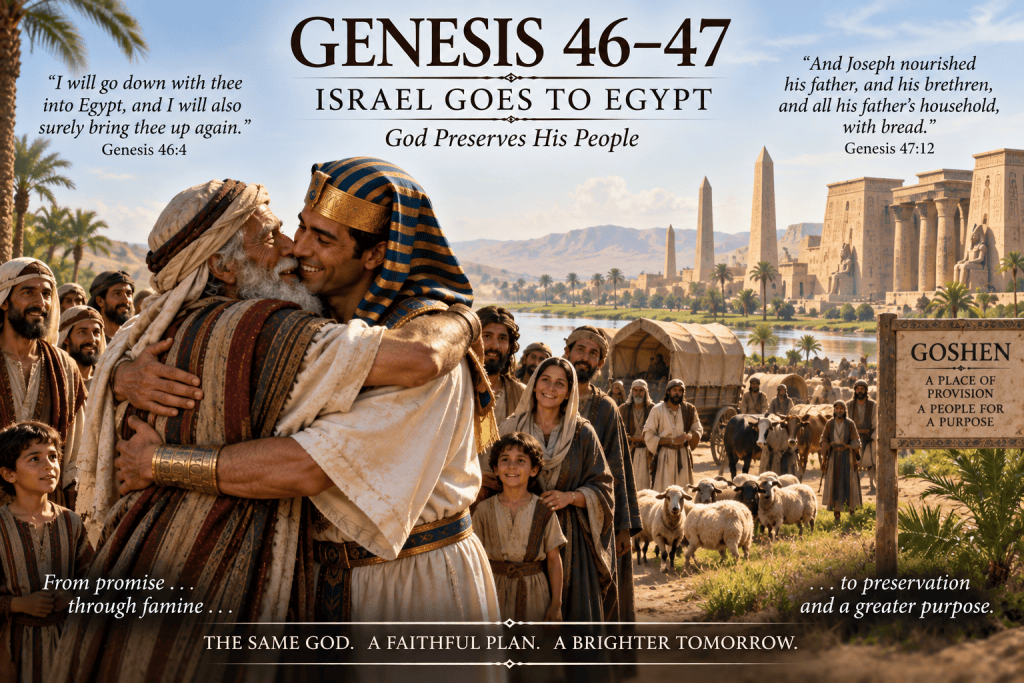
Key Scriptures: Genesis 46:1–34; Genesis 47:1–31; Genesis 15:13–16; Exodus 1:7; Acts 7:14–17
“Fear not to go down into Egypt; for I will there make of thee a great nation.” — Genesis 46:3
Jacob had spent years believing Joseph was dead.
Then his sons returned from Egypt with unbelievable news:
“Joseph is yet alive, and he is governor over all the land of Egypt.” — Genesis 45:26
Jacob saw the wagons Joseph had sent.
His spirit revived.
Then he said:
“Joseph my son is yet alive: I will go and see him before I die.”
However, traveling to Egypt was more than a family visit.
God was moving the covenant family.
Abraham had been called to Canaan.
Isaac had been told not to go down into Egypt.
Now Jacob was preparing to leave the Promised Land.
Was this really what God wanted?
Before Jacob went farther, God spoke.
Jacob Stopped at Beersheba
Genesis 46 begins:
“And Israel took his journey with all that he had, and came to Beersheba.”
Beersheba carried deep family significance.
Abraham had worshiped there.
Isaac had lived and worshiped there.
Now Jacob stopped there on his way to Egypt.
Then:
“He offered sacrifices unto the God of his father Isaac.”
Before Jacob entered a new chapter, he worshiped.
That is a good pattern.
Worship Before Major Decisions
Jacob had good reasons to go to Egypt.
Joseph was there.
Food was there.
Pharaoh had invited the family.
Wagons had arrived.
Everything seemed to point toward Egypt.
Nevertheless, Jacob stopped to worship.
Circumstances may open a door.
But believers should still seek God.
Before a major move, decision, commitment, or change, pray.
Ask:
“Lord, is this where You want me?”
God Spoke to Jacob
That night God spoke to Israel in visions.
He said:
“Jacob, Jacob.”
Jacob answered:
“Here am I.”
Then God said:
“I am God, the God of thy father.”
Those words must have brought great comfort:
- The God of Abraham.
- The God of Isaac.
- The God who met Jacob at Bethel.
- The God who wrestled with him at Peniel.
That same God was going with him into Egypt.
“Fear Not to Go Down into Egypt”
God said:
“Fear not to go down into Egypt.”
Apparently, Jacob needed reassurance.
And understandably so.
Egypt had not always represented blessing in his family history.
Abraham had gone there during famine and encountered trouble.
God had specifically told Isaac not to go there.
Moreover, Jacob was leaving the land God had promised his descendants.
Yet this time God said:
Go.
That teaches us something important.
God’s direction for one person or one season is not automatically His direction for another.
Isaac was told:
Do not go.
Jacob was told:
Do not be afraid to go.
Faith requires listening to God, not merely copying someone else’s journey.
God Had a Purpose in Egypt
God explained:
“For I will there make of thee a great nation.” — Genesis 46:3
Egypt was not merely a refuge from famine.
It would become an incubator for a nation.
Jacob’s family entered Egypt as a large extended family.
Generations later, their descendants would leave as the nation of Israel.
God was moving them for a purpose larger than they could see.
Sometimes God Moves Us to Prepare Us
Jacob probably thought primarily about seeing Joseph.
God was thinking about Israel’s future.
Our reasons for entering a season may be smaller than God’s reasons for allowing it.
We may think:
- “I took this job because I needed income.”
- “I moved because of family.”
- “I entered this ministry because someone asked.”
- “I went through this difficulty because circumstances forced me.”
Years later, we may discover that God was accomplishing something much larger.
“I Will Go Down with Thee”
God gave Jacob another promise:
“I will go down with thee into Egypt.” — Genesis 46:4
That was the promise Jacob needed most.
God did not merely say:
“Egypt will be safe.”
He said:
“I will go with you.”
The greatest security in life is not knowing where we are going.
It is knowing who goes with us.
God’s Presence Is Greater Than Geography
Jacob met God in Canaan.
He met God at Bethel.
Jacob met God at Peniel.
Now God assured him:
I will be with you in Egypt too.
God is not confined to a location.
You can know His presence:
- At home.
- At work.
- In retirement.
- In a hospital.
- In a nursing home.
- In a new city.
- In a difficult season.
- In an unexpected chapter.
Wherever God leads, He goes with His people.
God Promised to Bring Israel Back
God continued:
“And I will also surely bring thee up again.”
Jacob himself would die in Egypt.
However, his body would eventually be carried back to Canaan.
More importantly, Jacob’s descendants would one day leave Egypt and return to the Promised Land.
The Exodus was already part of God’s plan.
Long before Moses was born, God knew the way out.
God Knows the End Before the Beginning
Jacob was just entering Egypt.
God was already talking about coming out.
That is providence.
We enter circumstances one day at a time.
God sees the whole story:
- He knows the entrance.
- He knows the waiting.
- He knows the purpose.
- He knows the exit.
Therefore, we can trust Him in chapters we do not understand.
The Whole Family Went to Egypt
Jacob left Beersheba.
His sons carried him, their children, and their wives in Pharaoh’s wagons.
They brought livestock and possessions.
Genesis then records the members of Jacob’s family who went into Egypt.
The genealogy may seem like an interruption.
It is not.
God was keeping track of the covenant family.
God Knows Every Name
Genesis lists:
- Reuben.
- Simeon.
- Levi.
- Judah.
- Issachar.
- Zebulun.
- Gad.
- Asher.
- Benjamin.
- Dan.
- Naphtali.
- Joseph and his sons.
- And the members of their families.
Why record all these names?
Because God’s promises concern real people.
The family was becoming a nation.
Every generation mattered.
From One Man to a Nation
God had once called one man:
Abraham.
Then came Isaac.
Next Jacob.
Now Jacob had twelve sons.
Those sons had children.
The family was multiplying.
God’s promise to Abraham was unfolding gradually.
Later Exodus 1:7 would say:
“And the children of Israel were fruitful, and increased abundantly, and multiplied.”
God often fulfills large promises through small beginnings.
Judah Went Ahead
Jacob sent Judah ahead to Joseph.
That is another sign of Judah’s growing leadership.
Earlier, Judah helped sell Joseph.
Later, he offered himself for Benjamin.
Now Judah was trusted to lead the family toward Goshen.
God was changing him.
Transformation becomes visible through responsibility.
Joseph Prepared His Chariot
When Joseph heard that his father was approaching, he prepared his chariot and traveled to Goshen.
Then came the moment both men waited years to experience.
Genesis says:
“And he presented himself unto him; and he fell on his neck, and wept on his neck a good while.” — Genesis 46:29
No long speech.
Or theological explanation.
Just an embrace.
And tears.
Joseph and Jacob Were Reunited
Think of what that embrace represented.
More than twenty years of separation:
- Years of Jacob’s grief.
- Years of Joseph’s suffering.
- Years of unanswered questions.
Now father and son stood together again.
Jacob had believed Joseph was dead.
But Joseph was alive.
Some Joys Are Worth Waiting For
Jacob said:
“Now let me die, since I have seen thy face, because thou art yet alive.” — Genesis 46:30
Jacob was not necessarily asking to die immediately.
He was expressing deep satisfaction.
The grief that had followed him for years had been answered with reunion.
Sometimes God gives moments of joy that make years of waiting look different.
The pain was real.
But it was not the end.
Joseph Prepared His Family to Meet Pharaoh
Joseph then explained how his brothers should present themselves to Pharaoh.
They were shepherds.
Egyptians generally looked down upon shepherds.
That social distinction would actually help Joseph’s family remain somewhat separate from Egyptian society.
They would settle in Goshen.
Again, God was using even cultural differences to preserve Israel’s distinct identity.
Goshen Became Their Home
Genesis 47 records Joseph presenting some of his brothers to Pharaoh.
Pharaoh asked about their occupation.
They answered honestly:
“Thy servants are shepherds.”
They requested permission to live in Goshen.
Pharaoh agreed.
He told Joseph:
“In the best of the land make thy father and brethren to dwell.” — Genesis 47:6
The family arrived as famine refugees.
Yet Pharaoh gave them some of the best land available for their livestock.
God Provided More Than Survival
Jacob’s family came to Egypt because they needed food.
God gave them:
- Food.
- Land.
- Protection.
- A place to grow.
- Access to Joseph.
God’s provision often goes beyond the immediate need.
They thought they were escaping famine.
God was establishing a people.
Jacob Stood Before Pharaoh
Then Joseph brought Jacob before Pharaoh.
This must have been an extraordinary scene.
Pharaoh was the ruler of Egypt.
Jacob was an elderly shepherd from Canaan.
Yet Genesis says:
“And Jacob blessed Pharaoh.” — Genesis 47:7
That is remarkable.
The apparently weaker man blessed the apparently greater man.
Jacob Carried a Greater Promise
Pharaoh possessed political power.
Jacob carried the covenant promise.
God had told Abraham:
“In thee shall all families of the earth be blessed.” — Genesis 12:3
Now a descendant of Abraham stood before the ruler of Egypt and blessed him.
God’s people may not always possess worldly power.
But they can still bring spiritual blessing.
“How Old Art Thou?”
Pharaoh asked Jacob his age.
Jacob answered:
“The days of the years of my pilgrimage are an hundred and thirty years.” — Genesis 47:9
Notice his word:
Pilgrimage.
Jacob understood himself as a traveler.
Even after 130 years, he did not view this world as his permanent home.
Hebrews later describes the patriarchs as strangers and pilgrims seeking a better country.
Jacob Looked Back on His Life
He said:</p>
“Few and evil have the days of the years of my life been.”
Jacob had experienced much trouble.</p>
Conflict with Esau.
Years under Laban.
Family tension.
Rachel’s death.
Joseph’s apparent death.
The tragedy at Shechem.
Famine.
His life had not been easy.
Yet God had been faithful through all of it.
A Difficult Life Can Still Be a Blessed Life
Jacob’s words remind us that blessing does not mean the absence of trouble.
A person can walk with God and still know sorrow.
The better question is not:
“Did I avoid hardship?”
It is:
“Was God faithful through it?”
For Jacob, the answer was yes.
Joseph Settled His Family
Joseph gave his father and brothers land in the best part of Egypt.
Then Genesis says:
“And Joseph nourished his father, and his brethren, and all his father’s household, with bread.” — Genesis 47:12
- The brother they sold now fed them.
- The brother they rejected now protected them.
- The brother they wanted removed became the means God used to preserve them.
Grace had reversed the story.
Joseph Managed Egypt During the Famine
The famine became extremely severe.
Eventually, the Egyptians spent their money buying grain.
When the money was gone, they exchanged livestock for food.
Afterward, they offered their land and service to Pharaoh in exchange for seed and survival.
As a result, Pharaoh gained extensive ownership throughout Egypt.
Understanding Joseph’s Famine Policy
Modern readers may find this section uncomfortable.
Therefore, we should read it in its ancient setting rather than quickly imposing modern economic categories upon it.
Egypt was experiencing a catastrophic famine.
The people themselves came to Joseph asking for food and eventually proposed exchanging land and service for survival.
Joseph established a system in which Pharaoh supplied seed, while the people retained four-fifths of the harvest and gave one-fifth to Pharaoh.
The text presents Joseph as administering Egypt through an extraordinary national crisis.
Joseph Preserved Life
The Egyptians said:
“Thou hast saved our lives.” — Genesis 47:25
Whatever questions we may have about the economic structure, the people recognized the central outcome.
They survived.
Joseph’s task throughout the famine was preservation.
God had placed him in authority to keep people alive.
Wisdom Must Deal with Reality
Joseph did not create the famine.
But he had to manage its consequences.
Leadership often requires making difficult decisions in imperfect circumstances.
There may be no painless solution.
Wisdom asks:
“What is faithful, just, and workable in the situation before us?”
Joseph prepared during the years of plenty.
Now that preparation preserved an entire nation.
Israel Prospered in Goshen
Then Genesis contrasts Egypt’s suffering with Israel’s growth:
“And Israel dwelt in the land of Egypt, in the country of Goshen; and they had possessions therein, and grew, and multiplied exceedingly.” — Genesis 47:27
This is exactly what God told Jacob would happen.
“I will there make of thee a great nation.”
God’s promise was already taking shape.
The Place of Refuge Became the Place of Growth
Egypt was not the Promised Land.
But for a season, it was exactly where God wanted Israel.
That is important.
Sometimes God places us somewhere temporarily for growth and preparation.
Temporary does not mean meaningless.
Goshen mattered.
Egypt mattered.
The waiting mattered.
God was preparing Israel for what came next.
Jacob Knew Egypt Was Not Home
Jacob lived seventeen years in Egypt.
As his death approached, he called Joseph.
He made Joseph promise not to bury him permanently in Egypt.
Jacob said:
“I will lie with my fathers, and thou shalt carry me out of Egypt, and bury me in their buryingplace.” — Genesis 47:30
Why did this matter so much?
Because Jacob still believed God’s promise concerning Canaan.
Jacob Lived in Egypt but Belonged to the Promise
Egypt provided food, safety, Goshen.
But Egypt was not the final destination.
Jacob enjoyed God’s provision without confusing the provision with the promise.
That is a lesson we need.
We can appreciate what God gives us now without treating temporary blessings as ultimate things.
Don’t Get Too Comfortable in Egypt
There was nothing wrong with living in Egypt when God had sent them there.
The danger would come if they forgot that God had promised something beyond Egypt.
Likewise, Christians live in this world.
We work.
Build homes.
Raise families.
Enjoy friendships.
Serve communities.
But this world is not our final home.
Our citizenship is in heaven.
Jacob Worshiped
Genesis 47 ends:
“And Israel bowed himself upon the bed’s head.”
Hebrews 11:21 remembers Jacob worshiping near the end of his life.
That is a beautiful way for the story of Jacob’s final years to move toward its conclusion.
He had spent much of his early life grasping.
Scheming.
Running.
Struggling.
Now the old man worshiped.
From Grasping to Worshiping
Think about Jacob’s journey.
At birth, he grasped Esau’s heel.
He bargained for the birthright.
Jacob participated in deception for the blessing.
He fled from Esau.
Jacob struggled with Laban.
He wrestled at Peniel.
But over the years, God changed him.
Now Jacob could trust.
Bless.
Worship.
Grace had been at work for a lifetime.
Spiritual Growth Takes Time
Jacob’s life encourages those who become discouraged with slow spiritual progress.
God does not always transform us overnight.
He works through years.
Experiences.
Failures.
Correction.
Grace.
Suffering.
Worship.
The Jacob of Genesis 47 is not the Jacob of Genesis 27.
God had been changing him.
What Genesis 46–47 Means for Us
1. Seek God Before Major Transitions
Jacob stopped at Beersheba and worshiped before entering Egypt.
Do not let circumstances replace prayer.
2. God’s Direction Can Differ by Season
Isaac was told not to enter Egypt.
Jacob was told not to fear going there.
Follow God’s Word faithfully in the circumstances He gives you.
3. God’s Presence Is More Important Than Location
God promised:
“I will go down with thee into Egypt.”
Wherever God leads, His presence is enough.
4. God Often Has a Larger Purpose Than We Can See
Jacob wanted to see Joseph.
God was preparing a nation.
5. God Knows the End Before We Enter the Beginning
Before Jacob entered Egypt, God promised to bring Israel out again.
6. God Works Through Generations
The genealogy shows the covenant family growing toward nationhood.
7. Long Grief Can Give Way to Unexpected Joy
Jacob believed Joseph was dead for years.
Then he held his living son again.
8. God’s People Should Bring Blessing Wherever They Go
Jacob blessed Pharaoh.
Joseph preserved Egypt.
Believers should seek to bless the places where God puts them.
9. A Hard Life Can Still Be a Faithful Life
Jacob described his years as difficult.
Yet God’s faithfulness had never failed.
10. Wise Preparation Can Preserve Others During Crisis
Joseph’s preparation during abundance allowed Egypt to survive famine.
11. Temporary Places Can Serve Eternal Purposes
Egypt was not Israel’s final home.
But God used it to grow the nation.
12. Never Confuse God’s Provision with Your Final Destination
Jacob appreciated Egypt but still wanted to be buried in Canaan.
His heart remained connected to God’s promise.
When God Leads Somewhere Unexpected
Jacob probably never imagined spending his final seventeen years in Egypt.
Yet those years were part of God’s plan.
Perhaps your life has also gone somewhere you did not expect.
You expected one career.
Another came.
You expected one ministry.
God opened another.
You expected certain relationships to remain.
Life changed.
You expected retirement to look one way.
It looked different.
Unexpected does not mean outside God’s providence.
God Goes With You
The promise Jacob received remains deeply comforting:
“I will go down with thee.”
For Christians, Jesus gives an even broader promise:
“Lo, I am with you alway, even unto the end of the world.” — Matthew 28:20
The future may contain places we have never been.
But there is nowhere Christ sends His people where He cannot be with them.
God Is Already in Tomorrow
Jacob worried about going into Egypt.
But God was already there.
Joseph was there.
Goshen was there.
Food was there.
Pharaoh’s favor was there.
Provision had been prepared.
Jacob had not arrived yet.
But God had.
That is worth remembering.
Whatever tomorrow brings, God does not enter it after you.
He is already Lord over it.
Joseph’s Suffering Now Made Sense
Years earlier, Joseph arrived in Egypt as a slave.
Now he welcomed his entire family there:
- What once looked like exile had become preparation.
- What looked like abandonment had become positioning.
- What looked like loss had become preservation.
Joseph could now see something he could not see from the pit:
God had gone ahead.
Jesus Went Ahead for Us
There is also a beautiful Gospel connection.
Joseph went ahead of his family and prepared the way for their preservation.
Jesus told His disciples:
“I go to prepare a place for you.” — John 14:2
Joseph could preserve his family temporarily from famine.
Christ gives His people eternal life.
Joseph brought his family near to himself.
Jesus brings sinners near to God.
The Shepherd Blessed Pharaoh
Jacob’s meeting with Pharaoh also reminds us that God’s kingdom measures greatness differently from the world.
Pharaoh had a throne.
Jacob had a promise.
Pharaoh had armies.
Jacob knew God.
Pharaoh possessed Egypt.
Jacob belonged to the covenant.
Never assume the person with the most visible power possesses the greatest treasure.
Knowing God is greater.
The Story Is Moving Toward Exodus
Genesis 46–47 does not merely finish Joseph’s family story.
It prepares the next great biblical story.
Israel enters Egypt.
Israel multiplies.
Eventually another Pharaoh will arise.
Israel will be enslaved.
God will raise Moses.
The plagues will come.
Passover will come.
The Red Sea will open.
Israel will leave Egypt.
God had already told Abraham centuries earlier that his descendants would live in a foreign land before returning to Canaan.
The plan was moving exactly as God had said.
God’s Promises May Span Generations
Some of God’s promises unfold beyond one person’s lifetime.
Abraham did not see the nation fully formed.
Isaac did not.
Jacob would not see the Exodus.
Yet each generation played its part.
We should be willing to serve faithfully even when someone else will see the harvest.
Faithfulness Is Never Wasted
Perhaps you:
- teach children who will remember your words decades from now.
- pray for grandchildren whose future you will never fully see.
- serve a church whose greatest days may come after your ministry.
- plant seeds someone else will harvest.
That is all right.
God works across generations.
WIM Takeaway
Genesis 46–47 teaches us that God sometimes leads His people into unexpected places in order to accomplish purposes larger than they can see. Jacob went to Egypt to escape famine and see Joseph, but God was moving the covenant family there to preserve them and prepare them to become a nation. God promised, “I will go down with thee,” and His presence made Egypt a place of provision and growth. Therefore, when God leads us into an unfamiliar season, we can trust that He is already there, His promises still stand, and His providence reaches farther than we can see.
Questions for Reflection
- Why did Jacob stop at Beersheba before going into Egypt?
- Why might Jacob have been afraid to leave Canaan?
- What comfort did God give Jacob concerning Egypt?
- Why was Egypt part of God’s larger plan for Israel?
- What does “I will go down with thee” teach us about God’s presence?
- Why did Genesis carefully record the members of Jacob’s family?
- What does Joseph and Jacob’s reunion teach us about grief and hope?
- How did Goshen become both a place of refuge and a place of growth?
- Why is it significant that Jacob blessed Pharaoh?
- What did Jacob mean when he called his life a “pilgrimage”?
- How did Joseph’s earlier suffering prepare him to preserve his family?
- What can we learn from Joseph’s preparation for the famine?
- Why did Jacob insist on being buried in Canaan?
- Is God leading you through a season you did not expect?
- How does knowing that God is already in tomorrow change the way you face the future?
<<Back to the Book of Genesis
Dr. Alan Holden has served in pastoral ministry for more than 35 years, preaching and teaching the Bible in churches across the United States. He holds a Doctor of Ministry from Luther Rice Seminary and a Master of Divinity from The Southern Baptist Theological Seminary. Through What’s It Mean?, he seeks to help readers understand the meaning of Scripture and grow in their walk with Christ. He is currently the pastor of Lake Saunders Baptist Church in Tavares, FL.