






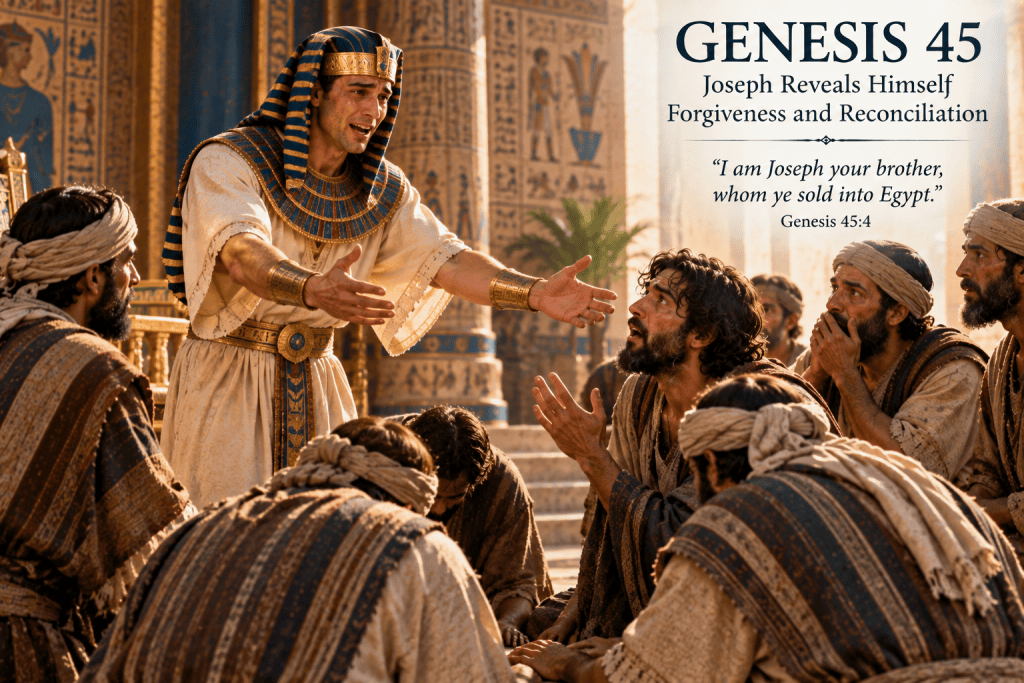
Genesis 45 — Joseph Reveals Himself: Forgiveness and Reconciliation
Key Scriptures: Genesis 45:1–28; Romans 8:28; Ephesians 4:31–32; Colossians 3:13; Romans 12:18
“Now therefore be not grieved, nor angry with yourselves, that ye sold me hither: for God did send me before you to preserve life.” — Genesis 45:5
Genesis 45 is one of the most moving chapters in all of Genesis.
For years, Joseph’s brothers had carried guilt.
Jacob had carried grief.
Joseph had carried the pain of betrayal and separation.
Now the moment of truth had come.
Judah had just offered himself in Benjamin’s place.
Joseph had seen what he needed to see.
His brothers were not the same men they had once been.
So Joseph could no longer hold back.
Joseph Could Not Restrain Himself
Genesis 45 begins:
“Then Joseph could not refrain himself before all them that stood by him.”
Joseph ordered everyone except his brothers to leave the room.
Then he wept.
Not quietly.
Genesis says:
“And he wept aloud.”
The Egyptians heard him.
Pharaoh’s household heard about it.
Years of emotion poured out at once.
Strong People Still Weep
Joseph had governed Egypt with wisdom.
He administered a national food program.
Joseph stood confidently before Pharaoh.
But now he wept.
There is no contradiction between strength and tears.
Sometimes tears reveal the depth of love.
Jesus wept.
Joseph wept.
Grief, relief, forgiveness, and joy can all produce tears.
“I Am Joseph”
Then Joseph said:
“I am Joseph; doth my father yet live?” — Genesis 45:3
Imagine the shock.
The brothers had believed Joseph was gone forever.
Now the Egyptian ruler standing before them said:
“I am Joseph.”
Their past suddenly stood in front of them.
Genesis says:
“And his brethren could not answer him; for they were troubled at his presence.”
That is understandable.
They probably expected judgment.
Joseph had the power to punish them.
Instead, he moved closer.
“Come Near to Me”
Joseph said:
“Come near to me, I pray you.”
That is a beautiful sentence.
The brothers probably wanted to back away.
Joseph invited them closer.
Then he said:
“I am Joseph your brother, whom ye sold into Egypt.”
Joseph did not pretend the past never happened.
He named it.
“Whom ye sold into Egypt.”
Forgiveness does not require pretending sin was imaginary.
Real reconciliation faces what happened.
Joseph Did Not Rewrite the Past
Joseph did not say:
“You did nothing wrong.”
He did not say:
“It was all a misunderstanding.”
He did not say:
“It did not hurt.”
What the brothers did was evil.
Joseph knew it.
They knew it.
But Joseph had learned to see something larger than their sin.
He had learned to see the providence of God.
“God Did Send Me Before You”
Joseph said:
“God did send me before you to preserve life.”
This is one of the clearest statements of providence in Scripture.
The brothers sold Joseph.
God sent Joseph.
Both statements are true.
The brothers acted with sinful motives.
God worked through their actions for a redemptive purpose.
That does not make their sin good.
It means God’s sovereignty is greater than human evil.
God Can Overrule Evil Without Approving It
This distinction is important.
God never needed the brothers to become righteous in order to accomplish His purpose.
He was able to take what they meant for harm and turn it toward preservation.
Later, Joseph would say:
“Ye thought evil against me; but God meant it unto good.” — Genesis 50:20
Their intention was evil.
God’s intention was good.
That is providence.
Joseph Explained the Famine
Joseph told his brothers that the famine had already lasted two years.
Five more years remained.
Then he said:
“God sent me before you to preserve you a posterity in the earth, and to save your lives by a great deliverance.” — Genesis 45:7
Now Joseph understood more clearly why he had gone through so much.
The pit.
Slavery.
Potiphar’s house.
False accusation.
Prison.
Waiting.
Palace.
All of it had brought Joseph to the place where he could preserve his family.
Sometimes Purpose Becomes Clear Later
Joseph did not understand the pit while he was in it.
He did not understand prison while he was waiting there.
But years later, he could look back and see a larger pattern.
That is often how providence works.
We understand backward what we had to trust forward.
“It Was Not You… But God”
Joseph said:
“So now it was not you that sent me hither, but God.” — Genesis 45:8
Joseph was not denying human responsibility.
He had just said:
“Whom ye sold into Egypt.”
Rather, he was emphasizing God’s greater purpose.
People acted.
God overruled.
Human responsibility and divine sovereignty stand together.
Joseph Saw God’s Hand Above Human Hands
This perspective protected Joseph from bitterness.
If Joseph saw only his brothers, he had every reason to remain angry.
But Joseph saw God above them.
That changed how he interpreted his story.
Joseph did not call evil good.
He saw that God had been working even through evil.
Forgiveness Grows from Providence
It is often easier to forgive when we trust that God is bigger than what happened to us.
That does not remove pain.
It does not erase consequences.
But it keeps the offender from becoming the final author of our story.
Joseph’s brothers had shaped part of his experience.
They had not controlled his destiny.
God had.
Joseph Sent for Jacob
Joseph told his brothers to hurry back to Canaan.
They were to tell Jacob:
“Thus saith thy son Joseph, God hath made me lord of all Egypt.”
Joseph wanted his father to come to Egypt.
He promised to provide for the entire family during the remaining famine.
After more than twenty years, father and son would soon be reunited.
Joseph Wanted His Family Near
Joseph told them:
“Thou shalt dwell in the land of Goshen, and thou shalt be near unto me.”
Reconciliation was not merely a conversation.
Joseph wanted restored relationship.
He wanted his family close.
That is important.
Forgiveness opens the door.
Reconciliation seeks restored fellowship when possible.
Forgiveness and Reconciliation Are Not Identical
Forgiveness can be given from the heart.
Reconciliation requires participation from both sides.
Joseph’s brothers had shown repentance; Joseph had shown forgiveness.
Now restored relationship became possible.
Not every broken relationship reaches that point.
Sometimes trust remains unsafe.
At other times, distance remains necessary.
But when repentance and forgiveness meet, reconciliation can become beautiful.
Joseph Wept on Benjamin
Joseph embraced Benjamin.
Genesis says:
“And he fell upon his brother Benjamin’s neck, and wept; and Benjamin wept upon his neck.”
Benjamin had not participated in Joseph’s betrayal.
These brothers shared Rachel as their mother.
Their reunion must have been deeply emotional.
Then Joseph kissed all his brothers and wept over them.
Joseph Kissed the Men Who Sold Him
That is one of the most remarkable acts in the chapter.
Joseph did not merely spare his brothers:
- He kissed them.
- He wept with them.
- He restored conversation.
Genesis says:
“And after that his brethren talked with him.” — Genesis 45:15
For years, there had been no relationship.
Now they could talk again.
Forgiveness Restores What Bitterness Destroys
Bitterness creates distance.
Forgiveness makes closeness possible.
Again, this does not mean every relationship must immediately return to its former state.
But Joseph shows the healing power of forgiveness when true repentance is present.
Pharaoh Heard the News
The report reached Pharaoh.
Pharaoh was pleased.
He told Joseph to send wagons for the family.
Pharaoh promised them:
“The good of all the land of Egypt.”
God did not merely provide enough.
He provided generously.
The family that once feared starvation would receive the best Egypt could offer.
God Had Prepared Provision Before They Needed It
This is another beautiful part of providence:
- Before Jacob knew the famine was coming, God had placed Joseph in Egypt.
- Before the brothers knew they would need food, God had raised Joseph to power.
- Before the crisis arrived, provision was already being prepared.
God often works ahead of our awareness.
Joseph Gave His Brothers Gifts
Joseph gave his brothers changes of clothing.
Benjamin received even more.
He also sent provisions for the journey and supplies for Jacob.
Then he gave them a memorable instruction:
“See that ye fall not out by the way.” — Genesis 45:24
That sounds almost humorous.
These men had a history of conflict.
Joseph had just forgiven them.
Now he warned them not to start arguing on the trip home.
Forgiven People Should Stop Fighting
That little instruction still speaks.
If grace has been given to us, we should become more gracious with others.
People who have received forgiveness should not remain experts at condemnation.
Paul wrote:
“Forgiving one another, even as God for Christ’s sake hath forgiven you.” — Ephesians 4:32
Grace received should become grace extended.
The Brothers Returned to Jacob
The brothers returned to Canaan.
Then came the unbelievable announcement:
“Joseph is yet alive, and he is governor over all the land of Egypt.” — Genesis 45:26
Jacob could hardly process it.
Genesis says:
“Jacob’s heart fainted, for he believed them not.”
For more than twenty years, Jacob had believed Joseph was dead.
Now his sons were telling him:
Joseph is alive.
Sometimes Good News Is Hard to Believe
Jacob had lived with grief for so long that hope sounded unbelievable.
Pain had trained him to expect loss.
Sometimes suffering can make good news difficult to receive.
We become cautious and protect ourselves from disappointment.
Jacob needed evidence.
Jacob Saw the Wagons
The brothers told Jacob everything Joseph had said.
Then Jacob saw the wagons Joseph had sent.
Genesis says:
“The spirit of Jacob their father revived.” — Genesis 45:27
The wagons became visible evidence that the incredible message was true.
Joseph was alive:
- There was food.
- There was a future.
- There would be reunion.
“It Is Enough”
Jacob said:
“It is enough; Joseph my son is yet alive: I will go and see him before I die.” — Genesis 45:28
What a reversal.
At the end of Genesis 37, Jacob said he would go to the grave mourning Joseph.
Now, in Genesis 45, he says:
“Joseph my son is yet alive.”
Grief turned toward hope.
The Coat Said Death; the Wagons Said Life
Years earlier, Jacob saw Joseph’s bloodstained coat.
That evidence convinced him Joseph was dead.
Now he saw Egyptian wagons.
They told a different story.
The coat said:
Death.
The wagons said:
Life.
The coat said:
Loss.
The wagons said:
Provision.
The coat said:
The story is over.
The wagons said:
God was still writing it.
Do Not Let One Chapter Define the Whole Story
Genesis 37 looked tragic.
Chapter 45 reveals that Genesis 37 was not the end.
We often interpret our lives too soon:
- A painful chapter feels final.
- A loss feels permanent.
- A closed door feels decisive.
But God may still be working.
Do not declare the ending while God is still writing.
Joseph Could Forgive Because He Saw God
Joseph did not say:
“My brothers were innocent.”
He said, in effect:
“My God is sovereign.”
That is different.
Forgiveness was rooted in Joseph’s theology of providence.
He believed God had been present in the worst parts of his story.
Therefore, he did not have to remain imprisoned by resentment.
Bitterness Creates a Second Prison
Joseph had already lived in a physical prison.
He refused to live in an emotional one.
Bitterness allows the person who hurt us to keep controlling our hearts long after the original event.
Forgiveness releases that hold.
It does not say:
“What happened was acceptable.”
It says:
“I will not live chained to it.”
Forgiveness Does Not Deny Justice
Biblical forgiveness is not pretending justice does not matter.
Joseph tested his brothers:
- He looked for change.
- He allowed truth to come into the open.
- Then he forgave.
Grace and truth belong together.
Forgiveness Is Not the Same as Forgetting
People often say:
“Forgive and forget.”
But Scripture does not command us to erase memory.
Joseph remembered exactly what happened.
He said:
“Whom ye sold into Egypt.”
The memory remained.
The bitterness did not have to.
That is an important distinction.
Forgiveness Does Not Always Remove Consequences
The brothers still had to face Jacob with the truth.
And the family still had years of pain behind them.
But the past could not be undone.
Forgiveness does not travel backward and erase history.
It changes how we carry that history forward.
Joseph Chose a Larger Story
The smaller story was:
“My brothers betrayed me.”
The larger story was:
“God sent me before you to preserve life.”
Both were true.
But Joseph chose to live inside the larger story.
That is one of the deepest spiritual lessons in Genesis.
Ask a Different Question
When we suffer, our first question is often:
“Why did they do this to me?”
Sometimes a better question later becomes:
“How might God still use this?”
That does not excuse wrongdoing.
It simply refuses to believe evil has the final word.
God Is Able to Redeem What He Did Not Approve
There are things God never commanded.
Betrayal.
Abuse.
Dishonesty.
Cruelty.
Injustice.
Yet God is so sovereign that He can work redemptively even through events He does not morally approve.
That is one of the great comforts of providence.
Joseph and Jesus
Joseph’s story again points beyond itself.
Joseph was rejected by his brothers.
Jesus was rejected by His own.
Joseph suffered unjustly.
Jesus suffered without sin.
Joseph was exalted.
Jesus was exalted.
Joseph’s suffering became a means of preserving life.
Jesus’ suffering became the means of eternal salvation.
Jesus Offers Greater Forgiveness
Joseph forgave brothers who had sinned against him.
Jesus prayed for those who crucified Him:
“Father, forgive them.” — Luke 23:34
At the cross, forgiveness reaches its highest expression.
We do not forgive because sin is small.
Instead, we forgive because God’s grace is great.
Reconciliation Begins with God
Human reconciliation matters.
But our greatest need is reconciliation with God.
Romans 5:10 says:
“When we were enemies, we were reconciled to God by the death of his Son.”
Through Christ, sinners can be brought near.
The God against whom we sinned offers peace through Jesus.
“Come Near”
Joseph said:
“Come near to me.”
That invitation reminds us of the Gospel.
Sin makes us want to hide.
Grace invites us near.
Hebrews says:
“Let us therefore come boldly unto the throne of grace.” — Hebrews 4:16
In Christ, sinners are invited to draw near to God.
What Genesis 45 Means for Us
1. Forgiveness Does Not Pretend the Past Never Happened
Joseph named what his brothers had done.
Truth and forgiveness belong together.
2. God’s Providence Is Greater Than Human Evil
The brothers sold Joseph.
God sent Joseph ahead to preserve life.
3. Human Responsibility and Divine Sovereignty Can Both Be True
The brothers were responsible for their sin.
God still worked through their actions.
4. A Larger View of God Helps Us Release Bitterness
Joseph saw God’s hand above the hands that hurt him.
5. Forgiveness Can Open the Door to Reconciliation
The brothers had changed.
Joseph forgave.
Relationship was restored.
6. Reconciliation Requires Truth
Joseph did not build restored relationship upon denial.
He faced the past honestly.
7. People Who Receive Grace Should Extend Grace
Joseph warned his brothers:
“See that ye fall not out by the way.”
Forgiven people should become forgiving people.
8. God Often Prepares Provision Before We Know We Need It
Joseph was already in Egypt before the famine began.
9. Pain Can Make Hope Hard to Believe
Jacob initially could not believe Joseph was alive.
Grief had shaped his expectations.
10. Do Not Judge Your Story Too Early
The bloody coat was not the final evidence.
The wagons eventually came.
When Someone Has Hurt You Deeply
Joseph’s story is beautiful.
But forgiveness after deep hurt is rarely easy.
Sometimes wounds last for years.
Forgiveness may begin with a decision before the feelings catch up.
You may need to say:
- “Lord, I cannot change what happened.”
- “I cannot make the past disappear.”
- “But I will not let bitterness rule my heart.”
- “Help me forgive as You have forgiven me.”
That may need to be repeated many times.
Forgiveness Does Not Require Foolishness
If someone remains dangerous, unrepentant, manipulative, or abusive, wisdom may require boundaries.
Joseph did not reveal himself before testing his brothers.
That matters.
Forgiveness can coexist with wisdom.
Love does not require pretending unsafe behavior is safe.
When Reconciliation Is Possible
Where genuine repentance exists, reconciliation should be pursued when appropriate.
Joseph did not keep punishing his brothers after he saw their change:
- He moved toward them.
- He embraced them.
- He provided for them.
- He restored fellowship.
Grace moved toward restoration.
Has God Redeemed Anything in Your Past?
Perhaps there is a season you once saw only as loss.
Years later, you may now see ways God used it:
- A disappointment redirected you.
- A closed door protected you.
- A painful experience made you compassionate.
- A hardship deepened your faith.
We should never call evil good.
But we can praise God for bringing good out of evil.
The God Who Was There All Along
Joseph’s story looked chaotic from the ground.
From above, God had been working all along.
At Dothan.
In the pit.
With the caravan.
In Potiphar’s house.
In prison.
Before Pharaoh.
During the famine.
And now in reconciliation.
The same God was present in every chapter.
WIM Takeaway
Genesis 45 teaches us that forgiveness becomes possible when we see God’s providence as greater than the wrongs committed against us. Joseph did not deny his brothers’ sin; he named it honestly. Yet he also recognized that God had worked through those painful events to preserve life. Because Joseph saw God’s hand above human evil, he could release bitterness, forgive his brothers, and move toward reconciliation. Therefore, we should tell the truth about the past, trust God’s sovereignty, extend grace where repentance is genuine, and refuse to let the people who hurt us become the final authors of our story.
Questions for Reflection
- Why could Joseph no longer restrain his emotions?
- Why were the brothers afraid when Joseph revealed his identity?
- What does Joseph’s statement “whom ye sold into Egypt” teach us about forgiveness and truth?
- How could Joseph say both that his brothers sold him and that God sent him?
- Why does God’s providence never excuse human sin?
- How did Joseph’s belief in providence help protect him from bitterness?
- What is the difference between forgiveness and reconciliation?
- Why was reconciliation possible between Joseph and his brothers?
- What does Joseph’s emotional reunion with Benjamin reveal about him?
- Why is “See that ye fall not out by the way” such a fitting instruction?
- Why did Jacob initially struggle to believe Joseph was alive?
- What did the wagons represent to Jacob?
- Is there an event in your past that you may be judging before seeing the whole story?
- Is there someone you need God’s help to forgive?
- How does Joseph’s story point us toward the forgiveness offered through Jesus Christ?
<<Back to the Book of Genesis
Dr. Alan Holden has served in pastoral ministry for more than 35 years, preaching and teaching the Bible in churches across the United States. He holds a Doctor of Ministry from Luther Rice Seminary and a Master of Divinity from The Southern Baptist Theological Seminary. Through What’s It Mean?, he seeks to help readers understand the meaning of Scripture and grow in their walk with Christ. He is currently the pastor of Lake Saunders Baptist Church in Tavares, FL.