







Genesis 42–44 — Joseph Tests His Brothers: Has the Family Changed?
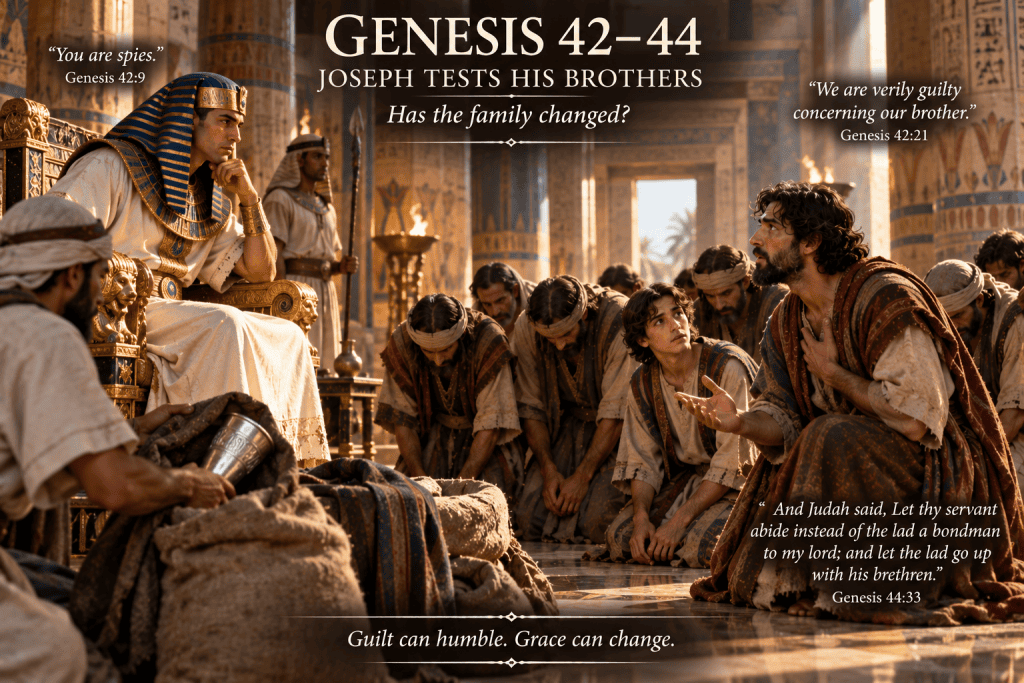
Key Scriptures: Genesis 42:1–38; Genesis 43:1–34; Genesis 44:1–34; Psalm 32:3–5; Proverbs 28:13; 2 Corinthians 7:10
“We are verily guilty concerning our brother.” — Genesis 42:21
Genesis 42–44 is not merely about food during a famine.
It is about guilt.
Memory.
Repentance.
Testing.
Responsibility.
And change.
Joseph’s brothers sold him into slavery.
They watched their father grieve.
And they kept the secret for years.
Now famine drove them to Egypt.
They did not know that the ruler standing before them was Joseph.
But Joseph knew exactly who they were.
The question was simple:
Were they still the same men?
The Famine Reached Canaan
The famine was not limited to Egypt.
It spread throughout the surrounding lands.
Jacob learned that grain was available in Egypt.
So he told his sons:
“Behold, I have heard that there is corn in Egypt: get you down thither.” — Genesis 42:2
Ten of Joseph’s brothers went.
Benjamin stayed home.
Jacob was afraid something might happen to him.
Jacob Was Still Protecting Rachel’s Son
This is important.
Joseph had been Jacob’s favorite.
After Joseph disappeared, Benjamin became the remaining son of Rachel.
Jacob could not bear the thought of losing him too.
Therefore, he kept Benjamin at home.
Once again, we see how old grief continued shaping the family.
Pain that remains unresolved often influences later decisions.
The Brothers Bowed Before Joseph
When the brothers arrived in Egypt, they stood before Joseph.
Then:
“Joseph’s brethren came, and bowed down themselves before him with their faces to the earth.” — Genesis 42:6
Joseph remembered the dreams.
Years earlier, the brothers had mocked him:
“We shall see what will become of his dreams.”
Now they were bowing.
The dreams had not failed.
God’s purpose had survived every attempt to stop it.
Joseph Recognized Them
Joseph recognized his brothers immediately.
But they did not recognize him.
That is understandable.
Joseph was now older:
- He wore Egyptian clothing.
- He spoke through an interpreter.
- He held enormous political authority.
The last time they saw him, he was a terrified young man being carried away by traders.
They had no reason to imagine that this Egyptian ruler was Joseph.
Joseph Spoke Roughly to Them
Joseph accused them of being spies.
He did not reveal his identity.
Instead, he began testing them.
Why?
The text shows that Joseph wanted to know whether the family had changed:
- Would they still sacrifice one brother to protect themselves?
- Would they still lie?
- Would they abandon Benjamin?
- Would Judah still think only of himself?
The tests would reveal the truth.
Testing Is Not the Same as Revenge
Joseph’s actions can feel severe.
However, he did not torture his brothers.
He did not enslave them.
Joseph did not retaliate for what they had done.
Instead, he created circumstances that brought their character into the open.
Joseph was not merely asking:
“Do they feel bad?”
He wanted to know:
Have they changed?
That is a different question.
The Brothers Explained Their Family
Joseph questioned them.
They explained that they were twelve brothers.
One was still at home.
But another one, they said, was:
“Not.”
They meant Joseph.
Imagine Joseph hearing them speak of him as though he no longer existed.
Yet Joseph remained silent.
Joseph Demanded Benjamin
Joseph told them that one brother must remain in Egypt while the others returned home and brought Benjamin back.
This placed pressure on the family:
- Would they return for Simeon?
- Would Jacob release Benjamin?
- Would the brothers risk themselves for one another?
The old family patterns were about to be tested.
Their Conscience Awakened
Then something remarkable happened.
The brothers said to one another:
“We are verily guilty concerning our brother.” — Genesis 42:21
Years had passed.
But the guilt remained:
- They remembered Joseph’s distress.
- They remembered his pleas.
- They remembered that they had refused to listen.
- They had hidden the sin from Jacob.
- They had not hidden it from themselves.
Buried Guilt Is Not Gone
People often assume time erases guilt.
It does not:
- We can distract ourselves.
- We can move.
- We can change jobs.
- We can get older.
- We can refuse to talk about the past.
But unresolved guilt has a way of returning.
The brothers carried Joseph with them in their consciences for years.
Reuben Said, “I Told You So”
Reuben reminded them that he had warned against harming Joseph.
He said:
“Spake I not unto you, saying, Do not sin against the child?”
Reuben had indeed tried to prevent Joseph’s death.
However, he still participated in the deception afterward.
Partial resistance does not erase shared responsibility.
Joseph Wept
The brothers did not know Joseph could understand them.
He turned away and wept.
This is one of the first times we see Joseph’s deep emotion:
- He was not cold.
- He was not enjoying their fear.
- He still loved them.
Yet he continued the test.
Sometimes love requires more than immediate relief because love seeks truth.
Simeon Was Detained
Joseph kept Simeon in Egypt.
Then he sent the other brothers home with grain.
But he secretly returned their money into their sacks.
When they discovered it, they became afraid.
They asked:
“What is this that God hath done unto us?” — Genesis 42:28
Their consciences were so burdened that unexpected events felt like judgment.
Guilt changes how we interpret circumstances.
Jacob Refused to Send Benjamin
When the brothers returned home, they explained everything.
They told Jacob that the ruler demanded Benjamin.
Jacob refused.
He said:
“My son shall not go down with you.”
He feared losing Benjamin just as he had lost Joseph.
Jacob’s grief had become fear.
Fear then became control.
Grief Can Make Us Hold Too Tightly
Jacob loved Benjamin.
That love was understandable.
But fear made him unwilling to release him.
Sometimes after loss, we become overprotective.
We try to prevent anything painful from ever happening again.
But control cannot guarantee safety.
Eventually, Jacob would have to trust God with Benjamin too.
The Famine Continued
The food eventually ran out.
Jacob told his sons to return to Egypt for more grain.
Judah reminded him:
“The man did solemnly protest unto us, saying, Ye shall not see my face, except your brother be with you.” — Genesis 43:3
They could not return without Benjamin.
Now the family faced a decision.
Judah Stepped Forward
This time Judah spoke differently.
He said:
“I will be surety for him; of my hand shalt thou require him.” — Genesis 43:9
That is a major change.
Earlier, Judah had suggested selling Joseph.
Now Judah was willing to become personally responsible for Benjamin.
The man who once sacrificed a brother was beginning to protect one.
This is exactly the kind of change Joseph needed to see.
True Repentance Produces Different Choices
Repentance is more than saying:
“I feel bad.”
Real repentance produces changed behavior.
The old Judah said:
“Let us sell him.”
The changing Judah said:
“I will be surety for him.”
Same kind of family crisis.
Different response.
That is evidence of transformation.
Jacob Finally Agreed
Jacob reluctantly allowed Benjamin to go.
He sent gifts and the double money.
Then he said:
“And God Almighty give you mercy before the man.” — Genesis 43:14
Jacob had done what he could.
Now he had to trust God.
There comes a point when planning ends and faith begins.
Joseph Saw Benjamin
When the brothers returned, Joseph saw Benjamin.
He ordered that they be taken to his house for a meal.
The brothers became frightened.
They assumed the invitation was a trap.
Again, guilt shaped their interpretation.
But Joseph had something very different in mind.
Joseph Asked About Jacob
Joseph asked:
“Is your father well, the old man of whom ye spake? Is he yet alive?” — Genesis 43:27
Imagine the emotion behind that question.
Joseph had not seen his father for more than twenty years.
He wanted to know if Jacob still lived.
The brothers answered that he did.
Then they bowed again.
Joseph Saw Benjamin Up Close
Joseph looked at Benjamin.
This was his only full brother.
Both were sons of Rachel.
Joseph asked:
“Is this your younger brother, of whom ye spake unto me?”
Then he said:
“God be gracious unto thee, my son.”
Joseph Wept Again
Overcome with emotion, Joseph hurried out of the room.
Genesis says:
“He entered into his chamber, and wept there.” — Genesis 43:30
Joseph’s restraint was not easy.
He was not playing a cruel game.
Joseph’s heart was breaking.
Yet the test was not finished.
He needed to know what these men would do when Benjamin was placed in danger.
The Brothers Ate with Joseph
Joseph arranged the brothers according to age.
They were astonished.
How could this Egyptian ruler know their birth order?
Then Benjamin received five times as much food as the others.
This was another subtle test.
Years earlier, the brothers had resented Joseph because their father favored him.
Would they resent Benjamin now?
Genesis records no outbreak of jealousy.
That silence is significant.
Perhaps they were changing.
Joseph Prepared the Final Test
Genesis 44 begins with Joseph instructing his steward to fill the brothers’ sacks with grain.
Again, their money was returned.
But Joseph added something else.
His silver cup was placed in Benjamin’s sack.
After the brothers left, Joseph sent his steward after them.
They were accused of theft.
The Brothers Were Confident
The brothers denied the accusation.
They were so certain of their innocence that they said whoever had the cup could die, and the others could become servants.
Then the sacks were searched.
The cup was found in Benjamin’s sack.
Everything suddenly changed.
The Brothers Tore Their Clothes
When the cup was discovered with Benjamin:
“Then they rent their clothes.” — Genesis 44:13
Years earlier, they had stripped Joseph of his special coat.
Then they went home without him.
Now another favored son was in danger.
Would they leave Benjamin behind too?
They did not.
All of them returned to the city.
That itself showed change.
They Returned Together
The old brothers had abandoned Joseph.
The new brothers would not abandon Benjamin.
This is exactly what Joseph needed to see.
Pressure reveals character.
They now had a perfect opportunity to say:
“Benjamin did it. Keep him. We are going home.”
Instead, they stayed together.
Judah Spoke for the Family
Judah approached Joseph.
He acknowledged their helplessness.
Then he began telling the family story:
- He spoke about Jacob.
- He spoke about Rachel.
- He spoke about the brother who was “dead.”
- He spoke about Benjamin.
- He explained how deeply Jacob loved him.
Judah understood what losing Benjamin would do to his father.
That awareness is striking.
Years earlier, Judah had helped cause Jacob’s grief.
Now he was desperate not to cause it again.
Judah Had Learned Empathy
People change when they learn to care about pain beyond their own.
The old Judah asked:
“What profit is it if we slay our brother?”
The new Judah asked, in effect:
“What will this do to my father?”
He was no longer thinking merely about himself.
Judah was thinking about Jacob.
And Benjamin.
That is growth.
Judah Offered Himself
Then Judah said:
“Now therefore, I pray thee, let thy servant abide instead of the lad a bondman to my lord; and let the lad go up with his brethren.” — Genesis 44:33
This is one of the most important moments in Judah’s life.
Judah offered himself as a substitute for Benjamin.
Years earlier, he had sold Joseph into slavery.
Now he was willing to become a slave himself to save his brother.
That is transformation.
Joseph’s Test Had Its Answer
The question had been:
Has the family changed?
Now Joseph knew.
Yes.
Not perfectly.
But genuinely.
The brothers no longer responded to danger the same way they had years earlier.
Especially Judah.
The man who once gave up a brother was now willing to give himself for one.
Repentance Is Seen in Reversed Behavior
Sometimes the strongest evidence of repentance is what a person does when given the same kind of opportunity again.
Years earlier:
A favored brother was vulnerable.
They sacrificed him.
Now:
A favored brother was vulnerable.
They protected him.
That is not mere regret.
That is change.
Guilt Can Lead Somewhere Good
The brothers’ guilt had tormented them.
But now that guilt was producing honesty.
Paul later distinguished between worldly sorrow and godly sorrow.
Worldly sorrow merely hates consequences.
Godly sorrow leads to repentance.
The brothers were beginning to move from guilt toward repentance.
Confession Brings Relief
Psalm 32 describes the burden of hidden sin.
David said:
“When I kept silence, my bones waxed old.”
Then:
“I acknowledged my sin unto thee.”
Hidden guilt drains the soul.
Confession brings things into the light.
Joseph’s brothers had not yet confessed directly to Joseph, because they did not know who he was.
But their own words showed that the truth was finally reaching the surface.
God Was Using the Famine
The famine looked like a natural disaster.
But God used it to bring the family together:
- Without the famine, the brothers would not have gone to Egypt.
- Without Egypt, they would not have stood before Joseph.
- Without those tests, their hearts might never have been exposed.
God used difficult circumstances to accomplish deeper spiritual work.
Providence Works on More Than Circumstances
We often think providence means God arranging external events.
And it does.
But in Genesis 42–44, God was also working internally.
He was working on:
The brothers’ consciences.
Judah’s character.
Jacob’s fear.
Joseph’s forgiveness.
Benjamin’s place in the family.
Providence is not only about where God takes us.
It is also about who He is making us.
Joseph Did Not Reveal Himself Too Soon
Joseph could have said immediately:
“I am Joseph.”
Instead, he waited.
Why?
Because emotional reunion without moral change would have left deeper problems unresolved.
Sometimes immediate relief is not the same as true restoration.
Joseph wanted reconciliation based on truth.
That required time.
Forgiveness and Trust Are Related but Different
Joseph had clearly not spent years plotting revenge.
But trust had been broken.
Before full reconciliation, he needed to see whether these men were trustworthy.
That distinction matters.
Forgiveness can be offered from the heart.
Trust is often rebuilt through demonstrated change.
Joseph’s tests allowed that change to become visible.
Reconciliation Requires Truth
Healthy reconciliation does not pretend nothing happened.
Joseph did not ignore the past.
He brought the family into circumstances that forced the past into the open.
Only then would reconciliation become possible.
Grace does not deny truth.
Instead, grace works through truth.
Judah as a Picture of Substitution
Judah’s offer is striking:
“Let thy servant abide instead of the lad.”
Judah offered himself in Benjamin’s place.
We should not force every detail into a prophecy.
However, this moment does prepare us to understand the biblical idea of substitution.
Later, from Judah’s line would come Jesus Christ.
And Christ would do something far greater.
He would give Himself in the place of sinners.
Jesus, the Greater Substitute
Jesus said:
“The Son of man came… to give his life a ransom for many.” — Mark 10:45
Judah offered to become a slave so Benjamin could go free.
Jesus gave His life so sinners could be set free.
Judah’s willingness points us toward the kind of self-sacrificing love that reaches its perfection in Christ.
What Genesis 42–44 Means for Us
1. Hidden Guilt Eventually Returns
The brothers had buried their sin for years.
But their consciences had not forgotten.
2. God Can Use Circumstances to Awaken the Conscience
The famine and Joseph’s tests forced the brothers to face what they had done.
3. Repentance Is More Than Regret
The brothers did not merely feel bad.
Their later choices were different.
4. Changed Behavior Is Evidence of Changed Character
The men who once abandoned Joseph refused to abandon Benjamin.
5. Judah Shows What Growth Looks Like
He moved from sacrificing a brother to offering himself for one.
6. Grief Can Become Fear
Jacob’s loss of Joseph made him afraid to release Benjamin.
Pain can shape us long after the original event.
7. We Eventually Have to Trust God with What We Cannot Control
Jacob could not protect Benjamin forever.
He had to release him.
8. Guilt Distorts Our Interpretation of Events
The brothers saw unexpected circumstances and immediately assumed judgment.
A troubled conscience often makes everything feel threatening.
9. Forgiveness Does Not Mean Ignoring Character
Joseph’s testing showed whether trust could be rebuilt.
10. Reconciliation Must Be Grounded in Truth
Real peace does not hide the past.
It deals honestly with it.
Has the Family Changed?
That is the central question of these chapters.
Joseph did not need to know whether his brothers could sound sorry.
He needed to know whether they had become different.
And the test revealed that they had.
Not perfectly.
But meaningfully.
The same crisis produced a different response.
That is one of the clearest signs of growth.
What Would You Do Differently Now?
That is a good question for all of us.
Perhaps there was a time when you failed badly.
If you faced a similar situation today, would your response be different?
- Would you tell the truth?
- Would you show mercy?
- Would you protect rather than exploit?
- Would you speak rather than remain silent?
- Would you take responsibility?
Growth is often measured by how differently we respond to familiar temptations.
God Can Change Families
Genesis has shown repeated family dysfunction.
Favoritism.
Deception.
Jealousy.
Violence.
Compromise.
But Genesis 42–44 shows something hopeful.
People can change.
Families can change.
Patterns can change.
Judah can change.
The brothers can change.
God’s grace is not limited by family history.
The Past Does Not Have to Repeat Forever
Maybe your family has repeated certain patterns for years.
Anger.
Silence.
Addiction.
Dishonesty.
Favoritism.
Financial irresponsibility.
Spiritual indifference.
Someone has to make a different choice.
By God’s grace, that person can be you.
Joseph Was Watching for Change
Joseph knew what his brothers used to be.
He wanted to see what they were now.
God also knows our past.
But He is not interested merely in reminding us of who we were.
He transforms.
Sanctification means that over time, our responses begin to change.
Not perfectly.
But genuinely.
Guilt Is Not the Final Destination
The brothers said:
“We are verily guilty.”
That was important.
But guilt alone is not enough.
Guilt should lead to confession.
Confession should lead to repentance.
Repentance should lead to change.
And change opens the door to restoration.
WIM Takeaway
Genesis 42–44 shows Joseph testing his brothers to discover whether they had truly changed. Years earlier, they had abandoned one favored brother. Now, when Benjamin was threatened, they refused to leave him behind. Most importantly, Judah offered himself in Benjamin’s place. Their guilt had begun to produce repentance, and repentance had begun to produce changed behavior. Therefore, real spiritual growth is not measured only by what we say about the past, but by the different choices we make in the present.
Questions for Reflection
- Why did Joseph’s brothers go to Egypt?
- How did their bowing before Joseph fulfill his earlier dreams?
- Why did Joseph test his brothers instead of revealing himself immediately?
- What does their statement, “We are verily guilty,” reveal about the human conscience?
- How had Jacob’s grief over Joseph affected the way he treated Benjamin?
- What changed in Judah between Genesis 37 and Genesis 43–44?
- Why is Judah’s offer to become Benjamin’s substitute so important?
- What is the difference between regret and repentance?
- How did the brothers show that they were no longer the same men?
- Why is changed behavior one of the best signs of genuine repentance?
- What is the difference between forgiveness and rebuilt trust?
- Why must reconciliation be grounded in truth?
- Is there an area where your past choices still burden your conscience?
- If you faced an old temptation again today, would you respond differently?
- What family pattern might God be calling you to break?
<<Back to the Book of Genesis
Dr. Alan Holden has served in pastoral ministry for more than 35 years, preaching and teaching the Bible in churches across the United States. He holds a Doctor of Ministry from Luther Rice Seminary and a Master of Divinity from The Southern Baptist Theological Seminary. Through What’s It Mean?, he seeks to help readers understand the meaning of Scripture and grow in their walk with Christ. He is currently the pastor of Lake Saunders Baptist Church in Tavares, FL.