







Genesis 40–41 — Joseph from Prison to Palace
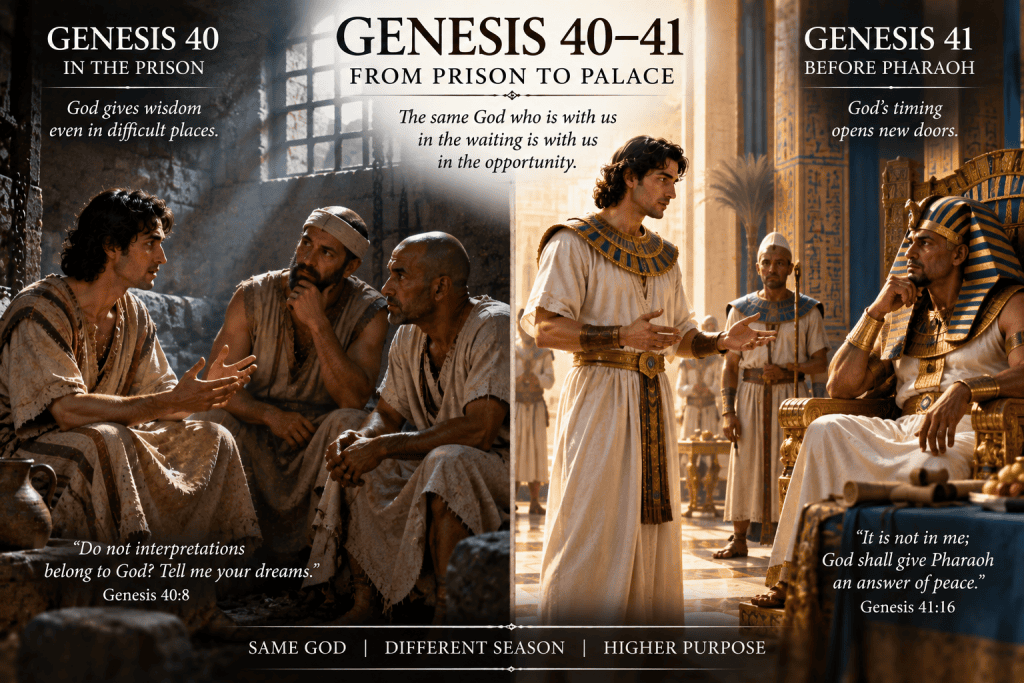
Key Scriptures: Genesis 40:1–23; Genesis 41:1–57; Psalm 105:17–22; Proverbs 21:1; Romans 8:28
“And Pharaoh said unto Joseph, Forasmuch as God hath shewed thee all this, there is none so discreet and wise as thou art.” — Genesis 41:39
Genesis 40 begins with Joseph in prison.
Chapter 41 ends with Joseph governing Egypt.
What happened between those two places?
God opened a door.
However, Joseph had to wait for that door much longer than he expected.
He had already been betrayed by his brothers.
Sold into slavery.
Falsely accused.
Thrown into prison.
Now Joseph would experience another painful trial:
He would be forgotten.
Nevertheless, God had not forgotten him.
Two Prisoners Arrived
While Joseph was in prison, two important officials from Pharaoh’s household offended the king.
One was Pharaoh’s chief butler, or cupbearer.
The other was Pharaoh’s chief baker.
Both men were placed in the same prison where Joseph was confined.
Genesis says:
“And the captain of the guard charged Joseph with them, and he served them.” — Genesis 40:4
Once again, Joseph served.
He was a prisoner.
Yet he remained faithful.
Joseph Served Where He Was
Joseph could have spent every day thinking:
“I should not be here.”
And he would have been right.
He had been falsely accused.
However, Joseph did not allow injustice to excuse irresponsibility.
He served faithfully where God had allowed him to be.
That is an important lesson.
Sometimes we spend so much time wishing we were somewhere else that we neglect what God has placed before us today.
Both Men Had Dreams
One night, the butler and baker each had a dream.
When Joseph saw them the next morning, he noticed they were troubled.
He asked:
“Wherefore look ye so sadly to day?” — Genesis 40:7
That small question tells us something about Joseph.
He noticed other people.
Joseph had plenty of problems of his own.
Yet he still noticed sadness on someone else’s face.
Suffering had not made him completely self-absorbed.
Pain Can Make Us More Compassionate
Suffering can do one of two things.
It can make us bitter.
Or it can make us more sensitive to the suffering of others.
Joseph knew what it meant to be troubled.
Therefore, he noticed troubled people.
Sometimes God uses our own pain to prepare us to minister to someone else.
“Do Not Interpretations Belong to God?”
The two officials told Joseph:
“We have dreamed a dream, and there is no interpreter of it.”
Joseph answered:
“Do not interpretations belong to God? tell me them, I pray you.” — Genesis 40:8
Notice Joseph’s response.
He did not say:
“I have a special gift.”
He pointed to God.
Joseph understood that whatever wisdom he possessed ultimately came from the Lord.
That is humility.
Use Your Gifts Without Taking God’s Glory
God had given Joseph an unusual ability connected with dreams.
Joseph used that gift.
But he gave God the credit.
That is a good pattern for every believer.
Use your abilities.
Develop your abilities.
Work hard.
Serve well.
But remember where the ability came from.
“Every good gift and every perfect gift is from above.” — James 1:17
The Butler’s Dream
The butler described a vine with three branches.
The vine budded, blossomed, and produced grapes.
Then the butler squeezed the grapes into Pharaoh’s cup and placed the cup into Pharaoh’s hand.
Joseph explained that the three branches represented three days.
Within three days, Pharaoh would restore the butler to his position.
That was good news.
“Think on Me”
After interpreting the dream, Joseph made a personal request.
He told the butler:
“But think on me when it shall be well with thee.” — Genesis 40:14
Joseph asked the man to mention him to Pharaoh.
He explained that he had been taken from the land of the Hebrews and had done nothing deserving imprisonment.
Joseph was not wrong to seek help.
Trusting God does not mean refusing legitimate opportunities.
Joseph prayed through his life by faith, but he also took reasonable action.
The Baker’s Dream
The baker heard the favorable interpretation and told Joseph his dream.
He had three baskets on his head.
The upper basket contained baked goods for Pharaoh.
However, birds ate the food from the basket.
Joseph gave a much more difficult interpretation.
Within three days, Pharaoh would execute the baker.
Joseph did not change the message simply because it was unpleasant.
Truth Is Not Always Comfortable
Sometimes God’s truth encourages us.
At other times God’s truth confronts us.
A faithful messenger cannot change the message merely to make it easier to hear.
Joseph told both men the truth.
One received good news.
The other received bad news.
Faithfulness means speaking truth with courage.
The Dreams Came True
Three days later, Pharaoh celebrated his birthday.
He restored the chief butler to his position.
However, the chief baker was executed.
Everything happened exactly as Joseph had said.
Surely now the butler would remember Joseph and Joseph would soon be released.
But Genesis 40 ends with painful words:
“Yet did not the chief butler remember Joseph, but forgat him.” — Genesis 40:23
Joseph Was Forgotten
Imagine Joseph waiting.
Perhaps the first day he expected someone to come.
Then another day passed.
And another.
Weeks became months:
- No messenger.
- No release.
- No explanation.
The butler had forgotten him.
But God had not.
People May Forget You
People forget promises:
- They forget favors.
- They forget kindness.
- They forget people who helped them.
Sometimes that hurts deeply.
However, our ultimate confidence cannot rest in human memory.
Isaiah 49:15–16 says:
“Yet will I not forget thee. Behold, I have graven thee upon the palms of my hands.”
People may forget.
God does not.
Two Full Years Passed
Genesis 41 begins:
“And it came to pass at the end of two full years.”
Two years.
Joseph remained in prison for two more years after helping the butler.
Why?
Genesis does not tell us everything God was doing during that time.
However, we can see something afterward.
If the butler had remembered Joseph immediately, Joseph might simply have been released.
But two years later, Pharaoh himself would desperately need someone who could interpret dreams.
God’s timing placed Joseph before Pharaoh at exactly the right moment.
Delay Is Not Always Denial
Joseph wanted release.
God intended promotion.
Joseph wanted out of prison.
God intended to place him before Pharaoh.
Joseph wanted something good.
God was preparing something larger.
Therefore, when God seems slow, do not assume He has said no.
Sometimes the delay is part of the preparation.
Pharaoh Had a Dream
Pharaoh dreamed that he stood beside the Nile.
Seven healthy, well-fed cows came out of the river.
Then seven thin, unhealthy cows appeared.
The thin cows ate the healthy cows.
Yet they remained thin.
Pharaoh awoke.
Then he dreamed again.
The Second Dream
Pharaoh saw seven healthy ears of grain growing on one stalk.
Then seven thin ears appeared, scorched by the east wind.
The thin ears swallowed the healthy ears.
Pharaoh awoke again.
He knew these dreams mattered.
But he did not know what they meant.
Egypt’s Wise Men Could Not Help
Pharaoh called his magicians and wise men.
He told them the dreams.
However:
“There was none that could interpret them unto Pharaoh.” — Genesis 41:8
Egypt possessed learning.
Power.
Religion.
Wealth.
Political authority.
But Egypt’s wisdom could not provide the answer Pharaoh needed.
Sometimes God allows human wisdom to reach its limit so His wisdom becomes unmistakable.
The Butler Finally Remembered
Suddenly, the chief butler remembered Joseph.
He said:
“I do remember my faults this day.” — Genesis 41:9
Then he told Pharaoh about the Hebrew prisoner who had correctly interpreted his dream and the baker’s dream.
Two years earlier, the butler had forgotten Joseph.
Now, at exactly the right time, he remembered.
God can use a person’s memory just as surely as He can use a miracle.
Joseph Was Summoned
Pharaoh immediately sent for Joseph.
Genesis says:
“And they brought him hastily out of the dungeon.”
What a change.
Joseph had waited for years.
Then suddenly:
“Come.”
Sometimes God’s work seems slow.
Then everything changes quickly.
Joseph Prepared to Meet Pharaoh
Joseph shaved.
He changed his clothes.
Then he stood before the most powerful man in Egypt.
- Think of Joseph’s journey:
- The coat.
- The pit.
- The slave market.
- Potiphar’s house.
- The prison.
- Now Pharaoh’s court.
Joseph could not have planned this path.
But God had been with him through every part of it.
Pharaoh Had Heard About Joseph
Pharaoh said:
“I have heard say of thee, that thou canst understand a dream to interpret it.” — Genesis 41:15
This was Joseph’s moment.
He could have promoted himself.
Instead, Joseph answered:
“It is not in me: God shall give Pharaoh an answer of peace.” — Genesis 41:16
Years of suffering had not removed Joseph’s humility.
He still pointed to God.
“It Is Not in Me”
Those five words reveal Joseph’s character.
“It is not in me.”
Joseph knew he had ability.
But he knew the source.
Spiritual maturity does not require pretending we have no gifts.
It means recognizing that every gift ultimately comes from God.
Joseph Interpreted Pharaoh’s Dreams
Joseph explained that both dreams carried the same message.
The repetition showed that the matter was established by God.
Seven years of great abundance were coming to Egypt.
Afterward, seven years of severe famine would follow.
The famine would be so severe that the years of abundance would be forgotten.
Then Joseph said:
“What God is about to do he sheweth unto Pharaoh.” — Genesis 41:28
Again, Joseph pointed to God.
Joseph Did More Than Identify the Problem
Joseph did not stop with the interpretation.
He offered a plan.
Egypt should appoint a wise administrator.
During the seven prosperous years, the nation should collect and store one-fifth of the produce.
Then the stored food could sustain Egypt during the famine.
Joseph combined spiritual insight with practical wisdom.
That is important.
Faith does not eliminate planning.
Often, wisdom means preparing today for what we know may come tomorrow.
Save During Times of Plenty
There is a practical financial principle here.
When resources are abundant, do not assume abundance will continue forever:
- Save.
- Prepare.
- Avoid unnecessary waste.
- Build reserves when possible.
The seven good years were the time to prepare for the seven difficult years.
Biblical wisdom looks beyond today.
Pharaoh Recognized Something Different
The king asked:
“Can we find such a one as this is, a man in whom the Spirit of God is?” — Genesis 41:38
<p>Pharaoh saw that Joseph possessed something his own advisers lacked.
Then he said:
“There is none so discreet and wise as thou art.”
Joseph had entered the room as a prisoner.
He would leave as a ruler.
From Prison to Palace
Pharaoh told Joseph:
“Thou shalt be over my house, and according unto thy word shall all my people be ruled.”
Only Pharaoh himself would outrank Joseph.
Think about that.
That morning Joseph had been a prisoner.
Before the day ended, he was second in command over Egypt.
God can change circumstances very quickly.
Pharaoh Gave Joseph His Ring
Pharaoh removed his signet ring and placed it on Joseph’s hand:
- He dressed Joseph in fine linen.
- He placed a gold chain around his neck.
- He had Joseph ride in the second chariot.
People cried before him:
“Bow the knee.”
Years earlier, Joseph dreamed that others would bow before him.
Now the dream was beginning to move toward fulfillment.
Joseph Was Thirty Years Old
Genesis 41:46 says:
“And Joseph was thirty years old when he stood before Pharaoh king of Egypt.”
Joseph had been seventeen when his brothers sold him.
Approximately thirteen years had passed.
Thirteen years.
Slavery.
Service.
Temptation.
False accusation.
Prison.
Waiting.
Joseph’s preparation took years.
His promotion took a day.
God Often Prepares Slowly and Moves Suddenly
We usually want quick preparation and immediate opportunity.
God often works differently.
He develops character before giving responsibility.
Joseph needed more than dream interpretation to govern Egypt.
He needed maturity.
Patience.
Administrative experience.
Humility.
Endurance.
Wisdom.
Where did he learn those things?
- In Potiphar’s house.
- In prison.
- In waiting.
The places that looked like delays were actually classrooms.
Your Waiting May Be Training
We often ask:
“When will God get me out of this?”
Sometimes another question may be helpful:
“What is God teaching me while I am here?”
Joseph learned administration in Potiphar’s house.
Then he learned leadership among prisoners.
By the time Pharaoh needed an administrator, Joseph had years of practical experience.
God wastes nothing.
Joseph Went to Work
Joseph did not celebrate his promotion and stop working.
He traveled throughout Egypt.
During the seven abundant years, he gathered enormous quantities of grain.
Genesis says the grain became so plentiful that they stopped counting it.
Joseph faithfully prepared during prosperity.
Joseph Married and Had Sons
Pharaoh gave Joseph a wife named Asenath.
She bore him two sons before the famine began.
Joseph named the first Manasseh.
He explained:
“For God… hath made me forget all my toil, and all my father’s house.” — Genesis 41:51
This does not mean Joseph literally forgot his family.
Rather, God had helped ease the pain of his suffering.
Ephraim
Joseph named his second son Ephraim.
He said:
“For God hath caused me to be fruitful in the land of my affliction.” — Genesis 41:52
What a testimony.
Egypt was:
“The land of my affliction.”
Yet it was also the place where God made Joseph fruitful.
Sometimes the place of our greatest pain becomes the place where God produces unexpected fruit.
Fruitful in Affliction
We often think fruitfulness requires ideal circumstances.
Joseph’s life says otherwise:
- You can grow in difficult circumstances.
- You can serve in difficult circumstances.
- You can bless others in difficult circumstances.
- You can become fruitful in the very place you once wished to escape.
God is not limited by your environment.
The Famine Came
After seven years of abundance, the famine began exactly as Joseph had predicted.
The surrounding lands suffered as well.
Eventually, the people of Egypt cried to Pharaoh for food.
Pharaoh told them:
“Go unto Joseph; what he saith to you, do.”
Joseph opened the storehouses.
Egypt had food because someone had prepared before the crisis came.
The World Came to Joseph
Genesis 41 ends:
“And all countries came into Egypt to Joseph for to buy corn; because that the famine was so sore in all lands.”
This prepares us for what comes next.
Among the people affected by the famine would be Jacob and Joseph’s brothers.
The brothers who sold Joseph into Egypt would eventually travel to Egypt looking for food.
And whom would they meet?
Joseph.
The Dreams Were Not Dead
Years earlier, the brothers had thrown Joseph into the pit and said:
“We shall see what will become of his dreams.”
Now we know.
The dreams survived the pit:
- They survived slavery.
- They survived false accusation.
- They survived prison.
- They survived years of waiting.
Why?
Because the dreams were rooted in God’s purpose.
God’s Timing Is Different from Ours
Joseph probably wanted freedom years earlier.
But God knew when Pharaoh would dream.
God knew when Egypt would need Joseph.
He knew when famine would come.
God knew when Joseph’s brothers would need food.
He was coordinating events far beyond Joseph’s ability to see.
That is providence.
When God Seems Late
We often judge God’s timing from our limited perspective.
“Lord, why haven’t You answered?”
“Why am I still waiting?”
“Lord, why hasn’t this changed?”
Joseph might have asked similar questions.
But God was not late.
When the right moment came, the prison door opened.
Don’t Waste the Prison Years
Joseph did not know how long he would remain in prison.
Nevertheless, he served:
- He noticed people.
- He used his gifts.
- He honored God.
- He remained faithful.
That is the challenge.
Do not wait until circumstances improve before you start serving God faithfully.
Serve Him now.
Be Faithful Where You Are
Perhaps you are not where you expected to be.
Maybe a door closed.
Perhaps retirement came differently than expected.
Or health changed your plans.
Perhaps a job disappeared.
Or a ministry opportunity ended.
Perhaps you are simply waiting.
Joseph reminds us:
God can use this season too.
Faithfulness today prepares us for whatever God chooses tomorrow.
When People Forget You
The butler forgot Joseph:
- Maybe someone has forgotten what you did for them.
- Maybe you served faithfully and received no recognition.
- Maybe someone promised to help and never did.
That hurts.
But do not build your hope upon human remembrance:
- God knows where you are.
- God knows what you have done.
- God knows when the time is right.
God Knows Your Address
Joseph was in a prison in Egypt.
But God knew exactly where to find him.
No situation places us beyond God’s reach:
- No hospital room.
- No nursing home.
- No lonely house.
- No difficult workplace.
- No financial struggle.
- No season of obscurity.
God knows where His people are.
Joseph Was Ready When the Door Opened
When Pharaoh called, Joseph was prepared.
He had:
- developed his gift.
- developed character.
- learned administration.
- learned humility.
- learned patience.
The opportunity came suddenly.
But Joseph’s preparation had taken years.
That is why we should prepare before the door opens.
Character Before Position
God gave Joseph authority only after years of developing his character.
That principle matters.
Talent can take a person somewhere character cannot keep him.
Joseph needed both.
His gift brought him before Pharaoh.
Joseph’s character enabled him to serve faithfully once he arrived.
Joseph and Jesus
Once again, Joseph’s life contains patterns that remind Christians of Jesus.
Joseph was rejected by his brothers:
- He descended into humiliation.
- He suffered unjustly.
- Then he was exalted.
Eventually, those who needed life would come to him for bread.
The parallels should not be forced into every detail.
However, the larger pattern is striking.
Humiliation.
Then exaltation.
Suffering.
Then glory.
Rejection.
Then salvation for others.
Christ Was Humbled and Exalted
Philippians 2 describes Jesus humbling Himself:
“He humbled himself, and became obedient unto death, even the death of the cross.”
Then:
“Wherefore God also hath highly exalted him.” — Philippians 2:8–9
Joseph’s story gives us a small Old Testament picture of a pattern fulfilled perfectly in Christ.
Jesus descended far lower than Joseph ever did.
And God exalted Him above every name.
The Bread of Life
During the famine, people came to Joseph for food.
Pharaoh said:
“Go unto Joseph.”
In a much greater way, sinners come to Christ for eternal life.
Jesus said:
“I am the bread of life: he that cometh to me shall never hunger.” — John 6:35
Joseph preserved physical life.
Jesus gives eternal life.
What Genesis 40–41 Means for Us
1. Serve Faithfully Where You Are
Joseph served even while imprisoned.
Do not wait for ideal circumstances before becoming useful.
2. Notice Hurting People
Joseph saw that the butler and baker were sad.
Our own pain should make us compassionate, not self-absorbed.
3. Give God Credit for Your Gifts
Joseph said:
“Do not interpretations belong to God?”
And later:
“It is not in me.”
Use your gifts, but give God the glory.
4. Speak the Truth Even When It Is Difficult
Joseph gave the baker an unpleasant interpretation because it was the truth.
Faithfulness does not change truth to gain approval.
5. People May Forget You, but God Will Not
The butler forgot Joseph.
God remembered exactly where Joseph was.
6. Delay Does Not Mean God Has Said No
Two full years passed.
Then everything changed.
7. God’s Timing Is Precise
Joseph reached Pharaoh exactly when Pharaoh needed him.
God’s timing connected Joseph’s gift with Egypt’s need.
8. Preparation Often Happens in Unwanted Places
Potiphar’s house and prison prepared Joseph to govern Egypt.
Your present season may be preparation too.
9. Faith and Planning Belong Together
Joseph trusted God and developed a practical plan for the famine.
Biblical faith is not careless.
10. Save During Seasons of Plenty
Egypt prepared during abundance.
Wise stewardship prepares for future needs when possible.
11. God Can Make Us Fruitful in Affliction
Joseph called Egypt:
“The land of my affliction.”
Yet God made him fruitful there.
12. God’s Purpose Survives Every Setback
The pit could not stop it.
Slavery could not stop it.
Prison could not stop it.
God’s purpose continued.
Prison or Preparation?
Joseph probably called it prison.
God was also using it as preparation.
That does not make injustice good.
False accusation was still wrong.
Imprisonment was still painful.
But God was greater than the injustice.
He could take a place Joseph never wanted to be and use it to prepare him for a place Joseph could never have reached on his own.
From Forgotten to Remembered
Genesis 40 ends:
Joseph was forgotten.
Genesis 41 begins:
Joseph was still waiting.
Then Pharaoh dreamed.
The butler remembered.
Joseph was summoned.
The dream was interpreted.
A plan was offered.
Pharaoh recognized Joseph’s wisdom.
And the prisoner became the governor.
God did not need years to change Joseph’s circumstances.
He used years to prepare Joseph.
Then He changed the circumstances in a day.
What Should You Do While You Wait?
Joseph gives us a simple answer.
Serve.
Notice people.
Use your gifts.
Tell the truth.
Honor God.
Prepare.
Wait.
You may not know what God is preparing.
In fact, you do not need to know.
You only need to be faithful today.
The Same God Was in Both Places
This may be the greatest lesson of all:
- God was with Joseph in prison.
- God was with Joseph before Pharaoh.
- God was with Joseph in obscurity.
- God was with Joseph in authority.
- The palace did not make God more present.
- The prison did not make God less present.
Circumstances changed.
God did not.
WIM Takeaway
Genesis 40–41 teaches us that God’s delays are not evidence of God’s absence. Joseph was forgotten by the chief butler and remained in prison for two more years, yet God was preparing the right moment. When Pharaoh dreamed, Joseph was brought from the prison to the palace and became ruler over Egypt. Therefore, while we wait, we should serve faithfully, use our gifts, prepare wisely, and trust God’s timing. People may forget us, circumstances may disappoint us, but God never loses track of His children.
Questions for Reflection
- What does Joseph’s concern for the butler and baker teach us about compassion?
- Why did Joseph say that interpretations belong to God?
- Was Joseph wrong to ask the butler to remember him? Why or why not?
- What can we learn from the fact that the butler forgot Joseph?
- Why might God have allowed Joseph to remain in prison two additional years?
- How did Pharaoh’s dreams create the opportunity Joseph needed?
- What do Joseph’s words “It is not in me” reveal about his character?
- How did Joseph combine faith with practical planning?
- What stewardship principle can we learn from storing food during the seven prosperous years?
- How might Potiphar’s house and the prison have prepared Joseph to govern Egypt?
- What did Joseph mean when he called Egypt “the land of my affliction”?
- How could the same place be both a place of affliction and fruitfulness?
- Is there a season in your life that may have been preparation rather than merely delay?
- What should you be doing faithfully while you wait on God?
- Where do you need to trust today that God’s timing is better than your own?
<<Back to the Book of Genesis
Dr. Alan Holden has served in pastoral ministry for more than 35 years, preaching and teaching the Bible in churches across the United States. He holds a Doctor of Ministry from Luther Rice Seminary and a Master of Divinity from The Southern Baptist Theological Seminary. Through What’s It Mean?, he seeks to help readers understand the meaning of Scripture and grow in their walk with Christ. He is currently the pastor of Lake Saunders Baptist Church in Tavares, FL.