






Genesis 34–36 — Trouble in Jacob’s Family
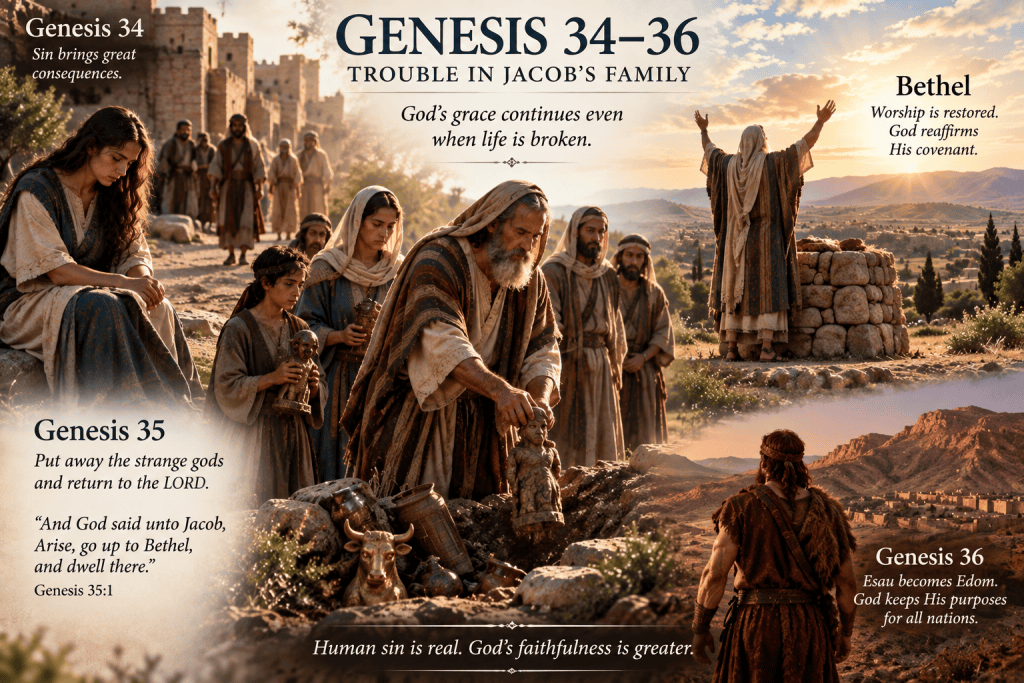
Key Scriptures: Genesis 34:1–31; Genesis 35:1–29; Genesis 36:1–43; Galatians 6:7; Hebrews 12:14–17
“And God said unto Jacob, Arise, go up to Bethel, and dwell there.” — Genesis 35:1
Genesis 32–33 ended on a hopeful note.
Jacob had wrestled with God.
God had given him the new name Israel.
Then Jacob met Esau, and the brothers were peacefully reconciled.
It would be wonderful if everything went smoothly from that point forward.
But it did not.
Genesis 34–36 reminds us that one spiritual experience does not instantly eliminate every problem.
Jacob had changed.
However, his family still carried unhealthy patterns.
Moreover, Jacob himself still had areas where he needed to grow.
Genesis 34 is especially dark.
Chapter 35 brings Jacob back to Bethel.
Genesis 36 turns our attention toward Esau and his descendants.
Through all three chapters, one truth remains:
Human beings may fail, but God remains faithful to His covenant purposes.
Jacob Settled Near Shechem
At the end of Genesis 33, Jacob purchased land near Shechem.
There he built an altar.
However, God had earlier promised to bring Jacob back to the land of his fathers, and Bethel held special significance in his journey.
Instead, Jacob remained near Shechem.
Genesis does not explicitly say that settling there was sinful.
Therefore, we should be careful not to say more than Scripture says.
Nevertheless, the next events brought terrible trouble into Jacob’s family.
Dinah Went Out
Genesis 34 begins with Dinah, the daughter of Leah:
“And Dinah the daughter of Leah, which she bare unto Jacob, went out to see the daughters of the land.” — Genesis 34:1
Then Shechem, the son of Hamor, saw her.
What followed was an act of sexual violation.
Scripture reports the evil without approving or excusing it.
Dinah was wronged.
The responsibility for that violation belonged to Shechem.
That distinction is important.
We should never shift responsibility for another person’s sinful actions onto the victim.
Shechem Wanted to Marry Dinah
Afterward, Shechem wanted Dinah as his wife.
He spoke tenderly to her and asked his father to arrange the marriage.
Hamor therefore approached Jacob.
However, affection after wrongdoing does not erase the wrongdoing.
Sin cannot be made right simply by saying:
“But I love this person.”
Love does not excuse exploitation.
Genuine love respects another person’s dignity.
Jacob Heard What Happened
Genesis 34:5 says:
“And Jacob heard that he had defiled Dinah his daughter.”
Yet Jacob remained silent until his sons returned from the fields.
Scripture does not explain everything Jacob was thinking:
- Perhaps he was shocked.
- Perhaps he was afraid.
- Perhaps he was waiting for his sons.
Therefore, we should not invent motives.
What is clear, however, is that Jacob’s sons became furious when they heard what had happened.
The Brothers Were Angry
Genesis says:
“The men were grieved, and they were very wroth.”
Their anger at what happened to Dinah was understandable.
A terrible wrong had occurred.
However, righteous anger can become sinful when it turns into uncontrolled revenge.
Paul later wrote:
“Be ye angry, and sin not.” — Ephesians 4:26
Anger can alert us that something is wrong.
But anger is a dangerous master.
Hamor Proposed an Alliance
Hamor suggested that Jacob’s family intermarry with the people of Shechem.
He offered them opportunities to live, trade, and acquire property in the region.
Shechem himself offered to pay whatever bride price Jacob’s family required.
However, Jacob’s sons had already decided upon deception.
The family that had suffered from deception was about to use deception again.
Sinful Patterns Were Still Repeating
Jacob had deceived Isaac.
Laban had deceived Jacob.
Rachel had deceived Laban concerning the household idols.
Now Jacob’s sons deceived the men of Shechem.
This is one of the sobering lessons of Genesis.
Sinful patterns can pass through families:
- Children watch.
- Children learn.
- Children sometimes repeat what they have seen.
Therefore, parents should remember:
We teach not only by what we say but also by how we live.
The Brothers Used Circumcision as Part of Their Plan
Jacob’s sons told Hamor and Shechem that their families could only intermarry if the males of the city were circumcised.
Circumcision was the sign God had given Abraham concerning the covenant.
Yet Simeon and Levi used that sacred sign as part of a deceptive plan for revenge.
That made their actions particularly disturbing.
They took something associated with God’s covenant and used it to conceal violent intentions.
Never use spiritual things to hide sinful motives.
Simeon and Levi Attacked the City
While the men of Shechem were physically weakened from circumcision, Simeon and Levi entered the city and killed the males, including Hamor and Shechem.
They recovered Dinah.
Then Jacob’s other sons plundered the city.
What began as anger over a genuine injustice became sweeping revenge against an entire community.
Scripture does not present this as righteous justice.
Later, Jacob himself strongly condemned Simeon and Levi’s violence.
Justice and Revenge Are Not the Same
This distinction matters.
What happened to Dinah was evil.
It deserved justice.
However, Simeon and Levi moved beyond justice into vengeance.
Romans 12:19 says:
“Vengeance is mine; I will repay, saith the Lord.”
Justice seeks what is right.
Revenge seeks personal retaliation.
Justice operates under moral restraint.
Revenge easily expands until innocent or less-culpable people suffer as well.
Therefore, we must not allow someone else’s sin to become an excuse for our own.
Jacob Was Afraid of the Consequences
Jacob confronted Simeon and Levi.
He said:
“Ye have troubled me to make me to stink among the inhabitants of the land.” — Genesis 34:30
Jacob feared that the surrounding peoples might unite against his family and destroy them.
His concern was understandable.
However, his first recorded response focuses heavily upon the danger created for him and his household.
Simeon and Levi replied:
“Should he deal with our sister as with an harlot?”
Their question highlighted the genuine evil committed against Dinah.
But their grievance still did not justify their excessive revenge.
Genesis 34 Has No Heroes
One striking feature of Genesis 34 is the absence of a clear human hero.
Shechem commits a terrible wrong.
Hamor attempts to negotiate an alliance.
Jacob appears passive and then fearful.
His sons deceive.
Simeon and Levi murder.
The other brothers plunder.
Dinah is the one who suffers amid the actions of powerful men around her.
Genesis does not sanitize the family from which Israel came.
The Bible tells the truth about its people.
The Bible Does Not Hide Human Sin
If human beings had invented Scripture merely to glorify their ancestors, Genesis would probably read very differently.
Instead, Scripture records failure openly.
Abraham failed.
Isaac failed.
Jacob failed.
Jacob’s sons failed.
Why?
Because the Bible’s ultimate hero is not Abraham, Isaac, Jacob, or Joseph.
The ultimate story is about God’s faithfulness and redemption.
God Told Jacob to Return to Bethel
Genesis 35 opens with a dramatic change:
“And God said unto Jacob, Arise, go up to Bethel, and dwell there.”
Bethel:
- The place where Jacob first encountered God.
- The place where he saw the ladder.
The place where God promised:
“I am with thee.”
Years had passed.
Jacob had traveled far.
His family was troubled.
Now God called him back.
“Go up to Bethel.”
Sometimes We Need to Return to Bethel
There are times in the Christian life when we need to return spiritually to where we began.
Not necessarily to a physical location.
Rather, we need to return to:
Prayer.
Scripture.
Worship.
Obedience.
Simple trust.
Our first love for Christ.
Life becomes complicated.
Responsibilities multiply.
Disappointments accumulate.
Sin creeps in.
Then God reminds us:
Come back.
Jacob Finally Took Spiritual Leadership
Jacob told his household:
“Put away the strange gods that are among you, and be clean, and change your garments.” — Genesis 35:2
This is a significant moment.
Household idols had apparently remained among Jacob’s company.
Rachel had previously stolen Laban’s household gods.
Moreover, other members of the household may have acquired pagan objects along the way.
Now Jacob took decisive action.
If his family was returning to Bethel, the idols could not come with them.
“Put Away the Strange Gods”
This command still speaks powerfully.
We may not keep small carved household gods.
However, idols still exist.
An idol is anything that takes the place in our hearts that belongs to God:
- Money can become an idol.
- Success can become an idol.
- Politics can become an idol.
- Family can become an idol.
- Comfort can become an idol.
- Entertainment can become an idol.
- Even ministry can become an idol if serving God becomes more important to us than knowing God.
Sometimes revival begins by identifying what needs to be removed.
Jacob Buried the Idols
The household gave Jacob their foreign gods and earrings associated with them.
Jacob buried them under an oak near Shechem.
That action was decisive.
He did not put the idols into storage.
Jacob did not carry them “just in case.”
He buried them.
There are sins we should not manage.
We should forsake them.
Repentance Requires Action
Repentance is more than feeling bad.
It involves turning.
Jacob said:
Put them away.
Then he actually removed them.
Likewise, if something repeatedly pulls us toward sin, repentance may require practical action.
Delete it.
Leave it.
End it.
Throw it away.
Change the habit.
Establish the boundary.
Seek accountability.
True repentance changes direction.
God Protected Jacob’s Family
As Jacob’s family traveled:
“The terror of God was upon the cities that were round about them.” — Genesis 35:5
The surrounding peoples did not pursue them.
Remember Jacob’s fear at the end of Genesis 34.
He worried that the inhabitants of the land would attack.
Yet God protected him.
Once again, Jacob discovered that his security ultimately came from God.
Jacob Returned to Bethel
Jacob arrived at Bethel and built an altar.
He called the place El-beth-el, meaning “God of the house of God.”
Years earlier, Jacob had been impressed by the place.
Now his focus had matured toward the God who met him there.
That is spiritual growth.
Our faith should not merely center upon experiences.
It should center upon God Himself.
God Appeared to Jacob Again
Genesis 35:9 says:
“And God appeared unto Jacob again.”
Then God repeated his new name:
“Thy name is Jacob: thy name shall not be called any more Jacob, but Israel shall be thy name.”
Jacob had already received the name Israel at Peniel.
Now God confirmed it.
Sometimes we need God to remind us who He has called us to be:
- Old habits may remain.
- Old failures may haunt us.
- Old names may cling to us.
But God’s grace points us forward.
God Reaffirmed the Covenant
God said:
“I am God Almighty.”
Then He repeated the promises of fruitfulness, nations, kings, and land.
The covenant given to Abraham and Isaac was now reaffirmed to Jacob.
Think about the timing.
Genesis 34 had just shown us terrible family failure.
Yet Genesis 35 reminds us that God’s covenant purpose had not collapsed.
Human sin had consequences.
But human sin could not defeat God’s redemptive plan.
Grace Is Greater Than Family Failure
This does not make sin unimportant.
Genesis 34 proves that sin causes terrible damage.
Nevertheless, Genesis 35 proves something else:
God’s grace is greater than human failure.
God can redeem broken families.
He can transform sinful patterns.
God can create a new future without pretending the past never happened.
Deborah Died
Genesis 35 also records the death of Deborah, Rebekah’s nurse.
She was buried beneath an oak.
The place was called Allon-bachuth, meaning “oak of weeping.”
This small detail reminds us that Jacob’s return home included grief.
The journey of faith contains both altars and graves:
- We worship.
- We grieve.
- We trust.
- We keep walking.
Rachel Gave Birth to Benjamin
As Jacob’s family continued toward Ephrath, Rachel went into difficult labor.
She gave birth to another son.
However, Rachel died during childbirth.
Before dying, she named the boy Ben-oni, meaning “son of my sorrow.”
Jacob renamed him:
Benjamin, commonly understood as “son of the right hand.”
Joy and sorrow stood side by side.
A son was born, but a wife died.
Life often contains both at the same time.
Faith Does Not Remove Grief
Jacob loved Rachel deeply.
He had worked fourteen years to marry her.
Now he buried her on the road to Bethlehem.
The man who had gained a large family also experienced painful loss.
Faith does not mean we never grieve.
Jesus Himself wept at Lazarus’s tomb.
Christians grieve.
However, we do not grieve without hope.
Rachel Was Buried Near Bethlehem
Jacob set a pillar upon Rachel’s grave.
Her burial place was near Bethlehem.
Centuries later, Bethlehem would become the birthplace of David.
Most importantly, Bethlehem would become the birthplace of Jesus Christ.
Once again, Genesis quietly points us toward the larger biblical story.
Reuben Sinned Against His Father
Genesis 35 then records another painful family failure.
Reuben, Jacob’s firstborn, had an immoral relationship with Bilhah, his father’s concubine.
The text reports the event briefly.
Jacob heard about it.
Later, in Genesis 49, Reuben’s action would have serious consequences for his position within the family.
Once again:
Sin has consequences.
The Twelve Sons of Jacob
Genesis 35 then lists Jacob’s twelve sons.
These men would become the patriarchs associated with the nation of Israel.
Look at the family behind those names.
Jealousy.
Competition.
Deception.
Violence.
Immorality.
Grief.
Yet God was building a nation.
That should not make us comfortable with sin.
It should make us amazed at grace.
Jacob Returned to Isaac
Eventually, Jacob returned to his father Isaac at Mamre.
This completes a long circle.
Jacob had fled home because of Esau’s anger.
Now he returned.
Jacobhad left as Jacob the deceiver.
He returned as Israel.
Jacob had left with little.
He returned with a large family and great possessions.
Most importantly, he returned knowing God in a deeper way.
Isaac Died
Genesis 35:28 says Isaac lived 180 years.
Then:
“Isaac gave up the ghost, and died, and was gathered unto his people.”
Notice who buried him:
“And his sons Esau and Jacob buried him.”
The brothers who once fought over Isaac’s blessing now stood together at their father’s grave.
Time had changed much.
God’s grace had done much.
Genesis 36 Turns to Esau
Genesis 36 records the generations of Esau.
At first glance, a long genealogy may seem disconnected from the dramatic stories surrounding it.
However, genealogies matter in Genesis.
They show us that God keeps track of families, nations, and promises.
Esau became the father of Edom.
God Blessed Esau Too
Esau did not receive the covenant line that continued through Jacob.
Nevertheless, God gave Esau descendants, possessions, chiefs, and territory.
Genesis 36:7 explains that Jacob and Esau had so many possessions that the land could not support them together.
Esau therefore settled in Mount Seir.
God’s covenant purpose centered upon Jacob.
However, God’s common blessings extended beyond Jacob.
Esau Became Edom
Genesis repeatedly says:
“Esau is Edom.”
This becomes extremely important later in Scripture.
The descendants of Esau became the Edomites.
Israel and Edom would have a complicated relationship for generations.
Therefore, Genesis 36 prepares us for later biblical history.
Kings Came from Esau
Genesis 36:31 says:
“These are the kings that reigned in the land of Edom, before there reigned any king over the children of Israel.”
Esau’s descendants developed into an organized people with rulers before Israel had kings.
From a purely human perspective, Edom might have appeared to be progressing faster.
But God’s timetable for Israel was different.
Never confuse faster development with greater divine favor.
God works according to His own purposes and timing.
God’s Promise Was Still Moving Forward
At the beginning of these chapters, Jacob’s family looked deeply troubled.
By the end:
Jacob returned to Bethel.
The idols were buried.
And the covenant reaffirmed.
Benjamin was born.
The twelve sons were named.
Jacob returned to Isaac.
Esau’s family became established.
The story moved forward.
God had not lost control.
What Genesis 34–36 Means for Us
1. The Bible Takes Sexual Wrongdoing Seriously
Dinah was wronged.
Scripture does not excuse the person who harmed her.
Therefore, we should treat people with dignity and never blame victims for another person’s sinful actions.
2. Anger at Evil Does Not Justify Revenge
Simeon and Levi had a legitimate reason to be angry.
However, their retaliation became sinful.
We must seek justice without becoming unjust ourselves.
3. Sinful Family Patterns Can Repeat
Deception appeared repeatedly in Jacob’s family.
Therefore, we should identify unhealthy patterns and ask God to help us break them.
4. Sacred Things Must Never Be Used for Sinful Purposes
Simeon and Levi misused circumcision as part of their deception.
Never use religion to conceal selfish or sinful motives.
5. Sometimes We Need to Return to Bethel
God called Jacob back to the place where he first encountered Him.
When spiritual life becomes cluttered, return to prayer, Scripture, worship, and obedience.
6. Idols Must Be Removed
Jacob told his household:
“Put away the strange gods.”
We cannot wholeheartedly worship God while knowingly protecting idols in our hearts.
7. Repentance Requires More Than Words
Jacob buried the idols.
True repentance takes practical action.
8. God Protects His People
Jacob feared retaliation.
Nevertheless, God protected his family as they traveled.
9. God’s Grace Is Greater Than Human Failure
Genesis 34 shows terrible failure.
Chapter 35 shows God reaffirming His covenant.
Sin is serious, but grace is powerful.
10. Faith Does Not Prevent Grief
Jacob lost Deborah, Rachel, and eventually Isaac.
Walking with God does not exempt us from sorrow.
However, God remains with us through sorrow.
11. Sin Has Consequences
Reuben’s actions would affect his future.
Grace forgives, but choices can still leave consequences.
12. God Works Across Generations
Genesis 36 shows Esau becoming Edom.
God was shaping not merely individuals but nations and history.
Returning to Bethel
Perhaps the central spiritual message of these chapters is found in God’s command:
“Arise, go up to Bethel.”
Jacob’s family was in trouble.
Violence occurred.
Idols remained in the household.
Fear surrounded them.
God’s answer began with a return to worship.
There are moments when we complicate spiritual renewal.
We look for something new:
- A new technique.
- A new program.
- A new experience.
Sometimes God’s message is simpler:
Go back to Bethel:
- Return to the Word.
- Return to prayer.
- Return to obedience.
- Return to worship.
- Return to the God who met you before.
What Needs to Be Buried?
Before Jacob went to Bethel, something had to happen.
The idols had to go.
That raises a personal question:
What needs to be buried before you go forward with God?
- Perhaps it is bitterness.
- Perhaps a secret habit.
- Perhaps an unhealthy relationship.
- Perhaps pride.
- Perhaps greed.
- Perhaps something that consumes your attention and affection.
We cannot carry idols to the altar and expect genuine revival.
Jacob buried them.
Then he went to Bethel.
The God of Bethel Was Still There
Many years had passed since Jacob first slept at Bethel with a stone for a pillow.
Jacob had changed.
His circumstances had changed.
Jacob now had wives, children, servants, and possessions.
He had known joy and disappointment.
Jacob had been deceived.
He wrestled with God.
Jacob reconciled with Esau.
He experienced family tragedy.
Yet when Jacob returned to Bethel:
God was still there.
He had not changed.
God Works with Broken Families
Jacob’s family was far from perfect.
That may be one of the most encouraging truths in Genesis.
God’s redemptive plan did not move through a flawless family.
It moved through a family filled with real human weakness.
Therefore, if your family has problems, do not conclude that God cannot work:
- Perhaps there is estrangement.
- Perhaps there are regrets.
- Perhaps adult children have made painful decisions.
- Perhaps old wounds remain.
- Perhaps relationships are complicated.
Do what is right before God.
Seek reconciliation where possible.
Establish wise boundaries where necessary.
Pray.
Forgive.
Tell the truth.
And trust God with what you cannot control.
Jesus Came Through This Family
Ultimately, the story becomes even more remarkable.
Through Jacob came Judah.
Then came David.
And through that family line came Jesus Christ.
Matthew’s genealogy does not present a spotless human family.
It presents the story of God’s grace working through generations of imperfect people.
Jesus came not because humanity had finally become good enough.
He came because humanity needed a Savior.
Christ Breaks the Cycle of Sin
Family patterns can be powerful.
But they are not sovereign.
Christ is.
In Christ, the cycle can change:
- A family known for anger can produce a peacemaker.
- A family marked by addiction can produce someone who walks in freedom.
- A family shaped by dishonesty can produce someone committed to truth.
- A family filled with spiritual indifference can produce someone devoted to Christ.
Your past influences you.
It does not have to control you.
God’s grace can begin something new.
From Shechem Back to Bethel
Genesis 34 begins in darkness.
Chapter 35 points Jacob back toward worship.
That movement is important:
- From sin to repentance.
- From idols to worship.
- From fear to trust.
- From Shechem back to Bethel.
Perhaps that is exactly the journey someone needs today.
You cannot change yesterday.
Jacob could not undo what happened at Shechem.
But he could obey God today.
So can you.
God’s command was:
“Arise, go up to Bethel.”
Get up.
Turn toward God.
Put away the idols.
Return to worship.
And keep walking.
WIM Takeaway
Genesis 34–36 shows both the destructive power of sin and the restoring grace of God. Jacob’s family experienced violation, revenge, deception, idolatry, immorality, grief, and death. Yet God called Jacob back to Bethel, where the idols were removed, worship was restored, and the covenant promise was reaffirmed. Therefore, our failures do not have to determine our future. We must turn from sin, remove our idols, return to God, and trust His grace to work even through broken families.
Questions for Reflection
- What does Genesis 34 teach us about the difference between justice and revenge?
- How did deception continue as a pattern in Jacob’s family?
- Why was the misuse of circumcision by Simeon and Levi especially serious?
- What did God mean when He told Jacob to return to Bethel?
- Are there times when Christians need to “return to Bethel” spiritually?
- What modern things can become idols in our lives?
- Why did Jacob bury the household idols rather than continue carrying them?
- What does this teach us about genuine repentance?
- How did God protect Jacob despite his fear after the events at Shechem?
- What does Rachel’s death teach us about faith and grief?
- How does Genesis 36 demonstrate God’s faithfulness to Esau as well as Jacob?
- Are there unhealthy patterns in your family that, by God’s grace, need to stop with you?
- What might you need to “bury” in order to move forward spiritually?
- Where do you need to hear God’s invitation today: “Arise, go up to Bethel”?
<<Back to the Book of Genesis
Dr. Alan Holden has served in pastoral ministry for more than 35 years, preaching and teaching the Bible in churches across the United States. He holds a Doctor of Ministry from Luther Rice Seminary and a Master of Divinity from The Southern Baptist Theological Seminary. Through What’s It Mean?, he seeks to help readers understand the meaning of Scripture and grow in their walk with Christ. He is currently the pastor of Lake Saunders Baptist Church in Tavares, FL.