






Genesis 32–33 — Wrestling with God: Jacob Becomes Israel
Key Scriptures: Genesis 32:1–32; Genesis 33:1–20; Hosea 12:3–5; Philippians 4:6–7; Romans 12:18
“And he said, Thy name shall be called no more Jacob, but Israel.” — Genesis 32:28
Genesis 32–33 brings Jacob face-to-face with the two things he fears most.
First, he must face Esau, the brother he deceived.
More importantly, he must face God.
For years, Jacob had survived by planning, negotiating, maneuvering, and outthinking other people.
However, on the night before meeting Esau, none of that was enough.
Jacob needed more than a strategy.
He needed God.
And before the night ended, Jacob would receive a new name.
Jacob Was Going Home
God had told Jacob:
“Return unto the land of thy fathers.” — Genesis 31:3
Therefore, Jacob obeyed.
He left Laban.
And Jacob crossed the boundary.
Then he continued toward Canaan.
However, one major problem remained.
Esau was there.
Jacob had not seen his brother for about twenty years.
The last time Jacob saw Esau, Esau wanted to kill him.
Now Jacob had wives.
Children.
Servants.
Flocks.
Possessions.
He had much more to lose.
The Angels of God Met Jacob
Genesis 32 begins:
“And Jacob went on his way, and the angels of God met him.”
That is remarkable.
At Bethel, Jacob had seen angels in a dream.
Now, as he approached Canaan, angels met him again.
Jacob called the place Mahanaim, meaning “two camps” or “two hosts.”
Perhaps Jacob saw his own camp and the camp of God.
Whatever the precise picture, the message is clear:
Jacob was not traveling alone.
God was still with him.
God Often Encourages Us Before the Trial
Before Jacob heard the frightening report about Esau, God gave him encouragement.
That is important.
Sometimes God reminds us of His presence just before we enter a difficult season.
The problem may still come.
The fear may still come.
However, God gives enough grace for what lies ahead.
Therefore, when God gives encouragement, receive it.
You may need it sooner than you realize.
Jacob Sent Messengers to Esau
Jacob knew he could not avoid his brother forever.
Therefore, he sent messengers ahead.
He instructed them to tell Esau that Jacob had been living with Laban and now possessed significant wealth.
Jacob also referred to Esau as:
“My lord Esau.”
And to himself as:
“Thy servant Jacob.”
Jacob’s tone was humble.
The brother who once grasped for superiority now approached Esau with caution and respect.
Esau Was Coming with Four Hundred Men
The messengers returned with troubling news:
“We came to thy brother Esau, and also he cometh to meet thee, and four hundred men with him.” — Genesis 32:6
Jacob immediately assumed the worst.
Four hundred men sounded like an army.
Genesis says:
“Then Jacob was greatly afraid and distressed.”
Jacob’s old fear returned.
He had obeyed God.
Jacob was going where God told him to go.
Nevertheless, he was afraid.
That reminds us:
Faith does not mean we never feel fear.
Faith means we bring our fear to God.
Jacob Divided the Camp
Jacob immediately created a plan.
He divided his people and livestock into two groups.
His reasoning was simple:
If Esau attacked one group, perhaps the other could escape.
This was classic Jacob.
Plan.
Prepare.
Reduce the risk.
There is nothing necessarily wrong with wise planning.
However, something important happened next.
Jacob prayed.
Jacob Finally Prayed
Genesis records one of Jacob’s most sincere prayers.
He said:
“O God of my father Abraham, and God of my father Isaac.”
Then he reminded God:
“The LORD which saidst unto me, Return unto thy country, and to thy kindred, and I will deal well with thee.”
Jacob prayed God’s promise back to Him.
That is an excellent model for prayer.
When we are afraid, we can remind ourselves of what God has already said.
Not because God forgets.
But because we do.
Jacob Confessed His Unworthiness
Then Jacob said:
“I am not worthy of the least of all the mercies, and of all the truth, which thou hast shewed unto thy servant.” — Genesis 32:10
This does not sound like the self-confident Jacob of earlier chapters.
He remembered how little he had when he first crossed the Jordan.
Jacob said:
“With my staff I passed over this Jordan; and now I am become two bands.”
Jacob recognized that everything he possessed came from God’s mercy.
That is spiritual growth.
Remember Where God Brought You From
Jacob looked back.
Once, he crossed the Jordan alone with only a staff.
Now he had a large family and abundant possessions.
Fear made him look ahead.
Gratitude made him look back.
Sometimes when the future frightens us, we need to remember the past.
Ask:
- How has God already provided?
- How has God already protected?
- How has God already carried me?
Past faithfulness strengthens present trust.
Jacob Asked God to Deliver Him
Jacob prayed plainly:
“Deliver me, I pray thee, from the hand of my brother, from the hand of Esau.”
He did not hide his fear.
Jacob said:
“For I fear him.”
That is honest prayer.
God does not require us to pretend.
We can say:
- “Lord, I am afraid.”
- “Lord, I don’t know what will happen.”
- “Lord, I need help.”
Faith is not pretending the danger is unreal.
Instead, faith is trusting God in the middle of real danger.
Jacob Reminded God of His Promise
Then Jacob said:
“And thou saidst, I will surely do thee good.”
Again, Jacob returned to God’s word.
This is one of the healthiest things we can do in anxious moments.
The mind says:
“What if everything goes wrong?”
Faith responds:
“What has God said?”
Feelings change.
Circumstances change.
God’s Word remains.
Prayer and Planning
After praying, Jacob continued making preparations.
He selected a large gift for Esau.
Goats.
Sheep.
Camels.
Cattle.
Donkeys.
He divided them into groups and sent them ahead with servants.
Each group was to tell Esau:
“They be thy servant Jacob’s; it is a present sent unto my lord Esau.”
Jacob hoped the gifts would soften Esau’s anger.
Again, Jacob prayed and planned.
The Bible does not teach us to choose between prayer and wise action.
We pray.
Then we act wisely.
However, we do not place our ultimate confidence in the plan.
Jacob Sent Everyone Across the River
That night, Jacob moved his wives, children, servants, and possessions across the brook Jabbok.
Then Scripture says:
“And Jacob was left alone.” — Genesis 32:24
That sentence is important.
For the first time in the chapter, Jacob had no crowd around him:
- No servants.
- No family.
- No livestock.
- No strategy to work on.
He was alone.
And that was where God dealt with him.
Sometimes God Gets Us Alone
Noise can distract us.
Busyness can hide things.
People can keep us from confronting our own hearts.
Sometimes God allows us to reach a place where distractions fall away.
Then we are left with Him.
That can be uncomfortable.
But it can also be transformative.
Jacob had spent his life wrestling with people.
Now he would wrestle with God.
A Man Wrestled with Jacob
Genesis says:
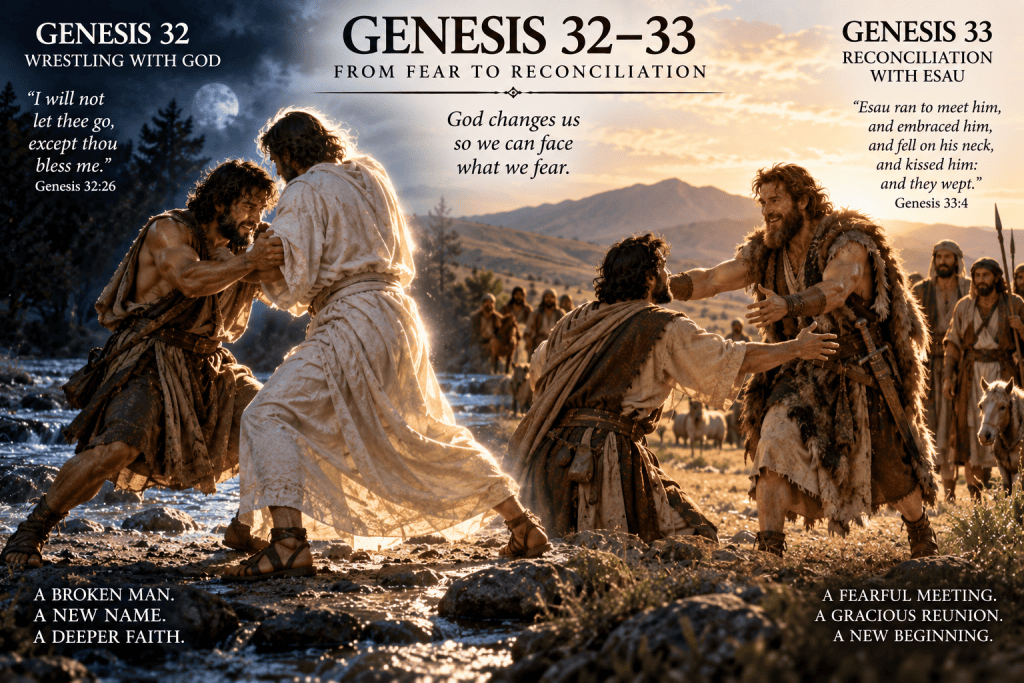
“And there wrestled a man with him until the breaking of the day.” — Genesis 32:24
The identity of this mysterious man becomes clearer as the story develops.
Jacob later said:
“I have seen God face to face.”
Hosea 12 also connects this event with God and the angel.
Many Christians understand this as a special appearance of God, possibly a pre-incarnate appearance of Christ.
However we describe the manifestation, the main point is clear:
He had an encounter with God.</strong>
Jacob Could Not Win</h2>
He had always found a way to gain advantage:
<ul>
- He outmaneuvered Esau.
- He deceived Isaac.
- He survived Laban.
Now he wrestled through the night.
But Jacob could not overpower God.
Then, with a simple touch, the man put Jacob’s hip out of joint.
Suddenly, the wrestler became the clinger.
That may be the most important moment in the story.
Jacob’s Strength Had to Be Broken
Jacob had spent much of his life relying on his own ability.
However, one touch from God showed him how limited he really was.
Sometimes God allows confidence in ourselves to be weakened so our confidence in Him can grow.
That is not always pleasant.
But dependence upon God is better than confidence in self.
Jacob entered the night strong.
He left limping.
Yet he also left blessed.
“I Will Not Let Thee Go”
The man said:
“Let me go, for the day breaketh.”
Jacob replied:
“I will not let thee go, except thou bless me.” — Genesis 32:26
Jacob had spent his life trying to obtain blessing through schemes.
Now he finally understood where blessing truly comes from:
- Not from stealing.
- Not from manipulating.
- Not from outsmarting others.
From God.
Jacob stopped trying to seize the blessing.
He clung to the One who gives it.
“What Is Thy Name?”
The man asked Jacob:
“What is thy name?”
Of course, God knew his name.
The question was for Jacob.
Years earlier, Isaac had asked:
“Who art thou, my son?”
Jacob lied:
“I am Esau.”
Now Jacob was asked again:
“What is thy name?”
This time he told the truth.
“Jacob.”
In effect:
- “I am Jacob.”
- “The heel-grabber.”
- “The schemer.”
- “The deceiver.”
Before transformation often comes honest confession.
God Gave Jacob a New Name
Then came the turning point:
“Thy name shall be called no more Jacob, but Israel.” — Genesis 32:28
The name Israel is connected with striving with God.
The exact nuance has been discussed, but Genesis explains:
“For as a prince hast thou power with God and with men, and hast prevailed.”
Jacob entered the night carrying his old identity.
He left with a new name.
God was changing him.
A New Name Signaled a New Direction
Abram became Abraham.
Sarai became Sarah.
Now Jacob became Israel.
In Scripture, a new name often marks a major change in calling or identity.
Jacob would still make mistakes.
His transformation was not complete.
However, his life had reached a decisive turning point.
The man known for grasping was learning to depend upon God.
Peniel
Jacob named the place Peniel, saying:
“For I have seen God face to face, and my life is preserved.” — Genesis 32:30
Jacob understood the encounter as an act of grace.
He had met God and lived.
The encounter did not leave him proud.
It left him humbled.
Jacob Walked with a Limp
Genesis 32:31 says:
“And he halted upon his thigh.”
Jacob walked away limping.
The limp became a permanent reminder of the night he met God.
Sometimes God’s deepest blessings leave marks.
We may carry reminders of hardship:
- A scar.
- A weakness.
- A loss.
- A changed plan.
However, what once looked like weakness may become a testimony of grace.
Jacob’s limp said:
“I met God, and I am not the same man.”
The Sun Rose
Genesis gives a beautiful detail:
“And as he passed over Penuel the sun rose upon him.”
Jacob entered the night afraid.
He came out with a limp.
But the sun rose.
A new day had begun.
And Jacob was about to discover that the thing he feared most had already been prepared differently than he expected.
Esau Came Near
Genesis 33 begins with Jacob seeing Esau approach.
Four hundred men were with him.
Jacob arranged his family.
Once again, we see traces of his favoritism.
He placed the servants and their children first.
Leah and her children next.
Rachel and Joseph last.
Jacob was changing, but old patterns had not disappeared completely.
Transformation is often a process.
Jacob Went Ahead of His Family
However, Jacob did something significant.
Previously, he had placed others between himself and danger.
Now:
“He passed over before them.” — Genesis 33:3
Jacob went first.
That is growth.
The man who had been hiding behind plans now stepped in front of his family.
Then he bowed to the ground seven times as he approached Esau.
Esau Ran to Meet Jacob
Jacob expected hostility.
Instead:
“Esau ran to meet him, and embraced him, and fell on his neck, and kissed him: and they wept.” — Genesis 33:4
What a scene:
- Twenty years of fear.
- Twenty years of unfinished history.
- Twenty years of uncertainty.
Then Esau ran toward Jacob.
Not to kill him.
To embrace him.
The confrontation Jacob feared became a reunion.
We Often Suffer Twice
Jacob had spent enormous emotional energy imagining what Esau might do.
However, the actual meeting was very different.
This does not mean every fear is imaginary.
Some dangers are real.
Nevertheless, anxiety often makes us suffer twice:
Once in our imagination.
Then again if the difficulty actually comes.
Jesus said:
“Sufficient unto the day is the evil thereof.” — Matthew 6:34
We are wise to prepare.
But we should not live tomorrow’s troubles today.
God Had Worked in Esau Too
The text does not explain everything that changed in Esau’s heart.
However, something clearly had.
The man who once wanted to kill Jacob now embraced him.
While God had been working on Jacob for twenty years, God had also allowed twenty years to pass in Esau’s life.
Sometimes we assume God is working only on us.
He may also be working in the people we fear.
Esau Asked About Jacob’s Family
Esau saw the women and children and asked:
“Who are those with thee?”
Jacob answered:
“The children which God hath graciously given thy servant.” — Genesis 33:5
Notice Jacob’s language.
He recognized his children as gifts of grace.
The old Jacob was increasingly becoming a man who saw God’s hand in his life.
Esau Did Not Need the Gift
Esau then asked about the large groups of animals Jacob had sent.
Jacob explained:
“These are to find grace in the sight of my lord.”
Esau replied:
“I have enough, my brother; keep that thou hast unto thyself.” — Genesis 33:9
That statement is significant.
Jacob had feared Esau might take everything.
Instead, Esau said:
“I have enough.”
The danger Jacob imagined did not exist in the way he expected.
Jacob Insisted
Jacob urged Esau to accept the gift.
Eventually, Esau did.
Jacob said:
“God hath dealt graciously with me, and because I have enough.”
Both brothers could say:
“I have enough.”
That is a beautiful change from their earlier competition:
- In Genesis 25, they struggled over the birthright.
- In Genesis 27, they struggled over the blessing.
- Now, in Genesis 33, both men had enough.
Contentment makes reconciliation easier.
Contentment Ends Many Rivalries
Much conflict grows from the belief:
“There is not enough.”
- Not enough recognition.
- Not enough money.
- Not enough attention.
- Not enough opportunity.
Therefore, we compete.
We compare.
Then we grasp.
However, when we trust God’s provision, we can say:
“I have enough.”
That does not mean we have everything we want.
It means we recognize God’s gracious care.
“I Have Seen Thy Face”
Jacob said to Esau:
“I have seen thy face, as though I had seen the face of God, and thou wast pleased with me.” — Genesis 33:10
Jacob had just come from Peniel, where he said he had seen God face to face.
Now reconciliation with Esau felt like another act of divine grace.
The brother he feared received him kindly.
Jacob saw God’s kindness reflected in that welcome.
Reconciliation Is Powerful
There are few things more beautiful than restored relationships.
Not every relationship can or should return to its former closeness.
Sometimes boundaries remain necessary.
However, when genuine reconciliation is possible, it reflects something of God’s grace.
The Gospel itself is a message of reconciliation.
Paul wrote:
“God was in Christ, reconciling the world unto himself.” — 2 Corinthians 5:19
Esau Offered to Travel with Jacob
Esau offered to accompany Jacob.
Jacob declined, explaining that the children and livestock needed to move slowly.
Esau then offered some of his men.
Jacob declined again.
The brothers parted peacefully.
Esau returned to Seir.
Jacob continued toward Canaan.
Jacob Came to Shechem
Eventually, Jacob arrived near Shechem.
There he purchased land and built an altar.
He called the altar:
“El-elohe-Israel.” — Genesis 33:20
The name means:
God, the God of Israel.
This is significant.
Earlier, Jacob spoke of:
- “The God of Abraham.”
- “The God of Isaac.”
Now Jacob builds an altar to:
The God of Israel.
The God of his fathers had become his God.
Jacob’s Faith Was Becoming Personal
At Bethel, Jacob was beginning to know God.
Bit at Peniel, that relationship deepened.
Now he worshiped God under his new name.
Every believer must eventually reach this point.
Christianity cannot remain merely:
- “My parents’ faith.”
- “My grandparents’ church.”
- “My pastor’s belief.”
Faith must become personal.
We must know God for ourselves through Jesus Christ.
What Genesis 32–33 Means for Us
1. Obedience Does Not Eliminate Fear
Jacob obeyed God and returned home.
Nevertheless, he was afraid.
Therefore, fear does not necessarily mean we are outside God’s will.
2. Bring Fear to God in Prayer
Jacob prayed honestly:
“I fear him.”
We should bring our anxieties to God instead of pretending they do not exist.
3. Pray God’s Promises
Jacob repeatedly reminded God of His Word.
Likewise, Scripture gives our prayers confidence and direction.
4. Remember Past Faithfulness
Jacob remembered crossing the Jordan with only a staff.
Looking back helped him recognize God’s mercy.
5. Planning Is Good, but Trust Must Rest in God
Jacob planned carefully.
However, his ultimate security came from God.
6. God Sometimes Gets Us Alone to Change Us
Jacob’s decisive encounter came when:
“Jacob was left alone.”
Quiet places often expose the heart.
7. Self-Reliance Must Give Way to Dependence
Jacob could not defeat God.
His hip was touched.
Then he clung.
True strength begins when we recognize our dependence upon God.
8. Honest Confession Opens the Door to Change
When asked his name, Jacob finally said:
“Jacob.”
He faced who he had been.
Then God gave him a new name.
9. Blessing May Come Through Brokenness
Jacob left Peniel limping.
However, he also left blessed.
Sometimes God uses weakness to teach us dependence.
10. The Thing We Fear May Not Happen the Way We Expect
Jacob expected Esau’s hostility.
Instead, Esau embraced him.
Therefore, do not assume your worst fear is your certain future.
11. God Can Work in Other People While He Is Working in Us
Twenty years had changed Jacob.
They had also changed Esau.
God works on both sides of situations we cannot control.
12. Contentment Makes Peace Possible
Both brothers could say:
“I have enough.”
Gratitude loosens the grip of rivalry.
Wrestling with God
What does it mean that Jacob wrestled with God?
It does not mean Jacob defeated God.
God demonstrated His power with a touch.
Rather, Jacob’s “prevailing” came through refusing to let go until he received God’s blessing.
Hosea 12:4 says:
“He wept, and made supplication unto him.”
Therefore, Jacob’s victory was not the victory of superior strength.
It was the victory of desperate faith.
Jacob stopped relying on cleverness.
He clung to God.
That is a much better way to live.
Sometimes Our Greatest Battle Is with Ourselves
Jacob thought his great problem was Esau.
However, before God allowed Jacob to face Esau, God dealt with Jacob.
The greatest problem was not merely:
“What will Esau do?”
It was:
“Who is Jacob becoming?”
We often ask God to change someone else.
But God may begin by changing us:
- “Lord, change my spouse.”
- “Lord, change my children.”
- “Lord, change my boss.”
- “Lord, change this church.”
- “Lord, change this situation.”
Sometimes God’s answer begins:
“Let Me change you.”
The Limp Was a Gift
Jacob probably did not enjoy walking with a damaged hip.
Nevertheless, the limp became a constant reminder.
Every step said:
“You are not self-sufficient.”
Every step said:
“God is stronger than you.”
Every step said:
“Your blessing comes from Him.”
Weakness can become holy when it drives us toward dependence upon God.
Paul later heard Christ say:
“My grace is sufficient for thee: for my strength is made perfect in weakness.” — 2 Corinthians 12:9
Jacob and the Gospel
Jacob’s story ultimately points us toward the larger story of grace.
Jacob was a flawed man:
- A deceiver.
- A schemer.
- A frightened fugitive.
Yet God pursued him.
God promised to be with him:
- God protected him.
- God corrected him.
- God humbled him.
- God renamed him.
- And God used him.
From Jacob—Israel—would come the twelve clans.
Through Judah would eventually come Jesus Christ.
God’s redemptive plan moved forward through a man transformed by grace.
We Also Need a New Identity
The New Testament describes salvation in similar terms.
Those who trust Christ receive a new identity.
Paul wrote:
“If any man be in Christ, he is a new creature.” — 2 Corinthians 5:17
We may carry old memories.
Old scars and consequences.
However, in Christ, the past does not have the final word.
God’s grace creates something new.
Jacob walked away from Peniel with both a limp and a new name.
Likewise, grace does not pretend our past never happened.
It transforms what our past means.
Facing the Esau in Front of You
Everyone eventually has an “Esau.”
Something unresolved:
- A conversation we dread.
- A person we need to face.
- A mistake we need to acknowledge.
- A responsibility we cannot avoid forever.
Jacob could run from Esau for twenty years.
But eventually, he had to go home.
Avoidance rarely produces peace.
Sometimes faith means taking the next right step even while afraid.
Pray.
Prepare.
Tell the truth.
Walk humbly.
Seek peace.
Then trust God with the outcome.
Romans 12:18 says:
“If it be possible, as much as lieth in you, live peaceably with all men.”
God Was Already There
Jacob feared what would happen when he reached Esau.
But God had gone ahead.
The reconciliation Jacob could not guarantee had already become possible.
That is providence.
God works in places we cannot see.
He works in conversations before they happen.
The Lord works in hearts we cannot reach.
He works in circumstances we cannot control.
Therefore, our responsibility is not to control everything.
Our responsibility is to trust and obey.
From Jacob to Israel
Genesis 32–33 tells the story of a man becoming different.
Not instantly perfect.
But different.
Jacob entered the night afraid.
He left humbled.
Jacob entered wrestling.
He left clinging.
Jacob entered with an old name.
He left with a new one.
Jacob entered trying to control outcomes.
He left more dependent upon God.
And then he faced Esau.
That order matters.
First Peniel. Then Esau.
First, God dealt with Jacob.
Then Jacob was ready to face his brother.
Sometimes the best preparation for dealing with another person is allowing God to deal with us first.
WIM Takeaway
Genesis 32–33 teaches us that God’s deepest blessings often come when self-reliance gives way to dependence. Jacob feared meeting Esau, but before he faced his brother, he encountered God at Peniel. There God humbled him, blessed him, and gave him a new name—Israel. Then the confrontation Jacob feared became a peaceful reunion. Therefore, when we face fear, unresolved relationships, or uncertain circumstances, we should pray honestly, trust God’s promises, seek peace, and cling to Him.
Questions for Reflection
- Why was Jacob afraid to meet Esau?
- How did God encourage Jacob before he heard the report about Esau?
- What can we learn from Jacob’s prayer in Genesis 32?
- Why is it important that Jacob admitted, “I fear him”?
- How did remembering God’s past faithfulness strengthen Jacob?
- Why did God ask Jacob his name?
- What did Jacob’s new name, Israel, represent?
- What did Jacob’s limp teach him about dependence?
- How had Jacob changed when he went ahead of his family to meet Esau?
- What does Esau’s response teach us about fearing future events?
- How does contentment help reduce rivalry and conflict?
- Is there an “Esau” in your life—a situation you know you need to face?
- Is there an area where God may need to change you before changing your circumstances?
- What would it look like for you to stop striving and simply cling to God?
<<Back to the Book of Genesis
Dr. Alan Holden has served in pastoral ministry for more than 35 years, preaching and teaching the Bible in churches across the United States. He holds a Doctor of Ministry from Luther Rice Seminary and a Master of Divinity from The Southern Baptist Theological Seminary. Through What’s It Mean?, he seeks to help readers understand the meaning of Scripture and grow in their walk with Christ. He is currently the pastor of Lake Saunders Baptist Church in Tavares, FL.