







Genesis 37 — Joseph and His Brothers: From Dreams to the Pit
Key Scriptures: Genesis 37:1–36; Acts 7:9–10; Psalm 105:17–19; Romans 8:28
“And when his brethren saw that their father loved him more than all his brethren, they hated him.” — Genesis 37:4
Genesis 37 begins one of the most powerful stories in the Old Testament.
Joseph is young.
His brothers are jealous.
Jacob shows favoritism.
Joseph has dreams.
His brothers hate him.
Then, in a shocking turn, they sell him into slavery.
From a human perspective, the chapter ends badly.
Joseph is gone.
Jacob believes his son is dead.
The brothers carry a terrible secret.
Yet the story is not over.
In fact, God is just beginning to reveal how He can take what people mean for evil and use it for good.
Joseph Was Seventeen Years Old
Genesis 37 introduces Joseph:
“Joseph, being seventeen years old, was feeding the flock with his brethren.”
Joseph was still a young man.
He worked alongside some of his brothers.
Then Scripture tells us:
“And Joseph brought unto his father their evil report.”
The text does not tell us every detail of what his brothers had done.
However, Joseph told Jacob about their behavior.
That probably did not improve their relationship.
Jacob Loved Joseph More
Then Genesis tells us:
“Now Israel loved Joseph more than all his children.” — Genesis 37:3
Why?
Because:
“He was the son of his old age.”
Joseph was also the first son of Rachel, the wife Jacob deeply loved.
Therefore, Jacob gave Joseph:
“A coat of many colours.”
The precise appearance of this garment is debated.
However, clearly it was distinctive and marked Joseph as special.
The problem was that he openly favored Joseph above the others.
Favoritism Had Already Hurt Jacob’s Family
This should sound familiar.
Isaac favored Esau.
Rebekah favored Jacob.
Jacob had grown up in a divided household.
Now he repeated the same pattern with his own children.
That is sobering.
People often repeat what wounded them.
Therefore, unexamined family patterns can continue from one generation to another.
Jacob knew what favoritism felt like.
Yet he practiced it anyway.
Joseph’s Brothers Hated Him
Genesis says:
“They hated him, and could not speak peaceably unto him.”
Their resentment was already deep.
Then Joseph had a dream.
The dream made things worse.
Joseph’s First Dream
Joseph told his brothers that they were binding sheaves in the field.
Then:
“My sheaf arose, and also stood upright; and, behold, your sheaves stood round about, and made obeisance to my sheaf.” — Genesis 37:7
His brothers understood immediately.
They asked:
“Shalt thou indeed reign over us?”
Therefore:
“They hated him yet the more for his dreams, and for his words.”
Joseph’s dream suggested that one day his brothers would bow before him.
That did not sit well with them.
Joseph’s Second Dream
Joseph then had another dream.
This time:
“The sun and the moon and the eleven stars made obeisance to me.” — Genesis 37:9
Joseph told the dream to his father and brothers.
Jacob rebuked him.
He asked:
“Shall I and thy mother and thy brethren indeed come to bow down ourselves to thee to the earth?”
Yet Genesis adds:
“His father observed the saying.”
Jacob did not fully understand the dream.
However, he remembered it.
Were Joseph’s Dreams From God?
The later story makes clear that Joseph’s dreams pointed toward what God would eventually accomplish.
His brothers would indeed bow before him in Egypt.
Therefore, these dreams were not merely youthful imagination.
God was revealing something about Joseph’s future.
However, Joseph did not yet understand how painful the road to fulfillment would be.
That is often true.
God may show us a direction without showing us every difficulty along the way.
Promise Does Not Mean Immediate Fulfillment
Joseph saw the destination:
- He did not see the pit.
- He did not see slavery.
- He did not see false accusation.
- He did not see prison.
- He did not see years of waiting.
The dream was real.
But the path was difficult.
Therefore, we should never assume that God’s promise means an easy journey.
Sometimes there is a long road between what God says and what God does.
Jealousy Is Dangerous
Genesis 37:11 says:
“And his brethren envied him.”
Jealousy is more than disappointment.
It resents another person’s blessing.
It says:
- “Why him?”
- “Why her?”
- “Why not me?”
Jealousy turns another person’s success into our pain.
Then resentment begins to grow.
James later warns that envy produces disorder and evil.
Therefore, jealousy must be confronted early.
If we feed it, it can become hatred.
The Brothers Went to Shechem
Joseph’s brothers took the flocks toward Shechem.
Later, Jacob became concerned and sent Joseph to check on them.
Joseph responded:
“Here am I.”
He willingly went.
However, when he arrived at Shechem, his brothers were no longer there.
A man found Joseph wandering in the field and told him they had gone toward Dothan.
So Joseph continued looking for them.
Joseph Went Looking for His Brothers
This detail is important.
Joseph traveled a considerable distance to find them.
Whatever tension existed in the family, Joseph obeyed his father and searched for his brothers.
However, they did not welcome him.
Genesis 37:18 says:
“And when they saw him afar off, even before he came near unto them, they conspired against him to slay him.”
Their envy had grown into murderous hatred.
“Behold, This Dreamer Cometh”
The brothers mocked Joseph:
“Behold, this dreamer cometh.”
Then they said:
“Come now therefore, and let us slay him.”
They planned to kill Joseph, throw his body into a pit, and tell their father that a wild animal had devoured him.
Then they said:
“And we shall see what will become of his dreams.”
That sentence carries terrible irony.
The brothers believed they could destroy Joseph’s dream.
Instead, their actions would help move Joseph toward its fulfillment.
People Cannot Defeat God’s Purpose
Joseph’s brothers opposed him.
They hated the dream and tried to stop the future they feared.
But they could not stop God.
That does not excuse their sin.
Their actions were wrong.
However, human rebellion cannot overturn God’s sovereign purpose.
Psalm 33:11 says:
“The counsel of the LORD standeth for ever.”
What God purposes will ultimately stand.
Reuben Tried to Save Joseph
Reuben heard the plan and intervened.
He said:
“Let us not kill him.”
Instead, he suggested putting Joseph into a pit without shedding his blood.
Genesis explains that Reuben intended to rescue Joseph later and return him to Jacob.
Reuben was far from perfect.
However, in this moment, he prevented immediate murder.
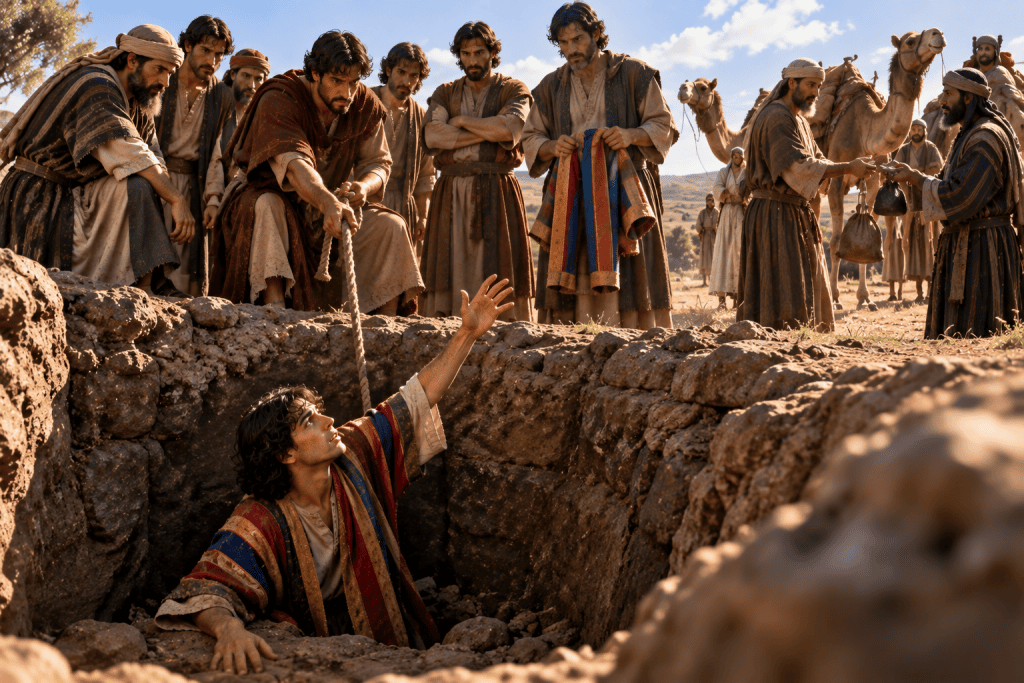
They Stripped Joseph’s Coat
When Joseph arrived, the brothers seized him.
Then:
“They stript Joseph out of his coat, his coat of many colours that was on him.”
The coat represented Jacob’s favoritism.
It had become a visible symbol of everything the brothers resented.
Now they tore it away.
However, removing the coat could not remove God’s plan.
People can strip away outward status.
They cannot strip away God’s purpose.
Joseph Was Thrown Into the Pit
Genesis says:
“And they took him, and cast him into a pit: and the pit was empty, there was no water in it.”
Joseph had gone from favored son to prisoner in a pit.
The dreams must have seemed very far away.
He had done what his father asked.
Yet now he was trapped.
This reminds us that obedience does not always produce immediate comfort.
Sometimes faithful people enter difficult places.
The Brothers Sat Down to Eat
One of the coldest details in the chapter comes next:
“And they sat down to eat bread.”
Joseph was in the pit.
His brothers were eating.
Later, Genesis 42 reveals that Joseph had pleaded with them.
They had seen:
“The anguish of his soul.”
Yet they refused to listen.
Resentment had hardened their hearts.
That is what hatred does.
It makes cruelty seem normal.
Hatred Dehumanizes
The brothers stopped seeing Joseph as their brother.
They saw him as a problem:
- “The dreamer.”
- “The favorite.”
- “The one standing in our way.”
Whenever we reduce people to labels, resentment becomes easier.
Therefore, Jesus teaches us to love even our enemies.
Why?
Because every person bears God’s image.
Hatred wants us to forget that.
Judah Suggested Selling Joseph
While the brothers ate, a caravan approached.
The traders were traveling toward Egypt.
Judah said:
“What profit is it if we slay our brother, and conceal his blood?” — Genesis 37:26
Then he proposed:
“Let us sell him to the Ishmeelites.”
At first glance, this sounded less violent than murder.
However, selling their brother into slavery was still terrible.
They agreed.
Joseph Was Sold
The brothers pulled Joseph out of the pit.
Then:
“They sold Joseph to the Ishmeelites for twenty pieces of silver.” — Genesis 37:28
Joseph became merchandise.
The favored son became a slave.
He was taken away toward Egypt.
From Joseph’s perspective, everything must have looked lost.
Yet Egypt was exactly where God would eventually use him.
The Pit Was on the Road to the Palace
Joseph did not know it.
His brothers did not know it.
Jacob certainly did not know it.
But the road to Egypt was part of God’s providence.
The pit did not cancel the dream.
It became part of the road toward it.
That does not make the brothers’ sin good.
It means God is powerful enough to work even through evil actions without approving them.
Reuben Returned
Apparently, Reuben was absent when Joseph was sold.
When he returned to the pit and discovered Joseph was gone:
“He rent his clothes.”
Then he cried:
“The child is not; and I, whither shall I go?”
Reuben had intended to rescue Joseph.
Now he feared what would happen.
However, the brothers had already gone too far to tell the truth.
So they created another deception.
One Sin Led to Another
They killed a goat.
Then they dipped Joseph’s coat in its blood.
Afterward, they sent the coat to Jacob and asked whether he recognized it.
This was cruel.
Jacob had once used a goat and clothing to deceive Isaac.
Now his sons used a goat and clothing to deceive him.
Again, the cycle of deception returned.
Sin has a way of repeating itself until someone decides to walk in truth.
Jacob Recognized the Coat
Jacob immediately recognized Joseph’s garment.
He concluded:
“An evil beast hath devoured him; Joseph is without doubt rent in pieces.” — Genesis 37:33
The brothers did not need to say:
“Joseph is dead.”
They allowed Jacob to reach that conclusion himself.
Deception often works by letting someone believe a lie without openly stating every part of it.
However, misleading someone intentionally is still dishonest.
Jacob Grieved Deeply
Jacob tore his clothes.
He put on sackcloth.
Then:
“He mourned for his son many days.”
His sons and daughters tried to comfort him.
But Jacob refused.
He said:
“For I will go down into the grave unto my son mourning.” — Genesis 37:35
Jacob’s grief was real.
He believed Joseph was dead.
Yet Joseph was alive.
This is one of the great ironies of the chapter.
Jacob mourned as though everything was lost.
Meanwhile, God was still working.
We Do Not Always Know the Whole Story
Jacob saw the bloody coat.
From that evidence, he reached what seemed like the obvious conclusion.
Joseph was dead.
However, Jacob was wrong.
The evidence he had was incomplete.
Sometimes our circumstances also seem to tell us:
“It’s over.”
“There is no hope.”
“God has forgotten.”
But we do not know everything God knows.
Therefore, we must be careful not to make permanent conclusions from temporary circumstances.
Joseph Arrived in Egypt
The final verse says:
“And the Midianites sold him into Egypt unto Potiphar, an officer of Pharaoh’s, and captain of the guard.”
Genesis 37 ends with Joseph in Egypt.
That looks like a tragedy.
Yet the reader already senses that something larger is happening.
God is positioning Joseph.
The place of suffering will become the place of preparation.
God Was Working Behind the Scenes
The most striking thing about Genesis 37 is that God is not directly quoted.
There is no dramatic appearance:
- No voice from heaven.
- No miracle.
- No angel.
Yet God is everywhere in the story.
He is working through circumstances.
Joseph’s dreams.
Jacob’s decision to send him.
The man who gave directions.
The empty pit.
Reuben’s intervention.
The passing caravan.
The destination of Egypt.
Nothing looked miraculous.
Yet providence was at work.
Providence Is Often Quiet
We sometimes expect God to work dramatically.
Sometimes He does.
However, often His providence is quiet:
- A conversation.
- A delay.
- A meeting.
- A closed door.
- A change of plans.
- A person who arrives at just the right time.
Only later do we see how the pieces fit together.
Joseph could not see it yet.
But God was arranging his future.
Joseph and Jesus
Christians have long noticed parallels between Joseph and Jesus.
Joseph was the beloved son of his father.
He was rejected by his brothers.
Joseph was stripped of his garment.
He was sold for silver.
Joseph suffered though he had not committed the wrong that brought the suffering upon him.
Later, God would use Joseph’s suffering to save many lives.
We should be careful not to force every detail into a symbolic interpretation.
However, Joseph’s story certainly prepares us to understand a great biblical pattern:
God can bring salvation through the suffering of a rejected servant.
That pattern reaches its ultimate fulfillment in Jesus Christ.
Jesus Was Rejected Too
John 1:11 says:
“He came unto his own, and his own received him not.”
Jesus was rejected.
Betrayed.
Sold for silver.
Condemned.
Crucified.
Yet what looked like defeat became the means of salvation.
Peter said:
“Him, being delivered by the determinate counsel and foreknowledge of God, ye have taken… and slain.” — Acts 2:23
Human beings acted wickedly.
God accomplished redemption.
The cross is the greatest example of the truth Joseph’s story begins to teach.
What Genesis 37 Means for Us
1. Favoritism Creates Deep Wounds
Jacob openly preferred Joseph.
The result was resentment among the brothers.
Therefore, families should guard against favoritism.
2. Jealousy Must Be Confronted Early
The brothers’ envy became hatred.
Hatred became conspiracy.
Sin grows when it is fed.
3. God’s Promises May Take Time
Joseph had dreams of future leadership.
However, fulfillment did not come immediately.
Faith must learn to wait.
4. The Road to God’s Purpose May Include Pain
Joseph went from the field to the pit and then toward slavery.
The difficult road was not evidence that God had forgotten him.
5. People Cannot Cancel God’s Purpose
The brothers said:
“We shall see what will become of his dreams.”
Eventually, they did.
God’s purpose stood.
6. Hatred Makes Cruelty Easier
Joseph’s brothers could eat while he suffered.
Therefore, we must guard our hearts against dehumanizing those we resent.
7. One Sin Often Leads to Another
Jealousy led to hatred.
Hatred led to violence.
Violence led to slavery.
Then came deception.
Sin rarely stays small.
8. Family Patterns Can Repeat
Jacob once deceived Isaac with clothing and a goat.
Now Jacob’s sons deceived him with clothing and a goat.
Unhealthy patterns must be confronted.
9. Circumstances Do Not Tell the Whole Story
Jacob believed Joseph was dead.
He was wrong.
Therefore, do not assume you know the final outcome simply because the present looks dark.
10. God Works Even When We Cannot See Him
Genesis 37 contains no dramatic miracle.
Yet God’s providence is everywhere.
When You Find Yourself in a Pit
Joseph never planned to enter that pit.
He did not choose it.
Joseph did not deserve his brothers’ hatred.
Nevertheless, the pit became part of his journey.
Perhaps you have experienced your own kind of pit:
- A betrayal.
- A job loss.
- A family conflict.
- A financial crisis.
- A disappointment.
- A diagnosis.
- A season where everything changed suddenly.
The pit can make us ask:
“Where is God?”
Joseph’s story eventually answers:
God is still there.
The pit is not necessarily the end.
Don’t Judge the Story Too Early
If we stopped reading at Genesis 37, Joseph’s life would look tragic:
- He had lost his home.
- His family.
- His status.
- His freedom.
But Genesis 37 is not the end of Joseph’s story.
That is an important lesson.
Do not judge God’s work by one chapter.
You may be living in a chapter that does not make sense yet.
The story is still being written.
God Can Use What Others Meant for Evil
Later, Joseph will tell his brothers:
“But as for you, ye thought evil against me; but God meant it unto good.” — Genesis 50:20
Notice Joseph did not say:
“What you did was good.”
He said:
You meant evil.
But:
God meant it for good.
That distinction matters.
God does not need to call evil good in order to overcome it.
He is sovereign enough to bring good even out of what others intended for harm.
The Coat Was Gone, but the Calling Remained
Joseph lost the coat his father gave him.
He lost his position in the family.
Joseph lost his freedom.
But he did not lose God’s purpose.
That is encouraging.
People can take possessions.
Positions can change.
Reputation can suffer.
Plans can collapse.
But no human being can remove what God ultimately intends to accomplish.
The Brothers Thought They Had Won
They sold Joseph, removed him from the family, and they deceived their father.
From their perspective, the problem was solved.
The dreamer was gone.
But God had not finished.
Years later, those same brothers would stand before Joseph in Egypt.
And they would bow.
Exactly as the dream had shown.
God’s Word does not fail.
The Silent God Was Still Working
Genesis 37 does not record God speaking directly.
That makes this chapter especially meaningful.
There are seasons when God seems silent.
Prayer feels unanswered.
No miracle appears.
Worse, no clear explanation comes.
Yet silence is not absence.
God can be working when we cannot hear Him.
He can be moving pieces we do not see.
Joseph did not know where the caravan was taking him.
God did.
From the Pit to God’s Purpose
Joseph’s story begins with dreams.
Then comes the pit.
After that comes slavery.
Later comes prison.
Finally comes the palace.
If Joseph could have seen only the destination, he might have misunderstood the journey.
So might we.
Sometimes the road God uses is not the road we would choose.
However, faith keeps trusting when the road makes little sense.
WIM Takeaway
Genesis 37 teaches us that jealousy, favoritism, hatred, and deception can cause terrible damage, but human sin cannot defeat God’s sovereign purpose. Joseph’s brothers stripped away his coat, threw him into a pit, and sold him into slavery, yet God was quietly moving Joseph toward Egypt, where He would eventually use him to save many lives. Therefore, when circumstances seem dark, do not judge the story too early. God may be working in ways you cannot yet see.
Questions for Reflection
- How did Jacob’s favoritism contribute to the brothers’ resentment?
- Why is jealousy spiritually dangerous?
- What did Joseph’s dreams reveal about his future?
- Why is there sometimes a long delay between God’s promise and its fulfillment?
- What does the brothers’ statement, “We shall see what will become of his dreams,” teach us about God’s sovereignty?
- How did hatred change the way Joseph’s brothers treated him?
- How did one sin lead to another in this chapter?
- What family pattern of deception repeated itself in Jacob’s household?
- Why was Jacob’s conclusion about Joseph understandable but wrong?
- Have you ever interpreted a difficult situation before knowing the whole story?
- How do we see God’s providence even though God does not speak directly in Genesis 37?
- What “pit” in your life might God still be able to use for a larger purpose?
- How does Joseph’s rejection prepare us to think about Jesus Christ?
- Where do you need to remember today that one painful chapter is not the end of the story?
<<Back to the Book of Genesis
Dr. Alan Holden has served in pastoral ministry for more than 35 years, preaching and teaching the Bible in churches across the United States. He holds a Doctor of Ministry from Luther Rice Seminary and a Master of Divinity from The Southern Baptist Theological Seminary. Through What’s It Mean?, he seeks to help readers understand the meaning of Scripture and grow in their walk with Christ. He is currently the pastor of Lake Saunders Baptist Church in Tavares, FL.