






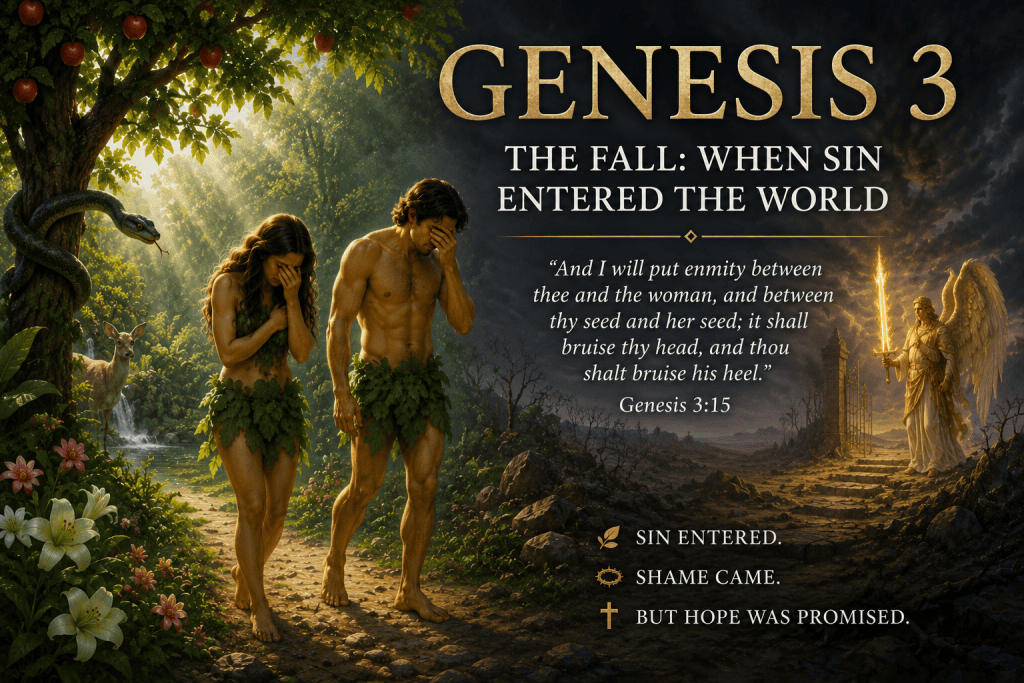
Genesis 3 — The Fall: When Sin Entered the World
Key Scriptures: Genesis 3:1–24; Romans 5:12–19; 1 Corinthians 15:21–22; 2 Corinthians 11:3; Revelation 12:9
“And when the woman saw that the tree was good for food, and that it was pleasant to the eyes… she took of the fruit thereof, and did eat, and gave also unto her husband with her; and he did eat.” — Genesis 3:6
Genesis 1 ends with God looking upon everything He created and declaring it “very good.”
Chapter 2 ends with Adam and Eve living together in the Garden of Eden without guilt, fear, suffering, or shame.
Then we come to Genesis 3.
Everything changes.
Sin enters the human experience. Shame replaces innocence. Fear replaces fellowship. Blame replaces unity. Pain enters human relationships. The ground comes under a curse. Death becomes humanity’s enemy.
Yet Genesis 3 is not only the story of humanity’s fall.
It is also the beginning of God’s revealed plan of redemption.
Before Adam and Eve leave the garden, God gives them a promise.
A Deliverer will come.
The Serpent Enters the Garden
Genesis 3 begins:
“Now the serpent was more subtil than any beast of the field which the LORD God had made.” — Genesis 3:1
Revelation 12:9 identifies the serpent with Satan, “which deceiveth the whole world.”
Notice how Satan begins his attack.
He does not immediately tell Eve, “Reject God.”
Instead, he asks:
“Yea, hath God said…?”
The first recorded temptation begins by questioning God’s Word.
Did God really say that?
Did God really mean that?
Can you really trust what God has said?
Satan still uses the same strategy.
Whenever he can persuade us to question God’s Word, he has taken the first step toward persuading us to disobey God’s Word.
Satan Distorted God’s Command
God had given Adam tremendous freedom.
Genesis 2:16 says:
“Of every tree of the garden thou mayest freely eat.”
There was only one prohibition.
They were not to eat from the tree of the knowledge of good and evil.
But Satan focused Eve’s attention upon the one thing God had withheld.
That is how temptation often works.
Instead of reminding us of everything God has provided, temptation concentrates our attention upon something we do not have.
Suddenly God’s generosity begins to look like deprivation.
God’s protection begins to look like restriction.
And God’s command begins to look unreasonable.
Temptation whispers:
“God is keeping something good from you.”
“Ye Shall Not Surely Die”
After questioning God’s Word, Satan directly contradicted it.
God had warned:
“Thou shalt surely die.” — Genesis 2:17
The serpent responded:
“Ye shall not surely die.” — Genesis 3:4
There we see the battle clearly.
God said one thing. Satan said another.
Eve had to decide whom she would believe.
So do we.
Every temptation eventually brings us to the same decision.
Will I trust what God says, or will I trust another voice?
Satan then suggested that disobedience would improve Adam and Eve’s lives:
“Ye shall be as gods, knowing good and evil.” — Genesis 3:5
The temptation was not merely about eating fruit.
It was about independence from God.
Human beings wanted the right to determine good and evil for themselves.
That desire remains at the heart of sin.
Sin says:
“I will decide what is right for me.”
Faith says:
“God has the right to determine what is right because He is my Creator.”
Eve Saw, Took, and Ate
Genesis 3:6 describes the progression:
“The woman saw that the tree was good for food, and that it was pleasant to the eyes… she took of the fruit thereof, and did eat.”
Notice the movement.
She saw, desired, took, and ate.
Then:
“gave also unto her husband with her; and he did eat.”
Adam was not an innocent bystander.
He knowingly joined Eve in disobedience.
Romans 5 places particular responsibility upon Adam as humanity’s representative:
“By one man sin entered into the world, and death by sin.” — Romans 5:12
One act of rebellion changed human history.
Their Eyes Were Opened
Satan had promised that their eyes would be opened.
In one sense, he told the truth.
Genesis 3:7 says:
“And the eyes of them both were opened.”
But what did they discover?
Not freedom, nor fulfillment, nor happiness.
Shame.
They suddenly recognized their nakedness and attempted to cover themselves with fig leaves.
Sin had promised something wonderful but delivered something terrible.
That is still sin’s pattern.
Sin advertises pleasure but hides the price.
It shows us the bait but conceals the hook.
Sin promises freedom but produces bondage.
Adam and Eve gained knowledge of evil—but they learned about evil by becoming participants in it.
They Hid from God
Then Adam and Eve heard God walking in the garden.
Previously, God’s presence would have brought joy.
Now it produced fear.
“Adam and his wife hid themselves from the presence of the LORD God.” — Genesis 3:8
Sin changes our relationship with God.
The people God created for fellowship with Him were now hiding from Him.
We still do the same thing.
When we sin, our natural instinct is often to hide.
We hide what we have done and make excuses. Then we avoid people who might confront us.
Sometimes we even withdraw from prayer, Scripture, and worship.
But hiding does not solve our problem.
We cannot hide from God.
“Where Art Thou?”
God called to Adam:
“Where art thou?” — Genesis 3:9
God was not asking because He had lost Adam.
He knew exactly where Adam was.
The question gave Adam an opportunity to recognize his condition and come forward.
There is something gracious in God’s question.
Adam sinned.
He hid.
God came looking for him.
That pattern will run throughout the Bible.
Sinful humanity runs from God.
God seeks sinful humanity.
Ultimately, Jesus would say:
“For the Son of man is come to seek and to save that which was lost.” — Luke 19:10
The God who called, “Where art thou?” in Eden is the God who came to seek the lost in Jesus Christ.
The Blame Game Begins
Adam admitted that he was afraid because he was naked.
God asked whether he had eaten from the forbidden tree.
Adam responded:
“The woman whom thou gavest to be with me, she gave me of the tree, and I did eat.” — Genesis 3:12
Adam blamed Eve.
But notice something else.
He also indirectly blamed God.
“The woman whom thou gavest…”
In other words:
“God, if You had not given me this woman, this would not have happened.”
Then God questioned Eve.
She replied:
“The serpent beguiled me, and I did eat.” — Genesis 3:13
Eve blamed the serpent.
Sin entered the world, and almost immediately people began shifting responsibility.
We have become very good at doing the same thing.
We blame:
- our upbringing.
- our circumstances.
- another person.
- society.
Sometimes we even blame God.
Other people may influence us, hurt us, or tempt us. But eventually we must take responsibility for our own choices.
Spiritual healing begins when we stop saying, “Look what they did,” and become willing to say, “Lord, I have sinned.”
Sin Brought Consequences
God then pronounced judgment.
The serpent was cursed.
The woman would experience increased pain in childbirth and difficulty within human relationships.
The man’s work would become painful and frustrating.
God told Adam:
“Cursed is the ground for thy sake; in sorrow shalt thou eat of it all the days of thy life.” — Genesis 3:17
The earth would now produce thorns and thistles.
Work itself was not the curse. Adam worked before the Fall.
The curse made work difficult.
Then came the most sobering consequence:
“For dust thou art, and unto dust shalt thou return.” — Genesis 3:19
Death entered the human experience.
Romans 6:23 summarizes the principle:
“For the wages of sin is death.”
Genesis 3 explains why the world of Genesis 1 no longer looks entirely “very good.”
Something happened.
Sin happened.
The First Promise of the Gospel
In the middle of God’s judgment appears an extraordinary promise.
God says to the serpent:
“And I will put enmity between thee and the woman, and between thy seed and her seed; it shall bruise thy head, and thou shalt bruise his heel.” — Genesis 3:15
Christians have often called this verse the Protoevangelium—the first announcement of the Gospel.
A descendant of the woman would come.
The serpent would wound Him.
But He would crush the serpent.
The rest of Scripture unfolds that promise.
The promised Seed ultimately leads us to Jesus Christ.
At the cross, Satan struck Christ’s heel.
Jesus:
- suffered.
- bled.
- died.
But through His death and resurrection, Christ defeated sin, death, and the powers of darkness.
Hebrews 2:14 tells us that through death Christ destroyed “him that had the power of death, that is, the devil.”
The Bible’s first announcement of salvation appears in the very chapter where humanity first needs salvation.
God’s grace appears immediately after humanity’s rebellion.
God Covered Their Shame
Adam and Eve attempted to cover themselves with fig leaves.
But their own covering was inadequate.
Genesis 3:21 says:
“Unto Adam also and to his wife did the LORD God make coats of skins, and clothed them.”
God provided the covering they could not adequately provide for themselves.
An innocent animal’s death appears to have been required to provide those garments.
We should be careful not to force every detail into an elaborate symbolism that Genesis itself does not explicitly state.
Yet the picture fits a truth that becomes increasingly clear throughout Scripture:
Sin brings death, and God Himself must provide the covering sinful humanity needs.
Our own efforts cannot remove our guilt.
Religion cannot remove it.
Good works cannot erase it.
Moral improvement cannot undo our past.
God must provide salvation.
And He did.
Through Jesus Christ.
Driven from Eden
God sent Adam and Eve out of the Garden of Eden.
Cherubim guarded the way to the tree of life.
The couple who once lived in perfect fellowship with God now lived outside Eden.
Sin had brought separation.
But Genesis does not end in chapter 3.
The Bible has only begun.
From this point forward, Scripture tells the story of God’s work to redeem fallen humanity and restore what sin destroyed.
Genesis begins in a garden where humanity loses access to the tree of life.
Revelation ends with God’s redeemed people once again having access to the tree of life.
Genesis begins with paradise lost.
Revelation ends with paradise restored.
And standing at the center of that great story is Jesus Christ.
What Genesis 3 Means for Us
1. Temptation Often Begins by Questioning God’s Word
“Yea, hath God said?”
We should recognize that question.
God’s Word remains our standard even when culture, feelings, circumstances, or popular opinion say something different.
2. Sin Always Costs More Than It Promises
Adam and Eve expected something better.
Instead, they received guilt, shame, fear, conflict, pain, and death.
Sin never shows us the entire bill before we order.
3. Hiding Cannot Fix Sin
Adam and Eve hid among the trees.
We may hide behind excuses.
Neither works.
God already knows.
The proper response to sin is confession and repentance.
4. We Must Accept Responsibility
Adam blamed Eve.
Eve blamed the serpent.
Neither excuse changed what they had done.
Spiritual maturity requires us to acknowledge our own sin honestly before God.
5. God’s Commands Are for Our Good
The serpent portrayed God as withholding something desirable.
But God’s command actually protected Adam and Eve.
God’s boundaries are expressions of His wisdom.
6. God Seeks Sinners
Adam hid.
God came calling.
That truth reaches its fullest expression in Jesus Christ.
We could not climb our way back into Eden, so God came to us.
7. Grace Is Greater Than Sin
Genesis 3 contains terrible news.
But it also contains wonderful news.
Humanity fell.
Yet God promised a Savior.
Sin entered the world.
But redemption was already in the heart and purpose of God.
From the First Adam to the Last Adam
The New Testament draws a remarkable comparison between Adam and Jesus.
Paul writes:
“For as in Adam all die, even so in Christ shall all be made alive.” — 1 Corinthians 15:22
Adam disobeyed in a garden.
Christ obeyed His Father, even when that obedience led Him through Gethsemane to the cross.
Through Adam came condemnation and death.
Through Jesus Christ come justification and life.
Romans 5:19 says:
“For as by one man’s disobedience many were made sinners, so by the obedience of one shall many be made righteous.”
Genesis 3 explains why we need the Gospel.
The world is broken because humanity rebelled against its Creator.
And we cannot repair that brokenness ourselves.
But God did not leave us without hope.
Even among the ruins of Eden, God pointed toward Jesus.
The serpent would not win.
Sin would not win.
Death would not win.
The Seed of the woman would come.
And He would crush the serpent’s head.
WIM Takeaway
Genesis 3 teaches us how sin entered the human experience and brought guilt, shame, suffering, separation, and death. But even in judgment, God demonstrated grace by seeking Adam and Eve, covering their shame, and promising the coming Savior who would ultimately defeat the serpent.
Questions for Reflection
- What can we learn from the serpent’s question, “Yea, hath God said?”
- How does temptation cause us to focus on what God has withheld rather than what He has provided?
- Why do people naturally try to hide or make excuses after they sin?
- Are there areas of your life where you need to stop blaming circumstances or other people and accept responsibility?
- How does Genesis 3:15 point forward to Jesus Christ?
- What does God’s search for Adam teach us about His grace toward sinners?
- How does understanding the Fall help explain the suffering and brokenness we see in the world?
- What hope does Jesus offer that Adam could not?
<<Back to the Book of Genesis
Dr. Alan Holden has served in pastoral ministry for more than 35 years, preaching and teaching the Bible in churches across the United States. He holds a Doctor of Ministry from Luther Rice Seminary and a Master of Divinity from The Southern Baptist Theological Seminary. Through What’s It Mean?, he seeks to help readers understand the meaning of Scripture and grow in their walk with Christ. He is currently the pastor of Lake Saunders Baptist Church in Tavares, FL.