







Genesis 4 — Cain and Abel: Sin at the Door
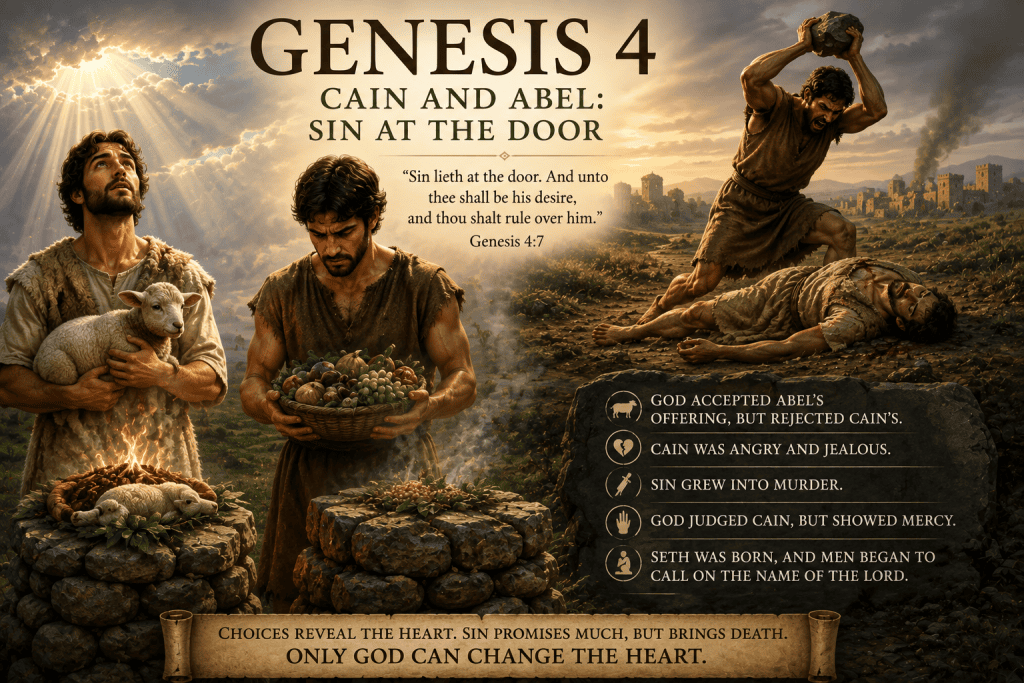
Key Scriptures: Genesis 4:1–26; Hebrews 11:4; 1 John 3:11–12; Jude 11
“And the LORD said unto Cain, Why art thou wroth? and why is thy countenance fallen? … sin lieth at the door. And unto thee shall be his desire, and thou shalt rule over him.” — Genesis 4:6–7
Chapter 3 tells us how sin entered the human experience.
Genesis 4 shows us how quickly it spread.
Adam and Eve disobeyed God by eating the forbidden fruit. Their son Cain murdered his own brother.
Sin moved from disobedience to jealousy, anger, hatred, deception, and murder in a single generation.
Genesis 4 therefore teaches us a sobering truth:
Sin never stays where it begins.
But this chapter also teaches us about worship, faith, personal responsibility, God’s warnings, His judgment, and even His mercy toward sinners.
Above all, Cain’s story warns us to deal with sin before sin takes control of us.
God told Cain:
“Sin lieth at the door.”
That warning still deserves our attention.
Cain and Abel
After leaving the Garden of Eden, Adam and Eve began their family.
Genesis 4:1 tells us:
“And Adam knew Eve his wife; and she conceived, and bare Cain.”
Later, Eve gave birth to Abel.
The two brothers followed different occupations.
“And Abel was a keeper of sheep, but Cain was a tiller of the ground.” — Genesis 4:2
There was nothing wrong with either occupation.
Abel cared for animals.
Cain cultivated the soil.
Both were legitimate forms of work.
The important difference between the brothers would not be found in their occupations.
It would be found in their hearts.
Cain and Abel Brought Offerings
Eventually, both men brought offerings to God.
Cain:
“brought of the fruit of the ground an offering unto the LORD.” — Genesis 4:3
Abel:
“brought of the firstlings of his flock and of the fat thereof.” — Genesis 4:4
Then Scripture tells us:
“And the LORD had respect unto Abel and to his offering: But unto Cain and to his offering he had not respect.”
Why did God accept Abel’s offering but reject Cain’s?
Hebrews helps us understand.
“By faith Abel offered unto God a more excellent sacrifice than Cain.” — Hebrews 11:4
The fundamental difference was faith.
Abel approached God in faith.
Cain did not.
Genesis also describes Abel bringing the “firstlings” and “fat” of his flock, emphasizing the quality of what he offered. Cain is simply described as bringing “of the fruit of the ground.”
The problem was not merely that one offering involved an animal and the other involved produce. Later in Scripture, God would accept grain and other agricultural offerings.
The deeper issue involved the worshiper.
God looked not merely at what Cain and Abel placed before Him.
God looked at their hearts.
Worship Is More Than an Offering
Cain teaches us that religious activity does not automatically please God.
Cain:
- believed in God.
- brought something to God.
- participated in worship.
Yet God rejected his offering.
That should make us think carefully about our own worship.
It is possible:
- to attend church while our heart remains far from God.
- to sing hymns without worshiping.
- to give money without giving ourselves.
- to pray while holding bitterness against another person.
God is not impressed merely because we perform religious activities.
Jesus later said:
“God is a Spirit: and they that worship him must worship him in spirit and in truth.” — John 4:24
True worship begins in the heart.
Cain Became Angry
When God rejected Cain’s offering:
“Cain was very wroth, and his countenance fell.” — Genesis 4:5
Cain had a choice.
He could examine himself and respond to God’s correction.
Or he could become angry.
Cain chose anger.
Notice something important.
Cain was angry with Abel even though Abel had done nothing wrong.
That is often how jealousy works.
Instead of correcting what is wrong within ourselves, we resent the person who reminds us of our failure.
Someone else:
- succeeds, and we become jealous.
- receives recognition, and we become bitter.
Someone’s faithfulness exposes our carelessness, and we begin finding reasons to criticize him.
Abel was not Cain’s problem.
Cain was Cain’s problem.
God Warned Cain
God did not immediately judge Cain.
Instead, He spoke to him.
“Why art thou wroth? and why is thy countenance fallen?” — Genesis 4:6
Again, God did not ask because He lacked information.
He confronted Cain with the condition of his heart.
Then God gave him a warning:
“If thou doest well, shalt thou not be accepted?” — Genesis 4:7
Cain did not have to continue down the path he had chosen.
He could:
- change direction.
- respond to God.
- do what was right.
Then came the warning:
“Sin lieth at the door.”
The picture is striking.
Sin is portrayed almost like a wild animal crouching outside the door, waiting for an opportunity to attack.
God warned Cain that danger was near.
Cain needed to master his sinful desire before that desire mastered him.
Sin at the Door
We should not miss the importance of God’s warning.
Most destructive sins do not suddenly appear out of nowhere.
They grow.
A small resentment becomes bitterness.
Bitterness becomes hatred.
A lustful thought becomes a habit.
A small lie requires another lie to cover it.
Jealousy becomes resentment.
Uncontrolled anger becomes destructive behavior.
God warns us before sin reaches its final destination.
James describes the process:
“Every man is tempted, when he is drawn away of his own lust, and enticed.” — James 1:14
Then:
“when lust hath conceived, it bringeth forth sin: and sin, when it is finished, bringeth forth death.” — James 1:15
Sin grows when we feed it.
That is why we should deal with sin early.
Do not invite it inside.
Sin is dangerous even while it is still lying at the door.
Cain Murdered Abel
Cain ignored God’s warning.
Genesis 4:8 tells us:
“Cain rose up against Abel his brother, and slew him.”
The first recorded death in Scripture was not from old age.
It was murder.
A brother killed his brother.
The sin that entered the world in Genesis 3 was already producing terrible fruit in Genesis 4.
The apostle John later explains Cain’s actions:
“Cain, who was of that wicked one, and slew his brother.” — 1 John 3:12
John then asks:
“And wherefore slew he him?”
The answer:
“Because his own works were evil, and his brother’s righteous.”
Cain’s hatred toward Abel ultimately reflected his rebellion against God.
“Where Is Abel Thy Brother?”
After the murder, God confronted Cain:
“Where is Abel thy brother?” — Genesis 4:9
Cain responded:
“I know not: Am I my brother’s keeper?”
The answer was both a lie and an expression of defiance.
Cain knew exactly where Abel was.
Then God said:
“The voice of thy brother’s blood crieth unto me from the ground.” — Genesis 4:10
Cain may have believed the murder was finished once Abel was dead.
But God saw everything.
No sin escapes God’s notice.
Things may be hidden:
- from family.
- from friends.
- from the church.
- from authorities.
But they are never hidden from God.
Hebrews 4:13 reminds us:
“All things are naked and opened unto the eyes of him with whom we have to do.”
“Am I My Brother’s Keeper?”
Cain’s question echoes throughout history:
“Am I my brother’s keeper?”
In one sense, Scripture answers:
Yes.
We are responsible for how we treat other people.
Jesus taught us to love our neighbor.
Paul told Christians to “bear ye one another’s burdens.”
We cannot live as though the needs and welfare of others have nothing to do with us.
Cain treated his brother as an obstacle.
God calls us to treat others as people made in His image.
We may not be responsible for every decision another person makes, but we are responsible for whether we respond with love, truth, compassion, justice, and mercy.
Cain Faced Judgment
God pronounced judgment upon Cain.
The ground Cain cultivated would no longer yield its strength to him.
Cain would become:
“a fugitive and a vagabond… in the earth.” — Genesis 4:12
Cain responded:
“My punishment is greater than I can bear.” — Genesis 4:13
Notice what Cain did not say.
He did not say:
“My sin is greater than I realized.”
His attention remained primarily on his punishment rather than his offense against God and his brother.
There is a difference between repentance and regret.
Regret says:
“I hate what this sin has cost me.”
Repentance says:
“I hate the sin itself because I have sinned against God.”
We should never confuse sorrow over consequences with genuine repentance.
God Put a Mark on Cain
Even while judging Cain, God demonstrated mercy.
Cain feared someone would kill him.
God responded by placing a mark upon Cain so that others would not take vengeance against him.
Scripture does not tell us what the mark looked like.
Therefore, speculation about its physical nature is unnecessary and often misleading.
Its purpose is what matters.
God protected Cain from private vengeance.
Cain deserved judgment.
Yet God restrained further violence.
Once again, even in a chapter filled with sin and death, we see evidence of God’s mercy.
Cain Went Out from the Presence of the Lord
One of the saddest statements in Genesis 4 appears in verse 16:
“And Cain went out from the presence of the LORD.”
Cain built a city.
His descendants developed livestock farming, music, and metalworking.
Human civilization advanced.
Yet spiritual darkness also increased.
Eventually we meet Lamech.
Lamech boasted about killing a man and celebrated his own violence.
Cain had murdered and attempted to conceal it.
Lamech murdered and bragged about it.
Sin was becoming normalized.
That progression should concern us.
One generation may tolerate sin.
The next may practice it and the next may celebrate it.
When people move farther from God, sin does not disappear.
It grows.
Civilization Cannot Cure the Human Heart
Genesis 4 contains an interesting contrast.
Cain’s descendants made impressive cultural and technological progress.
They:
- built cities.
- raised livestock.
- developed musical instruments.
- worked with bronze and iron.
None of those achievements were wrong.
They were expressions of human creativity.
But technological advancement did not produce moral advancement.
People became more skilled while also becoming more violent.
That lesson remains relevant.
Education cannot cure sin.
Technology cannot cure sin.
Economic prosperity cannot cure sin.
Political systems cannot cure sin.
Human beings can build remarkable civilizations while carrying sinful hearts.
Our deepest problem is not lack of knowledge.
Our deepest problem is sin.
And only God can change the human heart.
God Gave Another Son
Genesis 4 does not end with Cain and Lamech.
Adam and Eve had another son.
“And she bare a son, and called his name Seth.” — Genesis 4:25
Eve recognized Seth as God’s gracious provision following Abel’s death.
Then Genesis tells us:
“Then began men to call upon the name of the LORD.” — Genesis 4:26
That is a beautiful way to end a dark chapter.
There was:
- murder.
- violence.
- rebellion.
But there were still people calling upon the Lord.
God’s purposes had not failed.
The line through which His promise would continue had not disappeared.
Even when sin appears to dominate the story, God remains at work.
Abel’s Faith Still Speaks
Cain silenced Abel’s earthly voice.
But he could not silence Abel’s testimony.
Hebrews 11:4 says:
“He being dead yet speaketh.”
Thousands of years later, Abel’s faith still speaks.
His life reminds us that faithfulness to God matters even when the world does not reward it.
Abel’s earthly life appears to have been brief.
He built no city.
Scripture records no children.
We read of no great earthly achievements.
Yet God remembers him as a man of faith.
That should encourage us.
A meaningful life is not measured merely by length, possessions, accomplishments, or public recognition.
The question is:
Were we faithful to God?
What Genesis 4 Means for Us
1. God Looks at the Worshiper as Well as the Worship
Cain brought an offering, but his heart was not right with God.
We should never substitute religious activity for genuine faith.
2. Jealousy Can Become Dangerous
Cain allowed resentment toward Abel to grow.
We should deal honestly with jealousy before it turns into bitterness.
Someone else’s blessing does not diminish God’s goodness toward us.
3. Take God’s Warnings Seriously
God warned Cain before he murdered Abel.
Cain could have chosen another path.
When Scripture exposes something sinful in us, that warning is an expression of God’s mercy.
4. Deal with Sin Early
Sin lying at the door is easier to resist than sin we have welcomed into the house.
Do not:
- feed resentment.
- nurture lust.
- rehearse bitterness.
- excuse dishonesty.
Bring sin into the light and deal with it before God.
5. Stop Blaming Other People
Abel was not responsible for Cain’s anger.
Other people may influence us, but we remain responsible for our responses.
6. We Are Responsible for How We Treat Others
“Am I my brother’s keeper?”
God calls us to love our neighbor, care for one another, and treat every human life with dignity.
7. Human Progress Cannot Replace God
Cities, music, technology, education, and culture can improve many aspects of life.
But they cannot redeem the human heart.
We need more than progress.
We need salvation.
Cain, Abel, and Jesus
Abel was a righteous man murdered by his brother.
His blood cried from the ground for justice.
The New Testament points us to another righteous Man whose blood was shed.
Hebrews speaks of Jesus and:
“the blood of sprinkling, that speaketh better things than that of Abel.” — Hebrews 12:24
Abel’s blood cried out because a terrible injustice occurred.
Jesus’ blood speaks a better word.
Forgiveness.
Grace.
Reconciliation.
Redemption.
Cain’s story shows us what sin does to the human heart.
The Gospel shows us what Jesus can do for the sinful heart.
Cain allowed sin to master him.
Jesus came to free us from sin’s mastery.
Cain took his brother’s life.
Jesus gave His life for His brothers and sisters.
Cain went out from the presence of God.
Jesus died and rose again so that sinners could be brought into the presence of God.
Genesis 4 is a dark chapter.
But darkness will not have the final word.
God’s promise continues.
And eventually that promise leads us to Jesus Christ.
WIM Takeaway
Genesis 4 teaches us that sin grows when we allow it to remain unchecked. Cain’s jealousy became anger, his anger became hatred, and his hatred became murder. God warns us to deal with sin while it is still “at the door,” to worship Him by faith, and to take responsibility for how we treat others.
Questions for Reflection
- According to Hebrews 11:4, what made Abel’s sacrifice acceptable to God?
- What does Cain teach us about the danger of jealousy and resentment?
- Is there a sinful attitude in your life that may be “lying at the door”?
- How can we deal with anger before it becomes destructive?
- What is the difference between regretting consequences and genuinely repenting of sin?
- How would you answer Cain’s question, “Am I my brother’s keeper?”
- What does Cain’s civilization teach us about the limitations of human progress?
- What “better things” does the blood of Jesus speak compared with the blood of Abel?
<<Back to the Book of Genesis
Dr. Alan Holden has served in pastoral ministry for more than 35 years, preaching and teaching the Bible in churches across the United States. He holds a Doctor of Ministry from Luther Rice Seminary and a Master of Divinity from The Southern Baptist Theological Seminary. Through What’s It Mean?, he seeks to help readers understand the meaning of Scripture and grow in their walk with Christ. He is currently the pastor of Lake Saunders Baptist Church in Tavares, FL.