







Genesis 23–24 — A Bride for Isaac: God’s Guidance and Providence
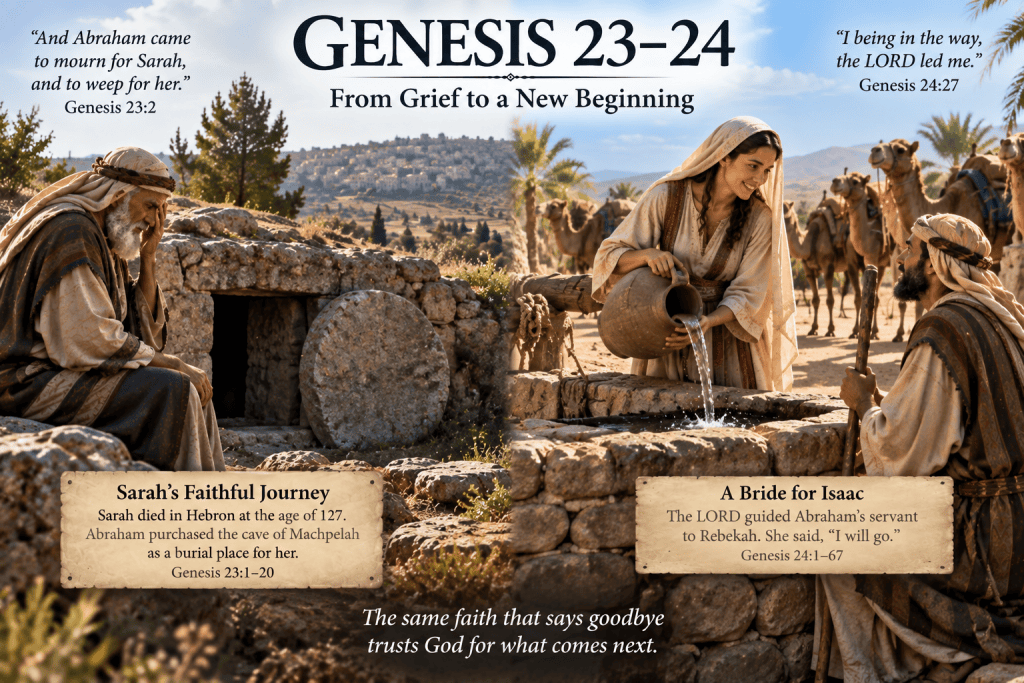
Key Scriptures: Genesis 23:1–20; Genesis 24:1–67; Proverbs 3:5–6; Psalm 32:8; Romans 8:28
“I being in the way, the LORD led me.” — Genesis 24:27
Genesis 23–24 takes Abraham’s family through two major transitions.
First, Sarah dies.
Abraham must say goodbye to the woman who had shared his long journey of faith.
Then, in Genesis 24, Abraham turns his attention toward the next generation. Isaac needs a wife, and Abraham wants that marriage to remain within God’s covenant purposes.
Therefore, these chapters move from death to a new beginning, from grief to hope, and from uncertainty to God’s providential guidance.
Perhaps the great statement of these chapters comes from Abraham’s servant:
“I being in the way, the LORD led me.”
That is a wonderful description of the Christian life.
We may not always see the entire road ahead.
However, as we walk faithfully in the way God has shown us, He directs our steps.
Sarah Died
Genesis 23 begins:
“And Sarah was an hundred and seven and twenty years old.” — Genesis 23:1
Sarah lived 127 years:
- She had traveled with Abraham from Ur to Haran and then into Canaan.
- She had endured years of childlessness.
- She had witnessed Abraham’s failures and victories.
- She had laughed at the promise of a son.
Then, at ninety years old, she held Isaac in her arms.
Now Sarah’s earthly journey was finished.
Genesis 23:2 says:
“And Sarah died in Kirjath-arba; the same is Hebron in the land of Canaan.”
Then Scripture adds:
“And Abraham came to mourn for Sarah, and to weep for her.”
Abraham Wept
Abraham was a man of great faith.
Nevertheless, he wept.
That is important.
Faith does not eliminate grief.
Sometimes Christians mistakenly believe that strong faith means we should not cry when someone we love dies.
The Bible teaches otherwise.
Abraham wept for Sarah.
David wept.
Jesus wept at Lazarus’ tomb.
Therefore, tears are not evidence of weak faith.
Grief is the price we pay for having loved someone deeply.
Christians grieve with hope, but we still grieve.
Paul says:
“That ye sorrow not, even as others which have no hope.” — 1 Thessalonians 4:13
Notice that Paul does not say believers do not sorrow.
He says we do not sorrow without hope.
Faith Does Not Deny Death
Abraham did not pretend Sarah had not died.
He mourned her.
Then he rose and began making arrangements for her burial.
Faith does not require us to deny painful realities.
Instead, faith faces reality while continuing to trust God.
We can say:
- “This hurts.”
- “I miss her.”
- “I do not understand.”
- “I wish things were different.”
And, at the same time:
“I still trust God.”
Abraham Needed a Burial Place
Abraham had lived in Canaan for many years.
God had promised the entire land to his descendants.
However, Abraham still did not legally own enough ground to bury Sarah.
Therefore, he approached the sons of Heth and said:
“I am a stranger and a sojourner with you.” — Genesis 23:4
What an interesting statement.
God had promised Abraham the land.
Yet Abraham still called himself:
“A stranger and a sojourner.”
Hebrews later uses this language to describe people of faith.
Hebrews 11:13 says they:
“Confessed that they were strangers and pilgrims on the earth.”
Abraham understood that his ultimate security did not come from earthly property.
The Cave of Machpelah
Abraham asked to purchase the cave of Machpelah from Ephron the Hittite.
The negotiations may sound unusual to modern readers. However, Abraham carefully followed the customs of the time.
Ephron initially spoke as though he would give Abraham the field and cave.
Nevertheless, a price eventually emerged:
“Four hundred shekels of silver.” — Genesis 23:15
Abraham paid the full amount.
Why?
Because he wanted the ownership to be unquestionable.
He did not want future generations arguing that the property had never legally belonged to him.
Therefore, Abraham purchased the field and cave before witnesses.
The First Piece of the Promised Land
There is something deeply significant about this purchase.
God had promised Abraham the whole land.
Yet the first piece Abraham actually owned was a burial place.
That might seem strange.
However, Abraham was making a statement of faith.
Sarah would be buried in Canaan because Abraham believed his family belonged there.
He was placing his dead in the land God had promised to his descendants.
Therefore, even the tomb became a testimony of faith.
Faith Looks Beyond the Grave
Abraham’s purchase reminds us that God’s promises extend beyond our immediate circumstances.
Abraham died without seeing the complete fulfillment of everything God promised.
Sarah did too.
Nevertheless, God remained faithful.
Likewise, Christians may die before seeing answers to every prayer or the completion of everything for which we have worked.
However, God’s purposes do not end when our earthly lives end.
Our hope extends beyond the grave.
Jesus said:
“Because I live, ye shall live also.” — John 14:19
Abraham Was Old
Genesis 24 begins:
“And Abraham was old, and well stricken in age: and the LORD had blessed Abraham in all things.”
Abraham now turned his attention to Isaac.
Sarah was gone.
Abraham was elderly.
Therefore, the covenant responsibility was moving toward the next generation.
Isaac needed a wife.
But Abraham did not want Isaac marrying one of the Canaanite women.
The covenant family needed to remain distinct from the idolatrous culture surrounding it.
Abraham Sent His Servant
Abraham called his oldest and most trusted servant.
Although Genesis 24 does not name him, many assume he may have been Eliezer, who was mentioned in Genesis 15. However, Scripture does not explicitly identify him here.
Abraham gave the servant an important assignment:
Go back to Abraham’s relatives and find a wife for Isaac.
This was no small responsibility.
The future of Abraham’s family was involved.
More importantly, the covenant promise was moving forward through Isaac.
Do Not Take Isaac Back
The servant asked an understandable question.
What if the woman refused to return with him?
Should Isaac go back to Abraham’s homeland?
Abraham answered:
“Beware thou that thou bring not my son thither again.” — Genesis 24:6
Why was Abraham so firm?
Because God had called him out of that land.
The future was in Canaan.
Therefore, Isaac was not to reverse Abraham’s journey of faith.
There is a spiritual lesson here.
Sometimes we are tempted to return to what God has called us away from.
However, faith keeps moving forward.
Abraham Trusted God’s Guidance
He told his servant:
“The LORD God of heaven… he shall send his angel before thee.” — Genesis 24:7
Abraham did not know which woman the servant would meet.
He did not know how everything would work.
Nevertheless, he trusted that God would guide the mission.
This is an important balance.
Abraham planned carefully.
Then he trusted God completely.
Faith is not an excuse for poor planning.
Likewise, planning should never replace dependence upon God.
We make wise plans.
Then we trust God with the results.
The Servant Began the Journey
The servant took ten camels along with gifts and traveled toward Mesopotamia.
Eventually, he arrived near the city of Nahor.
He stopped beside a well in the evening.
This was the time when women normally came to draw water.
The servant had reached the right region.
However, he still faced a major question:
Which woman?
Therefore, he prayed.
The Servant Prayed for Guidance
Genesis 24:12 says:
“O LORD God of my master Abraham, I pray thee, send me good speed this day.”
The servant asked God to guide him.
Then he proposed a sign.
He would ask a young woman for water.
If she willingly gave him water and also offered to water his camels, he would recognize that as God’s guidance.
This request was not entirely random.
The response would reveal something about the woman’s character.
She would need to be generous.
Kind.
Hardworking.
Hospitable.
Watering ten thirsty camels would require significant effort.
Therefore, the servant was not merely looking for outward beauty.
He was looking for character.
Before He Finished Praying
Then something remarkable happened.
Genesis 24:15 says:
“And it came to pass, before he had done speaking, that, behold, Rebekah came out.”
Before the servant finished praying, the answer was walking toward him.
Sometimes God answers prayer after years of waiting.
Other times, the answer arrives before we finish praying.
God is never limited by our timetable.
Moreover, Isaiah 65:24 says:
“Before they call, I will answer; and while they are yet speaking, I will hear.”
Rebekah Came to the Well
Rebekah was the granddaughter of Nahor, Abraham’s brother.
In other words, she came from Abraham’s extended family.
The servant did not yet know that.
He simply saw a young woman approaching the well.
He asked:
“Let me, I pray thee, drink a little water of thy pitcher.”
Rebekah immediately answered:
“Drink, my lord.”
Then, without being asked, she added:
“I will draw water for thy camels also.”
Exactly what the servant had prayed.
Rebekah’s Character Was Revealed
Watering ten camels was not a small gesture.
A thirsty camel can drink a large amount of water.
Therefore, Rebekah’s offer meant repeated trips to the well:
- She did not know this stranger.
- She did not know why he was there.
- She did not know that this ordinary act of kindness would change her life.
- She simply served.
That teaches us something important.
Character is often revealed in ordinary moments.
We sometimes imagine that God’s great opportunities will arrive with trumpets sounding.
Usually, they do not.
They arrive disguised as everyday opportunities to be faithful.
Faithfulness in Small Things
Rebekah was not trying to impress Abraham’s servant.
She was simply doing what came naturally from her character.
She saw a need and helped.
Jesus later taught:
“He that is faithful in that which is least is faithful also in much.” — Luke 16:10
Therefore, never underestimate small acts of faithfulness:
- A kind word.
- A meal delivered.
- A phone call.
- A prayer.
- A glass of water.
- A few minutes helping someone.
We never know what God may do through an ordinary act of kindness.
The Servant Watched
Genesis 24:21 says:
“And the man wondering at her held his peace, to wit whether the LORD had made his journey prosperous or not.”
The servant did not immediately jump to conclusions:
- He watched.
- He waited.
- He gathered more information.
This is another important lesson about guidance.
Prayer does not eliminate wisdom.
We should pray.
However, we should also observe circumstances, examine character, seek biblical principles, and exercise discernment.
God’s guidance and godly wisdom belong together.
Rebekah Was Abraham’s Relative
The servant asked about her family.
Then he learned who she was.
Rebekah was exactly from the family Abraham had specified.
Suddenly, the pieces came together.
The servant responded:
“And the man bowed down his head, and worshipped the LORD.” — Genesis 24:26
His first response was worship.
That is appropriate.
When God answers prayer, we should remember to thank Him.
Too often we pray desperately for something.
Then, when the answer comes, we quickly move on.
The servant stopped.
Bowed.
And worshiped.
“I Being in the Way, the LORD Led Me”
Then the servant said:
“I being in the way, the LORD led me.” — Genesis 24:27
That sentence beautifully summarizes God’s providential guidance.
Notice that the servant was in the way.
He was moving in obedience to Abraham’s instructions.
Then God directed him.
Sometimes we want God to show us every detail before we move.
However, guidance often comes while we are walking.
A parked car is difficult to steer.
Likewise, there are times when God directs us as we faithfully take the next step.
Get in the way God has shown you.
Then trust Him to lead.
God’s Providence
The word providence refers to God’s wise and sovereign care over His creation and His people.
Genesis 24 never describes spectacular miracles like the parting of the Red Sea.
Instead, God works through ordinary events:
- A servant travels.
- A woman walks to a well.
- A conversation begins.
- A family connection is discovered.
- A decision is made.
Yet behind all those ordinary events stands the guiding hand of God.
That is often how providence works.
God accomplishes extraordinary purposes through ordinary circumstances.
Rebekah’s Family Heard the Story
The servant entered Rebekah’s family home.
Then he explained his mission:
- He told them about Abraham.
- He told them about Isaac.
- He told them about his prayer.
- He told them about Rebekah’s arrival.
- He explained how every detail had come together.
Laban and Bethuel responded:
“The thing proceedeth from the LORD.” — Genesis 24:50
Even they recognized God’s hand.
Sometimes God’s guidance becomes clearest when we look backward.
At first, we see isolated events.
Later, we see how they connected.
Then we say:
“The Lord was leading me all along.”
The Servant Worshiped Again
When Rebekah’s family agreed to the marriage, the servant again:
“Worshipped the LORD, bowing himself to the earth.” — Genesis 24:52
Once again, answered prayer produced worship.
That pattern is worth copying.
Pray before the decision.
Watch for God’s guidance.
Thank Him when He answers.
Prayer should not merely be a tool for getting what we want.
It should deepen our relationship with God.
“Wilt Thou Go?”
The next morning, Rebekah’s family wanted her to remain for several more days.
However, the servant wanted to begin the return journey.
Therefore, they asked Rebekah directly:
“Wilt thou go with this man?” — Genesis 24:58
She answered:
“I will go.”
Those are simple but courageous words.
Rebekah was leaving home:
- She was traveling a long distance.
- She was going to marry a man she had never met.
- She did not know every detail of the future.
Nevertheless:
“I will go.”
Her response sounds remarkably like Abraham’s earlier obedience.
God called Abraham to leave home.
He went.
Now Rebekah leaves home to become part of the covenant family.
Faith moves forward.
Rebekah Had to Choose
God’s providence had clearly brought the circumstances together.
Nevertheless, Rebekah still had to make a decision.
God’s sovereignty does not eliminate human responsibility.
She was asked:
“Wilt thou go?”
She answered:
“I will go.”
Likewise, God places opportunities before us, but we must respond.
We cannot merely admire God’s direction.
We must walk in it.
Isaac Was in the Field
Meanwhile, Isaac was back in Canaan.
Genesis 24:63 says:
“And Isaac went out to meditate in the field at the eventide.”
This is a quiet and beautiful picture.
Isaac was alone in the field, apparently reflecting or praying.
Then he looked up.
Camels were approaching.
Rebekah also looked up and saw Isaac.
The long journey was almost finished.
Rebekah Became Isaac’s Wife
The servant told Isaac everything that had happened.
Then:
“Isaac brought her into his mother Sarah’s tent, and took Rebekah, and she became his wife; and he loved her.” — Genesis 24:67
Notice the final words:
“And he loved her.”
Genesis 24 began with the memory of Sarah’s death.
It ends with comfort.
The verse concludes:
“And Isaac was comforted after his mother’s death.”
Grief had not been erased.
Sarah was still gone.
However, God brought a new relationship and a new chapter into Isaac’s life.
God Brings New Chapters
Life includes endings.
Sarah died.
Abraham aged.
One generation was passing.
However, God’s covenant continued.
Rebekah arrived.
Isaac married.
Another generation began.
Sometimes an ending feels like the end of everything.
But God may be preparing another chapter.
That does not mean we forget the past.
Isaac did not forget Sarah.
Nevertheless, he continued living.
God still had work to do.
What Genesis 23–24 Means for Us
1. Faith Does Not Eliminate Grief
Abraham mourned and wept for Sarah.
Therefore, believers should not be ashamed of grief.
We sorrow, but we sorrow with hope.
2. God’s Promises Extend Beyond Our Lifetime
Abraham and Sarah did not see every covenant promise fulfilled.
Nevertheless, God’s plan continued.
Therefore, we can faithfully serve even when we may not see the final results.
3. Plan Carefully and Trust God Completely
Abraham gave his servant clear instructions.
However, he trusted God to guide the outcome.
Wise planning and faith belong together.
4. Pray for Guidance
The servant prayed before making his decision.
Likewise, we should seek God when facing important choices.
5. Character Matters
Rebekah’s kindness and willingness to serve revealed her character.
Therefore, we should evaluate people by more than outward appearance.
6. Be Faithful in Ordinary Things
Rebekah was simply drawing water.
However, an ordinary act became part of God’s extraordinary plan.
Never underestimate small acts of faithfulness.
7. Guidance Often Comes While We Are Moving
The servant said:
“I being in the way, the LORD led me.”
Therefore, do what you already know God wants you to do while trusting Him with what you do not yet know.
8. Providence Often Looks Ordinary
No sea parted in Genesis 24.
No fire fell from heaven.
Instead, God guided through travel, timing, conversation, character, and circumstances.
God is often working even when nothing appears miraculous.
9. Answered Prayer Should Produce Worship
The servant repeatedly stopped to thank God.
Likewise, we should remember to praise God after He answers.
10. Faith Must Respond
Rebekah was asked:
“Wilt thou go?”
She answered:
“I will go.”
Knowing God’s direction is not enough.
Eventually, we must act.
How Does God Guide Us Today?
Genesis 24 naturally raises a practical question:
How can I know God’s will?
First, God guides through Scripture.
God will never lead us contrary to what He has already revealed in His Word.
Second, God guides through prayer.
We should ask for wisdom.
James 1:5 says:
“If any of you lack wisdom, let him ask of God.”
Third, God guides through godly wisdom.
We should think carefully rather than making reckless decisions.
Fourth, God may guide through circumstances.
Doors open and close.
Opportunities appear.
However, circumstances must always be evaluated by Scripture.
Finally, God guides as we walk faithfully.
The servant could say:
“I being in the way, the LORD led me.”
Don’t Wait for a Sign When God Has Already Spoken
Genesis 24 should not be used as a formula for demanding signs from God.
The servant’s situation was unique.
Moreover, his request involved character traits appropriate to the mission.
Today, believers have the completed Scriptures.
Therefore, if God has clearly spoken about something in His Word, we do not need another sign.
We do not need to pray:
“Lord, if You really want me to forgive, make the phone ring.”
God has already told us to forgive.
We do not need a sign to obey a clear biblical command.
Instead, signs should never replace Scripture, wisdom, prayer, and obedience.
God Is Working Behind the Scenes
One of the most encouraging truths in Genesis 24 is that God was working before the servant understood what He was doing.
Rebekah was already on her way to the well while the servant prayed.
The servant could not see her coming.
But God could.
That may be true in your life right now.
You may be praying for an answer.
You cannot see anything happening.
Nevertheless, God may already be arranging circumstances you know nothing about.
Therefore, do not assume that silence means inactivity.
God can be working beyond the horizon of what you can see.
The God of Providence
Abraham had experienced spectacular moments with God:
- He had seen visions.
- He had heard God speak.
- He had witnessed the destruction of Sodom from afar.
- He had seen God provide a ram on Mount Moriah.
Genesis 24, however, is different.
God works quietly.
And yet His hand is everywhere.
That is providence.
Sometimes God works through miracles.
More often, He works through ordinary people, ordinary days, ordinary decisions, and ordinary circumstances.
Nevertheless, the same God is at work.
Isaac, Rebekah, and the Promise
Isaac’s marriage was important for more than personal happiness.
God had promised Abraham that his descendants would become a great nation.
Therefore, Isaac needed a family.
Isaac and Rebekah would eventually have Jacob.
Jacob would become Israel.
Through Israel would come Judah.
From Judah would eventually come David.
And through David’s line would come Jesus Christ.
Therefore, the servant’s journey to a well was part of something much larger than he could see.
God was continuing His plan of redemption.
Your Faithfulness May Be Part of Something Bigger
The servant probably did not understand how his assignment connected with the coming Messiah.
Rebekah certainly could not have imagined everything that would come from her decision:
“I will go.”
Nevertheless, their faithfulness became part of God’s larger plan.
The same principle applies to us.
You may never know how God uses a prayer you pray:
- A child you teach.
- A person you encourage.
- A gift you give.
- A sermon you preach.
- A kindness you show.
- A decision you make.
Therefore, be faithful with the part God has given you.
He sees the whole story.
“I Being in the Way, the LORD Led Me”
Those words are worth remembering:
“I being in the way, the LORD led me.”
You do not need:
- to know every turn in the road.
- to understand everything God is doing.
- to see ten years into the future.
Instead, ask:
“What is the next faithful step?”
Then take it.
Pray.
Read God’s Word.
Use wisdom.
Obey what you already know.
Trust God with what you do not know.
And keep walking.
Someday you may look backward and realize:
The Lord was leading me all along.
WIM Takeaway
Genesis 23–24 teaches us that faith can grieve while still holding onto hope, and it can face an uncertain future while trusting God’s providence. Abraham planned wisely, his servant prayed for guidance, Rebekah served faithfully, and God quietly brought every detail together. Therefore, when we do not know the whole road ahead, we should remain faithful to what God has already shown us and trust Him to direct the next step.
Questions for Reflection
- What does Abraham’s grief over Sarah teach us about faith and mourning?
- Why was Abraham’s purchase of the cave of Machpelah an act of faith?
- Why was Abraham determined that Isaac should not return to his former homeland?
- What can we learn from the servant’s prayer for guidance?
- What did Rebekah’s willingness to water the camels reveal about her character?
- Why should character matter more than outward appearance?
- What does “I being in the way, the LORD led me” teach us about guidance?
- How does God’s providence differ from a spectacular miracle?
- Why should answered prayer lead us to worship?
- What can we learn from Rebekah’s answer, “I will go”?
- Is there a decision in your life for which you need God’s wisdom and guidance?
- What is the next faithful step God has already shown you to take?
<<Back to the Book of Genesis
Dr. Alan Holden has served in pastoral ministry for more than 35 years, preaching and teaching the Bible in churches across the United States. He holds a Doctor of Ministry from Luther Rice Seminary and a Master of Divinity from The Southern Baptist Theological Seminary. Through What’s It Mean?, he seeks to help readers understand the meaning of Scripture and grow in their walk with Christ. He is currently the pastor of Lake Saunders Baptist Church in Tavares, FL.