







Genesis 22 — Abraham and Isaac: God Will Provide
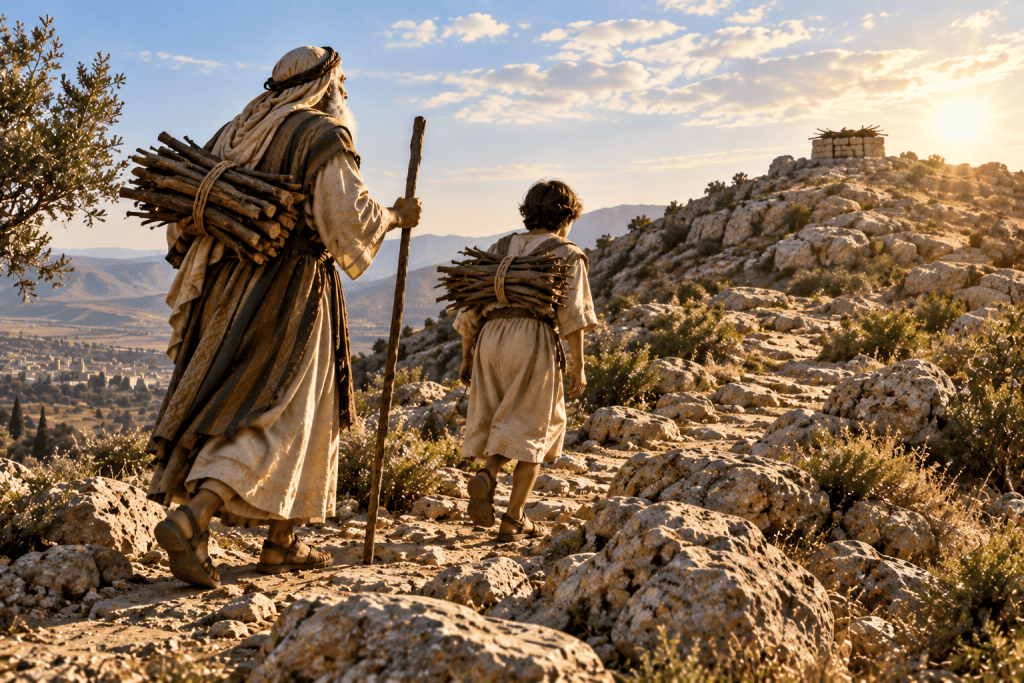
Key Scriptures: Genesis 22:1–24; Hebrews 11:17–19; James 2:21–23; John 3:16; Romans 8:32
“And Abraham said, My son, God will provide himself a lamb for a burnt offering.” — Genesis 22:8
Genesis 22 contains one of the most dramatic events in Abraham’s life.
For decades, Abraham had waited for the son God promised.
Finally, Isaac was born.
Sarah laughed with joy.
The impossible promise had become reality.
Then God gave Abraham a command that must have seemed impossible to understand.
God told him to take Isaac to the land of Moriah and offer him as a burnt offering.
Why would God give Abraham the promised son and then ask Abraham to surrender him?
Genesis 22 answers that question through a great test of faith.
Moreover, the chapter introduces a truth that reaches all the way to Calvary:
God will provide.
God Tested Abraham
Genesis 22 begins:
“And it came to pass after these things, that God did tempt Abraham.” — Genesis 22:1
In this context, the word tempt means to test or prove.
God was not enticing Abraham to sin.
James 1:13 makes that clear:
“God cannot be tempted with evil, neither tempteth he any man.”
Instead, God was testing Abraham’s faith.
There is an important difference between temptation and testing.
Satan tempts us to make us fall.
God tests us to reveal and strengthen faith.
Therefore, the test of Genesis 22 was not designed to destroy Abraham.
It would reveal how deeply Abraham had learned to trust God.
“Abraham”
God called:
“Abraham.”
Abraham answered:
“Behold, here I am.”
That response appears several times in the chapter.
Abraham was available to God.
Before he knew what God would ask, he essentially said:
“Here I am.”
That is a good posture for every believer.
We often want to hear the assignment before agreeing to obey.
However, faith begins by surrendering ourselves to God.
“Lord, here I am.”
“Teach me.”
“Lead me.”
“Use me.”
Take Your Son
Then came the command:
“Take now thy son, thine only son Isaac, whom thou lovest.” — Genesis 22:2
Notice how personal the words become.
Thy son.
Thine only son Isaac.
Whom thou lovest.
This is the first occurrence of the word love in the King James Version of the Bible.
Significantly, it appears in the context of a father’s love for his son.
Then God told Abraham to take Isaac to the land of Moriah and offer him there.
The command must have pierced Abraham’s heart.
Isaac was not merely Abraham’s son.
He was the promised son.
What About the Promise?
God had said:
“In Isaac shall thy seed be called.” — Genesis 21:12
Now God commanded Abraham to offer Isaac.
How could both statements be true?
If Isaac died, what would happen to the promise?
Abraham faced an apparent contradiction between what God had promised and what God had commanded.
Nevertheless, Abraham had learned something over the years.
God keeps His promises.
Therefore, even though Abraham could not understand how God would resolve the situation, he trusted that God would.
Abraham Rose Early
Genesis 22:3 says:
“And Abraham rose up early in the morning.”
That is remarkable.
Abraham did not delay.
He did not spend several days searching for an alternative.
Abraham did not bargain with God.
Instead, he prepared the donkey, took two servants and Isaac, cut the wood, and began the journey.
Faith obeys even when obedience is difficult.
Sometimes delayed obedience is simply disobedience wearing a respectable disguise.
Abraham obeyed promptly.
Three Days of Travel
The journey lasted three days.
Genesis 22:4 says:
“Then on the third day Abraham lifted up his eyes, and saw the place afar off.”
Imagine those three days.
Abraham walked beside the son he loved while carrying the knowledge of what God had commanded.
Every mile gave him time to turn around.
Each night gave him time to reconsider.
Nevertheless, he continued.
Faith is not merely one emotional decision.
Often, faith must keep choosing obedience mile after mile.
“I and the Lad Will Go… and Come Again”
When they reached the mountain, Abraham told his servants:
“Abide ye here with the ass; and I and the lad will go yonder and worship, and come again to you.” — Genesis 22:5
Notice Abraham’s words:
“We will… come again.”
Abraham expected both himself and Isaac to return.
How could he say that?
Hebrews 11 explains.
Abraham believed that if necessary:
“God was able to raise him up, even from the dead.” — Hebrews 11:19
Abraham did not know exactly what God would do.
However, he knew the promise depended upon Isaac.
Therefore, Abraham reasoned:
If Isaac must die, then God can raise Isaac from the dead.
That is extraordinary faith.
Faith Trusts God Beyond What It Understands
Abraham could not see the solution.
Nevertheless, he trusted the God who had made the promise.
That is often where faith becomes most difficult.
We want explanations.
God sometimes gives us promises instead.
We want to know how.
God asks us to trust Who.
Therefore, faith does not mean we understand everything God is doing.
Faith means we trust God when we do not understand.
Isaac Carried the Wood
Genesis 22:6 says:
“And Abraham took the wood of the burnt offering, and laid it upon Isaac his son.”
Isaac carried the wood up the mountain.
Abraham carried the fire and the knife.
Then:
“They went both of them together.”
Christians have long noticed how this scene points forward to Jesus.
Isaac carried the wood connected with his sacrifice.
Centuries later, Jesus would carry His cross toward Calvary.
John 19:17 says:
“And he bearing his cross went forth.”
We should not force every detail into a symbolic meaning.
Nevertheless, the larger parallels are difficult to miss.
“Where Is the Lamb?”
As father and son climbed the mountain, Isaac asked the obvious question:
“Behold the fire and the wood: but where is the lamb for a burnt offering?” — Genesis 22:7
Abraham answered with one of the greatest statements of faith in Genesis:
“My son, God will provide himself a lamb for a burnt offering.” — Genesis 22:8
Abraham did not know exactly how.
But he knew:
God will provide.
That statement becomes the central message of the chapter.
God Will Provide
Those words apply far beyond Abraham’s journey.
We often face situations where we cannot see the answer.
We ask:
- “How will this work?”
- “How will this need be met?”
- “How will I get through this?”
- “How will God fulfill His promise?”
Abraham gives us the answer:
God will provide.
That does not mean God will always provide exactly what we want.
Nor does it mean He will provide according to our schedule.
Instead, it means God is faithful to provide what is necessary to accomplish His purposes.
They Went Together
After Abraham’s answer, Genesis repeats:
“So they went both of them together.”
There is no indication that Isaac tried to run away.
Indeed, Abraham was an old man, while Isaac was likely strong enough to carry the wood.
Therefore, many interpreters have noted that Isaac appears to submit willingly to his father.
This also points our thoughts toward Jesus.
Jesus said:
“No man taketh it from me, but I lay it down of myself.” — John 10:18
Christ willingly went to the cross.
Abraham Built the Altar
They reached the place.
Abraham built the altar.
He arranged the wood.
Then he bound Isaac and placed him upon the altar.
The tension could hardly be greater.
The promised son lay upon the wood.
Abraham lifted the knife.
Then heaven spoke.
“Abraham, Abraham”
The angel of the LORD called:
“Abraham, Abraham.”
Again Abraham answered:
“Here am I.”
Then came the command:
“Lay not thine hand upon the lad.”
The test was complete.
God said:
“Now I know that thou fearest God, seeing thou hast not withheld thy son, thine only son from me.” — Genesis 22:12
Abraham had demonstrated that even Isaac would not take God’s place in his heart.
The Gift Must Never Replace the Giver
This is one of the deepest lessons in Genesis 22.
Isaac was God’s gift to Abraham.
However, even a gift from God can become spiritually dangerous if we value the gift more than the Giver.
That can happen with many good things.
Family.
Career.
Ministry.
Money.
Possessions.
Health.
Reputation.
Even our dreams.
Therefore, we should periodically ask:
“Is there anything I love more than God?”
Abraham loved Isaac deeply.
Nevertheless, he trusted God more.
A Ram Caught in the Thicket
Then Abraham looked up.
Genesis 22:13 says:
“Behold behind him a ram caught in a thicket by his horns.”
There was the substitute.
Isaac did not die.
The ram died in his place.
Genesis says:
“Abraham went and took the ram, and offered him up for a burnt offering in the stead of his son.”
Those last words are extremely important:
“In the stead of his son.”
One life was offered in place of another.
Here we see one of the great biblical themes of redemption:
Substitution.
The Substitute Died
Isaac deserved no judgment in this particular test.
Nevertheless, he was lying upon the altar.
Then God provided a substitute.
The ram died instead.
Later, Israel’s sacrificial system would repeatedly teach the principle of substitution.
An animal died in the worshiper’s place.
However, those sacrifices could never permanently remove sin.
Therefore, a greater Substitute was needed.
Jehovah-jireh
Abraham named the place:
“Jehovah-jireh.” — Genesis 22:14
The name means:
The LORD will provide.
Abraham did not name the mountain:
“Abraham Obeyed.”
He did not call it:
“Abraham Had Great Faith.”
Instead, he called it:
“The LORD Will Provide.”
The final emphasis belongs to God.
Yes, Abraham obeyed.
Yes, Abraham believed.
However, God provided the ram.
Salvation always begins with God’s provision.
God Reaffirmed His Promise
After the test, God reaffirmed the covenant promises.
Abraham’s descendants would multiply.
They would become as numerous as the stars and the sand.
Then God repeated:
“And in thy seed shall all the nations of the earth be blessed.” — Genesis 22:18
Again, the story points forward.
The blessing of the nations would ultimately come through Jesus Christ.
Abraham’s Faith Was Proven
James refers to this event when discussing the relationship between faith and works.
James 2:22 says:
“Seest thou how faith wrought with his works, and by works was faith made perfect?”
Abraham’s obedience did not earn the righteousness God had already credited to him in Genesis 15.
Instead, his obedience demonstrated that his faith was genuine.
True faith produces action.
We are saved by faith alone.
However, saving faith does not remain alone.
It produces obedience.
Abraham and Isaac Point Us Toward Calvary
Genesis 22 contains remarkable parallels with the Gospel.
Abraham was a father.
Isaac was his beloved son.
Isaac carried the wood.
The journey led to sacrifice.
A substitute was provided.
The location was associated with Moriah, where Solomon would later build the temple.
Moreover, the promised blessing would eventually come through Abraham’s Seed.
All of these themes move the biblical story toward Christ.
“Thine Only Son… Whom Thou Lovest”
Genesis says:
“Take now thy son, thine only son Isaac, whom thou lovest.”
The New Testament tells us:
“For God so loved the world, that he gave his only begotten Son.” — John 3:16
Abraham was stopped.
God was not.
Isaac was spared.
Jesus was given.
That is one of the most powerful contrasts in the chapter.
God Did What Abraham Was Not Required to Do
When Abraham raised the knife, God stopped him.
A ram took Isaac’s place.
Centuries later, Jesus went to Calvary.
No angel stopped the cross.
Romans 8:32 says:
“He that spared not his own Son, but delivered him up for us all.”
God did not require Abraham to complete the sacrifice of his son.
Instead, God Himself ultimately provided His Son for us.
At Moriah:
God provided a ram.
At Calvary:
God provided the Lamb.
“Behold the Lamb of God”
Isaac asked:
“Where is the lamb?”
That question echoes through Scripture.
The sacrificial system pointed toward the answer.
Isaiah spoke of One brought:
“As a lamb to the slaughter.” — Isaiah 53:7
Then John the Baptist saw Jesus and declared:
“Behold the Lamb of God, which taketh away the sin of the world.” — John 1:29
There is the answer to Isaac’s question.
Where is the Lamb?
Jesus Christ is the Lamb God provided.
What Genesis 22 Means for Us
1. God Tests Faith
God tested Abraham.
Therefore, difficult circumstances do not always mean something has gone wrong.
Sometimes God uses difficulty to strengthen and reveal our faith.
2. Obedience Should Be Prompt
Abraham rose early.
He did not delay.
Likewise, when God clearly speaks through His Word, we should obey.
3. Faith Trusts God When It Cannot Understand Him
Abraham could not reconcile the command with the promise.
Nevertheless, he trusted God.
Therefore, we can trust God even when we cannot see how everything will work out.
4. Nothing Should Take God’s Place
Isaac was precious.
However, Abraham would not place Isaac above God.
Even God’s blessings must never become idols.
5. God Provides What We Cannot Provide
Abraham said:
“God will provide.”
Then God did.
Our greatest need is salvation, and God has provided that through Christ.
6. Biblical Faith Produces Obedience
Abraham’s actions demonstrated his faith.
Likewise, genuine trust in God should affect how we live.
7. God Provides a Substitute
The ram died instead of Isaac.
Ultimately, Jesus died in the place of sinners.
When God Tests What We Love
Sometimes our greatest spiritual tests involve things we value most.
It is relatively easy to surrender something we do not care about.
The real test comes when God touches something precious:
- Our plans.
- Our security.
- Our possessions.
- Our family.
- Our future.
- Our dreams.
At those moments, faith asks:
“Do I trust the gift, or do I trust the Giver?”
Abraham had waited decades for Isaac.
However, his faith had finally matured enough to say:
“Even if I do not understand what God is doing, I know He will keep His promise.”
The Mountain of Provision
Abraham climbed the mountain expecting to surrender something.
Instead, he discovered God’s provision.
That is why he called the place:
Jehovah-jireh.
The LORD will provide.
Perhaps you are standing at the foot of your own mountain:
- You cannot see the answer.
- You cannot understand the circumstances.
- You do not know what God will do.
However, you know what Abraham knew.
God is faithful.
Therefore:
- Keep walking.
- Keep trusting.
- Keep obeying.
The provision may already be on the mountain even though you cannot yet see it.
God Will Provide Himself a Lamb
Abraham’s statement in Genesis 22:8 reaches far beyond that mountain:
“God will provide himself a lamb.”
And He did.
Not merely the ram caught in the thicket.
Ultimately:
Jesus Christ.
God provided the Lamb.
Christ carried the cross.
Jesus willingly offered Himself.
Christ became our Substitute.
Jesus bore our sins.
Christ died in our place.
And Christ rose again.
Therefore, Genesis 22 is not merely a story about how much Abraham trusted God.
It is ultimately a story pointing toward how much God has provided for us.
At the altar, Isaac was spared.
At the cross, Jesus was not.
Why?
Because:
“Christ died for our sins according to the scriptures.” — 1 Corinthians 15:3
Abraham called the place:
“The LORD will provide.”
Calvary gives us the ultimate proof.
God has provided the Lamb.
WIM Takeaway
Genesis 22 teaches us that genuine faith trusts God even when His purposes are difficult to understand. Abraham was willing to surrender Isaac because he believed God would keep His promise. However, God provided a ram as Isaac’s substitute. Ultimately, that provision points us to Jesus Christ, the Lamb of God who became the Substitute for sinners. Therefore, whatever mountain we face, we can trust Jehovah-jireh—the LORD who provides.
Questions for Reflection
- What is the difference between God testing us and Satan tempting us?
- Why was God’s command concerning Isaac such a difficult test for Abraham?
- What does Abraham’s early-morning obedience teach us?
- Why did Abraham believe that both he and Isaac would return from the mountain?
- What does Hebrews 11 tell us Abraham believed God could do?
- Is there a gift from God that could become more important to you than God Himself?
- What does the ram teach us about substitution?
- Why did Abraham call the place Jehovah-jireh?
- In what ways does Isaac’s experience point forward to Jesus?
- What is the significance of Romans 8:32—“He that spared not his own Son”?
- What situation in your life requires you to trust God even though you cannot understand what He is doing?
- How does Jesus ultimately answer Isaac’s question, “Where is the lamb?”
<<Back to the Book of Genesis
Dr. Alan Holden has served in pastoral ministry for more than 35 years, preaching and teaching the Bible in churches across the United States. He holds a Doctor of Ministry from Luther Rice Seminary and a Master of Divinity from The Southern Baptist Theological Seminary. Through What’s It Mean?, he seeks to help readers understand the meaning of Scripture and grow in their walk with Christ. He is currently the pastor of Lake Saunders Baptist Church in Tavares, FL.