







Genesis 25–26 — Jacob and Esau: Birthright, Blessing, and God’s Promise
Key Scriptures: Genesis 25:1–34; Genesis 26:1–35; Romans 9:10–13; Hebrews 12:16–17
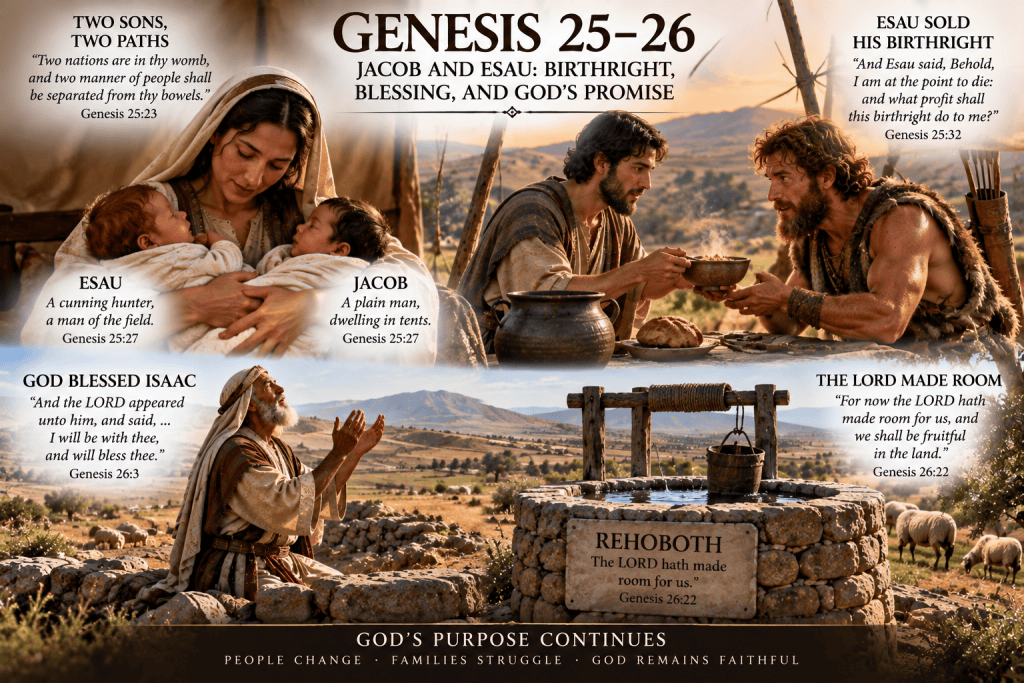
“And the LORD said unto her, Two nations are in thy womb, and two manner of people shall be separated from thy bowels.” — Genesis 25:23
Genesis 25–26 marks another major transition in the book of Genesis.
Abraham’s long journey is nearing its end. Isaac now becomes the central figure, and the next generation enters the story through Jacob and Esau.
These chapters show us family tension, spiritual choices, God’s promises, human weakness, and divine faithfulness.
Moreover, they remind us of something we have already seen repeatedly in Genesis:
God’s purposes continue even through imperfect people and difficult families.
Abraham’s Final Years
Genesis 25 records additional details from Abraham’s later life.
After Sarah’s death, Abraham married Keturah and had more children. However, the covenant line remained connected to Isaac.
Genesis 25:5 says:
“And Abraham gave all that he had unto Isaac.”
This does not mean Abraham had no concern for his other children. In fact, the passage says he gave gifts to the sons of his concubines.
Nevertheless, Isaac held a unique place in God’s covenant promise.
Therefore, the biblical story now follows Isaac’s family.
Abraham Died
Genesis 25:7 says:
“And these are the days of the years of Abraham’s life which he lived, an hundred threescore and fifteen years.”
Abraham lived 175 years.
Then:
“Abraham gave up the ghost, and died in a good old age.”
The man who had left Ur by faith had finished his earthly journey.
He had seen Isaac born.
Abraham had walked with God for decades.
He had made mistakes.
But he had also experienced remarkable growth.
Finally, he died:
“An old man, and full of years.”
Isaac and Ishmael Buried Abraham
Genesis tells us:
“And his sons Isaac and Ishmael buried him in the cave of Machpelah.”
That is an interesting detail.
The two sons whose lives had taken very different paths came together at their father’s burial.
Scripture does not tell us much about their conversation.
However, their presence together reminds us that family relationships can remain complicated even when people share moments of grief and responsibility.
God Blessed Isaac
After Abraham’s death:
“God blessed his son Isaac.” — Genesis 25:11
That statement is important.
Abraham was gone.
But God was not.
The covenant did not depend upon Abraham remaining alive.
God’s work continued into the next generation.
This is encouraging for every believer.
We are temporary servants.
God’s purposes are permanent.
Therefore, our responsibility is to remain faithful in our generation and trust God with the next one.
Ishmael’s Descendants
Genesis briefly records Ishmael’s descendants.
God had promised Abraham that Ishmael would become the father of a great people.
Now Scripture shows that God kept that promise.
Ishmael’s family grew.
Princes came from his line.
Then Ishmael died at 137 years old.
Again, Genesis demonstrates that God keeps His word even when different promises involve different covenant purposes.
Rebekah Was Barren
The story then turns to Isaac and Rebekah.
Genesis 25:21 says:
“And Isaac intreated the LORD for his wife, because she was barren.”
This is another familiar theme.
Sarah had been barren.
Now Rebekah was barren.
The covenant promise seemed to face another obstacle.
However, Isaac responded differently from some earlier family failures.
He prayed.
Then:
“The LORD was intreated of him, and Rebekah his wife conceived.”
Once again, God demonstrated that the covenant family continued because of divine faithfulness, not human ability.
The Children Struggled Within Her
Rebekah’s pregnancy was difficult.
Genesis 25:22 says:
“And the children struggled together within her.”
She was so troubled that she asked:
“If it be so, why am I thus?”
Therefore:
“She went to enquire of the LORD.”
That is a wise response.
When circumstances confuse us, prayer is better than panic.
Rebekah did not understand what was happening.
Nevertheless, she took her question to God.
Two Nations
God answered:
“Two nations are in thy womb.”
Then:
“The one people shall be stronger than the other people; and the elder shall serve the younger.” — Genesis 25:23
This prophecy was unusual.
In the ancient world, the older son normally received the primary inheritance and family leadership.
However, God announced that the normal order would be reversed.
The younger would hold the covenant position.
Therefore, even before Jacob and Esau were born, God revealed that His purpose would move through Jacob.
Esau and Jacob Were Born
The first child was Esau.
He was described as red and hairy.
Then Jacob was born holding Esau’s heel.
That detail became associated with Jacob’s name and character.
Jacob would become a man who grasped:
- He would scheme.
- He would manipulate.
- He would try to secure blessing through his own cleverness.
However, over time God would transform him.
Two Very Different Brothers
As the boys grew, their differences became obvious.
Genesis 25:27 says:
“Esau was a cunning hunter, a man of the field; and Jacob was a plain man, dwelling in tents.”
Esau loved the outdoors.
Jacob preferred life closer to home.
Different personalities are not sinful.
However, the family soon developed a deeper problem.
Verse 28 says:
“And Isaac loved Esau… but Rebekah loved Jacob.”
Favoritism entered the family.
That would cause serious damage.
The Danger of Favoritism
Parents may naturally connect differently with different children.
However, openly preferring one child over another creates wounds.
Isaac favored Esau.
Rebekah favored Jacob.
As a result, the household became divided into sides.
Instead of one united family, there were competing loyalties.
This problem will become even more obvious in Genesis 27.
Therefore, Genesis warns us that favoritism rarely remains private.
It eventually affects relationships.
Esau Came in from the Field
One day Jacob was cooking stew.
Esau returned from the field exhausted.
He told Jacob:
“Feed me, I pray thee, with that same red pottage; for I am faint.”
Jacob saw an opportunity.
Instead of simply feeding his hungry brother, he said:
“Sell me this day thy birthright.” — Genesis 25:31
This reveals Jacob’s calculating nature.
He wanted what belonged to Esau.
Moreover, he was willing to take advantage of Esau’s weakness to get it.
What Was the Birthright?
The birthright carried important family privileges.
It usually included a larger inheritance and leadership responsibilities within the family.
In this family, however, the birthright also had connection to the covenant promises God had given Abraham.
Therefore, this was not merely about property.
It involved spiritual privilege.
Jacob valued the birthright.
Unfortunately, he tried to secure it through manipulation.
Esau, on the other hand, did not value it enough.
Esau Sold His Birthright
Esau said:
“Behold, I am at the point to die: and what profit shall this birthright do to me?”
He exaggerated his immediate need.
Then he sold the birthright for bread and lentil stew.
Genesis concludes:
“Thus Esau despised his birthright.” — Genesis 25:34
Esau traded something of lasting value for immediate satisfaction.
That is a dangerous exchange.
Don’t Trade the Eternal for the Immediate
Esau’s mistake still happens today.
People trade long-term good for short-term pleasure.
They trade:
- integrity for money.
- marriage vows for a moment of lust.
- health for destructive habits.
- spiritual growth for constant entertainment.
Therefore, Esau’s story asks us:
What are you willing to give up for what you want right now?
Hebrews 12:16 warns believers not to be like Esau, who:
“For one morsel of meat sold his birthright.”
Jacob Wanted the Right Thing the Wrong Way
Jacob’s desire was different from Esau’s.
He valued the birthright.
However, valuing the right thing does not justify using the wrong method.
Jacob manipulated his brother.
Later, he will deceive his father.
This becomes another repeated Genesis lesson:
We should never sin in order to obtain something God wants to give.
God had already said the elder would serve the younger.
Jacob did not need manipulation.
He needed faith.
A Famine Came
Genesis 26 begins with another famine.
Isaac now faced a test similar to one Abraham had faced earlier.
God told him not to go down into Egypt.
Instead, Isaac was to remain in the land God showed him.
God said:
“Sojourn in this land, and I will be with thee, and will bless thee.” — Genesis 26:3
The promise now passed explicitly to Isaac.
God Reaffirmed the Covenant
God repeated the promises previously given to Abraham.
Isaac’s descendants would multiply.
The land would belong to them.
And:
“In thy seed shall all the nations of the earth be blessed.” — Genesis 26:4
Therefore, the covenant was not ending with Abraham.
It continued through Isaac.
God’s redemptive plan remained on course.
Because Abraham Obeyed
God said:
“Because that Abraham obeyed my voice, and kept my charge, my commandments, my statutes, and my laws.” — Genesis 26:5
This statement emphasizes Abraham’s overall life of faithful response to God.
Abraham was not perfect.
Genesis has made that clear.
Nevertheless, his life was ultimately characterized by faith and obedience.
That is an important distinction.
A faithful life is not a sinless life.
It is a life that keeps returning to trust and obedience.
Isaac Repeated Abraham’s Fear
Unfortunately, Isaac also repeated one of Abraham’s failures.
He was afraid the men of Gerar would kill him because Rebekah was beautiful.
Therefore, he said:
“She is my sister.”
This sounds almost exactly like Abraham’s earlier behavior.
Family patterns can repeat.
Children often learn both strengths and weaknesses from parents.
Therefore, we should remember that our example matters.
Abimelech Discovered the Truth
Eventually, Abimelech saw Isaac behaving toward Rebekah in a way that made it clear she was his wife.
He confronted Isaac.
Once again, a covenant family member was rebuked by a pagan ruler for deception.
Abimelech then warned the people not to harm Isaac or Rebekah.
God protected them despite Isaac’s fear.
Again, grace was greater than failure.
Isaac Prospered
Genesis 26:12 says:
“Then Isaac sowed in that land, and received in the same year an hundredfold: and the LORD blessed him.”
Despite the famine:
God blessed Isaac.
His wealth and flocks increased, and household became powerful.
As a result, the Philistines became envious.
Therefore, prosperity created conflict.
The Wells Were Stopped
The Philistines stopped up wells that Abraham’s servants dug.
In a dry land, wells were essential.
They meant survival.
Therefore, this was serious opposition.
Abimelech eventually told Isaac:
“Go from us; for thou art much mightier than we.”
Isaac moved away.
Isaac Dug Again
Isaac reopened the wells Abraham dug.
Then his servants discovered additional water.
However, local herdsmen argued over the wells.
The first well was called Esek, meaning contention.
Then the second was called Sitnah, associated with hostility.
Instead of fighting endlessly, Isaac moved again.
Finally, his servants dug another well, and no one quarreled over it.
Isaac called it Rehoboth.
Rehoboth: The LORD Made Room
Isaac said:
“For now the LORD hath made room for us, and we shall be fruitful in the land.” — Genesis 26:22
This is a wonderful picture of patience and faith.
Isaac could have fought for every well.
Instead, he repeatedly moved rather than escalating conflict.
Eventually, God made room for him.
Sometimes we spend too much energy fighting battles we do not need to fight.
There are times to stand firm.
However, there are also times to move on and trust God to provide another well.
God Appeared at Beersheba
Isaac went to Beersheba.
There God appeared and said:
“I am the God of Abraham thy father: fear not, for I am with thee.” — Genesis 26:24
God again addressed fear.
Then He reaffirmed His promise.
Isaac responded in a familiar way:
“And he builded an altar there, and called upon the name of the LORD.”
Like Abraham, Isaac built an altar.
This indicates continuity not only of family but of faith.
Altars and Wells
Isaac’s life in Genesis 26 can be summarized by two images:
Altars and wells.
The altar represented worship.
The well represented provision.
Isaac needed both.
So do we.
We need relationship with God.
And we need daily provision from God.
Therefore, believers should seek the Giver while trusting Him for the gifts.
Abimelech Returned
Later, Abimelech came to Isaac seeking peace.
Isaac asked why he had come after sending him away.
Abimelech answered:
“We saw certainly that the LORD was with thee.” — Genesis 26:28
That is a remarkable testimony.
Isaac’s enemies recognized God’s presence with him.
They wanted a covenant of peace.
Therefore, Isaac prepared a feast, and they established an agreement.
God Can Vindicate Without Our Fighting
Isaac did not need to prove himself through constant conflict.
He kept moving, digging, and trusting.
Eventually, the same people who had pushed him away came seeking peace because they recognized God was with him.
This teaches us an important principle:
We do not always have to defend ourselves aggressively.
Sometimes faithful consistency becomes our strongest defense.
Esau’s Marriages Brought Grief
Genesis 26 ends with Esau marrying Hittite women.
Verse 35 says:
“Which were a grief of mind unto Isaac and to Rebekah.”
This detail prepares us for the next chapter.
Esau’s choices continued to demonstrate spiritual carelessness.
The family tension was increasing.
Therefore, Genesis 27 will bring the conflict over the blessing into the open.
What Genesis 25–26 Means for Us
1. God’s Work Continues Across Generations
Abraham died.
Nevertheless, God blessed Isaac.
Therefore, we should remember that God’s purposes are larger than any one person.
2. Prayer Should Be Our First Response to Confusion
Rebekah did not understand her difficult pregnancy.
So she inquired of the LORD.
When we do not understand, prayer is better than panic.
3. Favoritism Damages Families
Isaac favored Esau.
Rebekah favored Jacob.
As a result, their household became divided.
Therefore, families should resist creating competing loyalties.
4. Do Not Trade Long-Term Blessing for Short-Term Satisfaction
Esau exchanged his birthright for one meal.
Likewise, we should not sacrifice lasting good for immediate pleasure.
5. A Right Desire Does Not Justify a Wrong Method
Jacob valued the birthright.
However, he manipulated Esau.
Therefore, we should trust God rather than scheme.
6. Family Weaknesses Can Repeat
Isaac repeated Abraham’s deception.
This reminds us that we should be aware of unhealthy patterns passed from one generation to another.
7. God Can Bless in Difficult Conditions
Isaac prospered during famine.
Therefore, God’s provision is not limited by circumstances.
8. Not Every Conflict Must Become a Battle
Isaac repeatedly moved rather than fighting over wells.
Eventually, God made room for him.
9. A Faithful Life Can Become a Testimony
Abimelech said:
“We saw certainly that the LORD was with thee.”
Our lives should make God’s presence visible to others.
Esau’s Great Mistake
Esau’s decision deserves special attention.
He was hungry.
The stew smelled good, but the birthright seemed distant and abstract.
Therefore, he chose what was immediate.
That is often how temptation works.
The immediate feels real, but the eternal feels distant.
However, the consequences eventually reverse that perspective.
The pleasure disappears, but the cost remains.
Therefore, wisdom asks us to look beyond the moment.
What Are You Selling Cheaply?
Esau sold something priceless cheaply.
That raises a serious question.
Are we doing the same?
Are we selling:
- peace for anger?
- trust for dishonesty?
- spiritual health for constant distraction?
- family relationships for career ambition?
- integrity for financial gain?
The bowl of stew changes, but the temptation remains.
Therefore, do not surrender something precious for something temporary.
Isaac Shows Another Kind of Faith
Abraham’s faith often appeared dramatic.
He left his homeland.
Abraham rescued Lot.
He climbed Mount Moriah.
Isaac’s faith often appears quieter.
He:
- stayed where God told him.
- planted and dug wells.
- moved rather than fight.
- built an altar.
- kept trusting.
That is encouraging.
Not every faithful life looks dramatic.
Some believers serve God through steady, quiet obedience.
And God values that faithfulness.
God Made Room
Perhaps one of the most encouraging phrases in Genesis 26 is Isaac’s statement at Rehoboth:
“The LORD hath made room for us.”
After one conflict.
Then another.
After moving and digging again.
Finally, room.
Maybe you feel crowded by difficulty.
Perhaps opportunities seem blocked.
Maybe one door after another has closed.
Genesis 26 reminds us:
God knows how to make room.
That does not mean every obstacle will disappear immediately.
However, it does mean we do not have to force every door open ourselves.
Sometimes we dig again.
Other times we move on.
Sometimes we wait.
And eventually, God provides the space He intends for us.
God’s Promise Still Stands
These chapters are filled with human weakness.
Jacob manipulates.
Esau despises his birthright.
Isaac deceives.
Family favoritism grows.
Conflict increases.
Nevertheless, over everything stands the faithfulness of God.
God:
- blessed Isaac.
- reaffirmed the covenant.
- preserved the promised line.
And God continued moving history toward Jesus Christ.
That is the great hope of Genesis.
Human beings are inconsistent. God is not.
WIM Takeaway
Genesis 25–26 teaches us that God’s promises continue through imperfect families. Esau traded lasting blessing for immediate satisfaction, while Jacob tried to grasp through manipulation what God had already promised. Meanwhile, Isaac learned to trust God through famine, opposition, and repeated conflict. Therefore, we should value spiritual things, resist shortcuts, seek peace when possible, and trust God to make room for us in His time.
Questions for Reflection
- What does Abraham’s death teach us about passing faith to the next generation?
- Why did Rebekah inquire of the LORD during her difficult pregnancy?
- How did favoritism affect Isaac and Rebekah’s family?
- Why was Esau’s sale of the birthright spiritually serious?
- What are some modern ways people trade long-term good for short-term satisfaction?
- What was wrong with Jacob’s method even though he valued the birthright?
- How did Isaac repeat one of Abraham’s weaknesses?
- What can we learn from Isaac’s response to conflict over the wells?
- What does Rehoboth teach us about trusting God’s provision?
- Why was Abimelech’s statement, “The LORD was with thee,” such a strong testimony?
- Is there a conflict in your life where peace may be wiser than continuing to fight?
- Is there anything temporary you are allowing to become more important than something eternal?
<<Back to the Book of Genesis
Dr. Alan Holden has served in pastoral ministry for more than 35 years, preaching and teaching the Bible in churches across the United States. He holds a Doctor of Ministry from Luther Rice Seminary and a Master of Divinity from The Southern Baptist Theological Seminary. Through What’s It Mean?, he seeks to help readers understand the meaning of Scripture and grow in their walk with Christ. He is currently the pastor of Lake Saunders Baptist Church in Tavares, FL.