






Genesis 20–21 — Isaac Is Born: God Keeps His Promise
Key Scriptures: Genesis 20:1–18; Genesis 21:1–34; Romans 4:18–22; Galatians 4:22–31; Hebrews 11:11–12
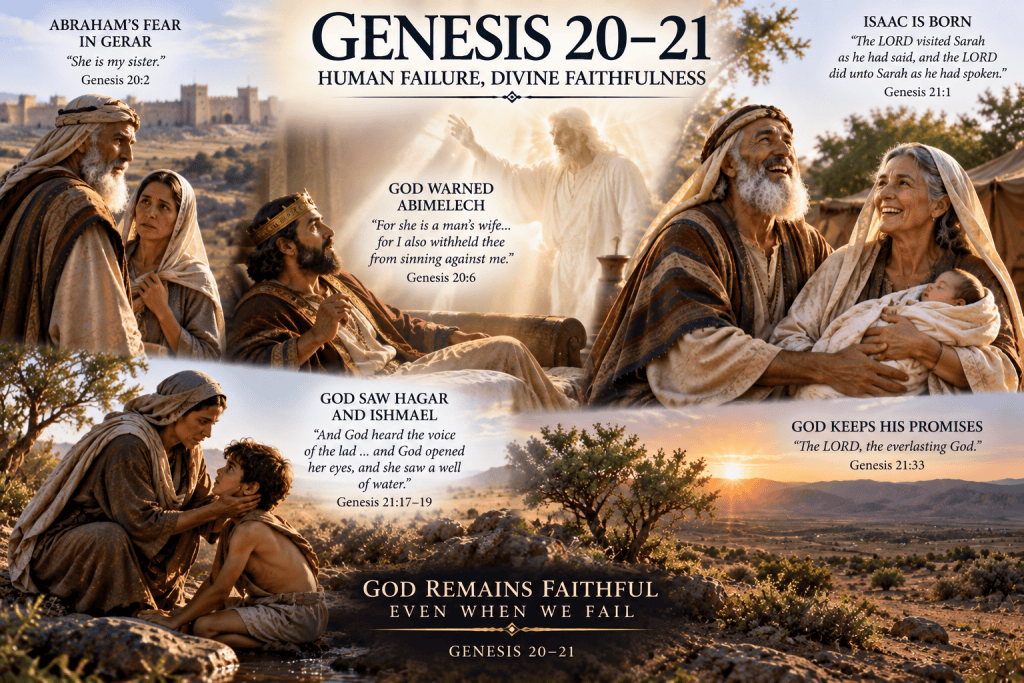
“And the LORD visited Sarah as he had said, and the LORD did unto Sarah as he had spoken.” — Genesis 21:1
Genesis 20–21 gives us one of the clearest demonstrations of God’s faithfulness in Abraham’s story.
In Genesis 20, Abraham repeats an old mistake. Once again, fear leads him to identify Sarah as his sister instead of openly acknowledging her as his wife.
Nevertheless, God protects Sarah and preserves His promise.
Then Genesis 21 begins with wonderful words:
“The LORD did unto Sarah as he had spoken.”
After years of waiting, Isaac is born.
Therefore, these chapters teach us an important lesson:
God’s faithfulness is greater than human weakness.
Abraham failed.
Sarah waited.
Hagar wept.
Ishmael faced an uncertain future.
However, through every circumstance, God remained faithful to His Word.
Abraham Moved to Gerar
Genesis 20 begins with Abraham traveling into the region of Gerar.
There he told people concerning Sarah:
“She is my sister.” — Genesis 20:2
We have seen this before.
In Genesis 12, Abraham feared the Egyptians would kill him because Sarah was beautiful. Therefore, he asked her to say that she was his sister.
Now Abraham repeats essentially the same mistake.
That should get our attention.
Old Temptations Can Return
Abraham had walked with God for years.
He had:
- built altars.
- received God’s covenant.
- believed God and been counted righteous.
- interceded for Sodom.
Nevertheless, Abraham still struggled with an old fear.
Spiritual maturity does not mean that old temptations can never return.
Sometimes the sins we struggled with years ago appear again.
Therefore, believers should never become careless.
Paul warns:
“Let him that thinketh he standeth take heed lest he fall.” — 1 Corinthians 10:12
Past victories do not eliminate our need for present dependence upon God.
Abimelech Took Sarah
Abimelech, king of Gerar, sent for Sarah.
Once again, Abraham’s attempt to protect himself placed Sarah in danger.
Moreover, God’s covenant promise was involved.
God had specifically said that Sarah would bear Isaac.
Therefore, God intervened.
Genesis 20:3 says:
“But God came to Abimelech in a dream by night.”
God warned him:
“Behold, thou art but a dead man, for the woman which thou hast taken; for she is a man’s wife.”
Abimelech had not yet touched Sarah.
As a result, he protested that he had acted innocently based upon what Abraham and Sarah had told him.
God Protected Abimelech from Sinning
God answered:
“Yea, I know that thou didst this in the integrity of thy heart.” — Genesis 20:6
Then God said something remarkable:
“For I also withheld thee from sinning against me.”
God had restrained Abimelech.
This teaches us that God’s providence sometimes protects people from sins they might otherwise commit.
We usually thank God for the things He gives us.
However, we should also thank Him for things He prevents.
There may be:
- doors God closes because walking through them would harm us.
- relationships He interrupts.
- plans that fail.
- circumstances He changes.
At the time, we may feel frustrated.
Nevertheless, God’s restraint can be an act of mercy.
Sin Is Ultimately Against God
God described taking another man’s wife as:
“Sinning against me.”
That is important.
Sin certainly hurts other people.
Adultery hurts spouses.
Dishonesty hurts relationships.
Violence hurts victims.
Greed hurts communities.
However, every sin is ultimately an offense against God.
David later confessed:
“Against thee, thee only, have I sinned.” — Psalm 51:4
Therefore, our concern about sin should go deeper than merely avoiding unpleasant consequences.
We should desire to please the God who created and redeemed us.
Abimelech Rebuked Abraham
The next morning, Abimelech confronted Abraham:
“What hast thou done unto us?” — Genesis 20:9
Once again, Abraham found himself being rebuked by someone outside the covenant.
That must have been embarrassing.
Abraham was supposed to be a blessing to the nations.
Instead, his fear had placed Abimelech’s household in danger.
This reminds us that our choices affect our witness.
People notice how Christians live.
Therefore, our conduct should support what we say we believe.
Abraham Explained His Fear
Abraham finally explained:
“Because I thought, Surely the fear of God is not in this place; and they will slay me for my wife’s sake.” — Genesis 20:11
Notice the phrase:
“I thought.”
Abraham made a decision based upon an assumption.
He assumed:
- the people of Gerar had no fear of God.
- they would kill him.
- deception was necessary for survival.
However, his assumptions were wrong.
Fear often creates imaginary futures and then treats them as facts.
We think:
- “What if this happens?”
- “What if they do that?”
- “What if everything goes wrong?”
Then we make decisions based upon events that have not even occurred.
Faith, however, asks:
“What has God actually said?”
A Half-Truth Can Still Be Deception
Abraham explained that Sarah really was his half-sister.
Therefore, his statement contained some factual truth.
However, Abraham had used that truth deliberately to create a false impression.
That is still deception.
Truthfulness means more than making technically accurate statements.
We can use true words dishonestly if our purpose is to make someone believe something false.
Therefore, believers should seek not only accurate speech but honest speech.
God Restored Abimelech’s Household
Abimelech returned Sarah to Abraham.
Then Abraham prayed for him.
Genesis 20:17 says:
“So Abraham prayed unto God: and God healed Abimelech, and his wife, and his maidservants.”
This is another picture of grace.
Abraham had created the problem.
Nevertheless, God still used Abraham’s prayer in the restoration.
God’s servants are not useful because they are flawless.
They are useful because God is gracious.
Then God Visited Sarah
Genesis 21 begins with one of the most beautiful statements in Abraham’s story:
“And the LORD visited Sarah as he had said, and the LORD did unto Sarah as he had spoken.”
Notice the repetition:
- As He had said.
- As He had spoken.
That is the emphasis.
God did exactly what He promised.
Years had passed.
Abraham had made mistakes.
Sarah had laughed.
Hagar had given birth to Ishmael.
Circumstances had seemed impossible.
Nevertheless:
God kept His Word.
God’s Timing Was Exact
Genesis 21:2 says:
“For Sarah conceived, and bare Abraham a son in his old age, at the set time of which God had spoken to him.”
Not merely at some time.
At the set time.
God had a time for Isaac’s birth.
Abraham and Sarah had wanted the promise earlier.
However, God was not late.
This is difficult for us because God’s timetable often differs from ours.
We think:
“Now would be a good time.”
God says:
“Wait.”
We think:
“This should have happened already.”
God says:
“Trust Me.”
Then, when God’s time arrives, we discover that He had not forgotten.
Delay Is Not Denial
Abraham was one hundred years old when Isaac was born.
Sarah was ninety.
From a human perspective, the promise had become impossible.
However, Romans 4 says Abraham believed:
“That what he had promised, he was able also to perform.” — Romans 4:21
That is the heart of faith.
God does not ask us to believe that we can do the impossible.
He asks us to believe that He is faithful.
Therefore, when God’s promise seems delayed, remember:
Delay does not mean God has forgotten.
Isaac Was Born
Genesis 21:3 says:
“And Abraham called the name of his son that was born unto him, whom Sarah bare to him, Isaac.”
Isaac means laughter.
Earlier, Abraham laughed when God told him a son would be born.
Sarah laughed too.
At first, the laughter reflected amazement and disbelief.
Now the laughter had changed.
Sarah said:
“God hath made me to laugh, so that all that hear will laugh with me.” — Genesis 21:6
God had turned the laughter of doubt into the laughter of joy.
God Can Turn Our Laughter Around
There are times when God’s promise seems so unlikely that we almost laugh at the possibility:
- “How could that happen?”
- “How could God solve this?”
- “How could anything good come from this situation?”
Sarah understood those questions.
However, she eventually held Isaac in her arms.
The promise she once laughed about became the source of her laughter.
God specializes in writing endings we could not have imagined at the beginning.
Abraham Obeyed God
When Isaac was eight days old, Abraham circumcised him:
“As God had commanded him.” — Genesis 21:4
This time Abraham did not improvise.
He obeyed.
His faith had grown through years of both successes and failures.
Again, Scripture reminds us that spiritual growth is a journey.
God patiently teaches His people to trust and obey Him.
Isaac Was Weaned
As Isaac grew, Abraham held a great feast when the child was weaned.
It should have been a joyful family celebration.
However, another problem soon appeared.
Sarah saw Ishmael:
“Mocking.” — Genesis 21:9
Paul later refers to Ishmael’s treatment of Isaac as persecution in Galatians 4:29.
Whatever the exact nature of the behavior, conflict had developed between the two sons.
The consequences of the decision made in Genesis 16 had not disappeared.
Sin Can Be Forgiven While Consequences Remain
God had forgiven and continued working with Abraham.
However, the consequences of earlier choices remained within the family.
That is an important distinction.
God’s forgiveness is complete.
Nevertheless, forgiveness does not always erase earthly consequences.
A relationship may still need healing.
Trust may need rebuilding.
Financial consequences may remain.
Family complications may continue.
Therefore, we should never treat sin casually simply because God is gracious.
Grace forgives us.
Wisdom teaches us to avoid creating unnecessary wounds.
Sarah Wanted Hagar and Ishmael Sent Away
Sarah told Abraham:
“Cast out this bondwoman and her son.” — Genesis 21:10
Abraham was deeply distressed.
Ishmael was his son.
Genesis says:
“The thing was very grievous in Abraham’s sight because of his son.”
We should not read this as though Abraham had no love for Ishmael.
He did.
Nevertheless, God told Abraham not to resist Sarah’s demand in this situation.
God explained:
“For in Isaac shall thy seed be called.” — Genesis 21:12
Isaac was the covenant son.
The redemptive line would continue through him.
God Still Cared About Ishmael
God then reassured Abraham:
“And also of the son of the bondwoman will I make a nation, because he is thy seed.” — Genesis 21:13
Isaac was chosen for the covenant line.
However, God did not abandon Ishmael.
That distinction is important.
God’s special purpose for Isaac did not mean Ishmael was invisible to Him.
God had already heard Hagar in Genesis 16.
Now He would hear Ishmael.
Hagar Wandered in the Wilderness
Abraham gave Hagar bread and water and sent her away.
Eventually, the water was gone.
Hagar placed Ishmael under a shrub and moved away because she could not bear to watch him die.
Then she wept.
This is one of the saddest scenes in Abraham’s story:
- A mother.
- A son.
- A wilderness.
- No water.
- No visible future.
However, once again:
God saw them.
God Heard the Boy
Genesis 21:17 says:
“And God heard the voice of the lad.”
Then the angel of God called to Hagar:
“What aileth thee, Hagar? fear not; for God hath heard the voice of the lad where he is.”
Remember Ishmael’s name:
God hears.
His very name now became reality again.
Hagar may have felt abandoned.
But God heard.
This is the second time Genesis shows God meeting Hagar in the wilderness.
Therefore, the message becomes unmistakable:
God sees the forgotten and hears the distressed.
God Opened Hagar’s Eyes
Then Genesis 21:19 says:
“And God opened her eyes, and she saw a well of water.”
The text does not say God suddenly created the well.
It says He opened her eyes and she saw it.
The provision was there.
Hagar needed God to enable her to see it.
Sometimes we pray for God to create an answer when the answer may already be nearby.
Therefore, another good prayer is:
“Lord, open my eyes”:
- Help me see the provision.
- Help me see the opportunity.
- Help me see the person You have sent.
- Help me see the next step.
God Was with Ishmael
Genesis 21:20 says:
“And God was with the lad.”
Ishmael grew.
He lived in the wilderness and became an archer.
His mother found a wife for him from Egypt.
God’s covenant line would continue through Isaac.
Nevertheless, God kept His promise to care for Ishmael.
God’s grace reaches into complicated family situations.
Abraham and Abimelech Met Again
The final section of Genesis 21 returns to Abimelech.
He recognized something about Abraham.
He said:
“God is with thee in all that thou doest.” — Genesis 21:22
What a change from Genesis 20!
Previously, Abimelech had rebuked Abraham for deception.
Now he acknowledged God’s blessing upon him.
Abraham’s failure had not become the final word about his testimony.
God continued working.
That should encourage us.
A past failure does not have to define the rest of our life.
The Dispute Over the Well
Abraham complained that Abimelech’s servants had violently taken a well.
In that dry region, wells were essential for survival.
Therefore, the matter was serious.
However, instead of going to war, Abraham and Abimelech established an agreement.
Abraham gave animals as evidence of the covenant between them.
Seven ewe lambs specifically testified that Abraham had dug the disputed well.
The place became known as Beersheba.
The name is associated with both a well and an oath.
Thus, a place of conflict became a place of agreement.
Abraham Called Upon the Everlasting God
Genesis 21 closes beautifully.
Abraham planted a grove, or tamarisk tree, in Beersheba.
Then:
“Called there on the name of the LORD, the everlasting God.” — Genesis 21:33
The Hebrew title is El Olam:
The Everlasting God.
That title fits the story perfectly.
Abraham had spent decades waiting.
People changed.
Circumstances changed.
Locations changed.
Abraham himself grew older.
However, God remained the same.
The God who made the promise years earlier was still keeping it.
He is the Everlasting God.
Abraham’s Failure and God’s Faithfulness
Genesis 20–21 deliberately places two realities side by side.
Chapter 20:
Abraham failed again.
Chapter 21:
God kept His promise anyway.
That does not mean Abraham’s sin did not matter.
It did.
His deception endangered Sarah and damaged his testimony.
However, God’s covenant did not rest upon Abraham’s perfection.
It rested upon God’s faithfulness.
This is good news for us.
Our salvation does not rest upon our ability to live flawlessly.
It rests upon Jesus Christ.
What Genesis 20–21 Means for Us
1. Old Temptations Can Return
Abraham repeated a failure from years earlier.
Therefore, we should remain watchful and dependent upon God.
2. Fear Often Produces Poor Decisions
Abraham acted upon what he feared might happen.
However, his assumptions were wrong.
Faith should be guided by God’s Word rather than imaginary worst-case scenarios.
3. Half-Truths Can Still Be Lies
Abraham’s statement about Sarah contained truth.
Nevertheless, he used it deceptively.
Therefore, honesty requires both truthful words and truthful intentions.
4. God’s Restraint Can Be Mercy
God prevented Abimelech from sinning.
Likewise, some closed doors in our lives may actually be God’s protection.
5. God Keeps His Promises
Isaac was born:
“As he had spoken.”
God’s promises may seem delayed.
Nevertheless, God does not forget them.
6. God’s Timing Is Perfect
Isaac came:
“At the set time.”
Therefore, we should not confuse waiting with abandonment.
7. God Can Turn Doubt into Joy
Sarah once laughed because the promise seemed impossible.
Later, she laughed because God had fulfilled it.
8. Sin Can Leave Consequences
The conflict involving Hagar, Ishmael, Sarah, and Isaac grew from an earlier attempt to run ahead of God.
Therefore, obedience today can spare us pain tomorrow.
9. God Sees and Hears the Forgotten
Hagar and Ishmael seemed alone in the wilderness.
However, God heard them.
10. God Can Restore a Damaged Testimony
Abimelech once rebuked Abraham.
Later, he said:
“God is with thee.”
Failure does not have to be the last chapter.
When God Says “Wait”
Abraham and Sarah waited decades for Isaac.
That is easy to summarize in a sentence.
It was much harder to live.
They experienced birthdays.
Seasons passed.
Years passed.
Bodies aged.
Circumstances became less promising rather than more promising.
Nevertheless, every passing year was moving them closer to God’s appointed time.
That is something we often forget.
When God asks us to wait, every day of waiting is not necessarily taking us farther from the answer.
It may actually be taking us closer to God’s appointed moment.
Therefore, do not measure God’s faithfulness by today’s circumstances.
Measure today’s circumstances by God’s faithfulness.
At the Set Time
Perhaps the most encouraging phrase in these chapters is:
“At the set time.”
God has times we cannot see.
He has purposes we do not yet understand.
God may not operate according to our calendar.
However, He is never late.
Isaac arrived at the set time.
Jesus did too.
Galatians 4:4 says:
“But when the fulness of the time was come, God sent forth his Son.”
God promised a son to Abraham.
At the set time, Isaac came.
God promised a Savior to the world.
At the fullness of time, Jesus came.
God keeps His appointments.
Isaac Points Us Forward
Isaac occupies a special place in God’s redemptive plan.
He was the promised son.
His birth came through God’s supernatural intervention.
Through Isaac would come Jacob.
From Jacob would come Israel.
Through Israel would come David.
And eventually, from that covenant family would come Jesus Christ.
Therefore, Isaac’s birth was more than the answer to an elderly couple’s prayer.
It was another step toward the fulfillment of Genesis 12:3:
“In thee shall all families of the earth be blessed.”
God was moving history toward Christ.
God Did What He Said
Genesis 21 begins:
“The LORD visited Sarah as he had said.”
Then:
“The LORD did unto Sarah as he had spoken.”
That is the message to remember.
God said it.
The Lord did it.
Abraham stumbled along the way.
Sarah doubted along the way.
They tried their own solution along the way.
They became old along the way.
Nevertheless:
God did what He said.
And that is where our confidence rests today.
Not in perfect circumstances, perfect obedience or our ability to understand everything.
Our confidence rests in the character of the Everlasting God.
When He makes a promise, we can trust Him.
When He tells us to wait, we can wait.
When we fail, we can return.
When circumstances look impossible, we can remember Isaac.
And when we wonder whether God will ultimately keep His Word, we can look to Jesus Christ.
God keeps His promises.
WIM Takeaway
Genesis 20–21 teaches us that human weakness cannot cancel God’s faithfulness. Abraham repeated an old failure, yet God protected Sarah and preserved His promise. Then, at God’s appointed time, Isaac was born. Therefore, we can trust the Everlasting God even when His promises seem delayed, our circumstances appear impossible, or our own faith has faltered.
Questions for Reflection
- Why do you think Abraham repeated the same mistake he had made years earlier?
- What old temptation do you need to remain watchful against?
- How did fear influence Abraham’s decision in Gerar?
- What does God’s restraint of Abimelech teach us about His providence?
- Why can a technically true statement still be deceptive?
- What do the words “as he had spoken” teach us about God’s character?
- What does Isaac’s birth teach us about God’s timing?
- How did God turn Sarah’s laughter of doubt into laughter of joy?
- What does the conflict involving Hagar and Ishmael teach us about the consequences of earlier choices?
- What does Hagar’s experience teach us about God’s care for people who feel forgotten?
- Is there a situation in which you need God to “open your eyes” to His provision?
- Where in your life do you need to trust the Everlasting God while you wait?
<<Back to the Book of Genesis
Dr. Alan Holden has served in pastoral ministry for more than 35 years, preaching and teaching the Bible in churches across the United States. He holds a Doctor of Ministry from Luther Rice Seminary and a Master of Divinity from The Southern Baptist Theological Seminary. Through What’s It Mean?, he seeks to help readers understand the meaning of Scripture and grow in their walk with Christ. He is currently the pastor of Lake Saunders Baptist Church in Tavares, FL.