






Genesis 18–19 — Abraham, Sodom, and the Judgment of God
Key Scriptures: Genesis 18:1–33; Genesis 19:1–38; Luke 17:28–32; 2 Peter 2:6–9; Jude 7
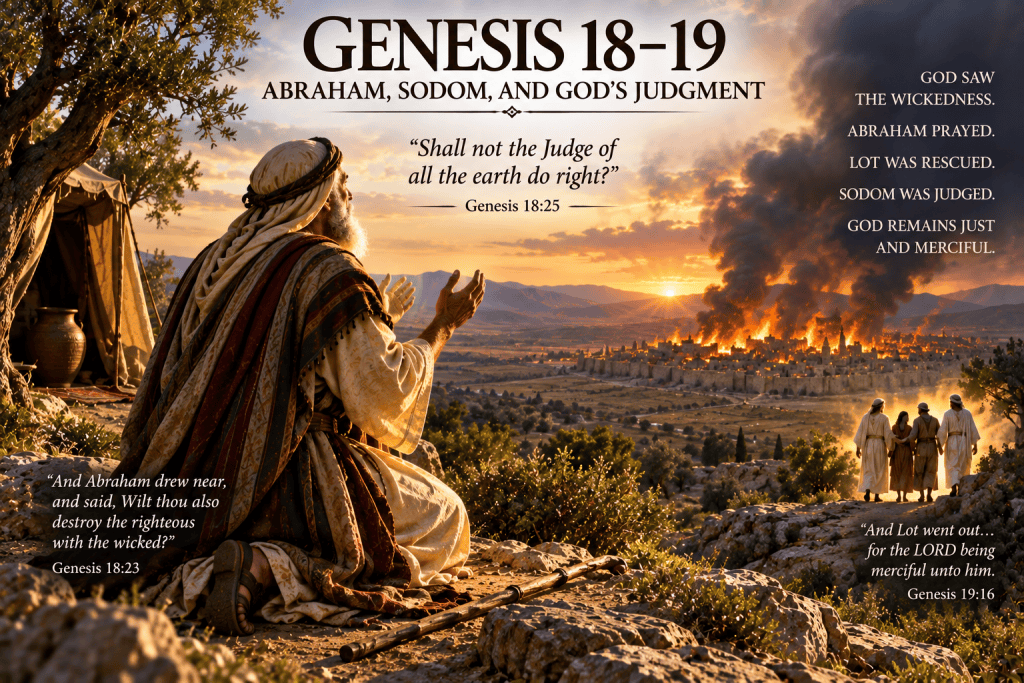
“Shall not the Judge of all the earth do right?” — Genesis 18:25
Genesis 18–19 contains both wonderful promises and terrible judgment.
In Genesis 18, God confirms that Sarah will have the promised son. In addition, Abraham learns that judgment is coming upon Sodom and Gomorrah. Therefore, he stands before God and intercedes for the people of Sodom.
Genesis 19 then takes us inside the city.
There we see how deeply wickedness had corrupted its people. Nevertheless, we also see God’s mercy as He rescues Lot and his family before judgment falls.
These chapters raise serious questions.
How does a holy God respond to persistent evil?
Can we trust God’s judgment?
What happens when believers become too comfortable with a sinful culture?
And, most importantly, what should we learn from the destruction of Sodom?
Genesis gives us a clear answer to the first question:
“Shall not the Judge of all the earth do right?”
Yes.
He will.
The LORD Appeared to Abraham
Genesis 18 begins:
“And the LORD appeared unto him in the plains of Mamre.” — Genesis 18:1
Abraham was sitting at the entrance of his tent during the heat of the day when he saw three men approaching.
Immediately, Abraham welcomed them.
He offered water for their feet.
Abraham provided a place to rest.
Then he arranged a generous meal.
Hospitality was extremely important in the ancient world. However, Abraham did more than the minimum.
He hurried to serve his visitors.
Hebrews 13:2 may reflect upon this event when it says:
“Be not forgetful to entertain strangers: for thereby some have entertained angels unawares.”
Abraham did not initially understand everything about his visitors.
Nevertheless, he treated them generously.
Where Is Sarah?
During the meal, one of the visitors asked:
“Where is Sarah thy wife?” — Genesis 18:9
Then came the promise:
“Lo, Sarah thy wife shall have a son.”
God had already promised Abraham that Sarah would bear Isaac.
Now the promise became even more specific.
The time was approaching.
After years of waiting, the promised son was coming.
Sarah Laughed
Sarah heard the conversation from inside the tent.
Genesis 18:12 says:
“Therefore Sarah laughed within herself.”
Her reaction is understandable.
Abraham was old.
Sarah was old.
Humanly speaking, having a child was impossible.
Therefore, Sarah laughed at the thought.
Earlier, Abraham had also laughed when God announced the promise.
Now Sarah did the same.
However, God asked one of the great questions of Scripture:
“Is any thing too hard for the LORD?” — Genesis 18:14
The answer is obvious.
No.
Is Anything Too Hard for the LORD?
That question reaches far beyond Abraham and Sarah.
We face situations that appear impossible.
A relationship seems beyond repair.
Problems that seem too large.
Prayers seem unanswered.
Doors seem permanently closed.
Our strength disappears.
Resources run out.
Nevertheless, Genesis 18 reminds us that our limitations are not God’s limitations.
God does not ask:
“Can Abraham accomplish this?”
He does not ask:
“Can Sarah accomplish this?”
Instead, the issue is:
Can God accomplish what He promised?
And the answer is:
Yes.
God Revealed His Plan to Abraham
After the meal, the visitors began moving toward Sodom.
Then the LORD said:
“Shall I hide from Abraham that thing which I do?” — Genesis 18:17
God had chosen Abraham for a special covenant purpose.
Therefore, God revealed that He was going to investigate the wickedness of Sodom and Gomorrah.
He said:
“Because the cry of Sodom and Gomorrah is great, and because their sin is very grievous.” — Genesis 18:20
Notice that God’s judgment was not arbitrary.
The sin was great.
It was grievous.
Moreover, the language of a “cry” suggests that wickedness had produced victims whose suffering had come before God.
God saw.
He heard.
And eventually, God acted.
God Does Not Ignore Evil Forever
Sometimes we wonder why God allows wickedness to continue.
Why does He allow:
- injustice?
- cruelty?
- people to hurt others?
Genesis 18 reminds us that God’s patience should never be confused with indifference.
God may delay judgment.
However, He does not ignore evil forever.
Ecclesiastes 12:14 says:
“For God shall bring every work into judgment.”
Therefore, when evil appears to prosper, believers should remember:
The Judge of all the earth still sees.
Abraham Drew Near
When Abraham learned that judgment was coming, he did something remarkable.
Genesis 18:23 says:
“And Abraham drew near.”
Then he began to intercede for Sodom.
Abraham knew Lot lived there.
Certainly, that must have been on his mind.
However, Abraham’s prayer went beyond Lot.
He asked whether God would spare the city if righteous people could be found within it.
First, Abraham asked about fifty, then forty-five, then forty, then thirty, then twenty. Finally, ten.
Abraham Prayed for a Wicked City
This is one of the great examples of intercessory prayer in the Old Testament.
Abraham did not approve of Sodom’s wickedness.
Nevertheless, he prayed for its people.
That distinction is important.
Christians do not have to approve of someone’s lifestyle in order to pray for that person.
We can oppose sin while loving sinners.
In fact, knowing that judgment is real should make us more concerned about people who are far from God.
Abraham did not celebrate the possibility of Sodom’s destruction.
He pleaded for mercy.
“Shall Not the Judge of All the Earth Do Right?”
At the heart of Abraham’s prayer stands this question:
“Shall not the Judge of all the earth do right?” — Genesis 18:25
Abraham appealed to God’s character.
He knew God was just.
Therefore, Abraham trusted that God would distinguish between the righteous and the wicked.
This verse gives us an important foundation when we face difficult questions about divine judgment.
There may be biblical events we do not fully understand.
Maybe circumstances in life that confuse us.
Nevertheless, we know the character of the Judge.
God is never unjust.
He never makes a mistake.
God never judges from incomplete information.
He never acts out of sinful anger.
Therefore:
The Judge of all the earth will do right.
The Angels Entered Sodom
Genesis 19 begins:
“And there came two angels to Sodom at even; and Lot sat in the gate of Sodom.”
That last detail is significant.
Earlier, Lot had pitched his tent toward Sodom.
Later, he lived in Sodom.
Now he sat in the gate of Sodom.
The city gate was often a place where leaders and respected citizens conducted business.
Therefore, Lot had apparently become deeply established in the city.
His journey toward Sodom had progressed.
Small compromises had become a settled lifestyle.
Lot Offered Hospitality
When Lot saw the visitors, he invited them into his home.
At first they declined.
However, Lot strongly urged them to stay with him.
Perhaps Lot understood the danger of spending the night in Sodom’s streets.
Eventually, they entered his house.
Then the wickedness of the city became unmistakable.
The Men of Sodom Surrounded the House
Genesis 19 says that men from throughout the city surrounded Lot’s house.
They demanded that Lot bring out his visitors so they could sexually abuse them.
This was attempted gang rape.
The scene demonstrates how deeply violence and sexual wickedness had corrupted Sodom.
Scripture elsewhere also identifies other sins associated with Sodom.
Ezekiel 16:49 says:
“Pride, fulness of bread, and abundance of idleness was in her and in her daughters, neither did she strengthen the hand of the poor and needy.”
Therefore, Sodom’s wickedness included pride, prosperity without compassion, neglect of the poor, sexual immorality, and violence.
The city’s problem was not one isolated sin.
Its culture had become deeply rebellious against God.
Lot Made a Terrible Offer
Lot went outside and tried to calm the mob.
However, he then offered his daughters to the men.
There is no justification for Lot’s proposal.
It was wrong.
His attempt to protect his guests did not excuse sacrificing his daughters.
Scripture reports what Lot did.
It does not approve of it.
This is another example of an important principle when reading Genesis:
The Bible honestly records human behavior without necessarily endorsing that behavior.
Even people whom God rescues can make terrible decisions.
The Angels Rescued Lot
The crowd turned against Lot.
They threatened him.
Then the angels reached out, pulled Lot back inside, and struck the men outside with blindness.
Nevertheless, the mob continued trying to find the door.
Their persistence demonstrates the depth of their corruption.
Then the angels told Lot:
“For we will destroy this place.” — Genesis 19:13
Judgment was now certain.
Lot Warned His Sons-in-Law
Lot went to warn the men who were going to marry his daughters.
He told them:
“Up, get you out of this place; for the LORD will destroy this city.”
Their response is tragic.
Genesis says:
“He seemed as one that mocked unto his sons in law.” — Genesis 19:14
They thought Lot was joking.
Why?
Scripture does not explicitly tell us.
However, Lot’s long accommodation to life in Sodom may have weakened his testimony.
When someone lives much like the surrounding culture and suddenly warns that culture about God’s judgment, people may struggle to take the warning seriously.
Our lives either strengthen our testimony or weaken it.
Lot Lingered
Morning came.
The angels told Lot:
“Arise, take thy wife, and thy two daughters.”
The message was urgent.
Judgment was coming.
Yet Genesis 19:16 says:
“And while he lingered…”
Lot lingered.
What a revealing word.
He knew Sodom was going to be destroyed.
Angels had warned him.
Still, he hesitated.
Why?
Perhaps he was thinking about his home, possessions, friends, position, or his plans.
Sodom had become part of his life.
It is possible to know something is spiritually dangerous and still have difficulty letting go of it.
The LORD Was Merciful
Lot lingered.
Nevertheless, the angels took him, his wife, and his daughters by the hand.
Why?
Genesis tells us:
“The LORD being merciful unto him.” — Genesis 19:16
That may be the most important phrase in the chapter.
Lot was not rescued because he had handled everything perfectly.
He had not.
Lot was rescued because:
The LORD was merciful unto him.
Peter later describes Lot as a righteous man who was deeply troubled by the wickedness around him.
Nevertheless, Genesis makes clear that Lot had also become dangerously entangled with Sodom.
His rescue was an act of mercy.
Escape for Thy Life
The angels commanded:
“Escape for thy life; look not behind thee.”
The message was urgent.
Leave.
Do not stop.
Do not look back.
Judgment was coming.
Lot and his family needed to separate themselves completely from the condemned city.
There are times when separation from sin must be decisive.
Not gradual, not negotiated, not halfway.
Leave it behind.
Fire Fell on Sodom
Genesis 19:24 says:
“Then the LORD rained upon Sodom and upon Gomorrah brimstone and fire from the LORD out of heaven.”
The cities were destroyed.
The fertile plain Lot had once chosen because it looked so attractive became a place of devastation.
This gives us a sobering contrast with Genesis 13.
Lot looked at the plain and saw prosperity.
God saw the wickedness developing there.
Lot saw opportunity.
God saw judgment coming.
Therefore, we should never evaluate life only by what we can see today.
Lot’s Wife Looked Back
As they fled:
“But his wife looked back from behind him, and she became a pillar of salt.” — Genesis 19:26
Jesus later gave a three-word warning:
“Remember Lot’s wife.” — Luke 17:32
Why did she look back?
The text does not explain all her motives.
However, her backward look represented disobedience to the explicit command they received.
Moreover, it appears that although her feet had left Sodom, her heart remained attached to it.
That remains a danger today.
We can physically leave something while emotionally longing to return.
Jesus warns us:
Remember Lot’s wife.
Do not look back longingly at the life from which God has called you.
Abraham Saw the Smoke
Early the next morning, Abraham returned to the place where he had stood before the LORD.
He looked toward Sodom.
Genesis 19:28 says:
“And, lo, the smoke of the country went up as the smoke of a furnace.”
Abraham had prayed.
Yet the city was destroyed.
Was his prayer unanswered?
No.
Genesis 19:29 says:
“God remembered Abraham, and sent Lot out of the midst of the overthrow.”
God did not spare Sodom because ten righteous people could not be found.
However, God rescued Lot.
Sometimes God answers our prayers differently from the way we imagined.
Abraham prayed.
God listened.
And Lot was delivered.
Lot Lost What He Chose
Consider Lot’s journey.
In Genesis 13, he chose the well-watered plain because it appeared prosperous.
Then he moved toward Sodom.
Afterward, he lived in Sodom.
Eventually, he became established there.
But when Genesis 19 ends, what does Lot have left?
His home, possessions, social position, and his wife are gone.
The city he chose is gone.
Lot gained Sodom for a time.
Then he lost nearly everything connected with it.
Jesus asked:
“For what shall it profit a man, if he shall gain the whole world, and lose his own soul?” — Mark 8:36
The Tragic End of Genesis 19
Unfortunately, the chapter does not end with Lot’s rescue.
Lot and his daughters eventually lived in a cave.
His daughters feared they would never have husbands or children.
Therefore, they devised a sinful plan.
They made their father drunk and committed incest with him.
The resulting sons were Moab and Ben-ammi, ancestors of the Moabites and Ammonites.
Once again, Genesis shows the lingering consequences of Sodom’s influence.
Lot escaped the city.
However, the values of the city had left deep scars upon his family.
This is why compromise is so dangerous.
Sin affects more than the moment.
It can shape families and future generations.
What Genesis 18–19 Means for Us
1. Nothing Is Too Hard for God
Sarah laughed because the promise seemed impossible.
However, God asked:
“Is any thing too hard for the LORD?”
Therefore, we should never measure God’s ability by our limitations.
2. God Sees Persistent Evil
Sodom’s wickedness had become great.
God saw it.
Likewise, injustice and cruelty in our world do not escape His attention.
3. God’s Judgment Is Always Right
Abraham asked:
“Shall not the Judge of all the earth do right?”
Yes.
Therefore, even when we do not understand every detail, we can trust God’s character.
4. Knowing Judgment Should Make Us Pray
Abraham interceded for Sodom.
Likewise, Christians should pray for people who are far from God rather than merely condemning them.
5. Compromise Usually Happens Gradually
Lot looked toward Sodom.
Then he moved toward Sodom.
Afterward, he lived there.
Finally, he became established there.
Therefore, pay attention to the direction of your life.
6. Our Testimony Matters
Lot’s sons-in-law thought his warning was a joke.
Consequently, we should live in such a way that our words about God are supported by our lives.
7. Do Not Linger When God Says Leave
Lot knew judgment was coming.
Nevertheless, he lingered.
When God calls us away from sin, immediate obedience is safest.
8. Salvation Is an Act of Mercy
Lot was rescued because:
“The LORD being merciful unto him.”
Likewise, we are saved not because we deserve rescue but because God is gracious.
9. Do Not Look Back
Jesus said:
“Remember Lot’s wife.”
Therefore, do not romanticize the life from which Christ has delivered you.
Sodom and the Coming Judgment
Jesus used the days of Lot as a warning about His return.
Luke 17 says people were eating, drinking, buying, selling, planting, and building.
Then judgment came suddenly.
Again, the ordinary activities were not the problem.
The problem was living as though God did not matter.
The people of Sodom carried on with life until judgment arrived.
Therefore, Jesus warned His hearers to be ready.
God’s patience is real.
However, patience should never be mistaken for permission.
Abraham Stood Before the LORD
One of the strongest images in these chapters is Abraham standing before God and praying for Sodom.
Abraham knew the city was wicked.
He knew judgment was deserved.
Nevertheless, he asked for mercy.
That should influence the way Christians look at our world.
It is easy to complain about society, to condemn people, or to become angry at cultural decline.
However, Abraham shows us another response:
Pray:
- for neighbors.
- for leaders.
- for communities.
- for people trapped in sin.
- for revival.
- for salvation.
If we truly believe judgment is real, then we should urgently pray that people find mercy.
Judgment and the Cross
Genesis 18–19 remind us that God judges sin.
The cross tells us something even more remarkable.
God did not simply overlook our sin.
Instead, Jesus bore judgment for us.
Isaiah says:
“The LORD hath laid on him the iniquity of us all.” — Isaiah 53:6
At Sodom, judgment fell upon the guilty city.
At Calvary, the sinless Son of God willingly took the judgment guilty sinners deserved.
Therefore, the cross shows us both the seriousness of sin and the greatness of grace.
God does not save us by pretending sin does not matter.
He saves us because Christ paid for it.
The Judge Is Also the Savior
Genesis asks:
“Shall not the Judge of all the earth do right?”
The Gospel answers:
Yes.
God is perfectly just.
However, He is also wonderfully merciful.
The Judge stepped into our world.
Jesus lived the righteous life we could not live.
He died the death our sins deserved.
Then He rose from the grave.
Therefore, sinners do not have to remain under judgment.
There is:
- a place of rescue.
- forgiveness.
- mercy.
- salvation.
And that salvation is found in Jesus Christ.
Lot was told:
“Escape for thy life.”
The Gospel gives an even greater invitation:
Come to Christ and live.
WIM Takeaway
Genesis 18–19 teaches us that the Judge of all the earth always does what is right. God patiently sees human wickedness, listens to intercessory prayer, judges persistent rebellion, and mercifully rescues those who belong to Him. Therefore, we should resist compromise, pray for those far from God, take His warnings seriously, and find our ultimate refuge in Jesus Christ.
Questions for Reflection
- What does God’s question, “Is any thing too hard for the LORD?” teach us about faith?
- Why did God judge Sodom and Gomorrah?
- What does Abraham’s intercession teach us about praying for people who are far from God?
- Why can we trust that God’s judgments are always right?
- How did Lot gradually become more involved with Sodom?
- Are there compromises in your life that seem small now but may be moving you in the wrong direction?
- Why do you think Lot lingered when the angels told him to leave?
- What does the phrase “the LORD being merciful unto him” teach us about salvation?
- What did Jesus mean when He said, “Remember Lot’s wife”?
- How can our lifestyle strengthen or weaken our Christian testimony?
- How should belief in coming judgment affect the way we pray for others?
- How does the cross reveal both God’s justice and His mercy?
<<Back to the Book of Genesis
Dr. Alan Holden has served in pastoral ministry for more than 35 years, preaching and teaching the Bible in churches across the United States. He holds a Doctor of Ministry from Luther Rice Seminary and a Master of Divinity from The Southern Baptist Theological Seminary. Through What’s It Mean?, he seeks to help readers understand the meaning of Scripture and grow in their walk with Christ. He is currently the pastor of Lake Saunders Baptist Church in Tavares, FL.